
Bosnia and Herzegovina
Bosnia and Herzegovina banknotes reflect a divided monetary past, where wartime currencies gave way to the Convertible Mark, structured across parallel entity-based designs.
1992 | Second Provisional Novčani Bon Issue

1992–1993 | Wartime Dinar Series


1993 | Overprints Emergency Issue

1994 | Currency Reform Dinar Series

1993 | Emergency Handstamp Series
-

Bosnia and Herzegovina 10000 Dinara 1993, P-53e, UNC
3,99 € -
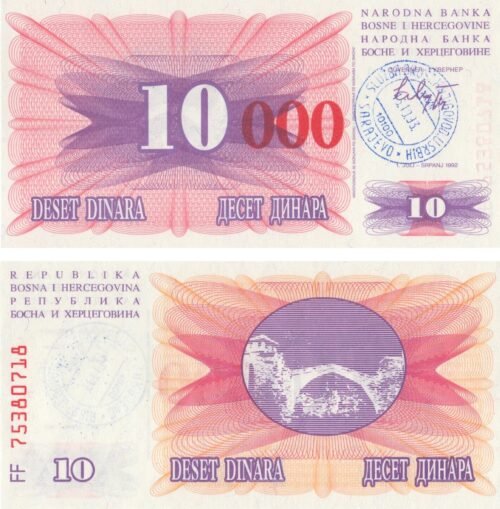
Bosnia and Herzegovina 10000 Dinara 1993, P-53f, UNC
3,99 € -

Bosnia and Herzegovina 10000 Dinara 1993, P-53g, UNC
3,99 € -

Bosnia and Herzegovina 10000 Dinara 1993, P-53h, UNC
3,99 € -

Bosnia and Herzegovina 25000 Dinara 1993, P-54a, UNC
3,99 € -

Bosnia and Herzegovina 50000 Dinara 1993, P-55h, UNC
3,99 €
1992–1993 | Serbian Republic Arms Series
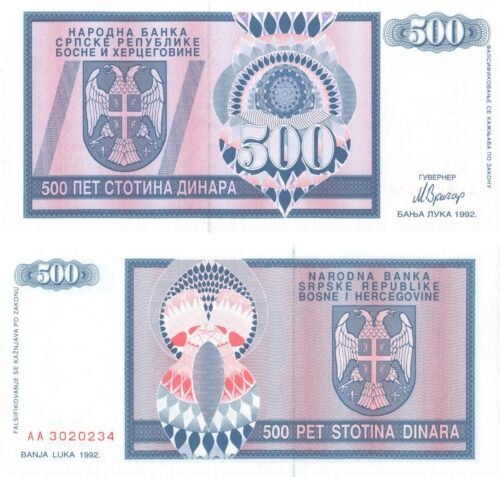

1993 | Serbian Republic Petar Kočić Series
-

Bosnia and Herzegovina 50000 Dinara 1993, P-153, UNC
1,49 € -

Bosnia and Herzegovina 10000000000 Dinara 1993, P-159, UNC
43,99 € -

Bosnia and Herzegovina 10000000000 Dinara 1993, P-159r, UNC
55,99 € -

Bosnia and Herzegovina 50000000000 Dinara 1993, P-160, UNC
43,99 € -

Bosnia and Herzegovina 50000000000 Dinara 1993, P-160r, UNC
55,99 €
Design & Visual Identity
The visual identity of Bosnia and Herzegovina’s banknotes is uniquely defined by dual design systems, where modern Convertible Mark (BAM) notes exist in two parallel artistic versions—issued for the Federation of Bosnia and Herzegovina and Republika Srpska—yet both remain valid across the entire country.
These notes prominently feature literary and cultural figures such as Nobel Prize laureate Ivo Andrić, alongside writers like Meša Selimović and Mak Dizdar, reflecting a shared intellectual heritage expressed through distinct visual interpretations. Earlier wartime issues, including the Republika Srpska Dinar with figures like Petar Kočić, contrast sharply with the refined, portrait-driven compositions of the post-war era.
Historical & Cultural Context
During the Bosnian War (1992–1995), the monetary system fragmented into parallel currencies, including the Bosnian dinar, Republika Srpska dinar, and Croatian kuna, reflecting the political divisions of the time. These overlapping systems created a complex and unstable monetary environment.
A decisive transformation came with the 1998 introduction of the Convertible Mark (Konvertibilna marka, BAM) under the Dayton Agreement. Pegged 1:1 to the Deutsche Mark (DEM), the new currency established monetary stability and unified the financial system, later transitioning seamlessly to a euro peg while maintaining its original structure.
For Collectors
For collectors, Bosnia and Herzegovina offers a uniquely layered field combining wartime emergency currencies with one of the most unusual modern banknote systems in the world. Early dinars and overprinted issues capture the immediacy of conflict and are highly sought after within WWII-style and Balkan wartime collections.
Equally compelling is the modern BAM series, where collectors seek both design variants—Federation and Republika Srpska—to complete a full set. This duality, combined with portraits of figures like Ivo Andrić, creates a collecting narrative that bridges division and unity within a single national currency system.