
Croatia
Croatia banknotes construct identity through place, where the kuna presents cities, fortresses, and architectural detail as precise markers of national heritage.
1991–1993 | Ruđer Bošković Dinar Series


1993–1994 | Serbian Krajina Knin Fortress Series


2001–2012 | Modern Kuna Series
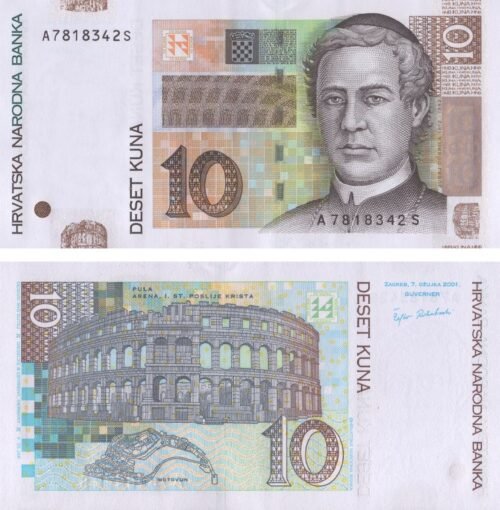

2004 | 10 Years National Bank Commemorative Issue
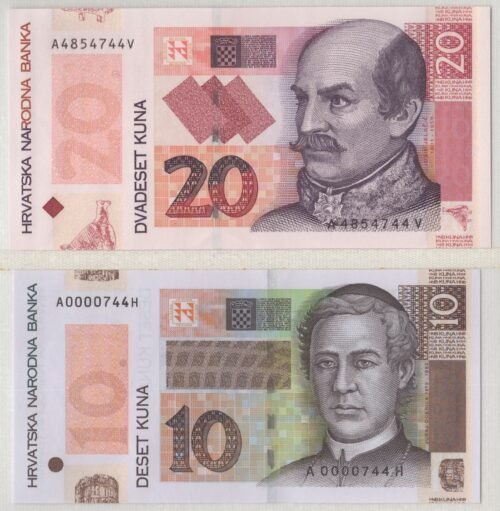
Design & Visual Identity
Croatian Kuna banknotes are structured as a visual itinerary of national heritage, pairing cultural figures with exact architectural and archaeological landmarks. The 10 kuna note anchors this narrative in antiquity through the Roman Pula Arena, one of the best-preserved amphitheaters in the world, while the 20 kuna introduces the Vučedol Dove alongside the city of Vukovar and the Eltz Manor, connecting prehistoric symbolism with historical continuity.
This progression continues with the 50 kuna, where poet Ivan Gundulić is paired with the Dubrovnik Old City, a UNESCO-recognized ensemble of fortified walls and stone streets that define Croatia’s Adriatic identity. The reverse of the 200 kuna depicts the former General Headquarters building in Osijek. Executed with European engraving precision, these compositions integrate watermark portraits, embedded security threads, and refined guilloché structures, reinforcing both clarity and technical sophistication.
Historical & Cultural Context
The Croatian Kuna emerged in the early 1990s as part of the country’s transition to independence, replacing earlier monetary systems and establishing a stable national currency rooted in cultural and historical identity. Its design direction reflected a conscious effort to align Croatia with broader European artistic and institutional traditions.
This trajectory culminated in the adoption of the Euro in 2023, closing the Kuna as a complete and finite series. The transition preserved the underlying design philosophy—clarity, proportion, and architectural focus—while embedding Croatia more deeply into the European monetary framework.
For Collectors
For collectors, Croatia offers a highly structured and visually coherent series where each denomination functions as a precise cultural and geographic marker. From the Pula Arena 10 Kuna and the Vučedol Dove to the Dubrovnik Old City banknotes and the former General Headquarters building in Osijek, the Kuna forms a complete and finite collection defined by architectural clarity, historical depth, and its clear endpoint with Euro adoption.