
Haiti
Haiti banknotes document revolution and statehood, where leaders, battle sites, and early republic architecture form a direct historical record.
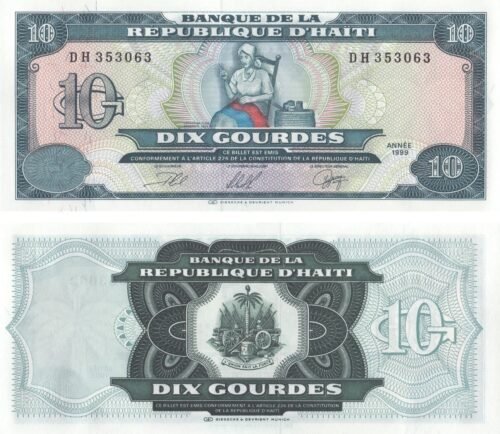
1989–1999 | Modern Gourde Series
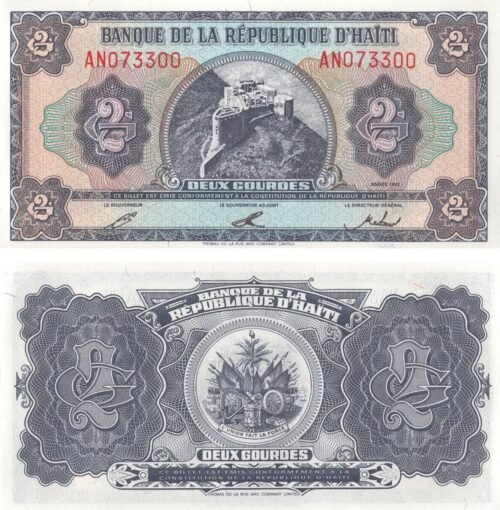
1992–1994 | Constitution Motto Series
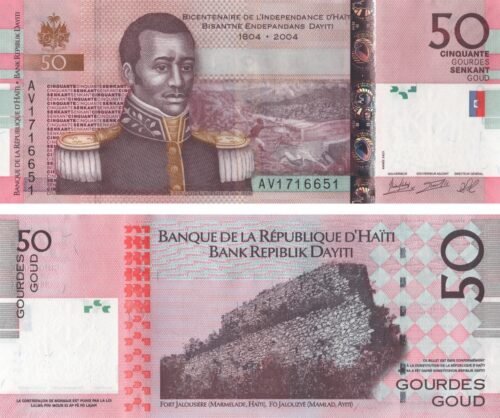
2000–2021 | Contemporary Gourde Series

2004–2023 | New Gourde Series
Design & Visual Identity
The structure of Haitian banknotes is defined by a clear revolutionary hierarchy. Toussaint Louverture appears as the central strategist of independence, while Jean-Jacques Dessalines represents the final declaration of sovereignty. Alongside them stands Catherine Flon, featured on the 10 Gourdes note, the revolutionary figure who sewed the first Haitian flag. This inclusion of a female national icon distinguishes Haiti from many other countries, creating a triad of leadership that collectors actively seek when assembling a complete series.
Architectural anchors reinforce this narrative through the Citadelle Laferrière and the Sans-Souci Palace, both UNESCO World Heritage sites. The Citadelle, positioned high in the mountains, is the largest fortress in the Americas and appears on multiple issues as a symbol of military resilience. The nearby Sans-Souci Palace, once the royal residence of Henri Christophe, adds a second layer of historical depth, linking the currency to the short-lived Haitian monarchy that followed independence.
Historical & Cultural Context
The battlefield of Vertières provides another critical reference point. Depicted on the 100 Gourdes note through the Monument of Vertières, it marks the decisive 1803 victory over French forces. This is not a generalized historical reference but a precise geographic and historical marker that defines the conclusion of colonial rule and the birth of the republic.
Cultural and indigenous elements expand the visual field beyond revolutionary portraiture. References to Arawak and Taíno heritage appear in design motifs and background elements, connecting the modern state to pre-colonial civilizations. These are complemented by detailed depictions of market life, rural activity, and traditional scenes that frame the primary historical figures without overshadowing them.
Each denomination within the Gourde system is tied to a specific figure or event, creating a structured and easily navigable collecting framework. Rather than abstract themes, Haitian banknotes present a sequential record of independence, where portraits, fortresses, and battlefields correspond directly to key moments in national history.
For Collectors
For collectors, Haiti offers a clearly defined historical series centered on the Catherine Flon 10 Gourdes note, the Toussaint Louverture portrait issues, and the monumental Citadelle Laferrière designs. Combined with the Vertières battlefield motif and the structured revolutionary narrative, these elements position Haitian banknotes as one of the most historically coherent and symbolically powerful collections in the Caribbean.
Quick Facts
Currency: Haitian Gourde
Issuer: Bank of the Republic of Haiti