
Mauritania
Mauritania banknotes record desert industry and nomadic life side by side, where ore trains, fishing fleets, and tea rituals share the same monetary surface.
1975–1981 | Unissued Ouguiya Notes
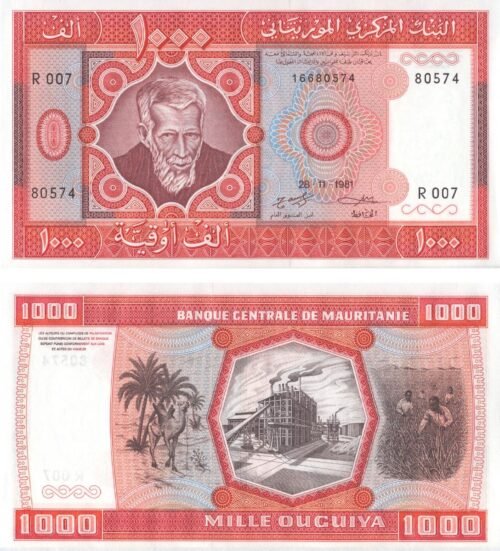
1974–2002 | G&D Printer Ouguiya Issue


1999–2002 | Holographic Image Ouguiya Issue
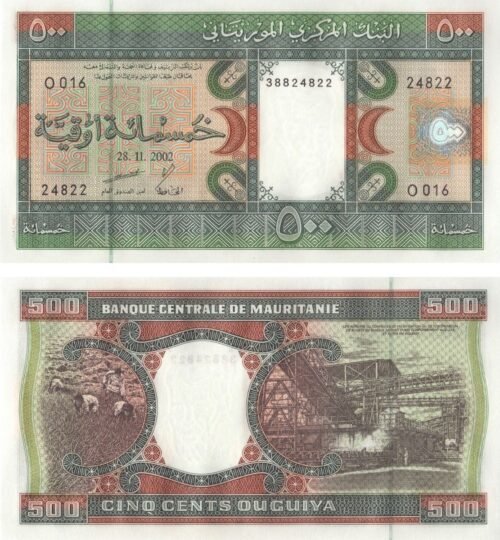
2011–2015 | Ouguiya Issue

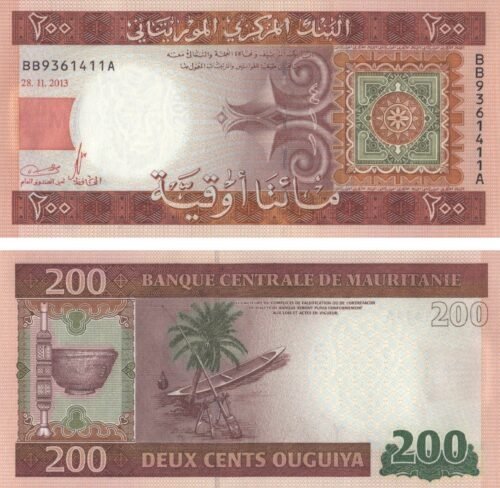


2023 | Ouguiya Anniversary Commemorative Issue
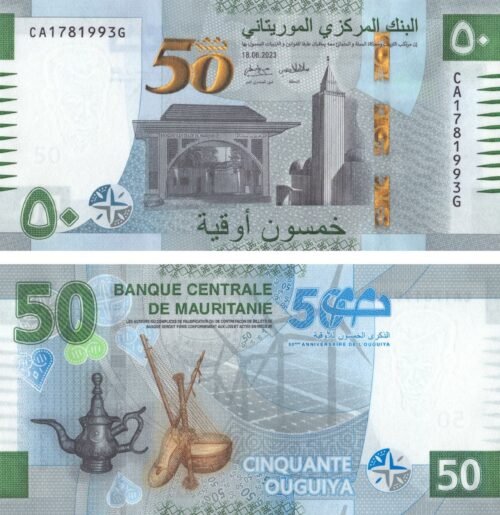
Design & Visual Identity
The highest denominations are dominated by the Mauritania Railway, where the SNIM iron ore train stretches across the composition in elongated perspective, its wagons forming a continuous mechanical line through the Sahara. This industrial axis is balanced by coastal scenes of Atlantic fishing trawlers, rendered with sharp structural detail—hulls, nets, and rigging—anchoring the country’s economy in both desert extraction and ocean harvest.
Mid and lower denominations shift to ethnographic precision: the Ardine harp and Tidinit lute are engraved with attention to strings, body curvature, and hand placement, turning musical heritage into visible structure. The Berrad teapot appears in controlled pouring motion, capturing the ritual of Mauritanian tea culture through gesture rather than symbolism. Surrounding these elements, herds of Zebu cattle and organized camel caravans are depicted in linear progression, reinforcing movement, trade, and pastoral rhythm across open terrain.
Historical & Cultural Context
The compositions rely on contrast between mechanical scale and human-scale craft, where trains and trawlers define economic backbone, while instruments, livestock, and ritual objects define continuity of life. There is no excess ornament—only functional detail arranged with clarity and balance.
This creates a series that reads as a structured archive of Saharan production and mobility, where every element is tied to labor, exchange, and survival within extreme geography.
For Collectors
For collectors, Mauritania offers a sharply defined thematic set built around the SNIM iron ore train, Atlantic fishing trawlers, traditional Ardine and Tidinit instruments, the Berrad tea ritual, and caravan-based livestock scenes. The Mauritanian Ouguiya appeals to those focused on industrial megastructures, ethnographic detail, and the visual documentation of desert economies.
Quick Facts
Currency: Mauritanian Ouguiya
Issuer: Central Bank of Mauritania