
Nagorno-Karabakh
Nagorno-Karabakh banknotes define the dram through a closed two-note system, where monasteries, fortifications, and regional craft are rendered with highly localized precision.
2004 | Dram Issue
Design & Visual Identity
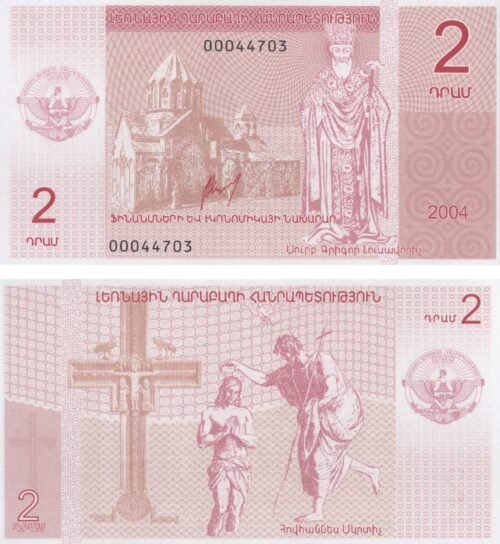
The 2 dram note is structured around Gandzasar Monastery, engraved with compact stone mass, conical dome, and sharply defined façade. Its reverse introduces Askeran Fortress through extended defensive walls and towers, while the Baptism of Christ scene adds a direct religious composition rarely present in modern banknote design. The elements are constructed through masonry and iconography, maintaining clarity without ornamental excess.
The 10 dram note shifts to Dadivank Monastery, depicted with layered roofs and mountain-integrated stone structures. On the reverse, the Khudafarin Bridge forms a linear architectural anchor, accompanied by ethnographic detail: a Karabakh carpet rendered through geometric pattern fields, alongside a wine barrel and grape clusters referencing local viticulture. These components are arranged as distinct elements, preserving readability and structural balance.
Historical & Cultural Context
The series is defined by strict limitation. Only two denominations exist, both built on the same visual logic of stone architecture, Christian symbolism, and applied craft. Each note isolates its subjects, creating clear thematic divisions without expansion into broader design families.
This results in a fixed currency system where identity is conveyed through architecture, iconography, and regional material culture, all presented with controlled engraving.
For Collectors
For collectors, Nagorno-Karabakh offers a highly specialized two-note field: the 2 dram with Gandzasar Monastery, Askeran Fortress, and the Baptism of Christ, and the 10 dram with Dadivank, Khudafarin Bridge, Karabakh carpet patterns, and wine symbolism. The closed nature of the series, combined with Austrian printing quality and the disappearance of the issuing state, positions these Artsakh notes as one of the most distinctive and finite modern collecting areas.
Quick Facts
Currency: Nagorno-Karabakh Dram