
Pakistan
Pakistan banknotes are built on rigid compositional order, where right-aligned portraiture, dense calligraphy, and sharply engraved reverses define a highly controlled currency.
1981–2001 | 1 Rupee Issues


1976–1982 | Without Urdu Text Line Issue

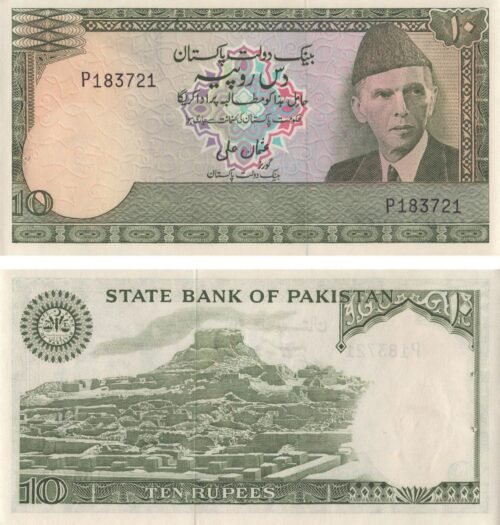
1983–2006 | Urdu Text Line Type B Issue


2005–2026 | Rupees Issue
-

Pakistan 10 Rupees 2015, P-45j, UNC
1,49 € -

Pakistan 10 Rupees 2022, P-45(2), UNC
0,99 € -
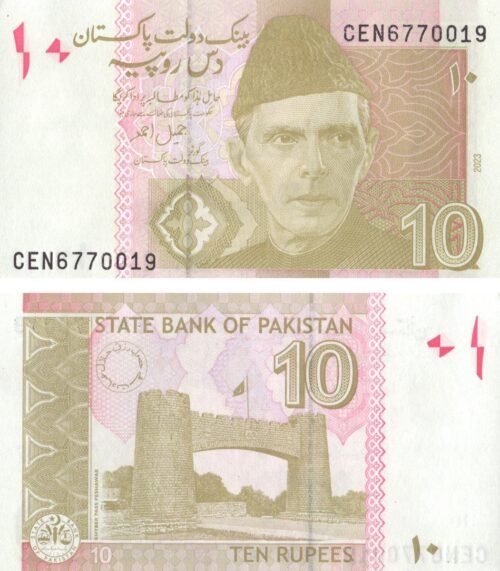
Pakistan 10 Rupees 2023, P-45, UNC
0,99 € -
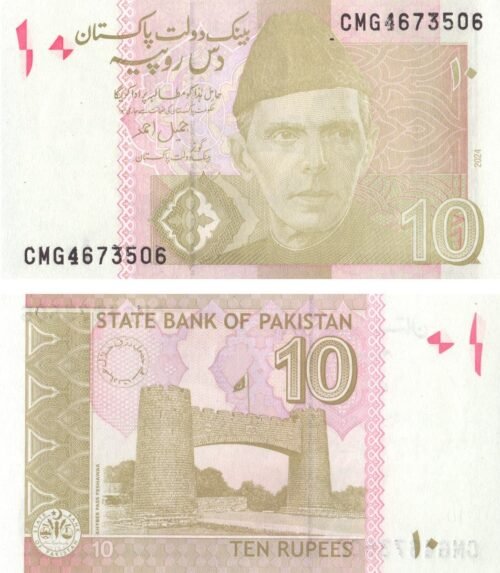
Pakistan 10 Rupees 2024, P-45, UNC
0,99 € -
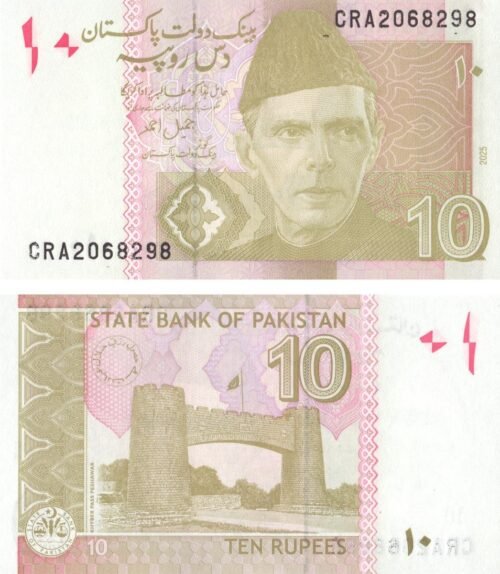
Pakistan 10 Rupees 2025, P-45, UNC
0,99 € -

Pakistan 20 Rupees 2005, P-46a, UNC
2,49 € -

Pakistan 50 Rupees 2021, P-47, UNC
2,49 € -

Pakistan 100 Rupees 2021, P-48, UNC
3,99 €
2007–2025 | Rupees Issue


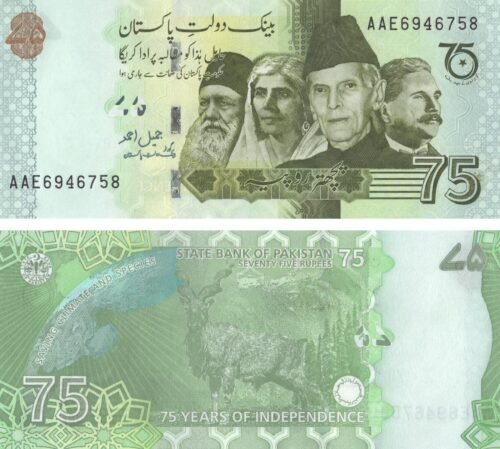
2022 | Independence 75 Years Commemorative Issue
2023 | State Bank Anniversary Commemorative Issue

Design & Visual Identity
The obverse layout is fixed and unmistakable. Muhammad Ali Jinnah is positioned on the right in deep intaglio, his sherwani rendered with heavy tactile relief, while the left field carries layered Urdu calligraphy, denomination panels, and integrated security features. This asymmetrical balance creates a disciplined visual identity consistent across all denominations.
Reverse imagery moves into clearly defined historical and geographical anchors. The excavated grid of Mohenjo-daro is shown through stepped brick formations with strict alignment, the wooden Ziyarat Residency appears with visible timber structure and linear façade detail, and the Khyber Pass is engraved as a narrow corridor cutting through steep mountainous terrain. These are precise locations, not symbolic approximations.
Religious and national monuments are included with controlled emphasis. Faisal Mosque is rendered through sharp angular rooflines, while Minar-e-Pakistan rises as a vertical column within balanced compositions, integrated without dominating the overall structure.
The surface is engineered for function and security. Dense guilloche lattices, microtext bands, watermark windows aligned with portrait zones, and sharply cut borders create a firm, tactile print field focused on durability and anti-counterfeiting precision.
Historical & Cultural Context
The earliest issues form a critical historical layer. The 1948 provisional overprints on Indian banknotes marked “Government of Pakistan” represent the first emergency currency of the state and remain a key rarity segment. Later specialized issues such as Haj pilgrimage notes introduce distinct subtypes with unique color coding and dedicated inscriptions.
For Collectors
For collectors, Pakistan offers a layered field built around the 1948 overprint notes, specialized Haj issues, and the precise engravings of Mohenjo-daro, Ziyarat Residency, and the Khyber Pass. The combination of strict layout discipline, calligraphic density, and historically anchored reverses makes Pakistani Rupee banknotes a highly structured and historically rich area within South Asian numismatics.
Quick Facts
Currency: Pakistani Rupee
Issuer: State Bank of Pakistan