
Paraguay
Paraguay banknotes combine human portraiture, hydroelectric engineering, and bilingual Spanish-Guaraní text within tightly ordered layouts.
1963 | Spanish Value Guaraní Issue


1982–1994 | Guaraní Value TDLR Issue

1995–2003 | Guaraní Issue

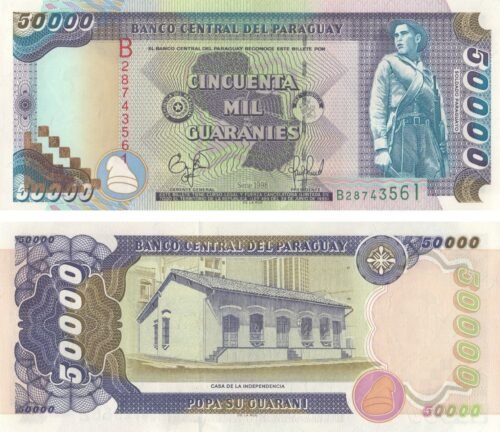
2005–2023 | Guaraní Issue


2013–2022 | Guaraní Issue

2015–2024 | Guaraní Issue

Design & Visual Identity
The obverse foreground is dominated by the “La Mujer Paraguaya” motif — a woman in traditional dress carrying a clay water jar (cántaro), her fabric folds and facial features rendered in fine intaglio lines that create depth and texture.
Text elements are distinctly bilingual, with “Guaraníes” and denomination values appearing alongside Guaraní language inscriptions, integrated directly into the design rather than treated as secondary captions.
Reverse compositions introduce large-scale infrastructure — most notably the Itaipu Dam, where stepped spillways, turbines, and massive concrete walls are engraved with precise geometric alignment across the banknote surface.
Modern issues expand into polymer substrates on lower denominations such as 2,000 and 5,000 Guaraní, incorporating transparent security windows with embedded national symbols and sharply separated color zones.
Historical & Cultural Context
Since its introduction in 1943, the Guaraní has remained unchanged without redenomination, resulting in high-denomination notes that reflect long-term monetary continuity rather than currency reform cycles.
This stability is mirrored in the visual structure, where traditional portrait engravings and national infrastructure coexist across decades without major disruption to the design framework.
For Collectors
For collectors, Paraguay stands out for its iconic “La Mujer Paraguaya” engraving, the highly detailed Itaipu Dam reverse, its bilingual Spanish–Guaraní inscriptions, and the rare case of a South American currency maintaining continuity without redenomination, creating a distinctive and historically stable collecting field.
Quick Facts
Currency: Paraguayan Guaraní
Issuer: Central Bank of Paraguay