
Thailand
Thailand banknotes form a dynamic symbolic system, where royal portraiture, strict color coding, and serial-number culture make the baht uniquely active in collector circles.
1978–1981 | Issue


1995 | 120th Anniversary of Ministry of Finance Commemorative Overprint Issue
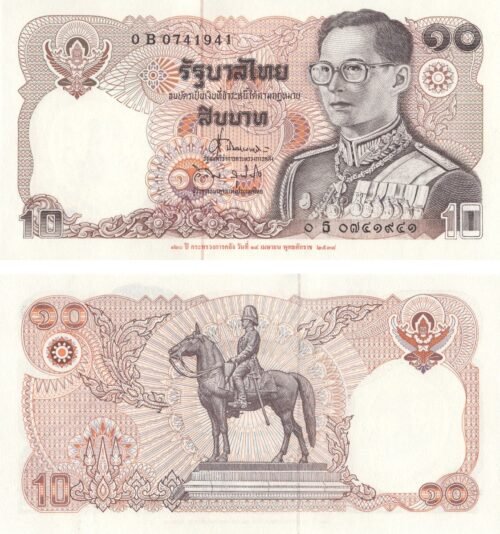
2003 | 20 Baht Issue

2010–2017 | Regular Issue

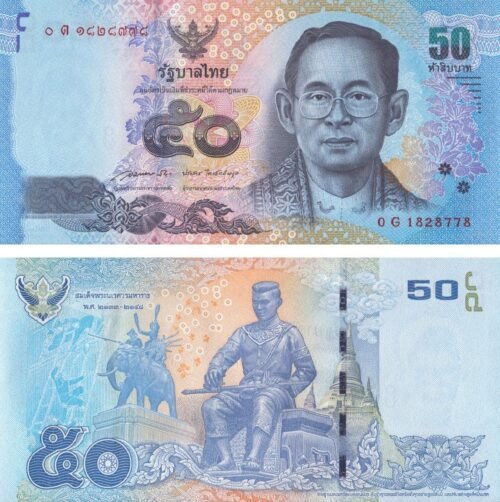
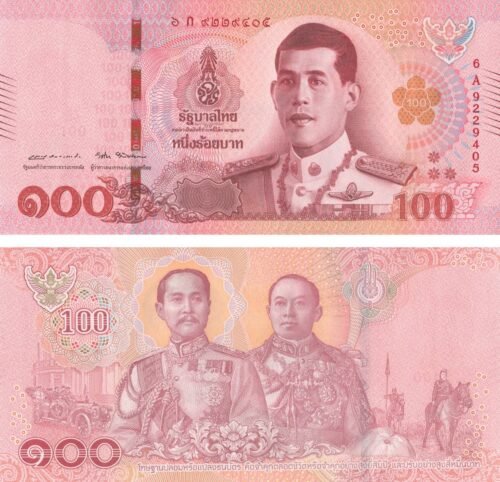
2018 | King Maha Vajiralongkorn Issue


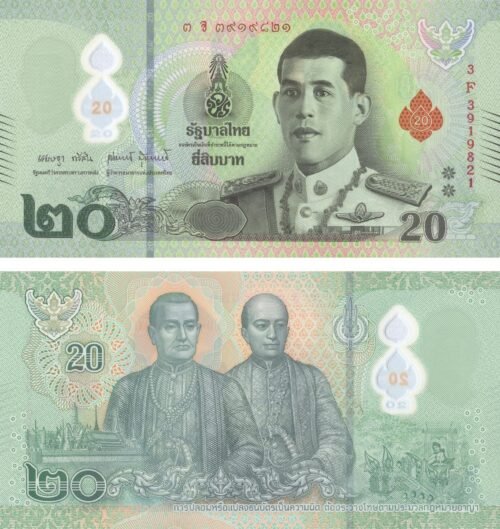
2022–2025 | Polymer Issue



Design & Visual Identity
At the heart of every Thai banknote stands the Garuda — not merely an emblem, but the Sovereign Seal of the kingdom. Engraved in raised intaglio, this mythical figure authorizes the currency itself, its wings and form pressed into the paper with tactile clarity. For collectors, the presence and sharpness of the Garuda is a defining authenticity marker — a symbol that transforms each note into an officially sanctioned object of state power.
Equally distinctive is Thailand’s global reputation as the epicenter of serial number collecting. Within the domestic market, numbers are not incidental — they are prized. Sequences containing the number “9,” associated with King Rama IX, carry cultural and monetary premium, while repeating patterns and auspicious combinations are actively sought. This creates a parallel collecting economy, where value is measured not only in condition, but in numerical symbolism.
Visually, the Thai Baht operates through strict color discipline. Each denomination is immediately identifiable: green for 20 Baht, red for 100, purple for 500, and brown for 1000. This vibrant coding is not decorative excess but functional precision — a system that organizes both circulation and collection with clarity.
The craftsmanship behind this system is driven by the Note Printing Works (NPW) of the Bank of Thailand. Their production is defined by multi-tonal watermarks of exceptional transparency and finely layered guilloché patterns. The intaglio engraving reaches a micro-sculptural level, particularly in royal portraits where the textures of ceremonial garments, medals, and insignia rise distinctly from the surface.
Thailand also stands apart through its commemorative imagination. The country has issued some of the most unusual formats in modern numismatics — including large square 60 Baht notes and multi-reign commemoratives such as the 16 Baht. These pieces extend beyond standard currency into collectible art objects, attracting specialists focused on format and rarity.
Within this structure, portraiture remains central, yet it is the combination of tactile engraving, symbolic authority, and visual coding that defines the Thai system. Every element — from Garuda to serial number — participates in a layered hierarchy of meaning.
In this synthesis of monarchy, precision, and collector culture, Thailand’s banknotes become more than currency — they are instruments of identity, engineered with both cultural weight and technical mastery.
Historical & Cultural Context
The fusion of Garuda symbolism, serial number culture, and unique commemorative formats creates one of the most active and specialized collecting markets in Asia.
For Collectors
For collectors, Thailand offers a currency of depth and diversity — where royal imagery, numerical symbolism, and exceptional printing converge into a vibrant and highly sought-after numismatic tradition.
Quick Facts
Currency: Thailand Baht
Issuer: Bank of Thailand