
Vietnam
Vietnam banknotes move from colonial-era engraving to polymer modernity, combining division, reunification, and strong landscape identity in a single long arc.
1980–1981 | State Bank Issue

1985 | Currency Reform Issue

1987–1988 | State Bank Issue


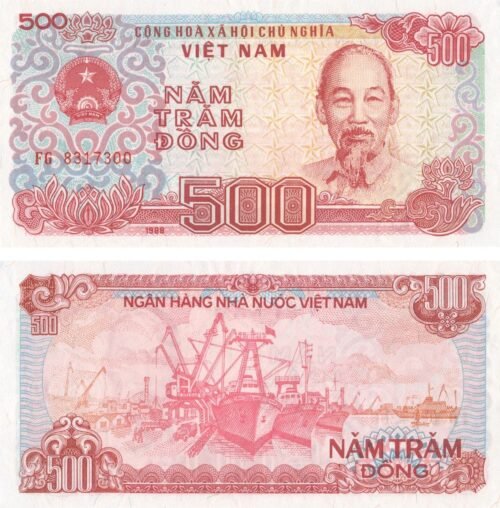
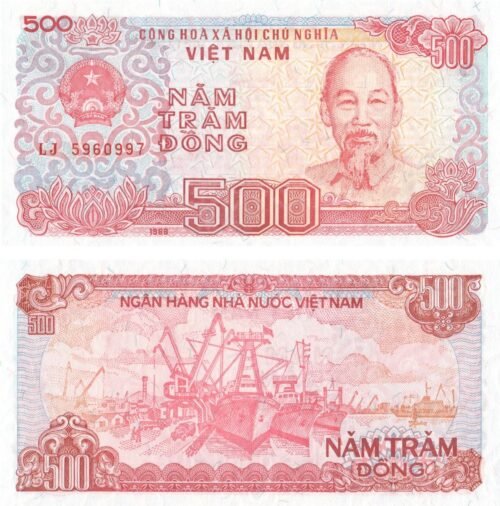
1988–1991 | State Bank Issue


2003–2025 | Polymer Issue
-

Vietnam 10000 Dong 2014, P-119h, UNC
2,49 € -

Vietnam 10000 Dong 2019, P-119, UNC
2,49 € -

Vietnam 10000 Dong 2020, P-119, UNC
2,49 € -

Vietnam 10000 Dong 2023, P-119, UNC
2,49 € -

Vietnam 10000 Dong 2024, P-119, UNC
2,49 € -
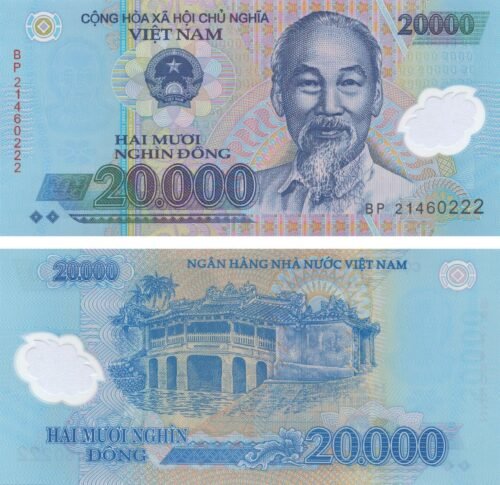
Vietnam 20000 Dong 2021, P-120, UNC
2,99 € -

Vietnam 20000 Dong 2022, P-120, UNC
2,99 € -

Vietnam 50000 Dong 2022, P-121, UNC
5,99 € -

Vietnam 100000 Dong 2021, P-122, UNC
11,99 €
2016 | 65th Anniversary of National Bank Commemorative Issue

Design & Visual Identity
The Vietnamese Đồng carries one of the most compelling dual narratives in modern numismatics: the contrast between South Vietnam and the unified state. Pre-1975 Republic of Vietnam issues feature refined, French-inspired engraving and the iconic “Three Graces” motif — a symbol of classical beauty and balance that stands in sharp contrast to the disciplined, ideological clarity of the modern socialist series.
The contemporary polymer family is anchored by its flagship: the 500,000 Đồng note. This highest denomination stands as the crown jewel of the series, depicting Ho Chi Minh’s birthplace in Kim Liên village. Its deep cyan palette, combined with advanced transparent security windows, positions it among the most recognizable high-value polymer notes in Asia.
Vietnam’s landscape identity is equally powerful. The 200,000 Đồng note features Ha Long Bay — a UNESCO World Heritage site — rendered with atmospheric precision across its limestone karsts, making it one of the most visually celebrated scenic banknotes in global collecting. Alongside it, architectural anchors such as the One Pillar Pagoda and the Temple of Literature (Văn Miếu) on the 100,000 Đồng note connect the currency to Vietnam’s intellectual and spiritual heritage.
The tactile identity of the Đồng is distinct. Unlike glossy interpretations, the polymer carries a matte, almost wax-like surface, interrupted only by smooth transparent windows where Ho Chi Minh’s portrait appears embedded within the material itself — a ghost-like security effect that defines the series. Raised intaglio printing adds sculptural depth, especially across facial features and denomination numerals.
Lower denominations retain scenes of agriculture and industry — rice harvesting, fisheries, and factory work — forming a visual language rooted in Socialist Realism. These vignettes document Vietnam’s transformation from agrarian economy to industrial growth, giving the series both narrative continuity and ideological structure.
Across all denominations, Ho Chi Minh remains the central figure — not as variation, but as permanence. His portrait forms the unchanging axis of the Đồng, bridging historical rupture with national continuity.
Historical & Cultural Context
The combination of French-influenced legacy notes, high-value polymer flagships, and UNESCO-level landscape design makes Vietnam one of the most accessible and visually rewarding entry points into world banknote collecting.
For Collectors
For collectors, Vietnamese banknotes offer a complete spectrum — from the elegant “Three Graces” of the South to the high-tech polymer era of the unified state, where history, design, and material innovation converge with striking clarity.
Quick Facts
Currency: Vietnamese Đồng
Issuer: State Bank of Vietnam