
Banknote Security Features Explained: A Collector’s Guide
Banknote security features are the physical and optical details that help a genuine note resist copying and allow it to be checked. They can be built into the substrate, created during printing, applied as a foil or optical element, or designed to appear only under particular light, movement or magnification.
For collectors, the important question is not simply whether a note has a watermark, thread or hologram. The question is whether the correct feature is present, correctly constructed and appropriate for the exact issue.
A modern polymer note may depend on integrated windows and dynamic effects. A paper note may combine a multi-tone watermark, embedded thread, raised printing and fluorescent fibres. A historical issue may have none of these and instead be judged through paper character, engraving, typography, plate work and documentary reference.
Core principle: Security features form a system. No single watermark, foil, thread or ultraviolet response proves that the complete banknote is genuine.
Table of Contents
What Are Banknote Security Features?
A security feature is a deliberately controlled element intended to make a banknote difficult to reproduce, easier to recognise or more suitable for machine processing.
Security features can be divided into three broad levels:
- public or overt features, intended to be checked without specialist equipment;
- covert features, which require ultraviolet, infrared, magnetic or other equipment;
- forensic features, reserved for issuing authorities, printers and specialist laboratories.
Most collectors work mainly with overt features and a limited number of covert features. These include the feel of the substrate, raised printing, watermarks, security threads, transparent windows, colour-shifting effects, microprinting and ultraviolet fluorescence.
The feature itself is only part of the evidence. Its position, scale, behaviour, printing quality and relationship to the rest of the note matter just as much.
A copied reflective patch may shine but produce the wrong image. A printed grey portrait may resemble a watermark but lack internal tonal depth. A dark line may imitate a thread while sitting entirely on the surface. Authentication depends on construction, not appearance alone.
Why Security Features Differ Between Banknotes
There is no universal feature checklist that applies to every banknote.
The expected features depend on:
- country and issuing authority;
- denomination;
- series and design generation;
- date or printing period;
- paper, polymer or hybrid substrate;
- printer and production method;
- security upgrade;
- circulation, commemorative or specialist purpose.
Two notes of the same denomination can therefore require different checks. A later printing may introduce a new thread. A higher denomination may receive a hologram that lower values do not have. A polymer redesign may replace a traditional watermark with a shadow image or transparent window.
This is why identification comes before feature analysis. Collectors who are not yet certain what a note is should begin with How to Identify a Banknote.
For the complete examination sequence, see How to Authenticate a Banknote.
A Practical Way to Read Security Features
Official currency authorities often organise basic checking around touch, transmitted light and movement. The European Central Bank uses Feel, Look and Tilt. The U.S. Currency Education Program similarly combines feel, tilt, light and magnification.
For collectors, the sequence can be expanded:
- Feel the substrate, relief and tactile marks.
- Look at the complete design, dimensions and print quality.
- Hold to light for watermarks, threads, windows and registration.
- Tilt for holograms, colour shifts and movement effects.
- Magnify microprinting, guilloche and print edges.
- Use UV or infrared only when the expected response is documented.
- Compare contradictions, not only successful features.
The feature should be checked in the condition in which it was designed to work. A static scan cannot demonstrate a rolling bar. A front-facing photograph cannot prove a latent image is absent. A reflected-light image cannot fully document a watermark.
These are evidential limits, not publication rules. The separate guide to photographing, scanning and reproducing banknotes compares the conditions published for eight monetary systems.
Substrate-Level Security
The substrate is the physical base of the banknote. It influences touch, flexibility, transmitted light and the type of security features that can be incorporated.
Security Paper
Banknote paper is not ordinary office paper. It may be made from cotton, linen, mixed fibres or another controlled formulation. Its structure can contain:
- watermarks;
- embedded threads;
- visible or fluorescent fibres;
- chemical and optical properties;
- controlled thickness and stiffness;
- machine-readable materials.
A genuine paper note should feel appropriate for its issuer, age and condition. Heavy circulation can soften the paper. Washing can remove stiffness or alter fluorescence. Pressing can reduce embossing. These changes affect evidence but do not automatically make the note counterfeit.
Security fibres should be assessed carefully. Genuine fibres may be embedded at random within the paper rather than printed on the surface. Their colour, distribution and ultraviolet response must match the issue.
Polymer Substrate
Polymer banknotes use specialised plastic film rather than traditional paper. The material makes it possible to create windows and optical structures that are integrated into the note.
The Reserve Bank of Australia emphasises that a clear window should be part of the substrate rather than an attached patch. Its printed, metallic or embossed details should also match the official design.
Polymer notes often feel smoother than paper, although raised ink may still be present. Genuine polymer can become scratched, clouded, folded or heat-damaged. Damage must not be confused automatically with counterfeiting.
Hybrid Substrates
Hybrid banknotes combine paper and polymer components or use a layered composite construction.
The word hybrid does not describe one universal technology. Different printers use different structures. Some notes retain a mainly paper body with a polymer reinforcement or window area; others use more complex laminated constructions.
A collector should therefore avoid assuming that every hybrid note must feel or transmit light in the same way. The expected construction must be confirmed for the exact issue.
Features Seen Against the Light
Transmitted light reveals features that are embedded in the substrate or coordinated between both sides of the note.
Watermarks
A traditional watermark is formed within banknote paper during manufacture. It is not printed later on the surface.
A reliable multi-tone watermark usually shows:
- light and dark tonal variation;
- soft transitions rather than a flat outline;
- correct alignment and position;
- visibility from both sides;
- the expected portrait, symbol or denomination.
Some notes also include an electrotype watermark, often a bright denomination numeral or short symbol produced with a more sharply defined appearance.
A printed imitation may look convincing under reflected light yet appear flat when the note is held up. It may also be stronger from one side or lack gradual tonal depth.
Not every paper banknote has a watermark, and polymer notes commonly use other transmitted-light features. The absence of a watermark is meaningful only when one is documented for that issue.
Security Threads
A security thread is a strip incorporated into the banknote substrate. It may be fully embedded, intermittently exposed in windows or combined with optical, magnetic and fluorescent properties.
Threads can contain:
- microtext;
- denomination values;
- metallic reflection;
- colour-changing effects;
- movement effects;
- magnetic material;
- ultraviolet fluorescence.
A fully embedded thread often appears as a continuous dark line against transmitted light. A windowed thread may appear as separate reflective blocks on the surface but become continuous when viewed through the note.
Thread position can vary between denominations. The correct inscription, width, colour and optical behaviour are therefore important. A technically impressive thread in the wrong position is still a contradiction.
See-Through Registration
A see-through register uses partial designs printed on opposite sides. When the banknote is held against light, the two parts combine into a complete image.
Check:
- whether the correct symbol is formed;
- whether the front and back elements align;
- whether the colour and line structure match;
- whether the expected precision is plausible for the printer and period.
Registration should not be judged against an unrealistic standard. Minor variation can occur on genuine notes, particularly on older or lower-precision issues. The acceptable tolerance depends on the production system.
Shadow Images and Transparent Windows
Polymer notes may use shadow images rather than paper watermarks. These appear as tonal images within the substrate when held to light.
Transparent windows can contain:
- portraits;
- buildings or symbols;
- printed white elements;
- metallic layers;
- microtext;
- embossing;
- colour-shifting borders;
- dynamic optical effects.
A convincing window should belong to the banknote as a complete physical object. Crude joins, attached clear film or an incorrectly shaped transparent patch are serious warnings.
Features Felt by Touch
Touch is valuable because many copying processes reproduce an image without reproducing its physical relief.
Intaglio Printing
Intaglio printing transfers ink from engraved recesses under high pressure. It can create raised, tactile printing in portraits, lettering, denomination values and other major elements.
Under magnification, intaglio often shows dense engraved lines and controlled ink edges. Under a fingertip, the printed area may feel slightly rougher or thicker than the surrounding substrate.
Relief can be reduced by circulation, washing or pressing. A heavily handled genuine note may feel flatter than an uncirculated example.
Embossing and Tactile Marks
Some banknotes use uninked embossing, raised dots, bars or edge marks. These may serve both security and accessibility functions.
Tactile marks should be:
- in the correct location;
- formed as part of the note;
- consistent in shape and number;
- appropriate for the denomination.
A printed imitation of a tactile bar is not equivalent to a raised feature. Inspection should remain gentle: do not scrape or aggressively rub a collectible banknote.
Case Study: Kenya 50 Shillings 2024
The Kenya 50 shillings note provides a useful example of how design, accessibility and security are combined.
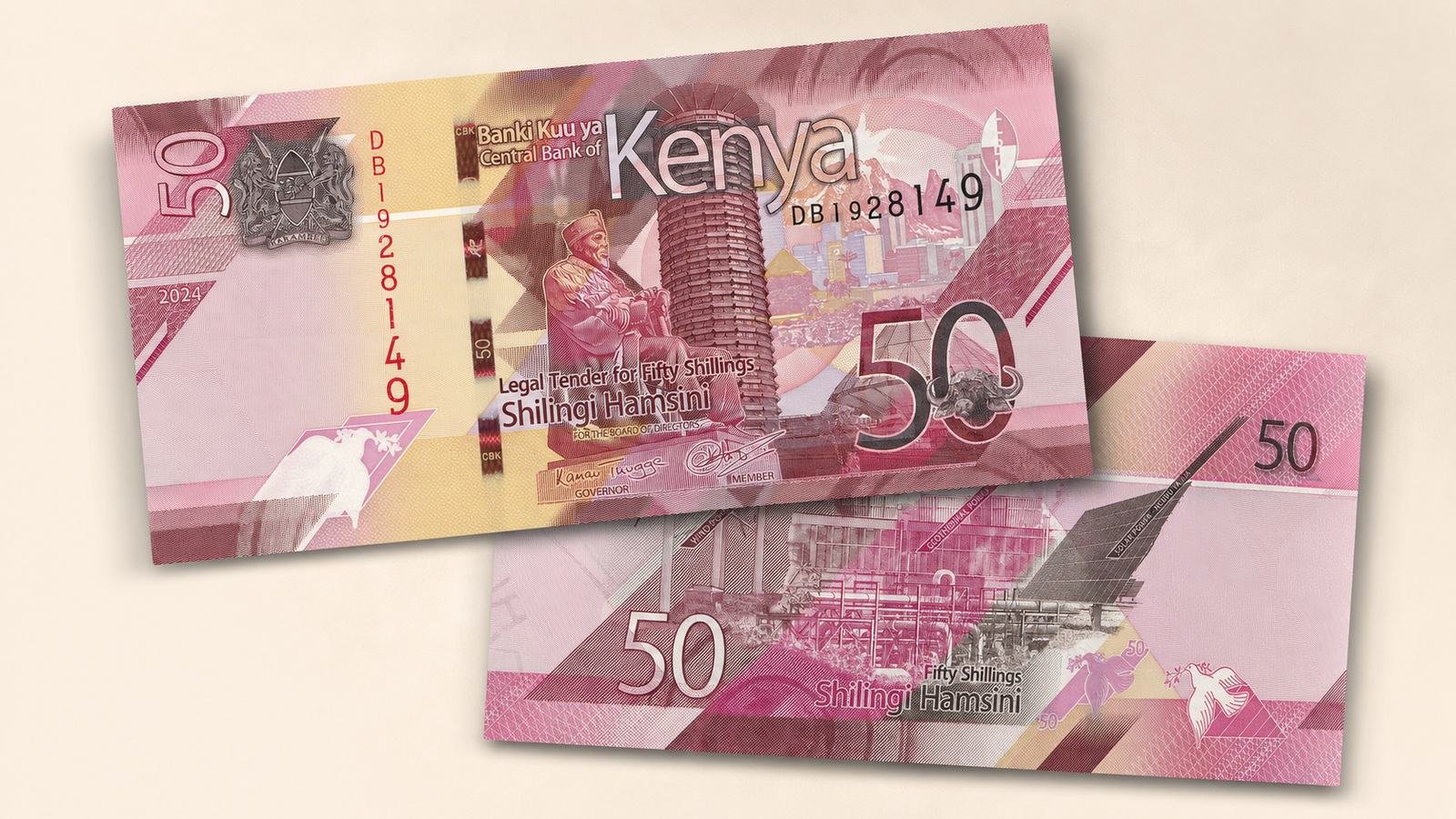
Central Bank of Kenya guidance for the series instructs the public to feel the word Kenya, the denomination and the tactile edge marks. For KES 50, one edge bar identifies the denomination.
Against light, the series shows a lion-head watermark with the text CBK and the value, while the security thread appears as a continuous line. The 2024 printing retained the established design but introduced denomination-specific colour-changing security threads.

The obverse combines the Kenyan coat of arms, Kenyatta International Convention Centre, a seated figure, Nairobi imagery and a dove. The reverse of the KES 50 note develops a green-energy theme through wind, geothermal and solar power.
These narrative elements are not all security features. They still matter because a genuine banknote must reproduce both its security system and its complete design accurately.
Explore this issue: View the Kenya 50 Shillings 2024 banknote →
Features Seen When the Banknote Is Tilted
Movement can reveal optical structures that cannot be assessed from a single still image.
Holograms and Foils
A hologram or diffractive foil may change image, colour, depth or denomination as the viewing angle changes.
Collectors should confirm:
- the correct image sequence;
- sharp boundaries;
- controlled movement;
- correct placement;
- whether the element is embedded, transferred or applied;
- whether microtext or fine imagery is present.
A counterfeit foil may reflect strongly but produce only a simple rainbow shine. Brightness alone does not prove a genuine hologram.
Colour-Shifting Ink
Optically variable ink changes colour when tilted. The effect should match the documented element and colour path.
Check:
- which numeral or symbol should change;
- the starting and ending colours;
- the viewing direction;
- whether the transition is strong, subtle or accompanied by movement.
Metallic ink may sparkle without producing a true colour shift. Surface damage can also weaken an authentic effect.
Rolling Bars and Dynamic Effects
Some modern inks and threads produce a moving bar, bright band or shape when tilted. Others use images that appear to move in the opposite direction to the note.
Dynamic features are particularly useful because a flat printed simulation may resemble one viewing angle but fail across movement.
A short controlled video can document the effect better than a still photograph, although direct examination remains preferable.
Latent and KIP Images
A latent image appears only at a shallow viewing angle. Intaglio-based KIP effects can switch between an image, letters or a denomination as the note is turned.
The viewing direction matters. A latent image may be invisible when viewed from directly above and fully visible when the note is almost parallel to the eye.
Case Study: Brunei 5 Dollar Polymer Note
The Brunei 5 dollar note shown here carries a 2024 date. Brunei Darussalam Central Bank presents this design family under its 2025 polymer series.
Its published feature set includes:
- a large vertical transparent window with a mosque cameo;
- a smaller shaped window;
- ultraviolet elements and an asymmetric serial number;
- AURORA™ colour-shifting effects around the window;
- METALIX™ metallic ink;
- smooth polymer substrate with raised printing;
- a SPARK® Live Sandune colour-shifting pattern.
For the BND5, BDCB describes the AURORA window colours changing from purple to green and from purple to orange. The metallic element shows a gold sheen, while the SPARK pattern changes from green to magenta.

The visual comparison with Serbia’s paper 100-dinar note demonstrates why a polymer note should not be checked as though it were simply a plastic version of paper currency. Its windows and optical effects are structural parts of the design.
Explore this issue: View the Brunei 5 Dollar 2024 polymer banknote →
Features Seen Under Magnification
Magnification is most useful after the main physical checks.
A 5× to 10× loupe is generally sufficient for routine collector work.
Microprinting
Microprinting consists of very small text or numerals placed within borders, portraits, threads, patterns or decorative lines.
Genuine microtext should normally be:
- in the documented location;
- clearly structured;
- consistent in spacing;
- formed from letters rather than vague strokes;
- integrated with surrounding print.
A counterfeit may replace microtext with a blurred line or meaningless shapes. The wording matters when it has been documented.
Guilloche and Fine-Line Patterns
Guilloche patterns use mathematically controlled curves, rosettes and repeated line structures.
Under magnification, warning signs include:
- merged lines;
- jagged digital edges;
- missing intersections;
- irregular spacing;
- moiré interference;
- toner dots;
- simplified transitions.
Modern digital printing can reproduce broad colour and design surprisingly well while failing in the smallest line fields.
Fine Engraving
Engraved portraits and narrative vignettes are built from controlled lines, dots and cross-hatching. The quality of facial modelling, hair, fabric, architecture and tonal transitions can reveal inconsistencies.
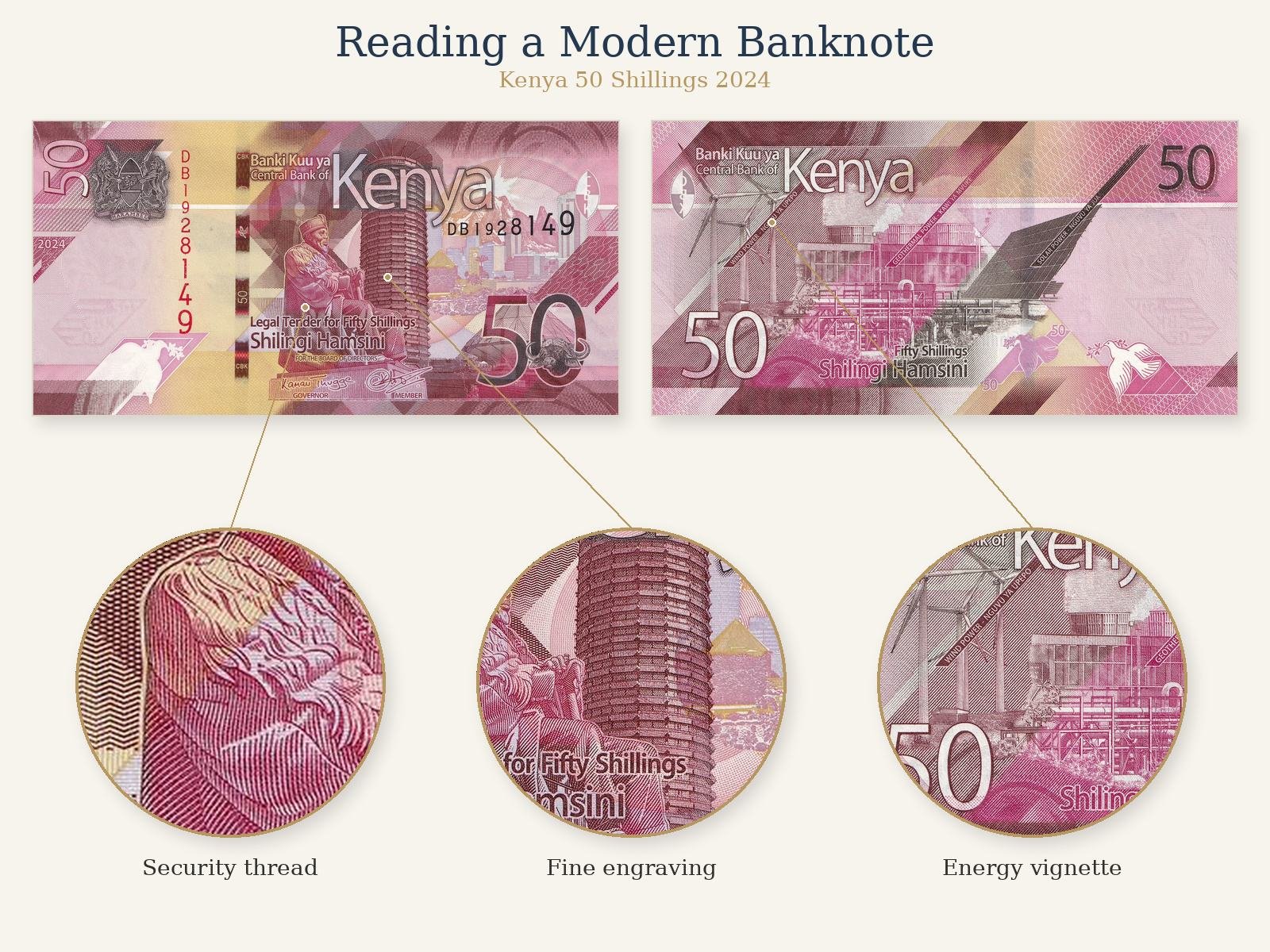
The Kenya detail study shows three different kinds of evidence: the structure of the security thread, fine engraved linework and the complexity of the reverse energy vignette. A counterfeit must reproduce all three consistently, not merely imitate the dominant pink colour.
Print Edges and Registration
Inspect the boundary between printed elements.
Separate printing stages can create distinctive relationships between:
- intaglio and offset;
- flat colour and raised detail;
- serial numbering and background;
- foil and substrate;
- front and back registration.
A single-pass reproduction may flatten elements that should differ in relief, ink density or edge character.
Ultraviolet and Infrared Features
Equipment can add evidence, but only when the expected response is known.
Ultraviolet Features
Under ultraviolet light, a banknote may show:
- fluorescent fibres;
- serial-number fluorescence;
- denomination patches;
- symbols or text;
- thread fluorescence;
- areas designed to remain dark;
- different responses on each side.
The substrate may be expected to remain relatively dull while selected elements fluoresce. Ordinary paper containing optical brighteners can glow strongly, but this is not a universal counterfeit test.
Ultraviolet response varies with:
- issue and denomination;
- wavelength;
- age;
- washing and contamination;
- substrate;
- printing ink;
- counterfeit simulation.
The Bank of England recommends a lamp around 365 nanometres for checking its own current notes and warns that UV should be used alongside other key features. That wavelength should not be presented as a universal rule for every currency.
Infrared and Machine-Readable Features
Some inks absorb or reflect infrared light differently, causing parts of the design to disappear or remain visible under an infrared viewer.
Other machine-readable features can include magnetic ink, thread properties, coded patterns and specialised optical responses.
These features may be valuable, but they require:
- correct equipment;
- issue-specific reference data;
- careful calibration;
- interpretation by a knowledgeable user.
A machine result should support, not replace, exact identification and physical examination.
Serial Numbers and Controlled Printing
Serial numbers are not decorative. Their structure may encode printing, denomination, issue or replacement-note information.
Check:
- prefix and character count;
- font;
- spacing;
- colour;
- alignment;
- position;
- size progression;
- fluorescence;
- consistency between repeated serials.
An unusual prefix is not automatically false. Replacement-note systems, printer changes and production blocks can create legitimate variations.
At the same time, a correctly formatted serial number does not authenticate a reproduction. The base substrate, printing and security elements must also be genuine.
Case Study: Serbia 100 Dinara 2012
The National Bank of Serbia specifies a detailed feature system for the 2012 100-dinar note.
The paper contains:
- a multi-tone Nikola Tesla watermark;
- an embedded silver-coloured thread with repeated negative microlettering;
- visible yellow, blue and red fibres;
- selected fibres that fluoresce under ultraviolet light.
The front combines intaglio and multicolour offset printing. The reverse uses multicolour offset and letterpress numbering. The two serial numbers have different colours and ultraviolet responses.
The note also includes microlettering, intaglio KIP effects and a see-through register that forms a stylised induction coil when front and back align.
This is a good example of a paper banknote whose security does not depend on a polymer window or a large hologram. Its strength comes from several coordinated print and substrate features.
Explore this issue: View the Serbia 100 Dinara 2012 banknote →
Modern Paper Security: Kenya and Peru
Modern paper notes can use highly dynamic features without becoming polymer.
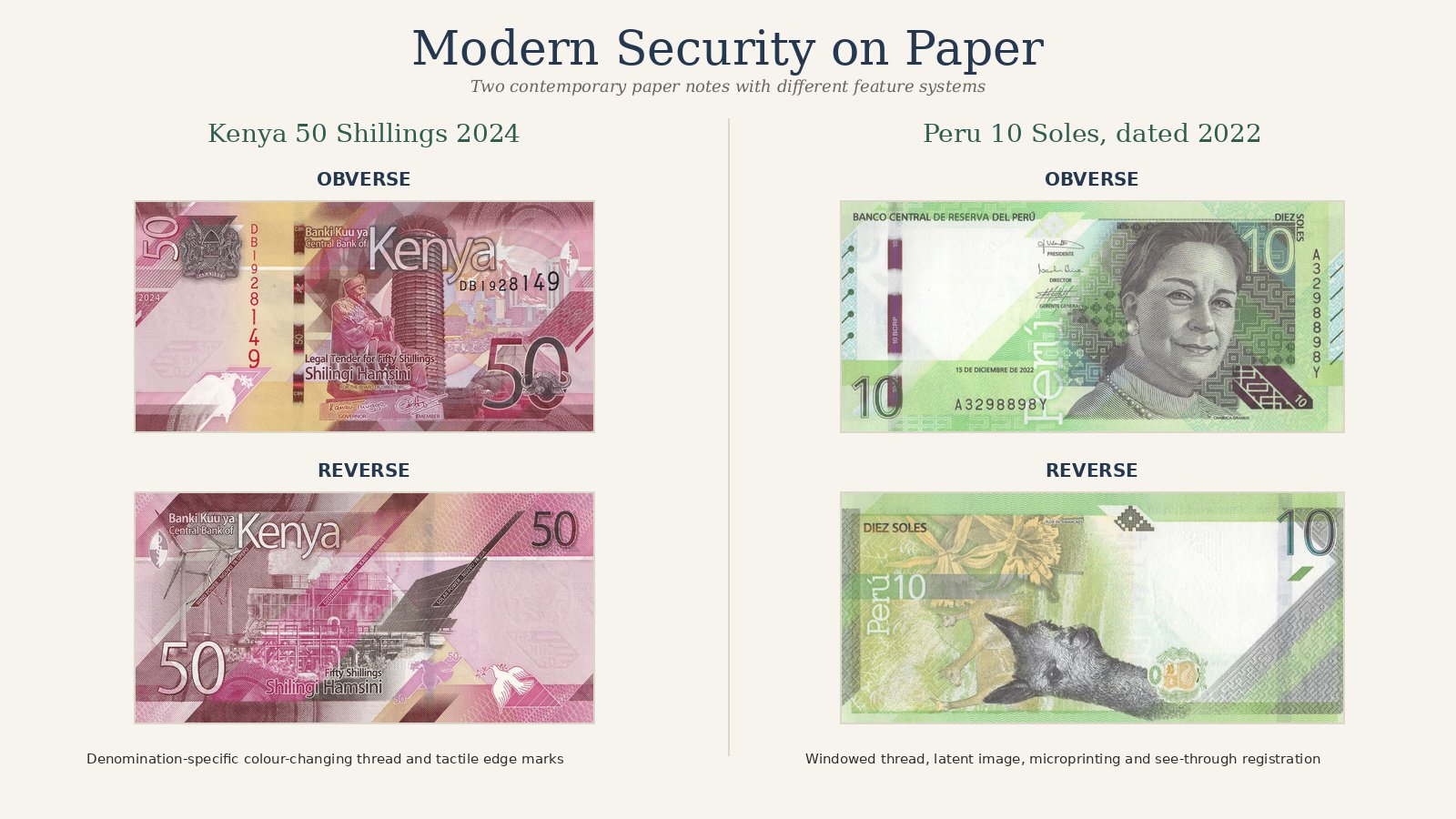
The Kenya 50 shillings note uses a denomination-specific colour-changing thread within an established paper series.
The Peru 10 soles design featuring Chabuca Granda uses a windowed security thread. Banco Central de Reserva del Perú describes movement in the thread, a colour change from violet to bronze and the text 10 BCRP. The design also includes a latent image, microprinting and a see-through register.
The Peru example demonstrates why the phrase security thread is too broad on its own. An embedded dark line, a windowed metallic thread and a dynamic colour-changing thread are different constructions and should not be treated as interchangeable.
Explore this issue: View the Peru 10 Soles 2022 banknote →
Paper, Polymer and Hybrid: What Changes?
| Area | Paper banknotes | Polymer banknotes | Hybrid banknotes |
|---|---|---|---|
| Base material | Security paper, often cotton-based or mixed fibre | Specialised plastic film | Composite or layered structure |
| Common transmitted-light features | Watermark, electrotype, embedded or windowed thread | Transparent window, shadow image, integrated optical structures | Depends on the particular construction |
| Touch | Paper character, intaglio relief, fibres | Smooth film with raised print or embossing | May combine different tactile zones |
| Typical tilt effects | Foils, threads, optically variable ink, latent images | Window effects, metallic and dynamic features | Issue-specific |
| Common mistake | Expecting every paper note to have a watermark | Treating the window as an attached patch | Assuming all hybrid notes use the same technology |
Substrate categories help organise expectations, but they do not replace an exact issue reference.
Historical Banknotes with Few Modern Features
Older banknotes may have no hologram, UV patch, polymer window or sophisticated thread.
Authentication may rely more heavily on:
- paper composition and natural ageing;
- watermark, if present;
- engraving and plate characteristics;
- typography;
- dimensions;
- serial-number style;
- seals, signatures and overprints;
- known varieties;
- provenance;
- specialised literature.
Age alone is not proof. Artificial toning, false stains and simulated wear can make a reproduction look old.
Poor production quality is not proof of counterfeiting either. Some genuine emergency, local or inflationary issues were printed under difficult conditions. The standard of comparison must match the actual issuer and period.
Why One Feature Never Proves Authenticity
Counterfeiters do not need to reproduce every feature equally well. They often imitate the most obvious feature and rely on the holder stopping the examination too early.
Examples include:
- a printed grey watermark imitation;
- reflective film presented as a hologram;
- a surface line imitating a thread;
- meaningless strokes imitating microtext;
- fluorescent ink copied without correct normal-light printing;
- a transparent patch attached to ordinary film;
- a genuine base banknote carrying a false overprint.
A strong conclusion should ask:
- Are the expected features present?
- Are they constructed correctly?
- Are they in the correct positions?
- Do they behave correctly?
- Do the substrate, printing and serials support the same issue?
- Is any feature contradictory?
The strongest evidence is consistency across the complete object.
Security-Feature Reference Table
| Feature | How to examine it | What to confirm | Main limitation |
|---|---|---|---|
| Substrate | Feel and flex gently | Correct material, thickness and surface | Wear and cleaning alter feel |
| Watermark | Hold against light | Tonal depth, image, position, visibility from both sides | Not every issue has one |
| Security thread | Reflected and transmitted light; tilt if dynamic | Position, width, inscription, continuity and behaviour | Threads differ by denomination |
| Transparent window | Normal and transmitted light | Integrated construction, correct printed and optical elements | Damage can cloud genuine polymer |
| Intaglio | Touch and magnification | Raised ink and engraved line structure | Circulation or pressing reduces relief |
| Hologram or foil | Tilt under one light source | Correct image, depth, colour and movement | Simple reflective patches can imitate shine |
| Colour-shifting ink | Tilt slowly | Correct element and colour path | Metallic ink can sparkle without shifting |
| Microprinting | 5×–10× magnification | Correct wording, sharpness and spacing | Scanner resolution can conceal quality |
| See-through register | Hold against light | Correct combined image and plausible alignment | Genuine registration tolerances vary |
| UV feature | Correct lamp and reference | Exact issue-specific fluorescence | Contamination and wrong wavelength mislead |
| Serial number | Normal light and magnification | Correct prefix, font, placement and response | A valid-looking serial does not prove the base note |
| Infrared or magnetic feature | Specialist equipment | Expected issue-specific response | Requires reliable equipment and data |
Collector’s Security-Feature Checklist
Before accepting a feature as evidence, record:
- the exact banknote issue;
- the source describing the expected feature;
- the feature’s correct location;
- how it should look in normal light;
- how it should appear against light;
- how it should behave when tilted;
- whether it should be tactile;
- whether UV or infrared is relevant;
- whether condition could explain a weak response;
- any contradiction elsewhere on the note.
A checklist should not turn authentication into box-ticking. It should prevent the collector from accepting a dramatic but incorrect feature.
Frequently Asked Questions
Does every genuine banknote have a watermark?
No. Watermarks are common on security paper but are not universal. Polymer notes often use transparent windows or shadow images, while some historical paper issues have no watermark.
Is a security thread enough to prove a note is genuine?
No. The thread must have the correct position, width, inscription and behaviour for the exact denomination and series. Surface printing can imitate the appearance of a simple thread.
Are polymer banknotes always safer than paper banknotes?
Not automatically. Polymer enables integrated windows and other specialised features, but security depends on the complete design and production system. Advanced paper notes can also use highly sophisticated threads, foils and inks.
What is the difference between a watermark and a shadow image?
A traditional watermark is formed within paper during manufacture. A shadow image is a transmitted-light feature commonly used in polymer or composite substrates.
Can a genuine note glow strongly under UV?
Yes, depending on the issue, feature, substrate and condition. Strong overall fluorescence can be suspicious for some currencies but normal for others. Always use issue-specific guidance.
Can washing or pressing damage security features?
Yes. Washing can change fluorescence, stiffness and surface appearance. Pressing can reduce embossing and intaglio relief. These alterations affect grading and may complicate authentication.
How much magnification is useful?
A 5× to 10× loupe is generally sufficient for routine checks of microprinting, fine lines and print edges. Higher magnification can help document details but is not automatically more reliable.
Do identical serial numbers prove counterfeiting?
They are a serious warning on ordinary circulating notes that should have unique numbers. However, specimens, replicas and some specialist products require issue-specific interpretation.
Can a genuine banknote have a false security-related element?
Yes. A genuine base note can carry a false overprint, altered serial, added stamp or repair. Each claimed element must be assessed separately.
Should collectors use detector pens?
Detector pens are not a universal authentication method. They do not authenticate polymer, can give misleading results on treated paper and may permanently mark a collectible banknote.
Final Thoughts
Banknote security features are best understood as coordinated evidence.
The substrate, printing, watermark or window, thread, optical effects, fine detail, serial system and machine-readable responses should all support the same issue.
The most useful collector habit is not memorising the largest number of features. It is learning to ask:
What should this exact banknote contain, and does every part of the note agree with that identity?
When the evidence is incomplete, inconclusive is a responsible conclusion.
Selected References
- European Central Bank — Security Features: Feel, Look and Tilt
- Reserve Bank of Australia — List of Security Features
- Bank of England — How to Check Your Banknotes
- U.S. Currency Education Program — Quick Reference Guide
- Central Bank of Kenya — New Generation Banknotes Pamphlet
- Central Bank of Kenya — 2024 Kenya Banknotes Press Release
- Brunei Darussalam Central Bank — Security Features
- National Bank of Serbia — Decision on the Issue and Main Features of the 100-Dinar Banknote
- Banco Central de Reserva del Perú — Nuevo Billete de S/ 10
About the Author
Audrius is the founder and curator of WorldBanknotes.eu, a specialised catalogue and marketplace dedicated to collectible banknotes from around the world. His work focuses on banknote identification, catalogue structure, security features, condition, design and the historical context behind individual issues.
Explore World Banknotes
WorldBanknotes.eu presents collectible banknotes with structured information on country, issuer, currency, denomination, date, signatures, catalogue references, security features and condition.