
How to Authenticate a Banknote: A Practical Collector’s Method
Authenticating a banknote means deciding whether it is consistent with a genuine example of the exact issue it claims to be. It is not the same as identifying the note, grading its condition or estimating its value.
A reliable authentication process does not depend on one dramatic feature. It combines identification, comparison, material, printing, transmitted-light features, movement effects and fine detail.

A genuine banknote should make sense as a complete object. One convincing feature cannot compensate for several contradictions.
Table of Contents
What Banknote Authentication Means
Authentication asks a specific question:
Is this banknote consistent with a genuine example of the exact country, issuer, denomination, date, series and variety it claims to represent?
That wording matters because genuine banknotes from different issues can have completely different security features.
A watermark expected on one series may be absent from another. A security thread can change position between denominations. A polymer window may belong only to a later redesign. An old note may have no ultraviolet feature at all.
Authentication therefore begins with the correct reference point.
These four tasks should be kept separate:
- identification determines what the banknote is;
- authentication assesses whether it is genuine;
- grading describes its physical condition;
- valuation estimates its market worth.
A genuine note can be in very poor condition. A visually attractive note can be counterfeit. A genuine banknote can also have an altered serial number, added overprint or repaired surface.
Identify the Exact Banknote First
Before checking security features, establish the claimed identity of the note.
Record:
- country or territory;
- issuing authority;
- currency;
- denomination;
- printed date or series date;
- design type;
- signatures;
- prefix and serial-number format;
- catalogue reference, if available;
- paper, polymer or hybrid substrate;
- expected dimensions.
This prevents one of the most common authentication errors: checking a genuine feature from the wrong series.
For example, two notes with the same denomination can differ because they were issued:
- by different banks;
- in different years;
- under different signature combinations;
- before and after a security upgrade;
- on different substrates;
- for circulation and commemorative purposes.
A security feature is meaningful only when it is expected on that exact issue.
Collectors who have not yet identified the note should begin with How to Identify a Banknote.
Use a Known Genuine Reference
The strongest practical comparison is a banknote of the same issue that is already known to be genuine.
The European Central Bank and the Reserve Bank of Australia both advise comparing a suspect note directly with a genuine one. This approach helps because the collector is not relying on memory alone.
Compare the notes side by side for:
- dimensions;
- substrate feel;
- colour balance;
- portrait detail;
- line sharpness;
- watermark position;
- thread position;
- window construction;
- foil or hologram behaviour;
- serial-number typography;
- margins and registration.
The reference should match as closely as possible.
A genuine banknote of another denomination or later series may be useful for understanding an issuer’s general production quality, but it is not a substitute for the correct issue.
What Counts as a Reliable Reference?
Useful references include:
- a banknote obtained from an established source;
- an example certified by a recognised authentication service;
- official central-bank security-feature material;
- a specialised catalogue with accurate issue distinctions;
- high-resolution images from an issuing authority or museum;
- another example from a documented genuine bundle or provenance group.
Marketplace photographs can help with identification, but they should not be treated as proof that the pictured note is genuine.

The Practical Authentication Sequence
A good sequence is:
- Identify the exact issue.
- Compare it with a genuine reference.
- Feel the substrate and printing.
- Look at the design and construction.
- Hold it to light for embedded and see-through features.
- Tilt it for movement and colour effects.
- Magnify fine printing and edges.
- Use UV or other equipment only when the expected response is known.
- Record contradictions, not just successful features.
- Stop when uncertain and seek specialist confirmation.
This extends the familiar “feel, look and tilt” method used by the European Central Bank and other currency authorities.
The order is deliberate. Special equipment should support a physical examination, not replace it.
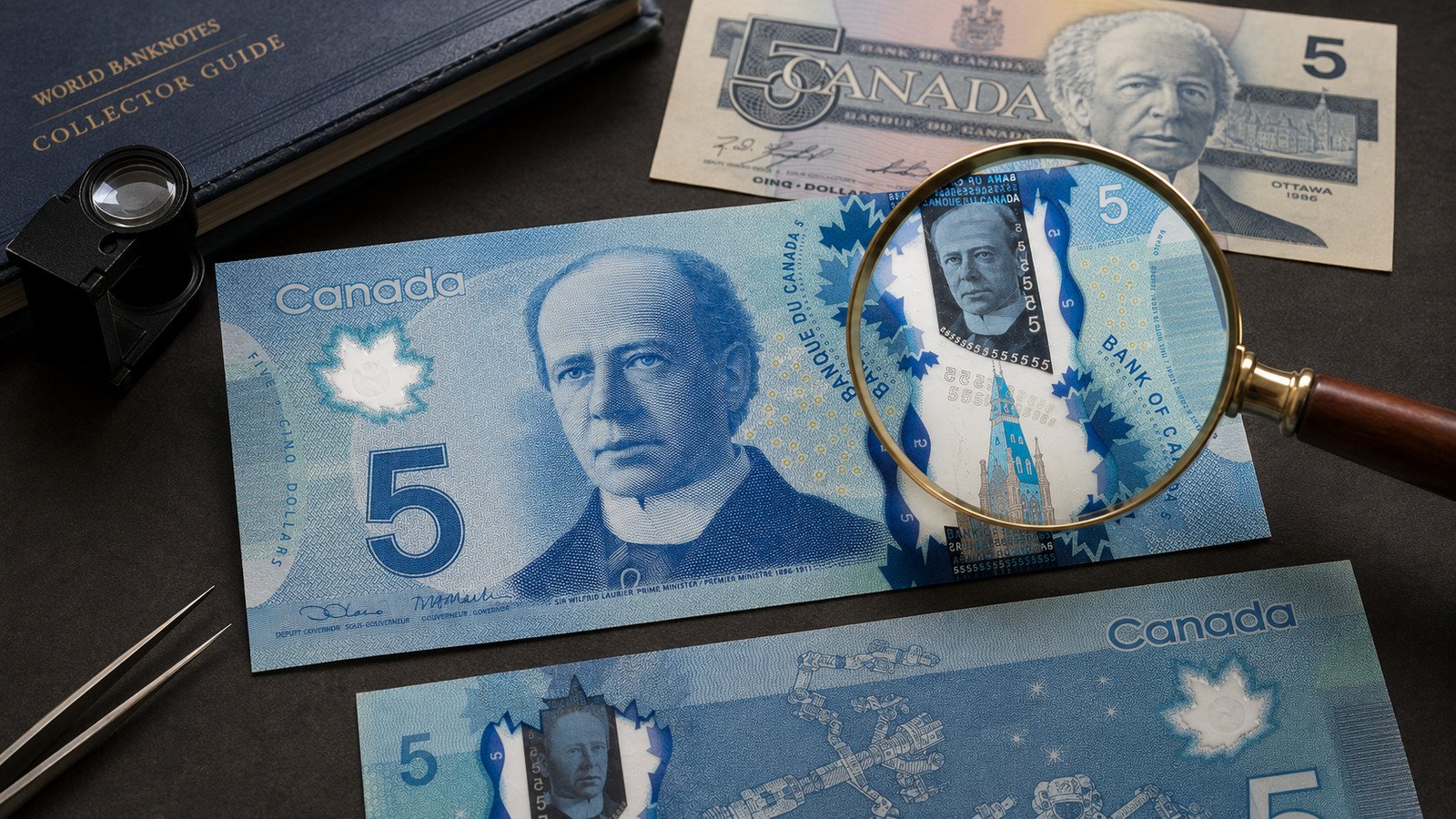
Step 1: Feel the Banknote
Touch provides information that a screen image cannot.
Substrate
Paper banknotes can be made from cotton-based paper, mixed fibres or other specialised materials. Polymer banknotes use plastic film. Hybrid notes combine layers or materials.
Ask:
- Does the material feel appropriate for the issue?
- Is it excessively thick or thin?
- Is it unusually glossy?
- Does it feel like ordinary office paper?
- Does the polymer feel integrated, or does a window seem attached?
- Has washing, pressing or coating changed the surface?
A counterfeit printed on ordinary paper may feel wrong immediately. However, touch is comparative: age, circulation, humidity and cleaning can change the feel of a genuine note.
Raised Printing
Intaglio printing can produce a tactile raised surface in portraits, lettering, numerals and other major elements.
Run a clean fingertip gently across the expected area. Do not scrape the note.
Genuine raised printing may feel slightly rougher than surrounding areas. A flat reproduction may imitate the image without reproducing the relief.
Not every genuine banknote uses intaglio printing, and heavy circulation or pressing can reduce the tactile effect. The absence of obvious relief is therefore not proof of counterfeiting unless the feature is expected and the note’s condition does not explain the loss.
Natural Flexibility
A genuine banknote should flex in a way consistent with its substrate and condition.
Avoid destructive tests. Do not deliberately tear, crease, wet, rub or apply chemicals to a collectible banknote.
Step 2: Look at the Banknote
Begin without magnification.
Overall Print Quality
Inspect:
- portrait modelling;
- fine-line backgrounds;
- guilloche patterns;
- borders;
- denomination numerals;
- small lettering;
- colour transitions;
- alignment between separate printed elements.
Counterfeit printing may appear:
- blurred;
- grainy;
- pixelated;
- too dark or too pale;
- uneven in line thickness;
- simplified in complex areas;
- surrounded by coloured toner dots.
A good counterfeit may reproduce the general image while failing in the smallest transitions and repeated patterns.
Dimensions and Proportions
Measure the banknote with a non-abrasive ruler or digital calliper used carefully at the edge.
Small variations can occur through production tolerances, cutting and wear, but a meaningful size discrepancy can indicate:
- a reproduction printed at the wrong scale;
- trimming;
- an altered note;
- confusion with another variety.
Do not judge dimensions from a photograph unless the image includes a reliable scale and is free from perspective distortion.
Colour
Compare colour under neutral lighting.
Colour differences can result from:
- fading;
- staining;
- scanner settings;
- white-balance errors;
- ageing;
- genuine printing variation;
- counterfeit reproduction.
Colour is supportive evidence, not a standalone test.
See-Through Windows
On polymer banknotes, inspect the transparent window as part of the substrate.
A genuine window should not look like a separate transparent patch glued or laminated onto the note. Official RBA guidance specifically advises checking that the clear window is continuous with the rest of the banknote.
Look for:
- clarity;
- integrated printed or metallic features;
- embossing;
- complex shapes;
- correct placement;
- absence of crude joins.
Step 3: Hold It to the Light
Transmitted light reveals features built into, or coordinated through, the substrate.
Watermarks and Shadow Images
A watermark should usually:
- appear within the paper rather than sit on its surface;
- show tonal variation, not only a flat outline;
- be visible from both sides;
- match the correct portrait, symbol or denomination;
- occupy the expected position.
Printed grey imitations often lack depth and may be more visible from one side.
Some polymer notes use shadow images rather than traditional paper watermarks. Do not expect a paper-style watermark on every polymer issue.
Security Threads
A security thread may be:
- fully embedded;
- windowed;
- metallic;
- printed with microtext;
- denomination-specific;
- responsive under UV light.
Check:
- location;
- width;
- continuity;
- inscriptions;
- visibility from both sides;
- interaction with transmitted light.
A line printed on the surface is not equivalent to an embedded thread.
Thread position may change between denominations. A thread that looks technically convincing but belongs in the wrong position is a serious contradiction.
See-Through Register
Some notes contain partial images printed on opposite sides. When held to light, the elements combine into a complete symbol or numeral.
Check whether the two sides align cleanly.
Poor registration can also occur on genuine notes, especially older or lower-quality issues, so the acceptable precision depends on the issuer and production standard.
Embedded Fibres and Other Material Features
Some banknote papers include coloured, fluorescent or otherwise distinctive fibres.
Confirm whether the fibres should be:
- embedded rather than surface-printed;
- visible in normal light;
- visible only under UV;
- distributed randomly or placed in defined areas.
Do not assume that every coloured fibre is a security feature. Contamination and paper ageing can create misleading marks.
Step 4: Tilt the Banknote
Many modern features are dynamic. They cannot be assessed properly in a static image.
Holograms and Foils
Tilt the banknote slowly under a single light source.
Look for:
- image changes;
- denomination changes;
- depth;
- movement;
- sharp edges;
- correct colour behaviour;
- correct placement.
A counterfeit foil may shine without producing the expected structured image or motion.
Colour-Shifting Ink
Optically variable ink changes colour when the viewing angle changes.
Confirm:
- which element should shift;
- the expected colours;
- direction of change;
- whether the effect is strong enough for that issue.
Ordinary metallic ink can sparkle without producing a true colour shift.
Rolling Bars and Moving Effects
Modern polymer and paper notes may use rolling colour bars, moving shapes, 3-D ribbons or other kinetic effects.
The movement should follow the official description for the issue.
Do not judge a motion feature from a single photograph. A short controlled video can be useful, but direct examination remains better.
Latent Images
A latent image may appear only at a shallow angle.
These features depend strongly on lighting and viewing position. Absence in a front-facing image proves nothing.
Step 5: Inspect Fine Detail
Magnification is valuable after the main physical checks.
A 5× to 10× magnifier is generally enough for routine collector inspection.
Microprinting
Genuine microtext should normally be:
- in the correct position;
- readable or clearly structured at appropriate magnification;
- sharp rather than broken into blobs;
- consistent in size and spacing.
ECB and RBA material both emphasise that genuine microprinting is clearly defined, while imitation microtext is often blurred or unreadable.
The exact wording matters. Counterfeiters sometimes imitate a line of microtext with meaningless strokes.
Fine Lines and Guilloche
Inspect repeated curves, rosettes and line fields.
Warning signs include:
- merged lines;
- jagged edges;
- uneven spacing;
- moiré patterns;
- missing intersections;
- pixelation.
High-resolution digital printing can look convincing at normal size but break down under magnification.
Edges of Printed Elements
Look at the boundary between colours and between raised and flat print.
Genuine multi-stage printing should match the known production method. A single-pass reproduction may flatten the distinction between elements that were originally printed by separate processes.
Serial-Number Printing
Inspect:
- font;
- spacing;
- ink;
- alignment;
- repeated numbers;
- prefix structure;
- letter shapes;
- consistency between two serial numbers, where present.
Serial numbers can vary by printer, series and replacement-note system. Confirm the correct format before treating an unusual prefix as suspicious.
What UV Light Can—and Cannot—Prove
UV examination is useful only when the correct response is known.
What to Check
Depending on the issue, UV light may reveal:
- fluorescent fibres;
- serial-number fluorescence;
- denomination patches;
- specific symbols;
- thread fluorescence;
- areas that remain dark;
- different colours on the obverse and reverse.
The substrate itself may be expected not to glow, while selected features fluoresce.
Why UV Is Not a Universal Test
A glowing note is not automatically counterfeit, and a non-glowing note is not automatically genuine.
Responses vary because of:
- substrate;
- series;
- denomination;
- age;
- washing;
- contamination;
- optical brighteners;
- lamp wavelength;
- counterfeit simulation.
The Bank of England notes that counterfeiters can imitate UV features and recommends checking UV alongside other key security features.
For current Bank of England notes, a lamp around 365 nanometres is recommended. That wavelength should not be presented as a universal rule for every banknote in the world; use the issuing authority’s guidance where available.
Detector Pens
Detector pens are not a reliable universal authentication method.
They may react with starch in ordinary paper, but they:
- do not authenticate polymer notes;
- may miss sophisticated counterfeits;
- can give misleading results on treated or contaminated paper;
- add a chemical mark to a collectible object.
Do not use a detector pen on a collectible banknote.
Infrared and Machine Authentication
Infrared viewers and authentication machines can provide additional evidence, but they require:
- issue-specific knowledge;
- correct equipment;
- current software or reference data;
- careful interpretation.
A machine result does not replace identification of the exact note.
Paper Banknotes
Paper banknotes are authenticated through a combination of:
- paper character;
- watermark;
- security thread;
- intaglio or other printing;
- fine-line detail;
- serial-number production;
- embedded fibres;
- UV and infrared response, where applicable.
Circulation can soften paper, reduce embossing and damage edges without making the note counterfeit.
Ageing can also change colour and fluorescence.
For older paper notes, production technology may be more important than modern security features.
Polymer Banknotes
Polymer requires a different inspection mindset.
Check:
- substrate feel;
- integrated transparent window;
- printed and metallic window features;
- shadow images;
- embossing;
- ink adhesion;
- dynamic effects;
- correct flexibility and recovery;
- clear areas for cloudiness or attached film.
RBA guidance notes that many counterfeits of Australian polymer notes are printed on paper. Material can therefore expose simple copies quickly.
However, do not use destructive tests such as forced tearing or aggressive crumpling on collectible notes.
A genuine polymer banknote may also be damaged by heat, chemicals or severe folding. Damage should not be confused automatically with counterfeiting.
A Canadian $5 Case Study: Paper and Polymer
The two Canadian five-dollar notes shown below demonstrate why authentication must remain issue-specific.
The older paper note is dated 1986 and belongs to the Birds of Canada series. The modern polymer note entered circulation on 7 November 2013 as part of the Frontiers series. Both feature Sir Wilfrid Laurier, but they were produced with different materials, designs and security expectations.
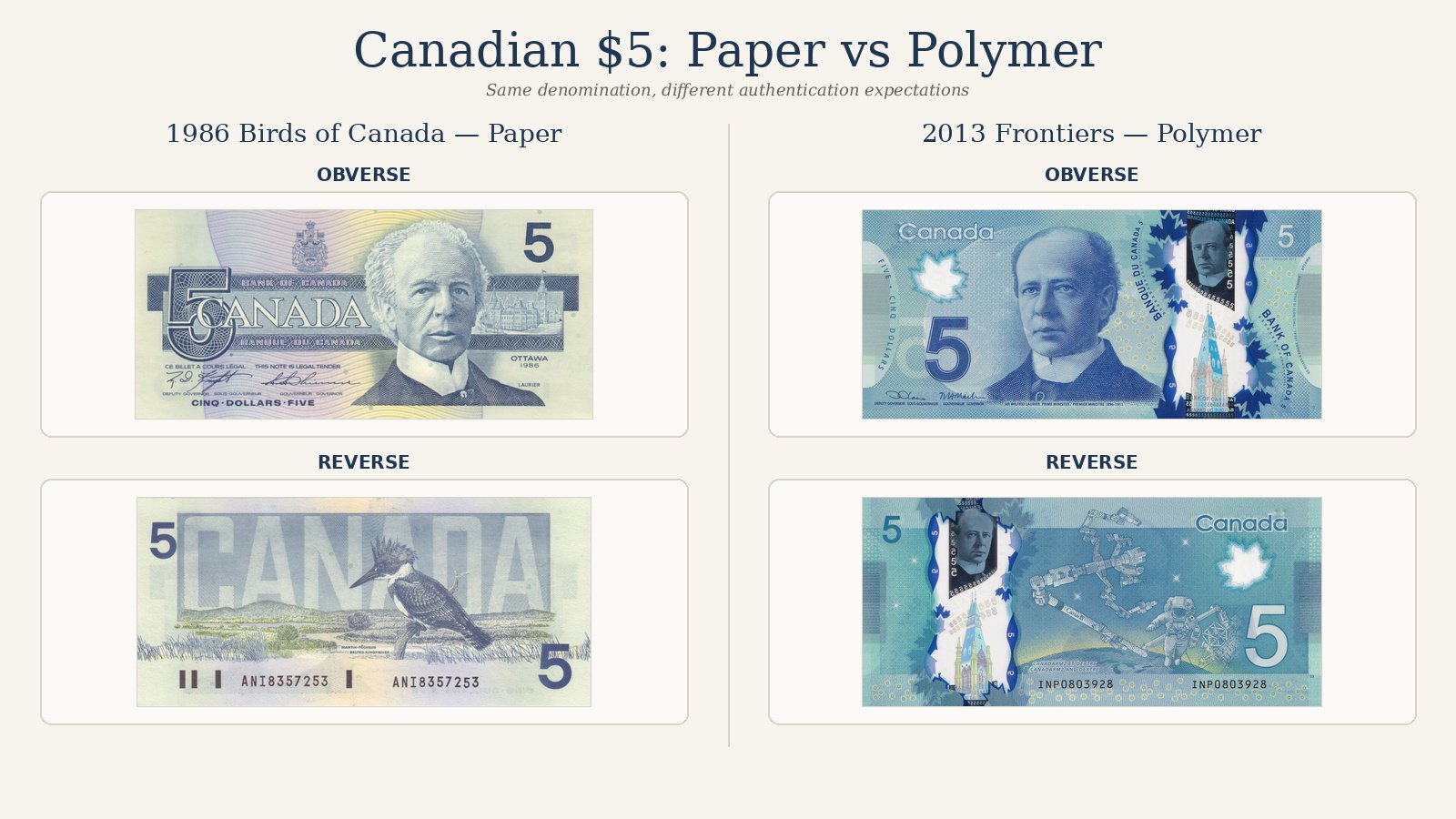
For the 1986 $5 paper note, check the raised ink on the large numerals, the shoulders of the portrait and the two horizontal bands running across the note. Small green dots should also appear randomly on both sides as part of the paper rather than as removable surface printing. Unlike the $20 and higher denominations in the series, the $5 note does not have a metallic patch.
For the 2013 note, the Bank of Canada instructs users to feel the smooth polymer, inspect its transparent areas, and follow a broader Feel, Look, Tilt and Flip sequence. Its reverse uses the Canadarm2 and Dextre space-exploration theme.
This is not a comparison in which the polymer note is “more genuine” than the paper note. It shows that the correct authentication method changes with the exact series.
Collector’s Note: A feature absent from the 1986 note may be essential on the 2013 note. That is normal design evolution, not evidence that the older note is counterfeit.
Explore this issue: View the 2013 Canadian $5 polymer banknote →
Older Banknotes with Few Modern Security Features
Historical banknotes can be harder to authenticate because they may lack:
- holograms;
- UV features;
- security threads;
- modern watermarks;
- microprinting;
- polymer windows.
Authentication then relies more heavily on production consistency and documentary reference.
Examine:
- paper composition and ageing;
- watermark, if any;
- engraving quality;
- plate characteristics;
- typography;
- serial-number style;
- signatures;
- seals;
- overprints;
- dimensions;
- known varieties;
- known counterfeits;
- provenance.
Printing Method
Older engraved notes often show fine lines and tactile relief that are difficult to reproduce convincingly.
Lithographed notes have different expected surfaces. A lack of raised printing is not suspicious when the issue was not produced by intaglio.
Natural Ageing
Genuine age can include:
- toning;
- foxing;
- edge wear;
- softness;
- oxidation of inks;
- old folds.
Artificial ageing may be uneven or inconsistent with protected areas, but ageing alone is not proof either way.
Reference Literature
For scarce historical issues, specialised catalogues, auction archives, museum holdings and expert opinions become more important.
When a note is rare enough that no reliable comparison is available, the authentication claim should remain cautious.
Serial Numbers, Signatures and Registration
These elements often reveal inconsistencies even when the central design looks convincing.
Serial Numbers
Confirm:
- expected number of characters;
- prefix pattern;
- replacement-note conventions;
- position;
- ink colour;
- font;
- repeated serial placement;
- relationship to series date, where documented.
A serial number that is valid in format can still have been added to a reproduction.
Signatures
Signatures can identify a variety, date range or issuing period.
Check:
- correct officials;
- correct combination;
- correct placement;
- printing method;
- whether the signatures should be printed or handwritten.
A genuine base note can be altered with false signatures or overprints.
Registration
Registration is the alignment of separate printed layers and, in some cases, the obverse and reverse.
Misregistration can occur genuinely. The question is whether the degree and pattern are plausible for the printer and issue.
Reproductions, Facsimiles and Prop Notes
Not every non-circulating banknote image is intended to deceive.
Authenticity and law answer different questions. An openly labelled replica may be easy to identify, yet making or publishing it can still be subject to jurisdiction-specific banknote reproduction rules.
Items may be produced as:
- replicas;
- facsimiles;
- souvenirs;
- educational copies;
- film or prop money;
- advertising notes;
- fantasy notes;
- specimen reproductions.
Look for:
- “SPECIMEN”;
- “COPY”;
- “REPLICA”;
- “FACSIMILE”;
- “FOR MOTION PICTURE USE ONLY”;
- incorrect issuer names;
- altered currency wording;
- identical serial numbers across multiple copies;
- missing security features;
- wrong dimensions;
- one-sided printing.
The Bank of England warns that some prop or training notes resemble real banknotes while using altered wording or lacking windows and holograms.
A genuine specimen banknote is different from a modern reproduction labelled “specimen”. Genuine specimens were produced or authorised for official purposes and require their own authentication.
Altered Genuine Banknotes
Not every deceptive object is entirely counterfeit.
A genuine banknote can be altered by:
- adding or changing an overprint;
- modifying a serial number;
- adding a false cancellation;
- joining pieces from different notes;
- replacing a missing area;
- changing a denomination element;
- applying false signatures or stamps.
Authentication must therefore ask two questions:
- Is the base banknote genuine?
- Are all claimed features original to that issue?
A genuine substrate and watermark do not prove that an added overprint or serial number is genuine. For documented examples, see our printing error or alteration guide.
Common Authentication Mistakes
Trusting One Security Feature
A copied watermark or reflective patch does not authenticate the whole note.
Checking the Wrong Series
Security features must match the exact issue, not merely the country and denomination.
Treating a Scanner Image as Proof
A scan cannot reliably show touch, movement, relief, material integration or many transmitted-light features.
Using UV Without a Reference
Unexpected fluorescence can result from contamination, washing or the wrong lamp.
Assuming Old Means Genuine
Age, wear and staining can be simulated.
Assuming Poor Quality Means Counterfeit
Some genuine notes were produced under difficult conditions or by printers with modest technical standards.
Confusing Damage with Counterfeiting
A genuine note may have lost embossing, window clarity, thread visibility or colour through wear.
Ignoring Alterations
The base note can be genuine while an overprint, serial number or stamp is false.
Relying on Seller Confidence
A confident description is not evidence. Record the physical and documentary basis for the conclusion.
Using Destructive Tests
Tearing, scratching, wetting, chemical pens and aggressive folding can damage genuine collectible banknotes.
What to Do When You Are Still Unsure
Uncertainty is a valid conclusion.
Use wording such as:
- consistent with a genuine example, but not independently certified;
- authentication inconclusive from photographs;
- requires examination in hand;
- overprint authenticity not confirmed;
- expert review recommended.
Seek specialist help when the note is:
- rare;
- high value;
- frequently counterfeited;
- known in deceptive reproductions;
- altered or repaired;
- missing a reliable comparison;
- being offered with an important provenance claim.
Possible sources of help include:
- the issuing central bank;
- a recognised banknote society;
- a specialist auction house;
- an experienced dealer;
- a professional grading and authentication service;
- a museum or archive with a reference example.
For a suspected current counterfeit, do not attempt to spend or pass it to another person. Follow the procedure of the relevant country, which may involve the police, a central bank or a commercial bank.
Practical Banknote Authentication Checklist
| Stage | What to confirm |
|---|---|
| Identity | Country, issuer, denomination, series, date, signatures and catalogue variety |
| Reference | A reliable genuine example or official issue-specific guide |
| Dimensions | Correct size, proportions and margins |
| Substrate | Correct paper, polymer or hybrid material |
| Printing | Sharp lines, appropriate relief, correct colours and production method |
| Light | Watermark, shadow image, thread, register and embedded features |
| Tilt | Hologram, foil, colour shift, rolling bar and latent image |
| Magnification | Microtext, fine lines, edges and toner or ink structure |
| Numbers | Correct serial format, prefix, font and placement |
| UV | Correct issue-specific response, checked with other features |
| Alterations | Overprints, stamps, serials, repairs and joined pieces |
| Conclusion | Genuine, likely genuine, inconclusive or suspect—with reasons recorded |
A Simple Decision Rule
A note should not be accepted as genuine merely because several broad features are present.
Ask instead:
- Are the expected features present?
- Are they correctly constructed?
- Are they in the correct positions?
- Do they behave correctly?
- Are any important features contradictory?
- Could the apparent feature be printed, attached or altered?
The quality of the conclusion depends on the quality of the reference.
Final Thoughts
Banknote authentication is a process of consistency.
The note’s identity, substrate, printing, security features, serial format and production quality should support the same conclusion.
The best practical method is:
Identify, compare, feel, look, hold to light, tilt and magnify.
UV light and specialist equipment can add evidence, but they are not shortcuts.
A collector does not need to prove that every suspect note is counterfeit. It is enough to recognise when the evidence is inconsistent or incomplete and to stop before making an unsupported claim.
Frequently Asked Questions
Can a banknote be authenticated from photographs?
Sometimes obvious reproductions can be rejected from good photographs, but photographs rarely provide complete authentication. Material, relief, dynamic effects and transmitted-light features may require examination in hand.
Is a watermark enough to prove a banknote is genuine?
No. A watermark is one feature. It must match the correct issue in image, position, construction and visibility from both sides.
Does every genuine banknote have a security thread?
No. Threads vary by country, denomination, series and period. Many historical notes have no thread.
Can a genuine banknote fail a UV test?
Yes. The expected UV response depends on the issue, lamp and condition. Ageing, washing and contamination can also affect fluorescence.
Are detector pens safe for collectible banknotes?
They should not be used. Detector pens are not universal, do not authenticate polymer and can mark the banknote.
Is raised printing always present on genuine banknotes?
No. Raised printing is expected on many intaglio-printed notes, but not every genuine issue uses intaglio. Circulation and pressing can also reduce relief.
How can I tell whether a polymer window is genuine?
The window should be integrated into the substrate and match the official design. Look for correct clarity, printed or metallic details, shape and placement rather than a separate attached patch.
Can a genuine banknote have a false overprint?
Yes. The base note can be genuine while an overprint, stamp, serial number or signature is altered or added later.
Are identical serial numbers proof of counterfeiting?
They are a serious warning when normal circulating notes should have unique serials, but specimens, reproductions and some special products require issue-specific interpretation.
What should I do with a suspected current counterfeit?
Do not pass it on. Follow the relevant national procedure, which may involve the police, central bank or a commercial bank.
Selected References
- Bank of Canada — $5 Polymer Note Security Features and $5 Polymer Note Design Elements.
- Bank of Canada — Checking Older Series Paper Bank Notes.
- European Central Bank — Security Features: Feel, Look and Tilt.
- Bank of England — How to Check Your Banknotes.
- Reserve Bank of Australia — Counterfeit Detection Guide and List of Security Features.
- U.S. Currency Education Program — How to Authenticate U.S. Currency and Dollars in Detail.
About the Author
Audrius is the founder and curator of WorldBanknotes.eu, a specialised catalogue and marketplace dedicated to collectible banknotes from around the world. His work focuses on banknote identification, catalogue structure, security features, condition, design and the historical context behind individual issues.
Explore World Banknotes
WorldBanknotes.eu presents collectible banknotes with structured information on country, issuer, currency, denomination, date, signatures, catalogue references, security features and condition.