
Who Made This Banknote? Reading the Tiny Names in the Margin
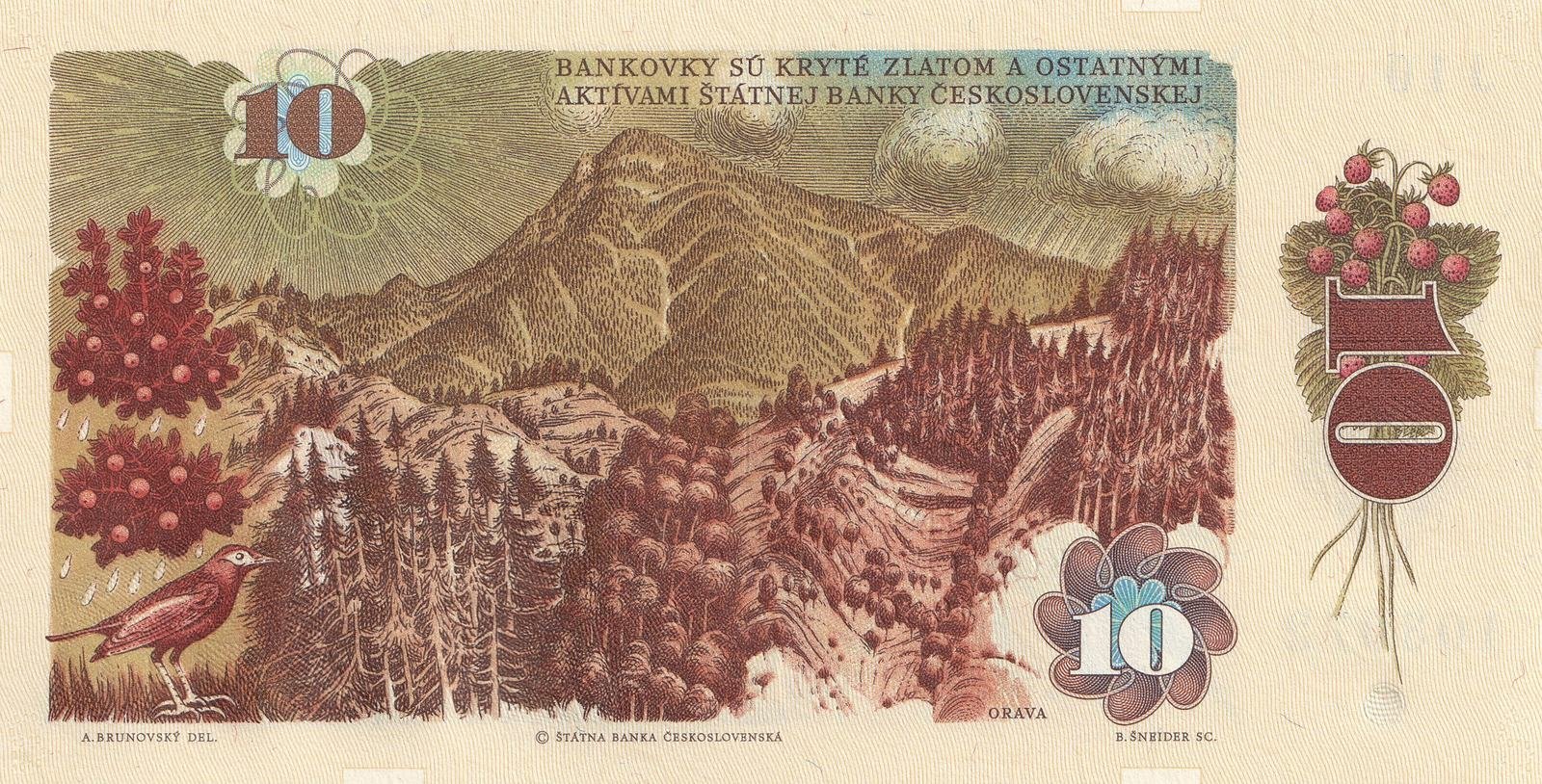
Look beneath the portrait on our Czechoslovak 10-korun note of 1986. At the left is “A. BRUNOVSKÝ DEL.”; at the right, “V. FAJT SC.” A printing-house name runs between them. Turn the note over and Brunovský appears again, this time opposite “B. ŠNEIDER SC.” The poet named beside the portrait is someone else entirely.
These small inscriptions are credits for particular pieces of work. Read alongside the issuing documents, they separate a design from an engraving, an engraving from the process used to print it, and an artist’s name from an official’s signature. Our Czech and Italian examples also show why the printed credits are not a complete list of everyone whose work contributed to the note.
Three Names Under the Poet
The portrait belongs to Pavol Országh Hviezdoslav. His name and the dates 1849–1921 identify the person depicted. They do not identify the designer or engraver. Those credits sit in the lower margin, away from the portrait label.
The original 1986 issuing decree describes the names individually. It calls A. Brunovský the author of the design and adds navrhl, meaning “designed”, after his printed credit. V. Fajt is the engraver of the obverse. On the reverse, B. Šneider is credited as the author of the engraved drawing. The Banknote Book supplies their full names: Albín Brunovský, Václav Fajt and Bohumil Šneider.
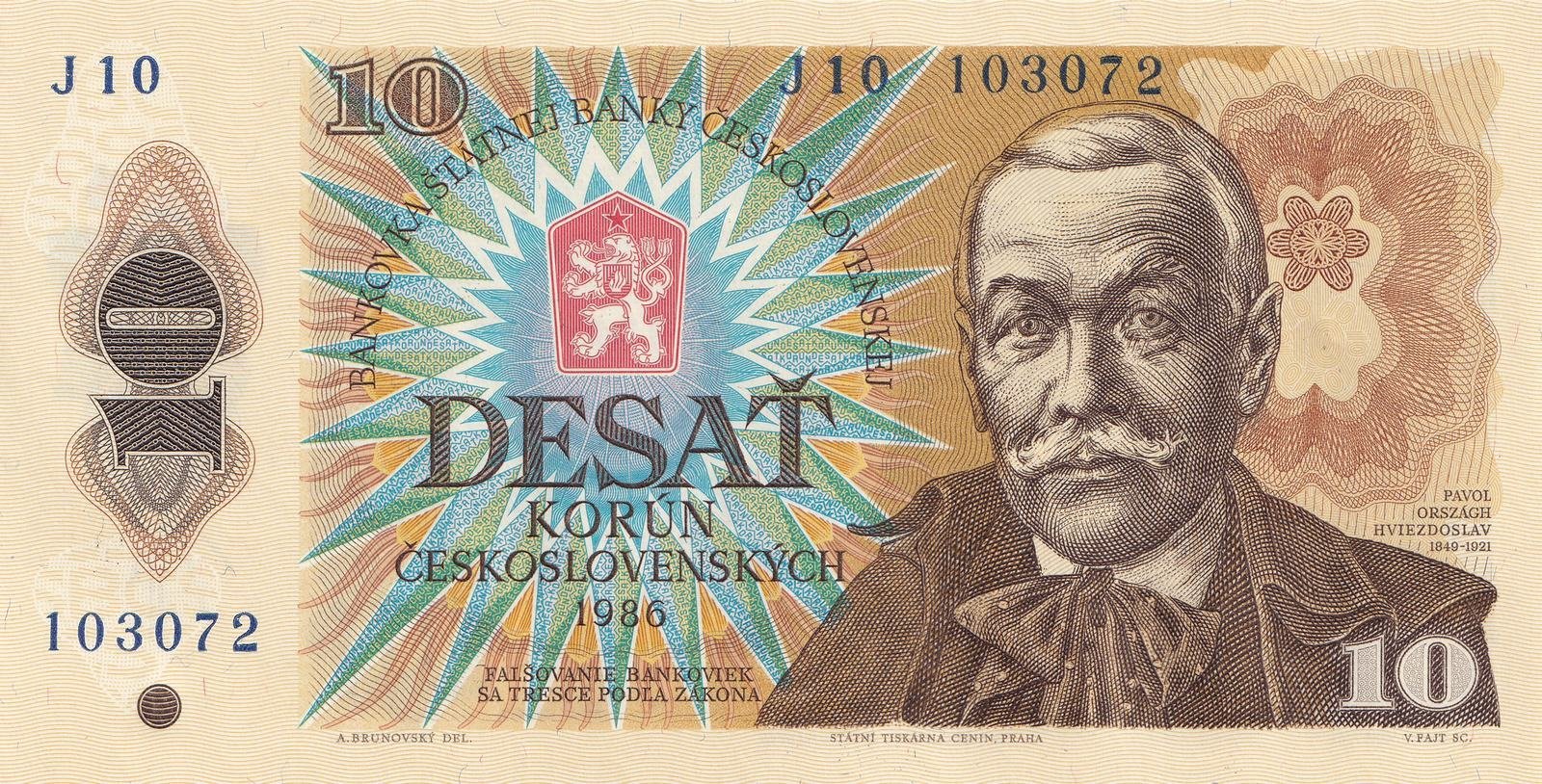
Design · obverse
Engraving · obverse
Engraved drawing · reverse
Printing house · obverse
Institutional © line · reverse
Both sides credit Brunovský’s design, but each names a different engraver. Recording only one name as “the artist” would lose that division of work.
The central inscriptions perform other jobs. “STÁTNÍ TISKÁRNA CENIN, PRAHA” names the printing house. The reverse has the issuing bank’s name with a © mark. Neither is a personal engraving credit. This type has no officials’ signatures, so the absence of a conventional signature panel does not leave the note without named contributors.
What the Abbreviations Credit
The abbreviations come from the vocabulary of printmaking. DEL., from delineavit, credits drawing; INV., from invenit, credits devising or designing. SC., from sculpsit, and INC., from incidit, are engraving inscriptions. These traditional expansions help identify a credit, but the wording alone may not tell us which part of a banknote the person worked on.
Compare the Czechoslovak note with our Czech 100-koruna note bearing 2018. Its issuing description identifies the front credits as “O. KULHÁNEK INV.” for the design and “M. ONDRÁČEK SC.” for the engraving. The reverse carries “V. FAJT SC.” The official ČNB leaflet identifies Oldřich Kulhánek’s design, Miloš Ondráček’s engravings and line drawings for the face, and Václav Fajt’s work for the reverse.

Designer · obverse
Engraver · obverse
Engraver · reverse

Official signature · obverse
The governor’s signature sits elsewhere, above “GUVERNÉR”. It represents a different function from the small artist credits. Our guide to banknote signatures deals with those official roles. A collection entry should not merge them with the people who drew or engraved the design.
The design credit is marked DEL. on the 1986 example and INV. on the 2018 one. The documents identify the work attributed to each person more precisely than the abbreviation alone. Likewise, an institution’s printer imprint should remain separate from a designer’s or engraver’s credit.
An Engraved Original, an Offset-Printed Note
An engraving credit is not a reliable shortcut to the final printing process. The Czechoslovak decree describes the 10-korun reverse as multicolour offset, although it carries Šneider’s SC. credit. It credits an engraved drawing; it does not say that the reverse was printed directly from an intaglio plate.
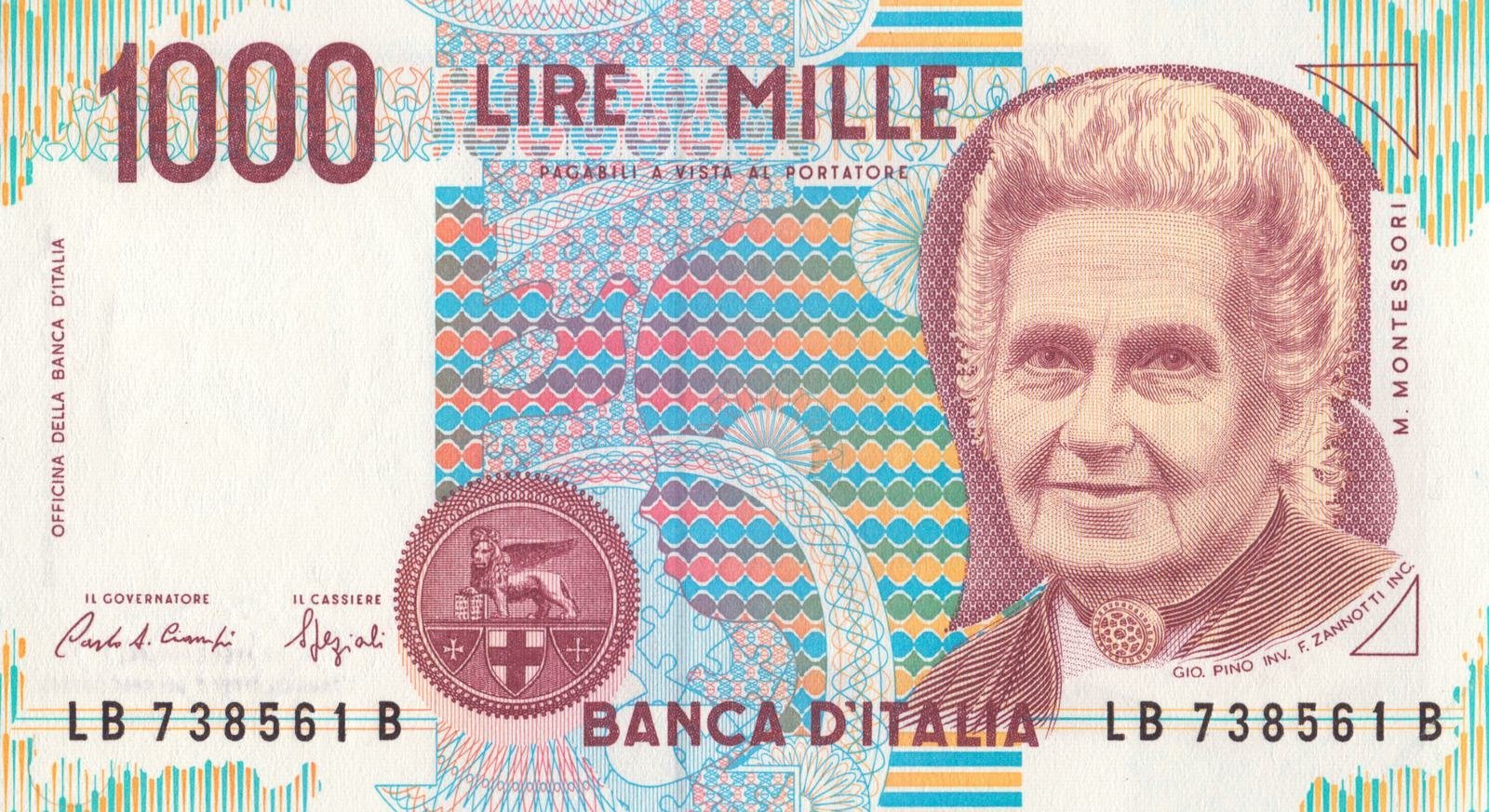
The Italian 1,000-lire Montessori design makes the distinction unusually clear. Beside the lower contour of Montessori’s portrait are “GIO. PINO INV.” and “F. ZANNOTTI INC.” The decree of 3 October 1990 identifies Pino as the bozzettista, the design-sketch artist, and Zannotti as the engraver.
That same decree specifies offset printing for the entire note apart from its letterpress numbering. It then explains that the matrices for the figurative elements on both sides are derived from hand-engraved originals, similar to those normally used for intaglio printing. Here, the document connects hand engraving with an offset-printed result. It does not give the intervening transfer procedure or say that every background and text element was engraved by hand.
The Czech 2018 reverse requires a more precise description. ČNB’s technical note calls its process indirect letterpress, or letterset, also described as dry offset. The note covers the face-side underprints and the reverse, except for numbering. This is not ordinary lithographic offset, and it is not a description that can simply be carried back to the 1986 note.
These documents describe different production arrangements. What the examples share is a limit on reading the small print: SC. or INC. tells us that engraving work is credited, not that the finished side must have been intaglio-printed. The broader differences between techniques belong in our banknote-printing guide.
The Painting Behind the Italian Reverse
The reverse of the Montessori note shows two children studying. Beneath the image is “A. DE ANGELIS INC.” That line credits the engraving, but it does not name the painter whose composition supplied the scene.
Montessori · obverse
Children studying · reverse

Pino and Zannotti · obverse
De Angelis · reverse
The decree identifies the source as Armando Spadini’s Bambini allo studio, a painting belonging to Banca d’Italia. It separately describes A. De Angelis as the author of the engraving, using the feminine autrice dell’incisione. The painter and the engraver therefore belong in different fields of a catalogue record.
Spadini’s name is not printed on the scanned reverse. Someone relying on the note alone could read the engraver’s credit without knowing the source painting. The official description supplies that missing connection. Our article on shared images on banknotes examines other cases where recognising a picture and establishing its authorship are separate tasks.
There is a related difference in the Czech material. Alongside the three people named in the small printed credits, ČNB’s leaflet names František Dvořák for design adaptations. It does not date those adaptations or identify him specifically as the author of the 2018 changes. His name adds to the documented team without appearing on the banknote itself.
Neither case gives grounds to describe a contributor as deliberately hidden or forgotten. The printed line and the institutional description serve different purposes. Reading both produces a fuller attribution than expanding the initials on the note ever could.
The Same Credits, Different Signatures
Our three Montessori examples provide a useful comparison within one design. They are catalogued as P-114a, P-114b and P-114c(2) in the collection. Their officials’ signatures change: Ciampi/Speziali, Fazio/Speziali and Fazio/Amici. The GIO. PINO INV. and F. ZANNOTTI INC. line remains the same, as does A. DE ANGELIS INC. on the reverse.
P-114a · Ciampi / Speziali
Creator-credit detail
P-114b · Fazio / Speziali

Creator-credit detail
P-114c(2) · Fazio / Amici

Creator-credit detail
The credit line identifies work retained in the design; the signature pairs distinguish the three compared varieties. This is an observation about these notes, not a rule that signatures define every variety or that artist credits never change.
There is also a date to keep in its proper place. “DECRETO MINISTERIALE 3 OTTOBRE 1990” refers to the decree for the type. It does not date the printing or first circulation of each physical example. Calling all three “the 1990 design” is different from claiming that all three pieces of paper were produced in 1990.
Recording a Credit Without Adding to It
A useful entry starts with the mark as printed, its side and its position. The role then comes from the relevant document, with the source identified. For the Czechoslovak reverse, that can be as simple as: “B. ŠNEIDER SC.; lower right; author of the engraved drawing for the reverse, according to §2(5) of the 1986 issuing decree.” The full name Bohumil Šneider is a separate catalogue attribution.
Preserve unfamiliar spellings rather than silently correcting them. The Italian credit is ZANNOTTI with two Ns. Where the source gives only GIO. PINO, F. ZANNOTTI or A. DE ANGELIS, initials should not be expanded by guesswork. On our Czech scan, the letters and their positions can be read more securely than every accent or full stop; the documented spelling should not be presented as if every detail had been resolved from the photograph.
The © line also deserves an accurate description. It names an institution in a copyright notice, separately from the personal credits. By itself it does not establish the artists’ contracts or the complete ownership of every contribution.
On these notes, a few millimetres of lettering preserve distinct stages of creative work. The most useful record keeps those distinctions intact: whose name is printed, what work is attributed to them, and where the attribution comes from.
Frequently Asked Questions
What do INV., DEL., SC. and INC. mean on banknotes?
These traditional printmaking abbreviations credit designing or drawing (INV. and DEL.) and engraving (SC. and INC.). The issuing documents can describe the particular side, image or work attributed to the named person.
Does an engraver’s name prove a note was intaglio-printed?
No. The Czechoslovak reverse and Italian Montessori examples carry engraving credits although their decrees specify offset printing. An engraving can contribute to the original artwork without being the final printing process.
Are designer credits the same as official signatures?
No. Designer and engraver credits name creative work. The governor or cashier’s signature serves a separate official role. The three Montessori varieties compared here retain their creator credits while their signature pairs change.
Who made the children’s picture on the Montessori note?
The Italian decree identifies the source painting as Armando Spadini’s Bambini allo studio. The reverse itself prints A. DE ANGELIS INC., crediting the engraving. The source painter and the engraver are different contributors.
Sources and Method
The illustrations use original WorldBanknotes.eu collection scans. They show the inscriptions, positions and signature differences discussed here. Role descriptions and printing arrangements come from the documents below; full names and variety references are attributed to the catalogue where appropriate.
- Czechoslovakia: Vyhláška 36/1986 Sb., original Sbírka zákonů scan hosted by Slov-Lex, especially §2(4)–(5). PDF pages 4–5, printed pages 260–261.
- Česká národní banka: 2018 100 Kč leaflet in Czech and English, pages 1 and 8, for the team and technical explanation. Czech spelling is used for Fajt; the English credit paragraph prints “Fait”.
- Czech issuing decree: Vyhláška 156/2018 Sb., §§3–4, read in a third-party reproduction, not an inspected official Gazette scan. The relevant roles and reverse printing description were checked against ČNB’s own leaflets.
- Italy: D.M. 3 ottobre 1990, Gazzetta Ufficiale 17 December 1990, no. 293, in Banca d’Italia’s official-document compilation. PDF pages 31–32, printed pages 27–28, for credits, source painting and printing provisions.
- Printmaking vocabulary: Princeton University Library, Graphic Arts, “Printmaker’s abbreviations”, for traditional Latin expansions, not banknote-specific attribution.
- Owen W. Linzmayer, The Banknote Book: Czechoslovakia B322, Czech Republic B127 and Italy B465, for catalogue attributions and varieties. Our catalogue methodology explains how observations and reference information are distinguished.
About the Author
Audrius is the founder and curator of WorldBanknotes.eu, a catalogue and shop for collectible banknotes. His work focuses on banknote identification, catalogue structure, printing, design and the context behind individual issues. The catalogue methodology explains how observations, reference information and editorial classifications are distinguished.