
Banknote Overprints: What Changed—and What Didn’t?
On the front of a Bolivian note in our catalogue, the denomination is still 10,000 pesos bolivianos. Turn it over and a black addition says one centavo de boliviano. Neither inscription is a misreading. The two values belong to different monetary units, and the relationship between them is exact.
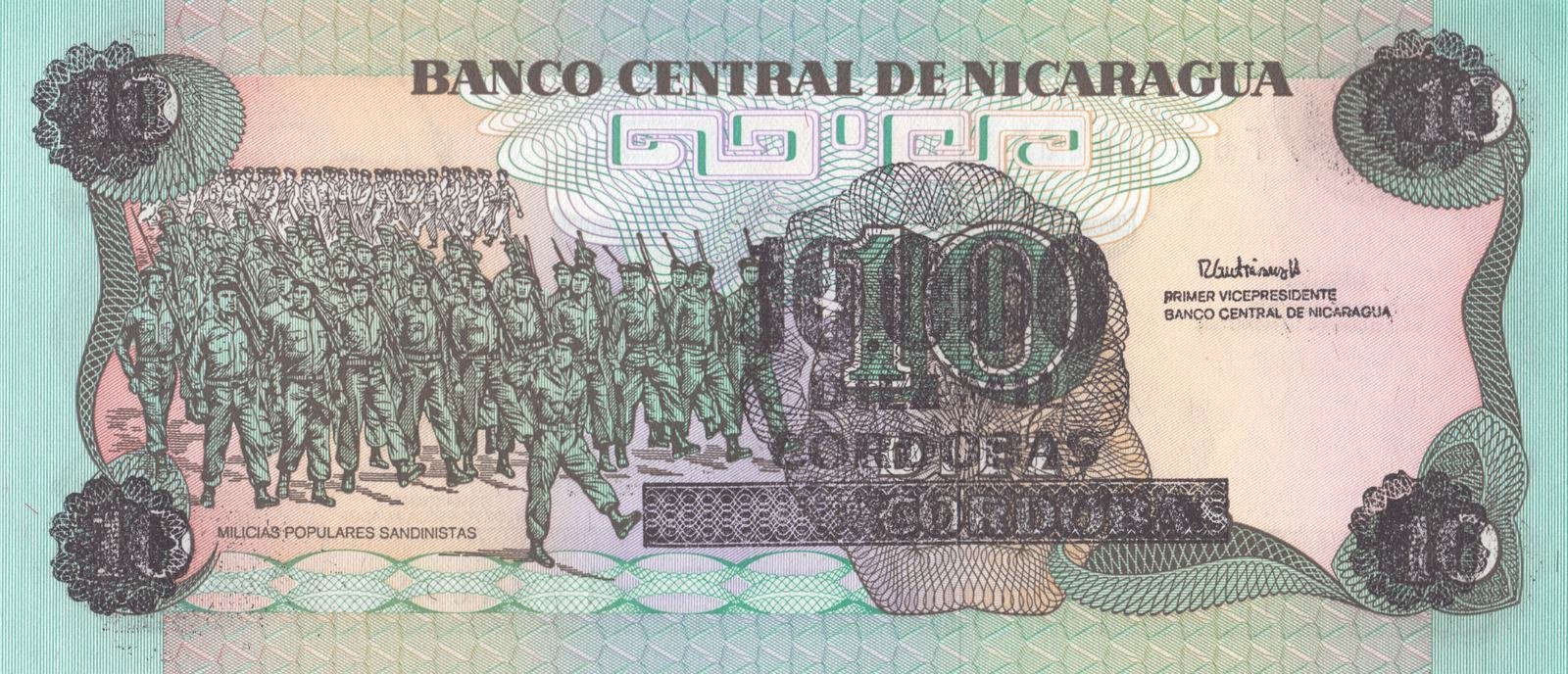
A Nicaraguan note presents a different puzzle: an old 10 remains visible beneath a new 10,000. A Mozambican note changes no denomination at all; it adds a bank name while leaving an older institution’s name, date and signatures in place. A large number is not always evidence of the same kind of change.
These three overprinted issues let us separate what an overprint visibly does from the historical explanation for it. The useful questions are specific: what was added, what was covered, what survived, and which source connects those layers to an issue?
Start with Both Sides
An overprint is an additional printed layer on an already printed banknote. Here, the word describes the additions on three catalogued issues; it is not a diagnosis of their printing process. A photograph can show a black inscription without establishing whether it was applied by lithography, another press process or a hand-held device.
The first reading should therefore be literal. Record the visible denomination, unit, bank name, date and signatures on each side before deciding what the addition means. That prevents an old date from silently becoming an overprint date, or an unchanged portrait from making a later issue look like the original one.
Front: the older denomination

Back: the added denomination
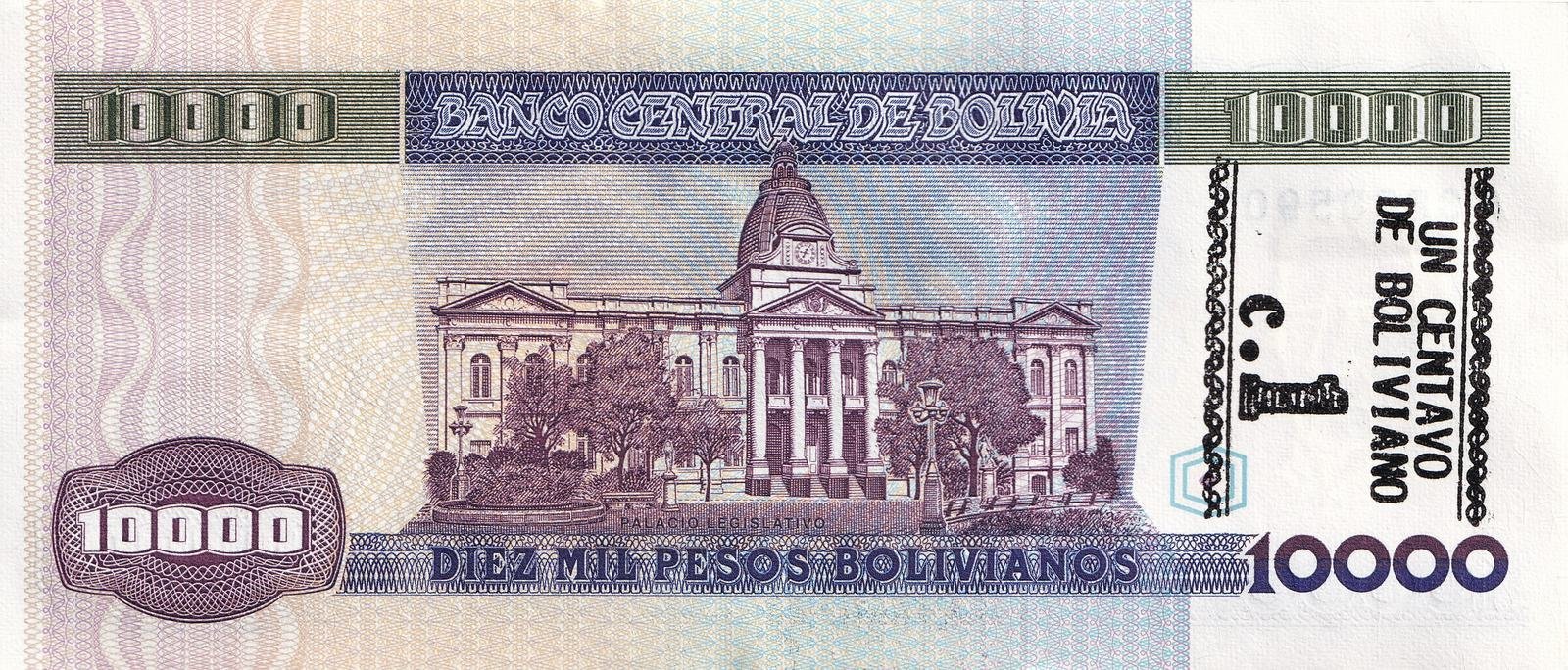
This Bolivian example makes the problem unusually clear. There is no new one-centavo value on the front to warn a reader who looks at only that side. The back supplies the missing information, but the note still does not explain the conversion rate or say when this particular overprint was applied. Those are separate research questions.
Bolivia: 10,000 Pesos Become One Centavo
The underlying design is catalogued as 10,000 pesos bolivianos, Pick P-169 / The Banknote Book B355. It retains a portrait, the Banco Central de Bolivia name and a reference to a decree dated 10 February 1984. The overprinted issue is P-195 / B380: one centavo de boliviano on that earlier denomination. The old currency wording and large 10,000 numerals remain visible.
The addition is compact: the new unit and value sit in the pale area at the right of the back, enclosed by a decorative border. It does not attempt to replace every old denomination. Reading the complete object requires accepting that the earlier design is still present underneath the later monetary use.
Underlying type: P-169

Overprinted type: P-195
Why the Arithmetic Works
Bolivia’s Law No. 901 of 28 November 1986 established the boliviano for circulation from 1 January 1987. One boliviano equalled 1,000,000 pesos bolivianos, and one centavo was one hundredth of a boliviano. The old and new inscriptions therefore agree:
10,000 pesos bolivianos = 0.01 boliviano = 1 centavo.
The printed “c.” also fits the symbol prescribed for centavos in Article 2. This is a change of unit, not evidence that adding the overprint itself destroyed the note’s purchasing power. The law supplies the conversion relationship; it does not identify P-195 or give the production history of this particular overprinted issue.
For that identification, The Banknote Book places B380 in its 1987 provisional issues and describes existing old-note stocks receiving new denominations on the back. That is a catalogue account, distinct from the conversion established by the law. Together, the sources explain both the issue’s identification and the otherwise surprising numerical equivalence.
What Did Not Change
Comparing the original front scans of these two notes shows the same underlying design, with different serial numbers. The unoverprinted front is not reproduced in the comparison above, which concentrates on the changed back. The bank name, denomination design, decree reference and signature arrangement remain the same. The Banknote Book also assigns both entries signature pair No. 75; the overprint did not introduce a different pair of signatories.
This matters when cataloguing the date. “1984” is visible within the earlier decree reference; “1987” is the catalogue’s introduction year for the overprinted issue. One need not erase the first to record the second. Our guide to dating a banknote explains why printed dates and issue dates need separate fields.
Nicaragua: A New Denomination in the Same Currency
Our Nicaraguan 10,000-córdoba note, P-158 / B452 uses a more interventionist design. Black additions appear on both sides. Large 10,000 numerals and the new denomination wording dominate the centre, dark devices cover the old corner numerals, and a strip obscures the earlier denomination text. The older design is suppressed in places, not removed.
On the front, the 1985 date remains readable. So do the bank’s name and the two original signatures near the bottom. There is also another signature, accompanied by a first-vice-president title. The additional signature appears twice on the front and once on the back: three placements of one additional signatory, not three additional people.
Front

Back
Detail: denomination and retained date
Detail: the additional signatory
A Printed Date Is Not an Issue Date
The Banknote Book identifies the underlying 10-córdoba type as P-151 / B445: dated 1985, introduced on 15 February 1988. It records the 10,000-córdoba overprint as a 1989 issue. The Banco Central de Nicaragua’s own numismatic catalogue independently lists this overprinted design as a demonetised 10,000-córdoba note with the year 1989. The date visible on the object and the year assigned to the overprinted issue are answering different questions.
There is a second date trap. Nicaragua did carry out a currency conversion in 1988: the central bank’s historical account gives 1,000 old córdobas for one new córdoba. But the underlying 10-córdoba type already belonged to that new issue. The later change from 10 to 10,000 on P-158 should not be presented as the arithmetic of the earlier old-to-new currency conversion.
In Bolivia, the smaller new number expresses an equivalent amount in a new unit. In Nicaragua, the larger number is a new denomination in the same currency unit as the underlying note. The thousandfold numerical difference between 10 and 10,000 does not mean the paper acquired a thousand times the purchasing power, nor does the photograph establish an exchange entitlement for holders of ordinary 10-córdoba notes.
The central bank’s historical account places these years within continued inflation in 1988–1990. The Banknote Book describes the provisional series as using existing stocks, without identifying whether individual notes were previously issued or unused. The overprinted denomination is documented; the earlier life of this particular specimen is not.
Mozambique: Two Bank Names on One Note
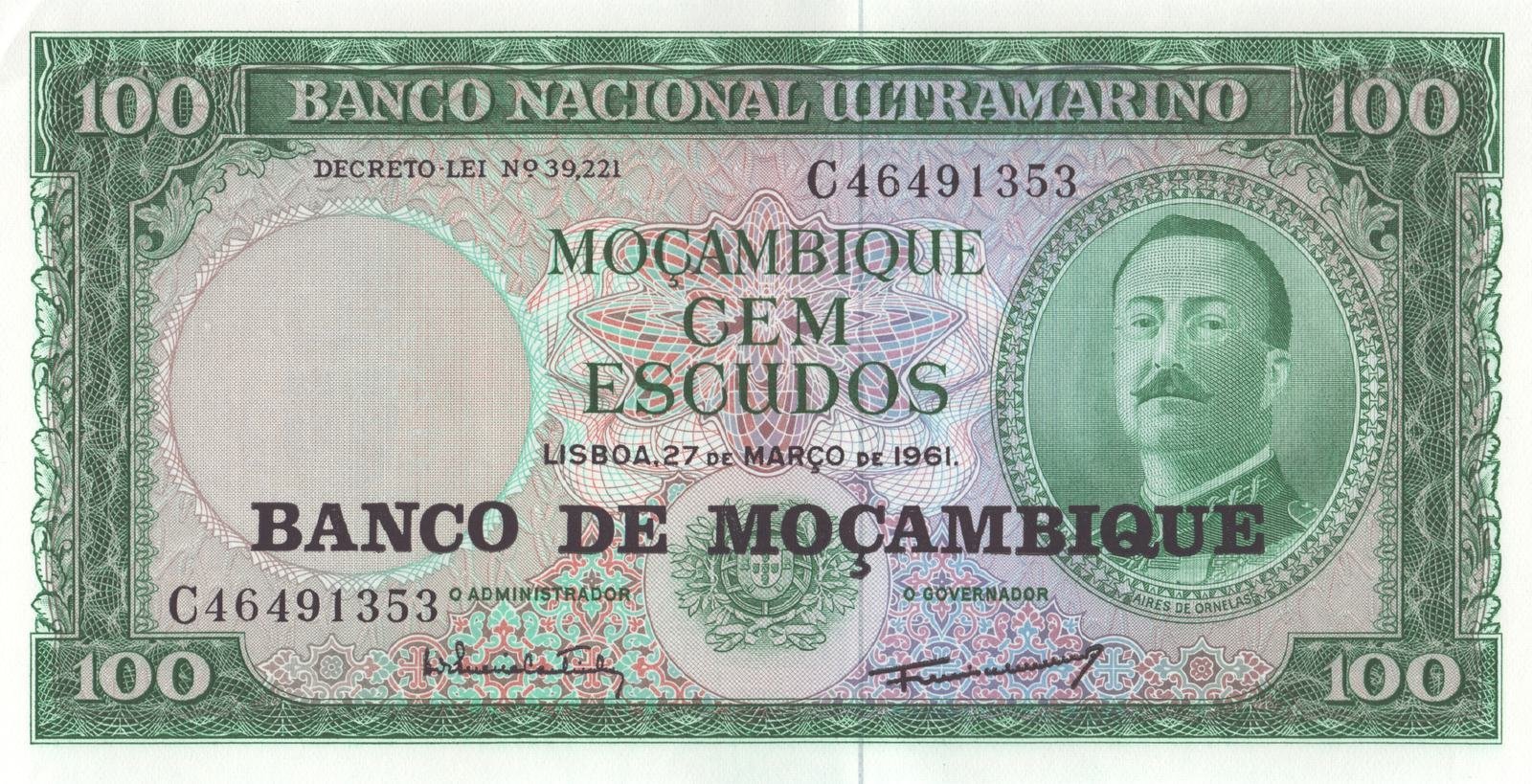
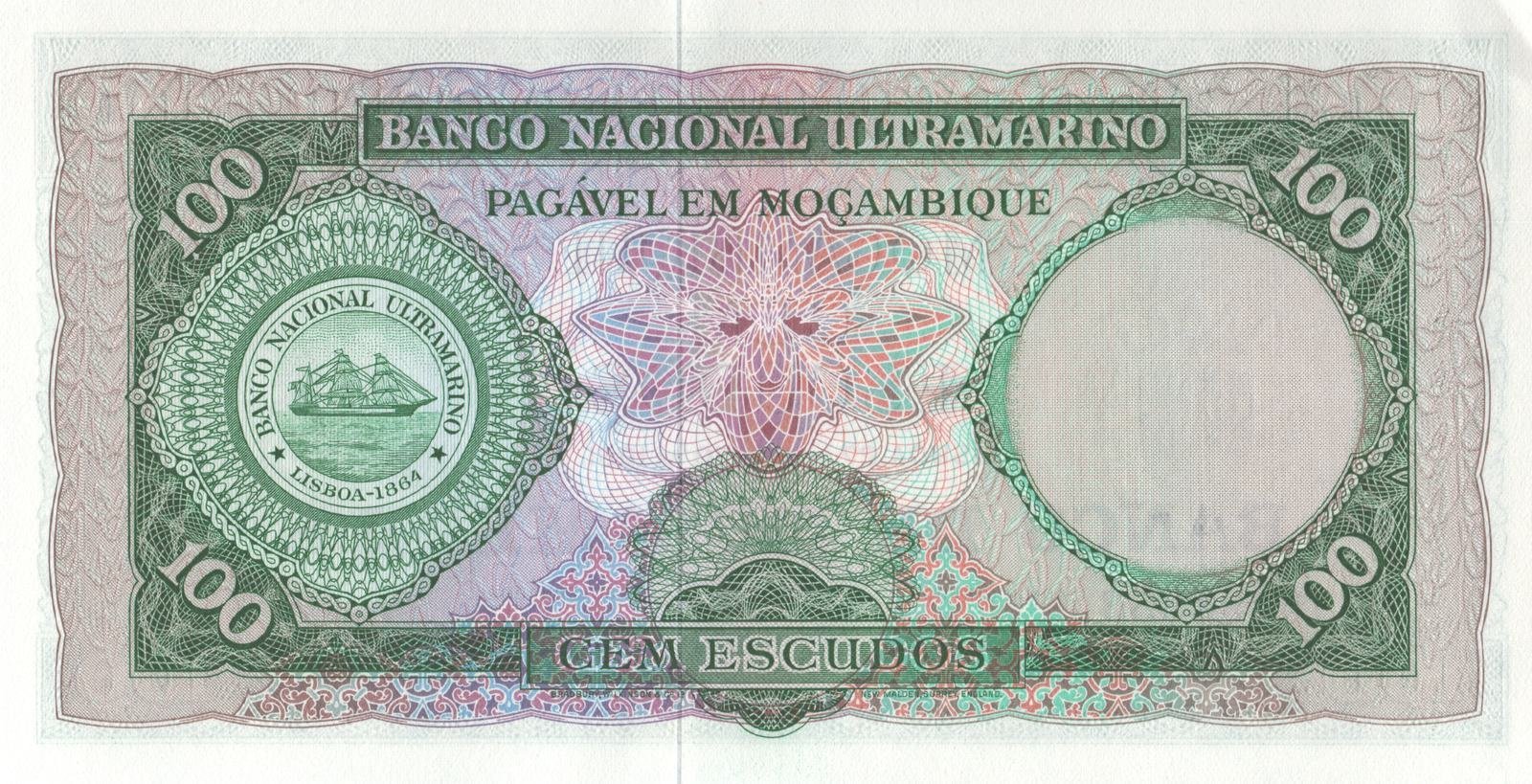
The 100-escudo note catalogued as Mozambique P-117 / B202 preserves its denomination. “100” and “CEM ESCUDOS” remain; the conspicuous black addition instead reads “BANCO DE MOÇAMBIQUE”. Above it, the older Banco Nacional Ultramarino name is still part of the design. The reverse also retains the earlier bank name, without the new overprint.
The date “LISBOA, 27 DE MARÇO DE 1961” remains on the front, along with the earlier signatures and their titles. A reader who follows only the date and largest engraved heading would miss the later identity under which the overprinted note is catalogued. A reader who follows only the black name would lose the history still visible in the underlying object.
Front: both bank names
Back: the earlier bank name retained
Detail: date, new name and retained signature titles
The Banknote Book identifies the underlying type as P-109 / B169 and records P-117 as introduced on 9 October 1978. Its account says that the new bank name was overprinted on the front while the original dates and signatures remained. Those are catalogue statements about this issue; the 1961 inscription is directly observable in the scan.
The Banco de Moçambique’s institutional history provides a different piece of evidence. It dates the bank’s creation to 17 May 1975 and records its inheritance of Banco Nacional Ultramarino’s assets in Mozambique. That establishes institutional context. It does not, by itself, date this note’s overprinting or explain why the catalogue gives an introduction in October 1978.
There are consequently three dates to keep apart: the date incorporated in the old design, the creation of the new bank, and the catalogue’s introduction date for the overprinted issue. They need not coincide. The overprint makes the new bank name visible; the legal effect of that particular addition cannot be reconstructed simply from the coexistence of two names.
This is also why “the issuer is the biggest name on the note” is an unreliable shortcut. Names may belong to different stages in an object’s history. Our guide to banknote issuers distinguishes the institution responsible for an issue from other institutional names that can appear on the paper.
Three Changes, Three Different Readings
The same catalogue label—overprint—covers three different interventions in these examples. Comparing the actual additions is more useful than assigning them a single historical explanation.
| Issue | Added layer | Important survival | Reading supported here |
|---|---|---|---|
| Bolivia P-195 | 1 centavo de boliviano, on the back | 10,000 pesos wording; earlier front design and signatures | An equivalent amount expressed in a new monetary unit |
| Nicaragua P-158 | 10,000 córdobas, covering devices and an additional signatory | 1985 date; bank name and earlier signatures | A higher denomination on an earlier design in the same currency unit |
| Mozambique P-117 | Banco de Moçambique, on the front | 100 escudos; older bank name, 1961 date and signatures | A new bank name added to the older design; specific legal effect not established by the image |
The distinction changes how the notes should be described. Calling all three “revalued” would obscure the unchanged Mozambican denomination. Calling every retained date the issue date would misdate the Nicaraguan and Mozambican overprints. And treating every large numerical change as a currency reform would confuse the two monetary examples.
These are observations about three documented cases, not a complete classification of every additional mark on a banknote. Specimen markings, commemorative additions, cancellation marks and private stamps raise their own questions. A SPECIMEN marking, for example, needs evidence about the object’s function and intended recipients; it cannot be understood by borrowing the explanation for a denomination overprint.
For a political legend, compare the Philippine Ang Bagong Lipunan issues, where the decree called for exchange at par and allowed notes that either bore the wording or were overprinted with it.
How to Record an Overprinted Banknote
A useful catalogue record keeps the layers recoverable. Start with the underlying type, describe the addition, then record the catalogued overprinted issue. Do not replace all earlier information with the new denomination or name: the features that survived are often what let another collector check your identification.
For the Bolivian example, a compact record can say: 1 centavo de boliviano on 10,000 pesos bolivianos; P-195 / B380. Black denomination overprint on the reverse; underlying P-169 / B355 design with the 1984 decree reference; introduction 1987 according to The Banknote Book.
For Mozambique, the equivalent record is different: 100 escudos; P-117 / B202. Banco de Moçambique overprint on the front; underlying P-109 / B169 design retaining the date 27 March 1961; introduction 9 October 1978 according to The Banknote Book.
Keep the basis for each field clear. An inscription can be transcribed from the note; an introduction date may come from a catalogue; a conversion rate may come from legislation. They can all belong in one record without carrying the same evidential weight. A Pick number identifies a catalogue entry, not the source of every historical statement attached to it.
The same separation helps with missing information. If the overprinting date or contractor is unknown, leave it unresolved rather than transferring the underlying note’s date or printer into that field.
Finally, identifying the intended type is not authenticating every surviving example. Matching wording and layout to a reference is useful, but an image alone cannot establish the age of an added mark or who applied it. Questions about the paper, ink, printing and provenance belong to the broader task of banknote authentication. Nothing in this comparison is a test for declaring an unfamiliar overprint genuine.
Sources and Method
The illustrations use original scans of banknotes held for the WorldBanknotes.eu catalogue. Full-note views preserve their contents; detail views crop and enlarge the same images. No inscription has been removed or reconstructed. Separate notes and independently enlarged details are identified in the captions. Scans document visible features, not the authenticity or production date of an overprint.
Issue identifications and the provisional-stock accounts were checked against The Banknote Book country chapters. Official sources supply the Bolivian conversion, Nicaragua’s currency history and matching catalogue entry, and Mozambique’s institutional chronology. These sources do not provide a complete production history for each object.
- The Banknote Book, Bolivia: B355 / P-169, printed p. 42; B380 / P-195 and the provisional-issue account, p. 50; signature pair 75, p. 15.
- The Banknote Book, Nicaragua: B445 / P-151, printed p. 18; provisional-issue account, p. 20; B452 / P-158, p. 21.
- The Banknote Book, Mozambique: B169 / P-109, printed p. 46; B202 / P-117 and the provisional-issue account, p. 52. Page numbers refer to the country-chapter copies consulted, not PDF viewer positions.
- Banco Central de Bolivia: Law No. 901, 28 November 1986, especially Articles 1–2. Used for the new unit, conversion ratio and centavo symbol, not as a specific P-195 issue order.
- Banco Central de Nicaragua: Reseña histórica de la moneda nacional and Productos numismáticos — billetes. The latter includes the matching demonetised 10,000-córdoba design under 1989.
- Banco de Moçambique: institutional history. Used for the bank’s establishment and institutional succession, not to date the illustrated overprint.
About the Author
Audrius is the founder and curator of WorldBanknotes.eu, a catalogue and shop for collectible banknotes. His work focuses on banknote identification, catalogue structure, printing, design and the context behind individual issues. The catalogue methodology explains how observations, reference information and editorial classifications are distinguished.