
Commemorative Banknotes Explained: How to Identify and Collect Special Issues
A commemorative banknote is never only a piece of currency with an anniversary printed on it. It is a monetary object created to carry memory: a state anniversary, the founding of an institution, a cultural movement, a sporting event, a national leader, a new currency or another event that an issuing authority has chosen to record in banknote form.
That purpose can be expressed in very different ways. One issuer may release a new denomination that enters ordinary circulation. Another may adapt an existing design, add a special overprint or create a short annual programme. A central bank may call an issue a collector banknote, a commemorative banknote or a numismatic banknote. Those terms are related, but they are not interchangeable.
For collectors, the difficulty is therefore not recognising that a note looks special. The difficulty is identifying exactly what kind of special issue it is, when it was issued, whether it circulated normally, how its denomination relates to the commemorated event, and whether its scarcity is real or merely assumed.
Core principle: A commemorative banknote should be classified from documented issuer purpose, not from unusual design, denomination, packaging or seller description alone.
This guide uses official issuer information and original WorldBanknotes.eu scans to explain the main commemorative formats, their dating problems, their circulation status and their collector significance. It also examines borderline cases where commemorative, collector, numismatic and legal tender overlap without meaning the same thing.
You can also browse our commemorative banknotes for sale to compare original catalogue scans and recorded issue details.
Table of Contents
What Is a Commemorative Banknote?
There is no single worldwide legal definition used identically by every central bank. A practical collector’s definition must therefore focus on purpose and documentation:
A commemorative banknote is an official banknote issue whose stated purpose, design programme or authorised modification deliberately marks a particular event, anniversary, person, institution or cultural subject.
Four elements are important.
First, the commemorative purpose should be supported by an issuing authority, authorised note-issuing bank or another reliable contemporary source. A dealer’s title is not enough.
Second, the purpose must belong to the issue itself. A banknote depicting a famous historical figure is not automatically commemorative. Many ordinary circulation series use national leaders, monuments and anniversaries as permanent design themes.
Third, the note must still be understood as a banknote. It may circulate normally, be sold primarily to collectors or occupy a narrower legal-tender role, but its status should be described accurately.
Fourth, the commemorative identity should be separated from the note’s date, catalogue number, substrate and denomination. These features help identify the issue, but none of them alone proves why it was created.
The WorldBanknotes.eu glossary definition of legal tender is especially relevant. Legal tender describes a currency’s recognised payment status within a jurisdiction. It does not automatically tell us whether the note was widely circulated, sold in a folder, issued above face value or designed mainly for the numismatic market.
Commemorative, Collector, Numismatic and Circulating
The most useful way to understand special issues is to separate four overlapping categories.
Circulating commemorative banknotes
These are official commemorative notes intended to pass through banks, tills, wallets and cash machines alongside ordinary denominations.
The Solomon Islands 10 Dollars 2023 is a clear example. The Central Bank of Solomon Islands described it as a limited-edition commemorative banknote for the XVII Pacific Games, but also stated that it would serve as a circulation note and be distributed widely after launch. Limited production did not make it non-circulating.
Guatemala’s 1 Quetzal note dated 2023 provides another model. Banco de Guatemala issued 25 million commemorative one-quetzal notes for the currency’s centenary and released them into circulation in September 2024. Its commemorative status therefore did not imply a small collector-only issue.
Collector banknotes
Some issuers use collector banknote as an official category.
The Central Bank of Armenia describes the 500 Dram “Noah’s Ark” issue of 2017 as a collector banknote. Its own definition is precise: collector banknotes are issued once, in limited quantities and sold above face value. The note was placed into circulation in the legal sense, but its production and distribution model differed from an ordinary high-volume circulation denomination.
Preserving that terminology is important. It would be misleading to flatten the Armenian issue into a generic “commemorative circulation note” when the issuer deliberately classifies it more narrowly.
Legal-tender numismatic banknotes
A note can be official currency and still be designed primarily as a numismatic product.
The Reserve Bank of Fiji calls the 88 Cents 2022 issue a Numismatic Banknote. Its face value is FJ$0.88, while the bank sold it locally for FJ$28. The denomination, auspicious theme and sales model clearly point towards a collector market rather than everyday cash use.
This case establishes an essential rule:
Legal tender does not mean ordinary circulation, and a special legal-tender banknote is not automatically a circulating commemorative issue.


Occasion-linked ordinary issues
A banknote can be released during a national celebration without being formally commemorative.
The official Cook Islands Ministry of Finance page states that the 3 Dollars 2021 replaced the previous design first issued in 1987 and co-circulates with the New Zealand dollar. The page describes its design and issue date, but does not classify it as a commemorative banknote.
A release during Constitution Week may provide context, but context is not the same as official purpose. This is why classification should begin with issuer language rather than inferred symbolism.
Why Issuers Commemorate
Commemorative banknotes allow monetary authorities to place selected memories into public circulation. The reasons vary widely.
Statehood and independence
National anniversaries are among the most common subjects.
The Namibia 30 Dollars 2020 commemorates 30 years of independence. Its denomination itself carries the anniversary number, while the portraits of three presidents represent continuity and the peaceful transfer of power.
The Djibouti 40 Francs 2017 uses the same structural idea: a 40-franc denomination for the 40th anniversary of independence.
The Saudi Arabia 20 Riyals 1999 belongs to an older commemorative tradition, marking the centennial associated with the founding of the modern kingdom. It also demonstrates how Hijri and Gregorian dates can coexist on one issue.
Institutions and monetary systems
Central banks and currencies can commemorate their own histories.
The Botswana 50 Pula 2025 celebrates 50 years of the Bank of Botswana. Its reverse also honours the country’s 2024 Olympic athletes, combining institutional memory with a contemporary national achievement.
The Mauritania 50 Ouguiya 2023 marks 50 years of the ouguiya. The issue is particularly unusual because the same design reportedly appeared in three substrate variants, turning the anniversary into both a monetary commemoration and a controlled material experiment.
Guatemala’s one-quetzal note commemorates a century of the national monetary unit itself. The low face value made the note broadly accessible and suitable both for circulation and preservation.
Cultural memory
Some notes commemorate events whose importance lies in language, religion, art or collective identity rather than state institutions.
The Bangladesh 60 Taka 2012 marks 60 years of the Bengali Language Movement. Its denomination, memorial imagery and references to the language martyrs transform the note into a compact historical narrative.
Armenia’s Noah’s Ark collector banknote combines biblical tradition, Mount Ararat, national identity and modern hybrid substrate technology.
Sport and international events
Major events allow banknotes to function as public records of international participation.
South Korea’s 2,000-won note was created for the PyeongChang 2018 Olympic Winter Games. Solomon Islands issued its 10-dollar note for the XVII Pacific Games. Algeria’s 2,000-dinar note commemorated the Arab League Summit in Algiers, showing that diplomatic gatherings can also become the formal subject of circulating currency.
These issues should not be grouped merely as “event notes”. Their distribution, issue dates and legal status differ significantly.
Anniversary Date, Printed Date and Issue Date
A commemorative banknote can carry several dates, each answering a different question.
- Anniversary date: the historical event being remembered.
- Printed or design date: the year shown on the banknote.
- Issue date: the date on which the note was officially released.
- Circulation date: the date on which the note became available through the banking system.
- Event year: the year named in the commemorative title, which may be later than the issue date.
These dates should never be collapsed into one field without explanation.
South Korea: issued before the games
The Bank of Korea’s official page calls the note the Olympic Winter Games PyeongChang 2018 Commemorative Banknote, but gives an issue date of 17 November 2017.
The title year belongs to the event. The issue year belongs to the release. A catalogue may use 2018 as the visible or event-linked year, but an article should still explain that the banknote entered the market before the games.
Guatemala: dated 2023, issued in 2024
The commemorative one-quetzal banknote bears the year 2023, but Banco de Guatemala released it into circulation in September 2024 for the 1924–2024 centenary.
A precise description is therefore:
dated 2023; issued in September 2024; commemorating the 2024 centenary of the quetzal.
Botswana: launch and circulation were separate
Botswana’s P50 note was ceremonially launched during the central bank’s golden-jubilee celebrations on 12 September 2025. The Bank later announced that it would officially enter circulation on 6 February 2026.
The note year, launch date and general-circulation date are all legitimate, but they are not interchangeable.
The same method applies throughout commemorative collecting. For a complete dating workflow, see How to Date a Banknote.
New Design, Modified Design, Recurring Programme and Overprint
Commemorative purpose can be expressed through several production formats.
A completely new design
Bangladesh 60 Taka, Namibia 30 Dollars and South Korea 2,000 Won were conceived as distinct commemorative designs rather than ordinary denominations with a small added inscription.
A new design gives the issuer complete control over imagery, denomination and narrative structure. It also makes the commemorative status visually obvious, although official documentation remains necessary.
A modified circulation design
Some issuers retain a familiar design family while changing portraits, colours, inscriptions, security elements or reverse scenes.
This approach creates continuity. The note remains recognisable within the national currency system but is differentiated enough to carry a special purpose.
A recurring commemorative programme
Macau’s Chinese Zodiac notes show that commemoration does not have to be a single isolated issue.
Bank of China began placing MOP10 Chinese Zodiac New Year commemorative notes into circulation from January 2012. The programme used a common red visual language, paper-cut zodiac animals and Spring Festival symbolism.
The 2013 Bank of China 10 Patacas and 2013 Banco Nacional Ultramarino 10 Patacas form a particularly useful pair. They commemorate the same zodiac year and use the same denomination, but they belong to separate issuing banks and have separate catalogue identities.
For collectors, the correct unit of study is therefore not simply “Macau Year of the Snake”. It is:
- territory;
- authorised issuing bank;
- denomination;
- zodiac year;
- series;
- catalogue reference;
- individual serial-number system.
Replica and revival issues
The Gibraltar 10 Shillings 2018 revives the appearance of an earlier design while occupying a highly unusual legal and numismatic position. Its title denomination, reported legal-tender value and limited redemption context do not align in the simple way expected from an ordinary circulating banknote.
Such issues should be described with explicit caution. Replica, commemorative, legal tender and circulating must not be treated as synonyms.
Commemorative overprints
An overprint adds text, symbols or other information to an existing note.
An official commemorative overprint can be entirely legitimate, but overprints are also vulnerable to later alteration, unofficial production and disputed attribution. The Madagascar Action Plan notes are a useful research warning: catalogues and dealers describe them as commemorative overprints, yet accessible authoritative issuer evidence remains insufficient for a confident narrative.
The editorial rule is straightforward:
When an overprint’s authority is uncertain, describe the uncertainty. Do not convert catalogue repetition into fact.
When the Denomination Becomes Part of the Message
Many commemorative notes use an unusual face value that mirrors the anniversary or event.
- Bangladesh: 60 Taka for 60 years of the Language Movement.
- Namibia: 30 Dollars for 30 years of independence.
- Djibouti: 40 Francs for 40 years of independence.
- Fiji: 88 Cents, using the auspicious symbolism of the number eight.
- South Korea: 2,000 Won, a denomination outside the ordinary circulation family and visually linked to the Olympic programme.
A symbolic denomination can strengthen identification, but it is not proof by itself. Cook Islands has long used a 3-dollar note as an ordinary local denomination. Unusual values also appear in souvenir, fantasy and numismatic products.
The collector should ask two separate questions:
- Why was this denomination chosen?
- How did the issuer classify and distribute the note?
The answers may reveal a circulating commemorative, a collector banknote, a legal-tender numismatic product or simply an unusual ordinary denomination.
Case Study: Bangladesh 60 Taka 2012
The Bangladesh 60 Taka note is one of the clearest examples of a commemorative denomination working as historical language.
Bangladesh Bank issued it in February 2012 for the 60th anniversary of the Language Movement of 1952. The central bank offered the note both at face value and in a commemorative folder at a higher price. This dual distribution model is important: the same issue could function as an official note and as a deliberately packaged collector object.
The commemorative purpose is integrated across the whole design. The denomination repeats the anniversary number. The Shaheed Minar memorial and images of the language martyrs turn the note into an account of sacrifice, identity and linguistic rights. The design does not merely mention the event; it is structured around it.
For collectors, the note demonstrates three principles.
First, a commemorative banknote can be historically serious without using a high denomination or luxury presentation.
Second, face-value distribution and premium packaging can coexist.
Third, the relationship between number and memory can make the denomination itself part of the design narrative.

WorldBanknotes.eu example: Bangladesh 60 Taka 2012.
Case Study: Namibia 30 Dollars 2020
Namibia’s N$30 note compresses several “firsts” into one issue.
The Bank of Namibia launched it on 21 March 2020 to celebrate the 30th anniversary of independence. The Bank describes it as a once-off print and its first commemorative banknote. It was also produced on polymer, giving the issue a material identity distinct from the ordinary paper denominations of the period.
The denomination records the anniversary directly. The portraits of the first three presidents present independence not as a single frozen event, but as an institutional sequence. The design therefore links founding, continuity and peaceful transfer of power.
Its transparent features also show how commemorative issues can introduce or showcase technology. The Bank’s promotional material highlights the polymer window and dynamic optical effects. These are not separate from the commemoration: they help make the special issue visually and physically distinct.
The note is an excellent reminder that commemorative importance may arise from several layers at once:
- the event;
- the unusual denomination;
- the first national commemorative status;
- the substrate;
- the portrait group;
- the once-off production decision.

WorldBanknotes.eu example: Namibia 30 Dollars 2020.
For a deeper discussion of material differences, see Paper, Polymer and Hybrid Banknotes.
Case Study: South Korea 2,000 Won PyeongChang
The Bank of Korea’s 2,000-won Olympic note is valuable because it separates event identity from issue chronology.
The official title refers to the PyeongChang 2018 Olympic Winter Games, but the note was issued on 17 November 2017. Its imagery brings several winter sports into one composition and connects the modern event with Korean artistic tradition.
The issue was legal commemorative currency, yet its practical distribution was collector-oriented rather than equivalent to an ordinary cash denomination. This makes it different from Solomon Islands’ Pacific Games note, which the central bank explicitly intended to circulate widely through banks and cash machines.
Two notes can therefore share an international sporting theme while belonging to different circulation models.
The South Korean issue also shows why the year in a product title may require explanation. “2018” identifies the event and the commemorative programme. It should not erase the official 2017 issue date.
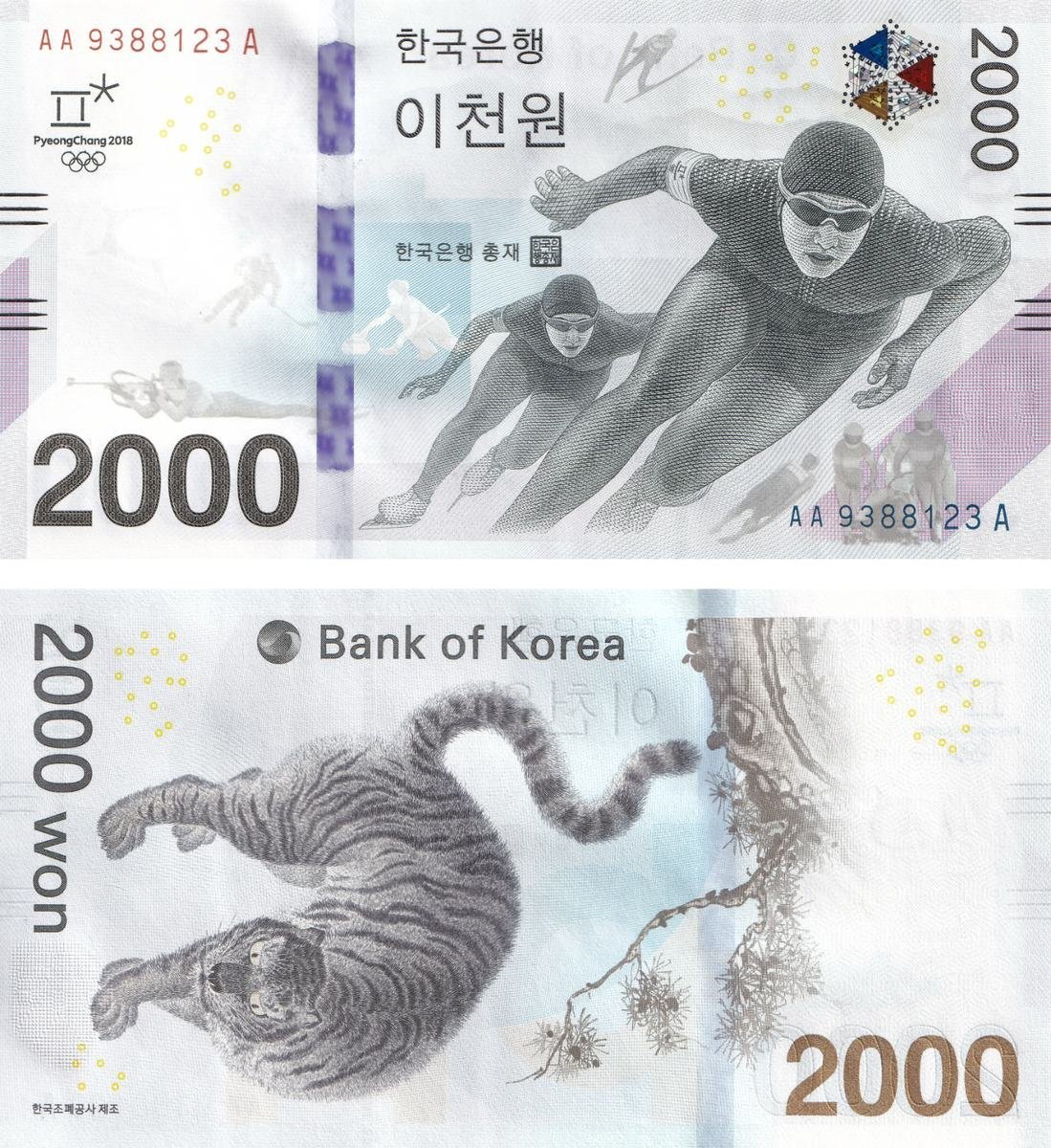
WorldBanknotes.eu example: South Korea 2,000 Won 2018.
Case Study: Macau Zodiac Notes and Dual Issuers
Macau’s zodiac programme replaces the one-off anniversary model with a recurring annual cycle.
Bank of China states that its MOP10 Chinese Zodiac New Year commemorative banknotes entered circulation from January 2012. Their shared visual vocabulary includes red colouring, paper-cut zodiac animals, Spring Festival motifs and security features adapted to each annual animal.
Banco Nacional Ultramarino also issued zodiac notes. The result is an unusual collecting structure: one territory, one denomination and one zodiac year, but two authorised issuers.
The 2013 Year of the Snake notes illustrate why issuer identity must remain visible in a catalogue. They are thematically paired, not interchangeable.
A collector can approach the programme in several ways:
- one bank across all twelve zodiac years;
- both banks for one selected year;
- complete annual pairs;
- design or security-feature comparisons;
- serial-number and signature variants within each issuer.
This is a commemorative programme, not merely a group of unrelated special notes.
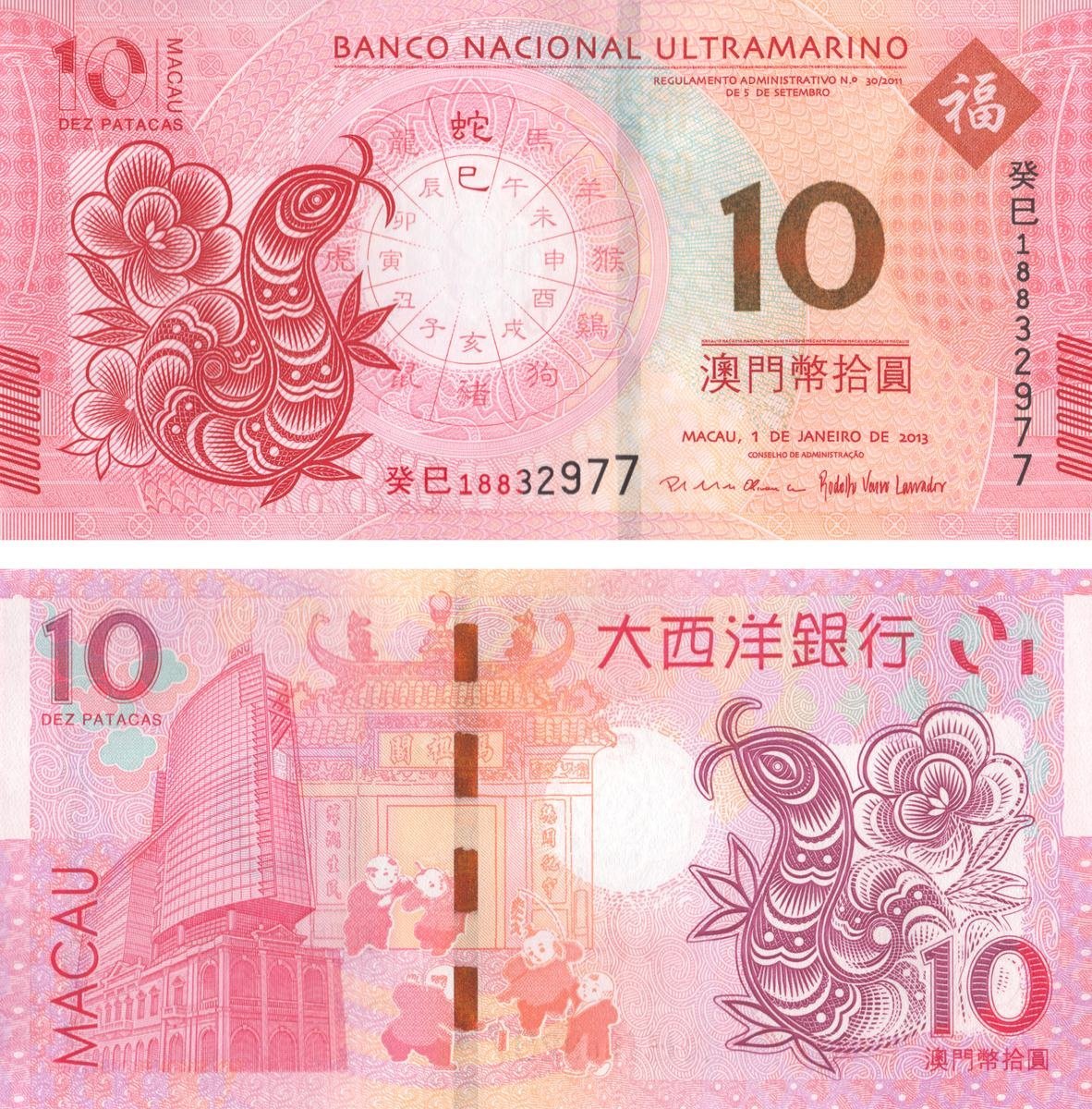

WorldBanknotes.eu examples: Macau 10 Patacas 2013 — BNU and Macau 10 Patacas 2013 — Bank of China.
Case Study: Mauritania 50 Ouguiya 2023
Mauritania’s 50-ouguiya note commemorates the 50th anniversary of the ouguiya, introduced in 1973.
The issue is unusual because specialist technical reporting identifies three versions of the same design produced on different substrates. The reported purpose was to compare performance under Mauritanian circulation conditions.
This turns the note into more than a currency-anniversary issue. It becomes a controlled experiment in how commemorative production can support future banknote policy.
Collectors should nevertheless keep two layers of evidence separate:
- the 50th-anniversary purpose and 18 June 2023 issue date;
- the exact technical description and identification of each substrate variant.
The first is straightforward. The second requires careful attention to prefix, material and reliable technical documentation. A seller’s generic “polymer” or “hybrid” label should not be accepted without confirming which variant is offered.

WorldBanknotes.eu example: Mauritania 50 Ouguiya 2023.
Limited Edition Does Not Mean Non-Circulating
Collectors often assume that a limited issue must have been produced only for presentation folders. That is false.
The Solomon Islands Pacific Games note was described as limited-edition, but the central bank also stated that it would serve as a circulation banknote. It was made available through the normal financial system.
Botswana’s P50 note was introduced more gradually. It was launched during the Bank’s anniversary celebrations, followed by public education, and later entered general circulation.
Three circulation models in original scans
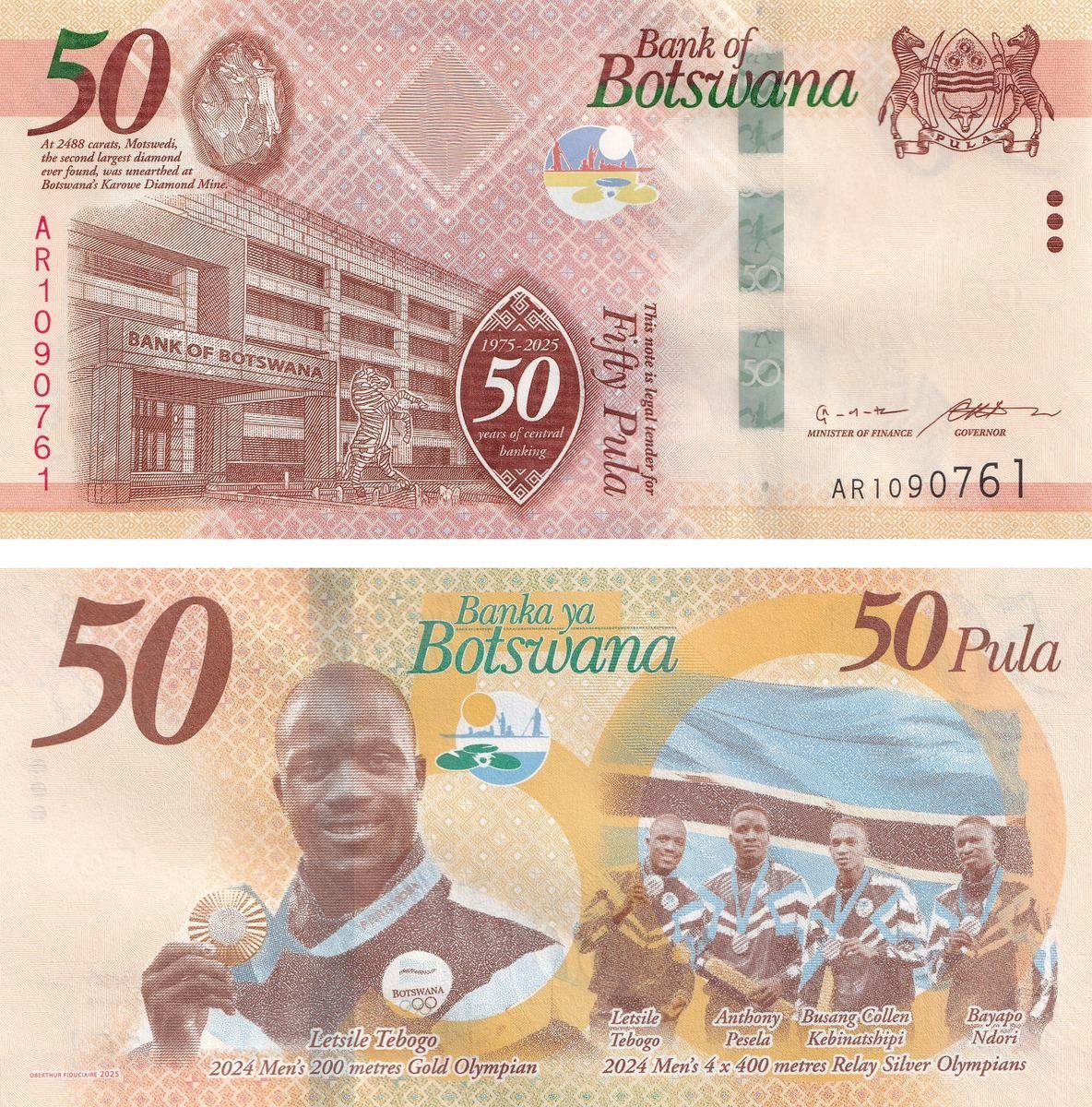


South Korea’s Olympic note occupied a more collector-focused distribution model.
Armenia’s Noah’s Ark note belongs to an official collector-banknote category and was sold above face value.
Fiji’s 88-cent issue was marketed as a numismatic banknote and sold for many times its nominal value.
The phrases limited edition, legal tender, put into circulation and sold to collectors answer different questions. A precise record should therefore include:
- authorised quantity, where known;
- issue or release date;
- legal-tender status;
- sales price;
- distribution channel;
- whether ordinary circulation was intended;
- whether presentation folders or uncut sheets were offered;
- whether the issuer uses a special category name.
Rarity, Packaging and Collector Value
Commemorative status does not create automatic rarity.
A note may be commemorative but printed in tens of millions. Another may have a small authorised quantity but weak collector demand. A third may be common as a loose note but scarce in its original folder.
Value is usually shaped by several independent factors.
Issue quantity
A documented print quantity is more useful than the word limited. Guatemala issued 25 million centenary one-quetzal notes. That is a substantial quantity, even though the issue remains historically distinctive.
Distribution
A note released through banks and ATMs is likely to survive in both circulated and uncirculated condition. A note sold mainly in folders may be common in UNC but unusual with genuine circulation wear.
Packaging
Original folders, certificates and official envelopes can form a separate collecting category. They should not be assumed to be part of every note’s original issue format.
Condition
Special issues are often saved immediately, so UNC examples may be normal rather than exceptional. Condition premiums should be evaluated against the survival pattern of the exact issue.
Design demand
Cultural themes, wildlife, sport, royalty, unusual denominations and visually strong polymer windows may attract collectors beyond the issuing country.
Completeness
Macau zodiac notes illustrate the value of programme completeness. A single note may be inexpensive, while complete annual issuer sets or matched pairs create a different collecting objective.
The correct question is not “Is it commemorative?” but:
How many were made, how were they distributed, what survives, what form is complete, and who collects the theme?
Common Misidentifications
“It has an anniversary date, so it is commemorative”
Not necessarily. Ordinary series may reproduce historical dates or anniversaries as part of permanent national iconography.
“It has an unusual denomination, so it is commemorative”
Not necessarily. The Cook Islands 3-dollar note is an established local denomination. Unusual values require context. The wider policy logic is examined in Why Do Banknotes Have Different Denominations?
“It is legal tender, so it circulated normally”
False. Armenia’s collector banknote and Fiji’s numismatic banknote demonstrate that legal status and circulation model are separate.
“It was sold above face value, so it is not a real banknote”
False. An issuer may sell an official collector banknote above nominal value.
“Limited edition means rare”
Not automatically. Quantity must be considered alongside demand, distribution and survival.
“The year in the title is the issue year”
Not always. South Korea, Guatemala and Botswana show why event, printed, launch and circulation dates need separate fields.
“A special overprint must be official”
False. Overprints require evidence of authority, date and production context.
“Every commemorative issue is a new series”
Not necessarily. It may be a one-off note, a modified member of an existing design family, a recurring annual programme or a separate collector issue.
Collector’s Identification Workflow
Identify the exact note. Record country or territory, issuer, denomination, visible date, series and catalogue reference.
Find the issuer’s terminology. Look for commemorative banknote, collector banknote, numismatic banknote, special issue or another official label.
Identify the commemorated subject. Record the event, person, anniversary or institution in neutral language.
Separate the dates. Record anniversary year, printed year, official issue date and general-circulation date independently.
Establish legal status. Confirm whether the note was legal tender, redeemable, restricted or sold under another official arrangement.
Establish circulation intent. Determine whether the issuer intended ordinary cash use, bank distribution, collector sales or a mixed model.
Classify the design form. New design, modified design, recurring programme, overprint, replica or collector presentation.
Check the denomination logic. Decide whether the value itself reflects the anniversary.
Check material and security. Record substrate, watermark, thread and window only from issue-specific evidence.
Record quantity and packaging carefully. Distinguish total notes, folders, uncut sheets and specimen products.
Link the note to its wider series. A commemorative issue may be independent, paired with another issuer or embedded in a recurring programme.
Preserve uncertainty. If official commemorative status is not confirmed, write status not confirmed rather than forcing a classification.
Commemorative Banknote Reference Table
| Example | Official or best-supported category | Main purpose | Key date information | Circulation model |
|---|---|---|---|---|
| Bangladesh 60 Taka | Commemorative note | 60 years of the Language Movement | Issued February 2012 | Face-value note and premium folder |
| Namibia 30 Dollars | Commemorative polymer banknote | 30 years of independence | Launched 21 March 2020 | Once-off official issue |
| South Korea 2,000 Won | Olympic commemorative banknote | PyeongChang 2018 | Issued 17 November 2017 | Collector-focused distribution |
| Algeria 2,000 Dinars | Commemorative circulation issue | Arab League Summit in Algiers | Issued November 2022 | Circulating |
| Botswana 50 Pula | Commemorative circulation issue | 50 years of the central bank | Launched 2025; circulated 2026 | General circulation after launch phase |
| Mauritania 50 Ouguiya | Commemorative circulation issue | 50 years of the ouguiya | 18 June 2023 | Circulating; multiple reported substrate variants |
| Macau 10 Patacas pair | Recurring zodiac commemorative programme | Chinese New Year zodiac cycle | 2013 Year of the Snake | Two authorised issuers |
| Guatemala 1 Quetzal | Commemorative circulation issue | Centenary of the quetzal | Dated 2023; circulated September 2024 | Released into circulation; 25 million notes issued |
| Solomon Islands 10 Dollars | Limited-edition commemorative note | XVII Pacific Games | Launched October 2023 | Banks, ATMs and collectors |
| Armenia 500 Dram | Collector banknote | Noah’s Ark and Armenian dram anniversary context | 22 November 2017 | Limited quantity, sold above face value |
| Fiji 88 Cents | Numismatic banknote | Auspicious 88 and Chinese wealth symbolism | 2022 | Collector-market sales |
| Cook Islands 3 Dollars | Replacement circulation design | New version of established $3 note | 3 August 2021 | Co-circulates with New Zealand dollar |
Frequently Asked Questions
Are commemorative banknotes real money?
Many are. Some enter ordinary circulation, while others are official collector or numismatic banknotes with legal-tender status. The exact status must be checked for each issue.
Does commemorative mean rare?
No. Commemorative purpose and rarity are separate. Print quantity, demand, distribution and survival determine scarcity.
Can a commemorative banknote have an ordinary denomination?
Yes. Guatemala used one quetzal and Solomon Islands used ten dollars. A special denomination is common, but not required.
Can the issue year differ from the anniversary year?
Yes. South Korea’s PyeongChang 2018 note was issued in 2017, while Guatemala’s note dated 2023 was released for the 2024 centenary.
Are collector banknotes the same as commemorative banknotes?
Not always. Collector banknote may be an issuer-defined category with limited production and premium sales. It should be recorded using the issuer’s terminology.
Are numismatic banknotes intended for circulation?
Often not. Fiji’s 88-cent note is an official numismatic product sold to collectors. Legal-tender status alone does not prove normal circulation.
Is every overprinted note commemorative?
No. The overprint must be authorised and connected to a documented event or programme.
Do commemorative notes always form a separate series?
No. They may be one-off issues, modified designs, recurring annual programmes or collector products outside the ordinary series structure.
Should packaging be kept?
Official folders, envelopes and certificates can be part of the issue’s collector history. Store them separately and safely so they do not damage the banknote.
What matters most when buying a commemorative banknote?
Correct identification, documented status, condition, original packaging where relevant, and a realistic understanding of quantity and demand.
Final Thoughts
A commemorative banknote is a deliberate act of monetary memory.
Sometimes that memory enters ordinary circulation, as in Guatemala or Solomon Islands. Sometimes it is concentrated into a symbolic denomination, as in Bangladesh, Namibia or Djibouti. Sometimes it becomes a recurring programme, as in Macau. Sometimes the issuing authority deliberately creates a collector category, as Armenia did. And sometimes the note sits at the boundary between currency and numismatic product, as Fiji’s 88-cent issue demonstrates.
These differences are not complications to be ignored. They are the reason commemorative banknotes are worth studying.
The strongest catalogue entry does more than add the word commemorative. It explains who authorised the issue, what it marks, which dates apply, how it was distributed, whether it circulated, how the design differs and what evidence supports the classification.
A special banknote may preserve an anniversary, but the collector’s task is to preserve the context.
Selected References
- Bangladesh Bank — Commemorative Notes
- Bank of Namibia — N$30 Commemorative Banknote
- Bank of Korea — PyeongChang 2018 Commemorative Banknote
- Central Bank of Armenia — Collector Banknotes
- Central Bank of Solomon Islands — Pacific Games Commemorative Note
- International Association of Currency Affairs — Guatemala 1 Quetzal Centennial Banknote
- Bank of Botswana — P50 Commemorative Banknote Enters Circulation
- Bank of China Macau — Chinese Zodiac New Year Commemorative Banknotes
- Cook Islands Ministry of Finance — Cook Islands Currency
- Reserve Bank of Fiji — 88 Cents Numismatic Banknote
- BanknoteNews — Mauritania 50 Ouguiya: One Design, Three Substrates