
Counterfeiting Warnings on Banknotes: Reading the Small Print
A Thai 20-baht note in our collection carries a warning of life imprisonment or up to twenty years in prison, together with a fine of up to 40,000 baht. It belongs to the first issue of Series 17 in 2018. By the time that issue entered circulation, the maximum fine in the law had already risen to 400,000 baht.
The explanation is documented by the Bank of Thailand. The later response is visible on another note in our collection: the warning no longer prints a sum of money at all. It directs the reader to the Criminal Code.
Counterfeiting warnings are small pieces of a banknote’s design that can repay close reading. They may distinguish catalogue varieties, preserve an earlier legal formulation or name the instrument differently from its large denomination. The Thai notes and two one-rouble notes from Transnistria show how to read those clues without treating a printed sentence as a complete statement of the law.
Reading the Thai Warning
On the reverse of the 2018 paper 20-baht note, P-135a, the warning runs along the lower edge, beneath the portraits. Its lettering is much smaller than the denomination. The portraits and large numerals identify the familiar design; the sentence below them records a detail that a general description of the design can miss.
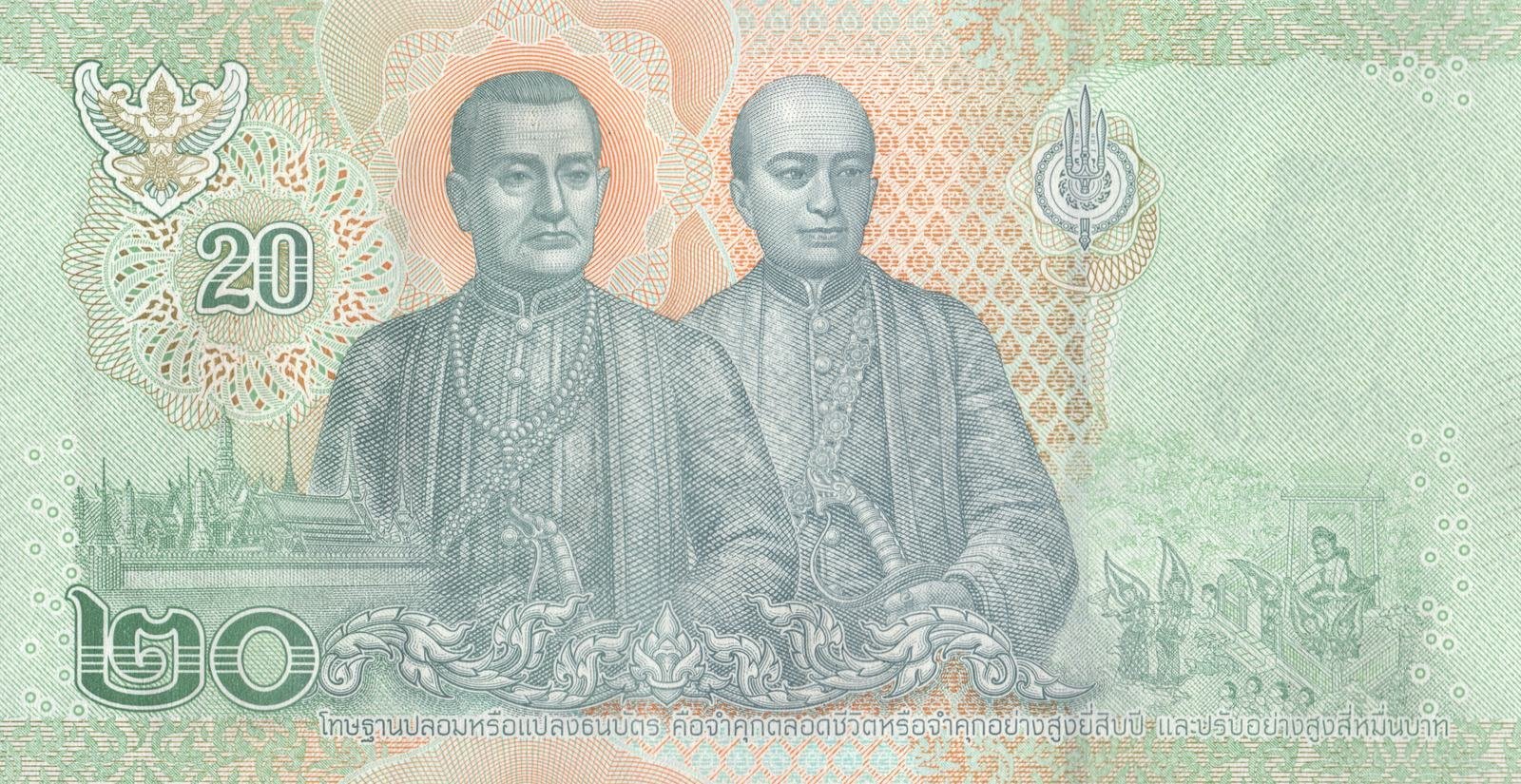
The original wording reads:
โทษฐานปลอมหรือแปลงธนบัตร คือจำคุกตลอดชีวิตหรือจำคุกอย่างสูงยี่สิบปี และปรับอย่างสูงสี่หมื่นบาท
“The penalty for counterfeiting or altering banknotes is life imprisonment or imprisonment of up to twenty years, and a fine of up to forty thousand baht.”
This is an editorial translation of the inscription, not an official English rendering of a statute. Three details deserve to survive the translation.
First, the Thai includes หรือ, meaning “or”, between counterfeiting and altering. Rendering the whole phrase simply as “making counterfeit banknotes” loses that distinction. Second, life imprisonment is an alternative in the sentence; the warning cannot accurately be shortened to “up to twenty years”. Third, the fine is expressed as an upper limit, not a fixed payment.
The inscription does not set out the full definitions of the offences. The Bank of Thailand’s published legal summary separates counterfeiting under section 240 from alteration under section 241. The latter specifies alteration intended to make others believe the currency has a higher value. That qualification is absent from the short warning. The English word “altering” should therefore not be expanded into a claim that every physical change to a note is the offence described there.
For a collector’s transcription, keep the sentence as it appears. For a question about what the law required, the inscription is only the starting point. The relevant legal text supplies definitions and conditions that a line of small print cannot be assumed to contain.
Why Thailand Changed the Wording
In its 2 May 2018 clarification, the Bank of Thailand explained that printing for Series 17 had begun in late 2016. A 2017 amendment subsequently raised the maximum fine from 40,000 to 400,000 baht. The 20-, 50- and 100-baht notes entered circulation on 6 April 2018 bearing the earlier warning.
The Bank announced revised wording for all five denominations from 28 July 2018. Rather than insert the larger fine, it chose a general reference to the Criminal Code, expressly to accommodate future legal changes. It also made clear that the law in force—not the old amount on the note—governed punishment.
For the physical note, the result is a recognised variation in the printed text. The Banknote Book distinguishes the first paper 20-baht issue, B193a, from B193b with the revised warning at the lower right of the reverse. It records the latter’s introduction as 28 July 2018. The warning is therefore useful when identifying a variety, even though it is not a reliable substitute for the law.
A catalogue entry can preserve that distinction without calling the earlier note a printing error. The change concerns an inscription used on an issue, not a stray misplaced character on one example. Nor does the older wording, by itself, establish rarity or a price premium. Those would require separate evidence about availability and actual transactions.
What Our Paper and Polymer Notes Show
Our 2022 polymer 20-baht note, P-145(1-1), carries the revised wording. The reverse retains the two portrait subjects and the broad composition of the paper design, but the material, windows and other design details differ. It is a second object with which to compare the warning, not an otherwise identical copy of the first.
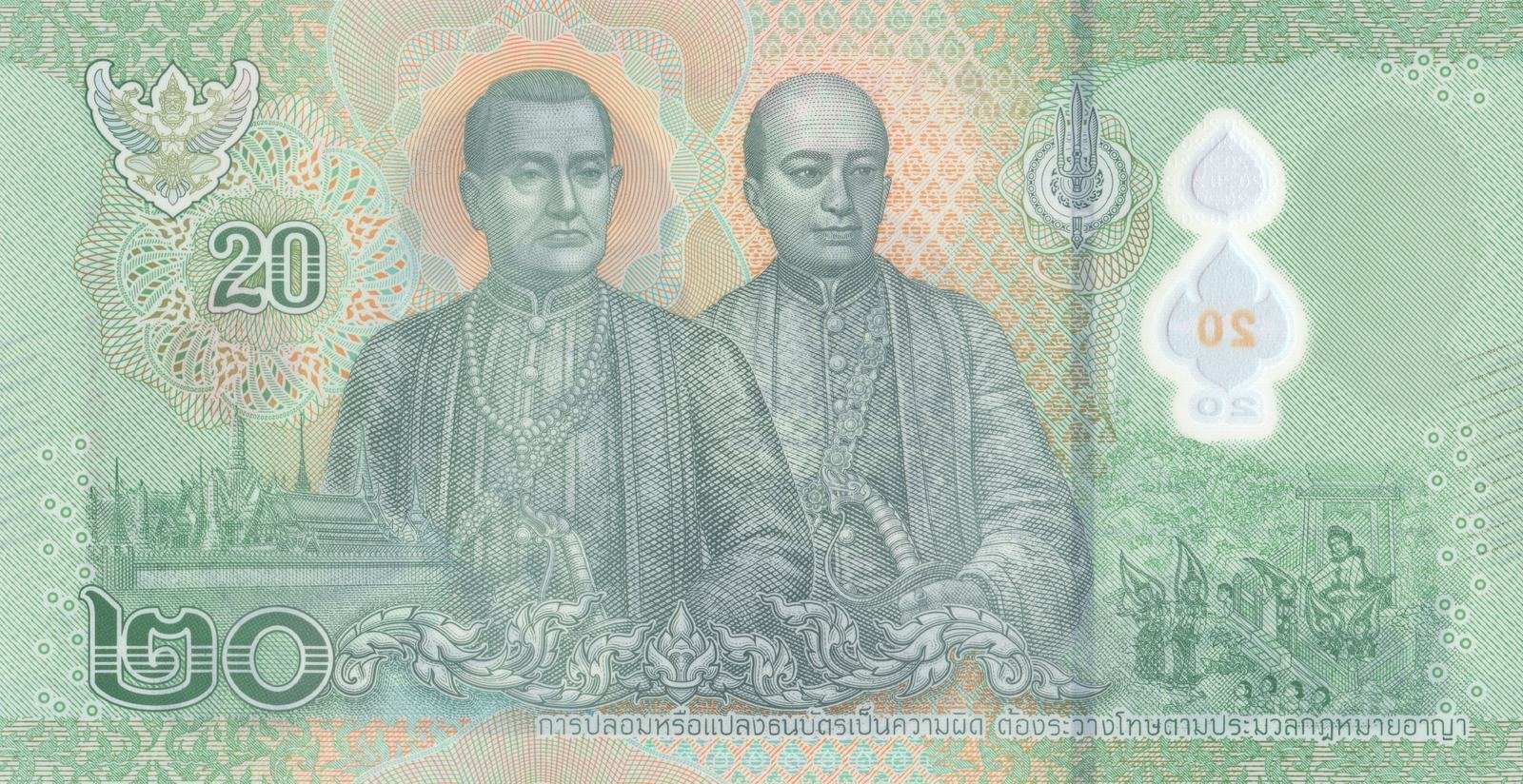
การปลอมหรือแปลงธนบัตรเป็นความผิด ต้องระวางโทษตามประมวลกฎหมายอาญา
“Counterfeiting or altering banknotes is an offence punishable under the Criminal Code.”
The new sentence keeps the two actions and the object—banknotes—but removes the stated prison terms and fine. It does not say that punishment has disappeared. It changes where the reader must look for it.
The two collection scans are enough to demonstrate this difference in wording. They are not enough, on their own, to date the change. The revised paper variety documented by the catalogue comes before the polymer issue. Attributing the shorter warning to the switch of material would confuse two separate developments.
The Bank of Thailand’s polymer launch announcement scheduled the new 20-baht type for 24 March 2022 and described its design theme as continuing that of the paper note. It explained the material change in terms of cleaner, more durable notes. That is a different explanation from the earlier decision about legal wording. Our guide to paper, polymer and hybrid banknotes examines the material comparison itself.
This is also why dates in collection labels need care. Neither of these Thai notes prints the year used in its catalogue listing. An introduction year identifies the type or variety; it does not reveal the exact day on which this particular piece was printed. The distinction is explored in our guide to dating a banknote.
Transnistria: “Coupons” and “Notes”
The reverse of our Transnistrian one-rouble note dated 1994, P-16, offers a different kind of clue. Its large denomination reads ОДИН РУБЛЬ—“one rouble”. At the upper right, the warning calls the protected objects КУПОНОВ: coupons.
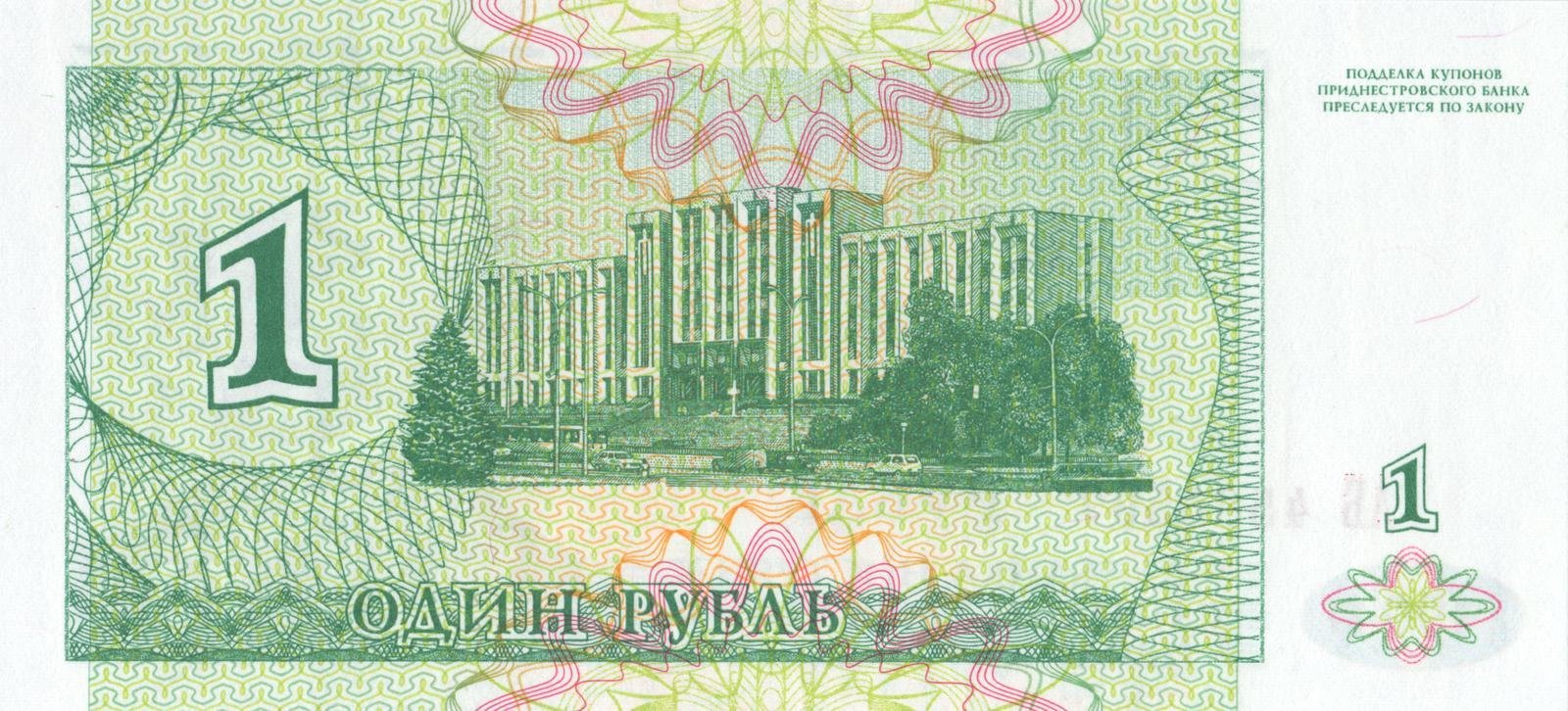
ПОДДЕЛКА КУПОНОВ ПРИДНЕСТРОВСКОГО БАНКА ПРЕСЛЕДУЕТСЯ ПО ЗАКОНУ
“Counterfeiting the coupons of the Pridnestrovian Bank is prosecuted under the law.”
“Rouble” and “coupon” do different work here. One names the denomination’s unit; the other names the instruments in the warning. Recording only the large value would omit a word printed on the note itself. Translating every such object simply as “banknote” would make the English smoother while hiding the difference we want to examine.
On our one-rouble note dated 2000, P-34, the warning moves to the upper left. The sentence has the same basic structure, but КУПОНОВ has become БИЛЕТОВ:

ПОДДЕЛКА БИЛЕТОВ ПРИДНЕСТРОВСКОГО БАНКА ПРЕСЛЕДУЕТСЯ ПО ЗАКОНУ
“Counterfeiting the notes of the Pridnestrovian Bank is prosecuted under the law.”
The Russian word билет can literally mean “ticket”; in this monetary context, “note” is the appropriate English reading. Neither warning states a fine or a prison term. The ending refers to prosecution under the law, without supplying a scale of punishment.
The Pridnestrovian Republican Bank’s 2019 historical account provides the monetary context. It describes the earlier system as the rouble-coupon and records a redenomination from 1 January 2001, at one million old coupons to one new rouble. Its next page identifies the new banknote series as the 2000 design. That establishes a reform and helps explain why two notes labelled “one rouble” should not be treated as equal amounts in an unchanged monetary unit.
It does not establish who chose the replacement word in the warning or precisely why. The evidence permits two statements: the inscriptions differ, and the notes belong to the monetary systems documented by the issuer. Claiming that a particular decree ordered the wording change would go beyond the material reviewed.
The comparison also shows why a translation should remain close to the object. The prosecution wording stays the same while the noun changes. That is useful information even without a documented reason for the edit. Our article on languages on banknotes considers other cases where translating only the denomination leaves part of the inscription unread.
Adding the Warning to a Collection Record
A useful record starts with a location and a transcription. “Reverse, lower right; warning refers to the Criminal Code” is more informative than “anti-counterfeiting text”. Where a catalogue distinguishes the wording, add the relevant variety reference. Keep an exact transcription separate from its English translation, particularly when a small conjunction or a noun carries the distinction.
Example collection note
Thailand, paper 20 baht, P-135a / TBB B193a. Reverse warning states life imprisonment or up to twenty years and a fine of up to 40,000 baht. Distinguished from the revised paper variety B193b by the warning text. The inscription is recorded as a design feature, not as a statement of present-day law.
Then separate what the image proves from what another source supplies. The Thai scan shows the words; the catalogue identifies the variety; the issuer’s announcement explains the revision. In the Transnistrian comparison, the scans show the changed noun, while the historical account supplies the reform context. No single source performs all those jobs.
Several tempting conclusions remain outside the inscription. A severe printed penalty does not demonstrate how frequently counterfeiting occurred or what courts actually imposed. A shorter warning does not prove a weaker law. The presence of the expected sentence does not authenticate the note: its wording is one identification detail, not a substitute for examining the object and its security features. Our banknote authentication guide addresses that separate task.
The reward for reading the small print is more precise identification. On the Thai note it separates versions of an issue. On the Transnistrian notes it preserves a distinction between coupons and notes that the denomination alone does not express. Both are worth recording exactly, without asking the sentence to prove more than it says.
Frequently Asked Questions
Does the printed warning state the current penalty for counterfeiting?
Not necessarily. A banknote preserves wording used for its design or issue. Check the relevant law and its date before treating the inscription as legal guidance; a printed warning may omit definitions, conditions or later amendments.
Can different warning texts identify banknote varieties?
Yes, where the distinction is documented for that issue. The Banknote Book separates Thailand’s paper 20-baht B193a and B193b by their warning text. This does not mean every wording difference is a recognised variety or commands a premium.
Is a warning about counterfeiting proof that a banknote is genuine?
No. The sentence can help identify the intended design, but its presence is not an authentication test. Authenticity requires examination of the note itself, including the relevant material, printing and security features.
Sources and Method
Inscriptions were read from original collection scans. English translations here are editorial translations; they preserve the distinction between counterfeiting and alteration, and between coupons and notes. Line breaks are simplified in the transcriptions. The images have not been redrawn or used to reconstruct missing letters.
This is a study of printed wording and documented historical context, not advice on a present-day legal case. No court-sentencing data were used. The reason for the Transnistrian wording change is not established. The Thai comparison illustrates two different materials and issue years; it is not a pair of the original and revised 2018 paper varieties.
- Bank of Thailand: Clarification on Series 17 Banknotes, No. 28/2561, 2 May 2018, p. 1. Primary explanation of the warning revision.
- Bank of Thailand: Counterfeit Banknotes, Thai-language currency-offence section, especially sections 240 and 241. Used to distinguish the offences, not to build a table of current penalties.
- Bank of Thailand: The Bank of Thailand will start issuing 20 Baht Polymer Banknote on 24 March 2022, No. 2/2022, 20 January 2022, p. 1. Identifies the later material change and its stated purpose.
- Pridnestrovian Republican Bank: 25 Years of the Pridnestrovian Rouble, 2019, PDF pp. 1–3. Issuer’s historical account used for monetary terminology and reform chronology, not as evidence for the reason behind an inscription change.
- The Banknote Book: Thailand chapter, entries B193a–b and B200a; Transnistria chapter, B118a and B201a. Used for catalogue identification and the revised Thai paper variety. The physical inscriptions are transcribed from the scans rather than copied from catalogue translations.
- Collection evidence: the four linked WorldBanknotes.eu records and their original reverse scans: Thailand P-135a and P-145(1-1); Transnistria P-16 and P-34.
About the Author
Audrius is the founder and curator of WorldBanknotes.eu, a catalogue and shop for collectible banknotes. His work focuses on banknote identification, catalogue structure, printing, design and the context behind individual issues. The catalogue methodology explains how observations, reference information and editorial classifications are distinguished.