
How to Date a Banknote: Printed Dates, Series Years, Issue Dates and ND Notes
Dating a banknote sounds simple until the first contradiction appears. A year is printed on the note, yet the catalogue assigns a later date. A complete series shares one design name but entered circulation over several years. A banknote has no printed date at all, while references confidently describe it as ND (1993). In other cases, a serial-number prefix, signature combination or security feature is more useful than the large date visible on the design.
These are not necessarily cataloguing errors. They reflect the fact that a banknote can be connected to several different dates at once.
A collector may encounter:
- a date printed on the banknote;
- a series year or design year;
- an authorisation or decree date;
- a first issue or circulation date;
- a production period;
- a date inferred from signatures, prefixes or security features;
- a withdrawal or demonetisation date.
The purpose of this guide is not to reduce every banknote to one number. It is to show how to identify which date is being described, how to record it accurately and how to avoid turning a useful clue into a false conclusion.
Core principle: A visible year is evidence, not automatically the final catalogue date. Date the complete variety, not only the printed numeral.
Collectors who are still establishing the country, issuer or denomination should begin with How to Identify a Banknote.
Table of Contents
Why Banknote Dating Is More Complicated Than It Looks
A banknote is both a designed object and a mass-produced financial instrument. Its design may be approved in one year, first printed in another, introduced into circulation later and then produced for several more years without changing the visible date.
The date printed on a banknote can therefore describe the design rather than the physical sheet in a collector’s hand. This is especially clear in the United States, where the official Currency Education Program explains that the series year identifies the year in which a new design was approved or the year in which new Treasury signatures were incorporated. It is not a simple manufacturing date for each individual note. U.S. Currency Education Program: Banknote Identifiers
A similar distinction appears in many other monetary systems. A banknote may retain an older printed date while new signature combinations, serial-number formats, printer imprints or security features are introduced. A catalogue may separate those later varieties even though the prominent year remains unchanged.
Series can also be released gradually. The European Central Bank introduced the Europa series over several years: the first denomination began circulating in 2013, while the €100 and €200 completed the series in May 2019. European Central Bank: Current Banknotes
The Bank of England’s Series G provides another example. The series name describes one coordinated generation of designs, but the denominations were launched between 2016 and 2021. Bank of England: The Journey from Design to Launch
The practical consequence is important: country + denomination + printed date may still be insufficient to identify the exact banknote.
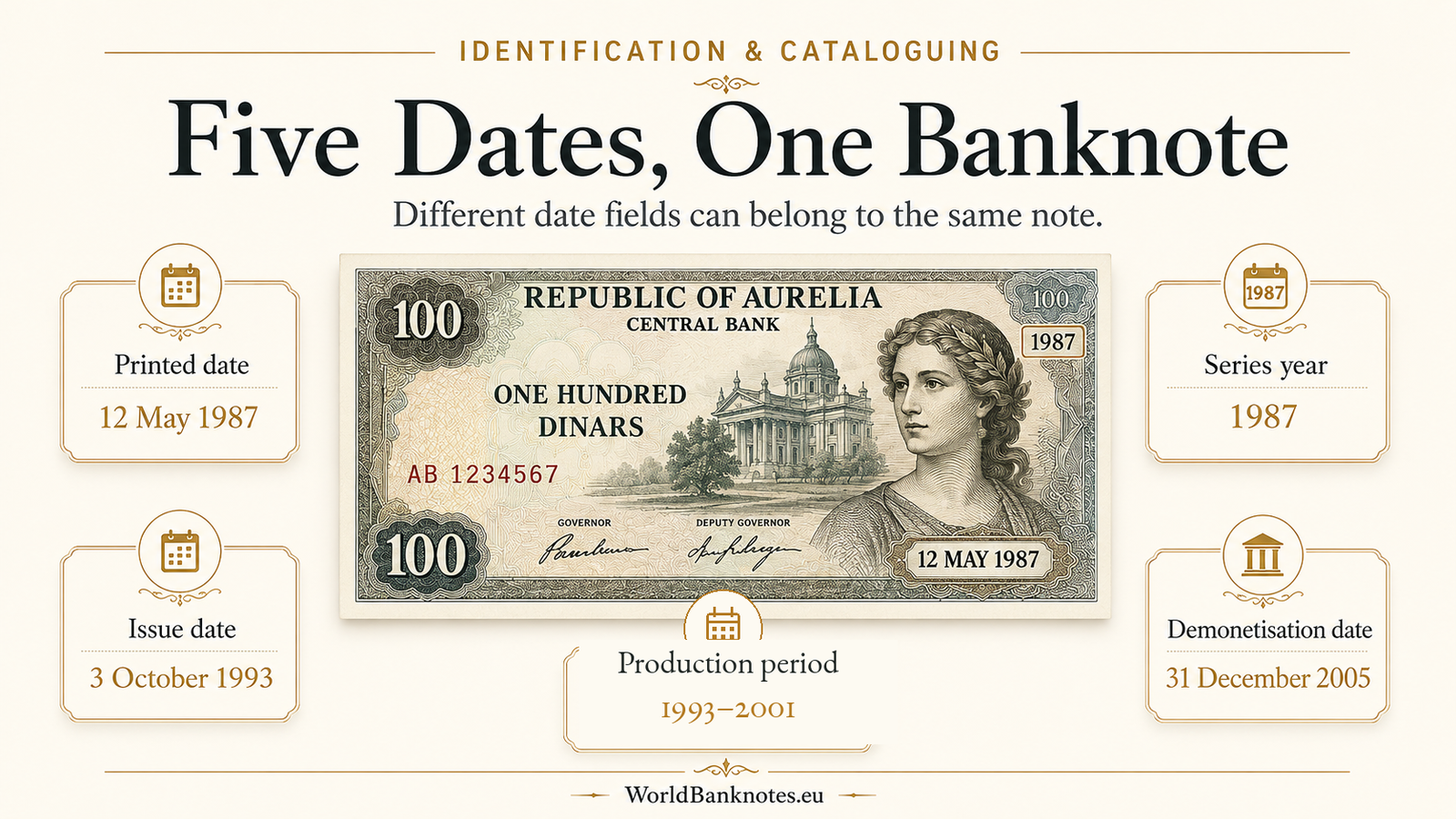
The Five Dates Most Collectors Encounter
The same note can be associated with several dates that answer different questions.
1. Printed Date
The printed date is the year or full calendar date physically present on the banknote. It may appear near the signatures, within legal text, beside the issuing authority or in a decorative panel.
This is the easiest date to observe, but it does not necessarily tell you when your individual note was printed or released.
2. Series Year or Design Year
A series year identifies a design generation, administrative change or signature update. The exact meaning depends on the issuing system.
In the United States, the series year may change when a new design is approved or when a new Secretary of the Treasury or Treasurer signature is incorporated. A suffix letter, such as A, can distinguish a later signature combination within the same general design framework.
Elsewhere, a series may be named by a year, a letter, a portrait, a theme or an internal bank designation. The name can remain stable while different denominations enter circulation at different times.
3. First Issue or Circulation Date
This is the date on which a banknote was officially released or began circulating. It may be published by the central bank and may differ from the date printed on the note.
Polish banknotes provide a clear example of this distinction. The current series carries an issue date of 25 March 1994, while the notes entered circulation from 1 January 1995. Narodowy Bank Polski records both pieces of information separately. Narodowy Bank Polski: Banknotes Put into Circulation
4. Production or Printing Period
A design can remain in production for years. Later print runs may retain the same visible date but use different signatures, prefixes, printers, plates, security threads or serial-number structures.
The production period is usually reconstructed from official records, specialist catalogues or the banknote’s variable features. It should not be guessed from condition, paper colour or perceived age.
5. Withdrawal, Legal-Tender or Demonetisation Date
This date describes the end of a banknote’s monetary role, not its origin. It is important historically, but it should not replace the issue date in a collector’s main identification field.
A note can be withdrawn from circulation while remaining exchangeable at a central bank. In other systems, it may be demonetised completely. These are separate legal events and should be recorded separately.
Start with the Date Printed on the Banknote
The first stage is direct observation.
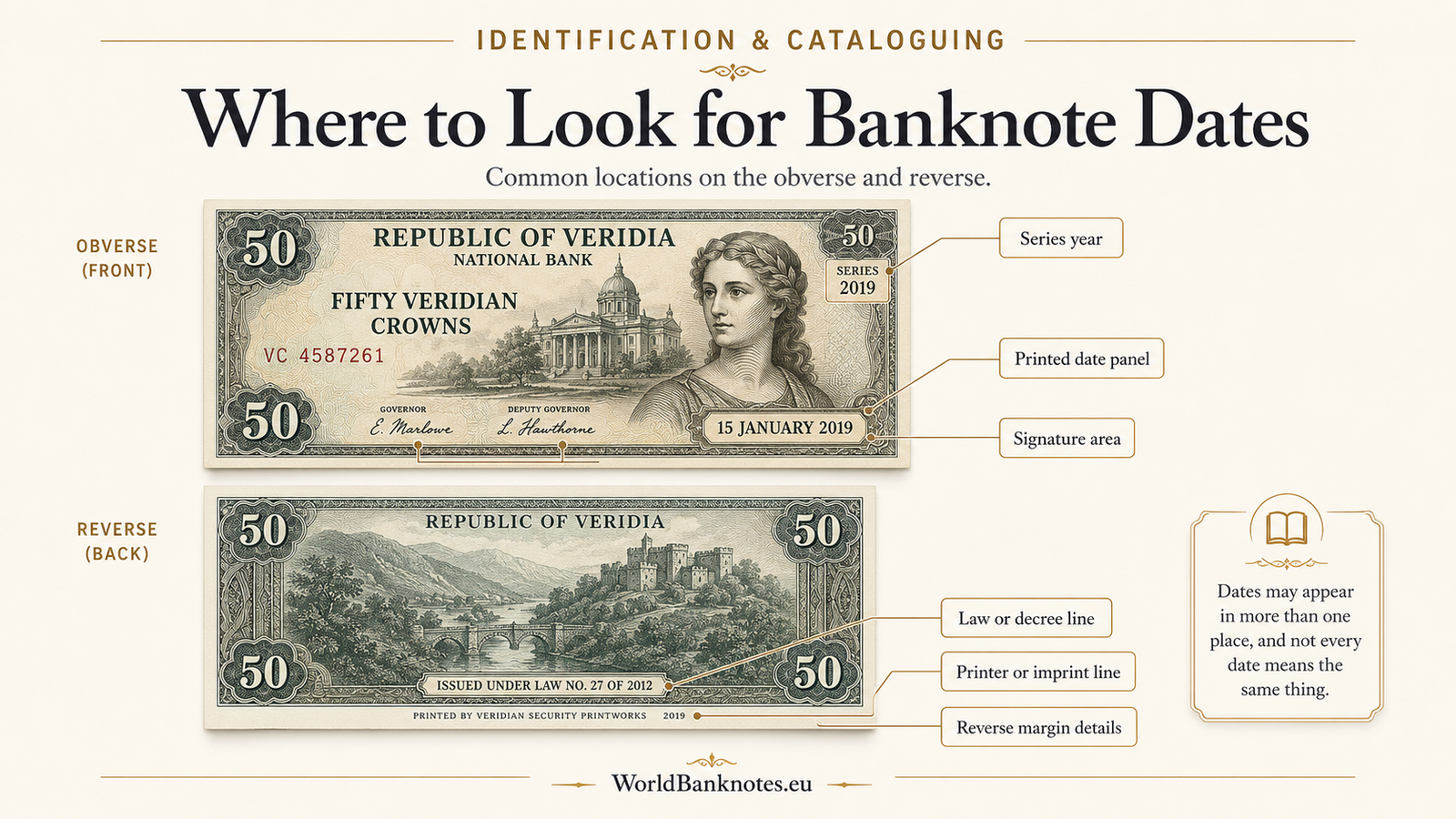
Inspect both sides under good light and look for:
- a four-digit year;
- a full written date;
- a date near the signatures;
- a date inside a legal promise or decree;
- a date written in another numeral system;
- a year embedded in microtext or a commemorative inscription;
- multiple dates serving different purposes.
Do not assume that the largest date is the issue date. On commemorative notes, a prominent anniversary year may refer to the event being celebrated. A historical date beside a portrait may refer to a person’s lifetime. A date in the legal text may identify the authorising law.
Record the wording exactly before interpreting it. If the note reads 25 March 1994, do not reduce it immediately to 1994 in your research notes. The full date may help distinguish it from a later redesign or reissue.
The month can separate varieties within the same year. Our Macedonian denar identification guide compares 100-denar notes dated January and June 2007: recording only the year would lose a distinction used in their catalogue identification.
Photograph the date area at high resolution. This is especially useful when numerals are ornate, worn or printed in a script that is unfamiliar to you.
A clear record also needs a separate publication check. Official rules for scanning and reproducing banknotes can govern size, colour, resolution, markings and permission even when the image was made from your own note.
Printed Date Does Not Always Mean Printing Date
The phrase printed date describes location, not meaning. It tells you that the date appears on the note; it does not prove what event the date represents.
A banknote printed in 2018 may retain a design or series date of 2013. A replacement batch may use the same printed date as the original issue. A new signature combination may appear under an unchanged series year.
For this reason, avoid catalogue descriptions such as:
Printed in 1999
unless a source specifically confirms the production year.
Safer wording is:
Dated 1999
or:
Carries the printed date 1999; the specific variety is attributed to 2013.
That distinction protects the catalogue from turning a visible date into an unsupported manufacturing claim.
In the early Kazakh tenge comparison, 1993 remains printed on the notes while The Banknote Book places the illustrated one- and three-tenge varieties’ introduction in 1995.
Series Years: What They Can and Cannot Tell You
A series year is a controlled identifier. It may be highly useful, but only within the rules of that issuing authority.
The U.S. system is one of the clearest documented examples. The series year can indicate the approval of a new design or a change in Treasury signatures. On redesigned Federal Reserve notes of $5 and higher that use two initial serial letters, the first identifies the series. On $1 and $2 notes in the one-initial-letter format, it identifies the Federal Reserve Bank instead. This allows the printed series designation, signatures and serial format to be cross-checked rather than interpreted in isolation.
Three cautions follow:
- A series year is not necessarily the year the note entered circulation.
- It is not necessarily the year your individual note was printed.
- A suffix letter is part of the series designation and should not be silently discarded.
Other countries use the word series differently. A catalogue may group notes by design family, while a central bank uses a separate internal series name. Always identify whose terminology you are using.
A Series Can Span Several Issue Years
Collectors often expect one series to equal one year. Modern banknote programmes regularly contradict that assumption.
The Europa series began circulating in 2013 and was completed in 2019. The Bank of England’s Series G ran from the £5 launch in 2016 to the £50 launch in 2021. A collector dating a €200 or £50 note should therefore use the denomination-specific issue date, not simply the opening year of the series.
This matters in catalogue architecture. The following are separate concepts:
- Series: the coordinated design generation;
- Denomination issue date: when that value entered circulation;
- Variety date: the date associated with a signature, prefix, printer or security change;
- Individual production date: when the physical note was printed, if known.
A strong catalogue preserves these distinctions rather than forcing them into one ambiguous Year field.
What ND Means in Banknote Catalogues
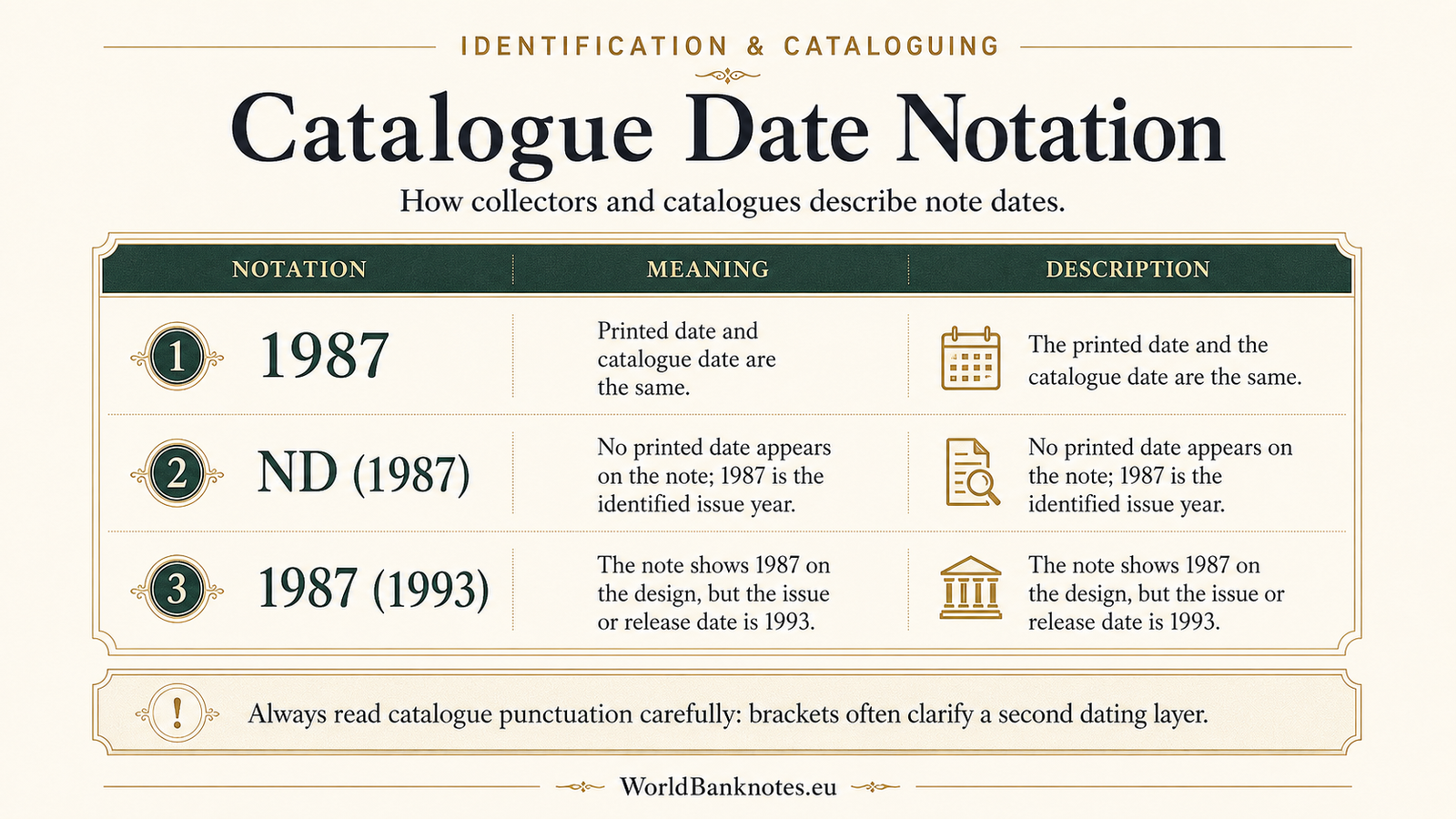
ND normally means No Date or Not Dated: the banknote itself carries no printed issue or series date that the catalogue treats as its date.
It does not mean that the issue period is completely unknown.
A catalogue may write:
ND (1993)ND (1993–2002)ND (2013–2023)
In these forms, ND describes the physical banknote, while the parenthetical date is an external catalogue attribution based on issue records, signatures, serial prefixes, documented releases or other evidence.
Banknote.ws, for example, groups Eastern Caribbean States notes under ND (1993) and Central African States notes under ND (1993–2002). The date in parentheses is therefore not presented as a date printed on the note. Banknote.ws: Eastern Caribbean States
This distinction should be preserved in product data:
- Printed date: None / ND
- Catalogue year: 1993
- Year display: ND (1993)
Do not replace ND (1993) with simply 1993 if the absence of a printed date is relevant to identification.
How to Read Parenthetical Dates
Parentheses are useful, but they are not universal. Different catalogues may use them for slightly different purposes.
In many modern banknote references, a parenthetical date commonly indicates a catalogue-attributed issue year when the note is undated, or a later issue year for a variety that retains an earlier printed date.
Example: ND (1993)
- No date is printed on the banknote.
- The issue is attributed to 1993 by the reference.
Example: 1999 (2013)
- The banknote carries or retains the date 1999.
- The particular variety is attributed to 2013.
Banknote.ws records Tajikistan 5 Somoni P-23 as 1999 (2013), illustrating how a visible or inherited date can coexist with a later variety date. Banknote.ws: Tajikistan P-23
Example: 1993–2002
- The issue or variety spans a documented period.
- It does not prove that every year within the range appears as a distinct printed date.
The safest rule is:
Read the catalogue’s own introduction and country notes before assuming that parentheses mean the same thing everywhere.
Date Ranges: Issue Period, Production Period or Signature Period?
A range such as 1999–2013 can describe several different things:
- years encoded by serial numbers;
- a production period;
- a period during which a signature combination was used;
- the span of a design family;
- the known issue dates of several varieties grouped under one catalogue number.
Banknote.ws records some New Zealand and Swiss issues with year information encoded in the serial-number structure. In those cases, the date range is not merely decorative metadata; the banknote itself contains a production clue in its prefix or first digits.
Do not convert every date range into a list of assumed annual issues. A range may contain gaps, limited printings or years for which no examples are known.
For database design, keep these fields separate when possible:
Printed DateIssue YearYear RangeSignature PeriodSerial-Derived YearCatalogue Display Date
Signatures as Dating Evidence
Signatures are among the most useful tools for dating undated or long-running designs.
Central-bank governors, finance ministers, treasurers and chief cashiers change over time. When the design remains otherwise stable, a signature combination can define a distinct catalogue variety.
The Bank of Canada’s current note pages demonstrate this clearly by listing multiple signature combinations under one denomination and design. A note’s issue date may remain the same at design level, while later signatures identify subsequent printings. Bank of Canada: $5 Polymer Note Design Elements
A reliable signature workflow is:
- Identify each office, not only the handwritten name.
- Transcribe the names carefully.
- Confirm the officials’ terms of office from a reliable source.
- Check whether the catalogue separates the combination.
- Use the overlap of both officials’ terms as a possible date window.
- Confirm the result with prefix, printer and security features.
Do not assume that a new official’s appointment date equals the note’s first issue date. Existing stocks may continue to circulate, and production with the new signature may begin later.
Serial Numbers and Prefixes
Serial numbers can provide dating evidence at several levels.
They may identify:
- a production batch;
- a printing facility;
- a replacement note;
- a regional or national allocation;
- a series year;
- an encoded year of issue.
The serial format must be interpreted within the correct issuing system. A letter that indicates a year in one country may indicate a printer, region or bank in another.
Useful observations include:
- prefix letters and their order;
- number of digits;
- vertical versus horizontal placement;
- font and size;
- repeated serials on both sides;
- letter-number transitions;
- special replacement symbols;
- year codes embedded in the first or final digits.
Never derive a date from a prefix without a documented key. Prefix systems can restart, omit letters or change meaning between series. Our comparison of five banknote serial-number systems shows why the issue matters as much as the number.
Security Features Can Define a Later Variety
A note may retain its printed date while gaining a new security thread, holographic stripe, foil, tactile mark, UV feature or latent image.
This can create a later catalogue variety even when the portrait, denomination and main date remain unchanged.
Belarus’s 2000-dated notes provide denomination-specific examples: a spelling revision and later thread changes were introduced while the printed year remained unchanged.
When the visible date conflicts with the apparent technology, compare:
- thread type and position;
- watermark design;
- window or foil format;
- optically variable ink;
- tactile features;
- see-through registration;
- UV fluorescence;
- microtext;
- substrate type;
- printer imprint.
A security feature is strongest as comparative evidence. Do not date a note solely because a feature “looks modern”. The same technology can remain in use for many years, and counterfeit or altered notes may imitate individual elements.
Printer Imprints, Plate Marks and Production Codes
Some banknotes name the printer directly. Others include abbreviations, logos, plate letters, position numbers or coded marks.
A printer change can help date a variety, especially when the design and printed year remain unchanged. It can also explain differences in colour, engraving sharpness, plate layout or security-thread construction.
However, printer evidence should be treated carefully:
- one printer may produce several years of the same issue;
- two printers may overlap;
- a catalogue may separate printers even when the central bank considered them one issue;
- a plate letter may identify position rather than year;
- an imprint may be absent on some legitimate printings.
Record the exact imprint first. Interpret it only after comparison with a trusted reference.
Dates in Laws, Decrees and Promissory Text
Historical notes often contain legal language. A date may refer to:
- the law authorising the currency;
- the decree creating the issuing bank;
- the date of a monetary reform;
- a promise to pay under a particular statute;
- an emergency issue authorisation.
Such a date is historically important but may predate the physical note by years.
A common mistake is to treat every legal date as the issue date. The correct approach is to label it explicitly:
Authorising law dated …Decree date …Printed legal date …
Do not merge it into Year of Issue unless the catalogue or issuing authority confirms that interpretation.
The legal text itself may also lag behind legislation; our comparison of counterfeiting warnings on banknotes shows why an inscription and the law in force must be checked separately.
Commemorative Dates and Anniversary Years
Commemorative banknotes often carry dates connected to an event rather than production.
The note may show:
- the founding year and anniversary year;
- a historical event date;
- the life dates of a person;
- a jubilee range;
- the official celebration year.
The Bank of Canada’s commemorative $20 was issued on 9 September 2015 to mark the day Queen Elizabeth II became Canada’s longest-reigning sovereign. The event, design and issue date are closely connected, but that relationship should be verified rather than assumed for every commemorative note. Bank of Canada: 2015 Commemorative $20
When a note displays several years, identify the role of each one before entering data.
Calendar Systems and Non-Gregorian Dates
Not every banknote uses the Gregorian calendar, and some use more than one calendar.
Collectors may encounter:
- Islamic Hijri years;
- Solar Hijri years;
- Buddhist Era years;
- Bikram Sambat dates;
- Ethiopian calendar dates;
- Japanese era years;
- regnal years;
- revolutionary or local calendars.
The greatest danger is using a fixed subtraction rule without identifying the calendar precisely.
For example, a lunar Hijri year cannot be converted by simply subtracting a constant number because the lunar year is shorter than the Gregorian year. Solar calendars may differ by one Gregorian year depending on the month and day. Era-based dates require the correct era name as well as the numeral.
Best practice:
- Identify the numeral system.
- Identify the calendar.
- Transcribe the original date exactly.
- Convert using an authoritative calendar tool or specialist reference.
- Preserve both forms in your catalogue.
- Mark uncertain conversions as approximate.
A professional catalogue might record:
Original date: ١٤٤١ AHGregorian equivalent: 2019–2020
rather than forcing one exact Gregorian year when the original date spans two.

Numerals Can Be Misread Even When the Calendar Is Known
Dates may use Arabic-Indic, Eastern Arabic, Devanagari, Thai, Bengali, Khmer, Burmese or other numeral forms.
Collectors should avoid relying on visual resemblance alone. A numeral that looks like a familiar 0, 2 or 7 may represent something else in another script.
A safe method is to build a small comparison table for the script and read each digit independently. Check whether the date is written left-to-right or embedded in right-to-left text.
Digital translation tools can help with recognition, but they should not replace catalogue confirmation. Stylised banknote typography, guilloche backgrounds and worn printing can confuse automatic recognition.
Our guide to Egyptian banknote dates works through Arabic-Indic numerals, Gregorian dates and the older split-year format using scanned examples.
Overprints, Reissues and Provisional Notes
An overprint can change a banknote’s date context without changing the underlying note.
Examples include:
- a new denomination over an older note;
- a new issuing authority;
- a political or territorial overprint;
- a currency reform mark;
- an emergency validation stamp;
- a commemorative overprint.
Record two layers:
- the date of the underlying banknote;
- the date or period of the overprint.
Do not date the complete object only by the base note if the overprint created the collectible variety. Conversely, do not describe the paper itself as printed in the overprint year unless that is documented. The three cases in our guide to banknote overprints keep the evidence for the base note and the added wording separate.
For a catalogue entry, wording such as this is clearer:
Base note dated 1985; overprinted and issued in 1992.
An overprint of this kind belongs to a documented changeover window, which makes it unusually precise dating evidence. Our guide to currency reform explains how those windows are established and why two notes carrying the same figure can belong to different currencies.
Reprints and Later Print Runs
A central bank may reprint an existing design without changing the visible date. Later printings may be distinguishable through:
- new signatures;
- changed serial prefixes;
- different printer imprints;
- revised security threads;
- altered plate letters;
- colour differences;
- changed dimensions;
- modified UV features.
The key question is whether the difference is a documented variety or normal production variation.
Do not create a new date from colour alone. Ink batches, storage, scanning and ageing can produce misleading differences.
Specimens, Proofs and Unissued Notes
A specimen may carry the same date as the circulation issue, a development date or no meaningful date at all. Proofs and essays may predate the final issue. Unissued notes may show a date even though they never entered circulation. Our study of who specimen banknotes were made for separates the printed date from the evidence for their production and purpose.
The date field should therefore be paired with status:
- Circulation
- Commemorative
- Foreign Exchange Certificate
- Unissued
- Specimen or proof status recorded separately
Do not interpret UNC as unissued. UNC is a condition grade; it does not describe whether the note was officially released.
For an unissued banknote, use wording such as:
Dated 1994; prepared for issue but not released.
only when reliable sources confirm that status.
A Practical Banknote Dating Workflow
Use the following sequence whenever the date is uncertain.
Step 1: Identify the Exact Issuer and Denomination
Confirm the country or territory, issuing authority, currency and denomination. Dating evidence is meaningless if the note has been assigned to the wrong issuer.
Step 2: Record Every Visible Date
Transcribe all dates from both sides. Photograph them before conversion or interpretation.
Step 3: Classify Each Date
Ask whether the date appears to be:
- printed issue date;
- series year;
- legal or decree date;
- commemorative event date;
- portrait life date;
- calendar date in another system.
Step 4: Record Signatures and Serial Format
Transcribe the signatories, prefix, digit count and serial placement.
Step 5: Compare Design and Security Features
Check substrate, watermark, thread, foil, UV features, printer imprint and plate details.
Step 6: Consult More Than One Reliable Reference
Use the issuing authority where available, then compare specialist catalogues. Note any disagreement rather than silently choosing the most convenient date.
Step 7: Preserve the Evidence in Separate Fields
A robust record can include:
- Printed Date
- Issue Year
- Year Range
- Series
- Signatures
- Prefix
- Printer
- Catalogue Display Date
- Dating Notes
Step 8: Mark Uncertainty Honestly
Use circa, attributed to, reported as or date not confirmed where necessary. Precision that is not supported by evidence is worse than a clearly stated range.

Building a Clean Database Date Structure
A single Year field is convenient for display but inadequate for research.
A practical structure is:
| Field | Purpose | Example |
|---|---|---|
| Printed Date | Date physically visible on the note | 1999 |
| Issue Year | Confirmed first issue year of the variety | 2013 |
| Year Range | Documented span | 2013–2016 |
| Date Status | Dated / ND / uncertain | Dated |
| Calendar | Calendar used on the note | Gregorian |
| Original Date Text | Exact transcription | 1999 |
| Catalogue Display Date | Human-readable combined form | 1999 (2013) |
| Dating Evidence | Signatures, prefix, security feature | Holographic stripe |
For a simple shop interface, the public Year can remain concise. The detailed evidence can be retained internally for auditing and future updates.
How to Write the Date Without Overclaiming
Good catalogue wording separates observation from interpretation. The goal is to show the reader what is physically present, what is documented and what remains inferred.
Use direct wording for visible evidence:
Dated 1999.No printed date.Series 2009A.Serial prefix begins with M.Signatures of [official] and [official].
Use qualified wording for external attribution:
Attributed to 2013 by the catalogue.Reported as issued in 1993.Production period recorded as 2000–2013.The serial-number code indicates 2008.The variety is associated with the later holographic-stripe issue.
Avoid combining the two into an unsupported statement. For example, if a note reads 1999 and the catalogue lists the variety as 2013, do not write printed in 2013 unless production records confirm it. Write:
Dated 1999; the holographic-stripe variety is attributed to 2013.
This is not weaker writing. It is more precise. It tells the collector which part can be verified directly and which part depends on documentary evidence.
Where references disagree, the catalogue note can preserve both positions:
Banknote.ws attributes this variety to 2013; the issuing authority source located during this audit did not provide a denomination-specific release date.
That wording allows later research to improve the record without first undoing an absolute claim.
Common Banknote Dating Mistakes
Treating the Printed Year as the Printing Year
A visible date may identify the design or legal authority, not the physical production batch.
Using the First Year of a Series for Every Denomination
Series introduced gradually require denomination-specific issue dates.
Removing ND from the Catalogue Display
Changing ND (1993) to 1993 hides the fact that no date is printed on the note.
Ignoring Signature Changes
A later signature pair can identify a later printing under an unchanged date.
Guessing a Calendar Conversion
Fixed subtraction rules can produce incorrect Gregorian dates.
Assuming Parentheses Have One Universal Meaning
Catalogue conventions must be checked within the reference being used.
Dating by Condition
A crisp note is not necessarily recent, and a worn note is not necessarily old.
Dating by Technology Alone
Security features can remain in use for long periods and may overlap between varieties.
Confusing Issue Date with Withdrawal Date
The end of legal-tender status does not identify when the note originated.
Ignoring the Base Note Under an Overprint
The underlying note and the overprint can belong to different periods.
Collector’s Dating Checklist
Before finalising a banknote date, confirm:
- The country or territory is correct.
- The issuing authority is correct.
- The denomination and currency are correct.
- Both sides have been checked for dates.
- Every visible date has been transcribed.
- Decorative or biographical dates have been excluded.
- The calendar and numeral system have been identified.
- The printed date has not been assumed to be the printing date.
- The series designation has been recorded exactly.
- Signature names and offices have been identified.
- The serial prefix and number format have been recorded.
- Security features have been compared with the correct variety.
- Printer imprints and plate marks have been checked.
- Any overprint has been dated separately from the base note.
- The central bank or issuing authority has been consulted where possible.
- Catalogue notation has been interpreted using that catalogue’s conventions.
NDhas been preserved where the note is undated.- Parenthetical dates have been explained internally.
- Conflicting references have been documented.
- Uncertainty has been stated rather than concealed.
Frequently Asked Questions
What does ND mean on a banknote listing?
ND means the banknote is not dated or has no printed date treated as its issue date. A parenthetical year, such as ND (1993), is usually a catalogue attribution rather than a date visible on the note.
Is the year printed on a banknote the year it was printed?
Not necessarily. It may be a series year, legal date or design date retained across later print runs. Signatures, serial prefixes and security features may identify a later variety.
What is a banknote series year?
A series year is an identifier used by the issuer for a design or administrative version. Its meaning varies by country. In the United States it can reflect design approval or a change in Treasury signatures.
What does 1999 (2013) mean in a catalogue?
It commonly indicates that the note carries or retains the date 1999 while the specific variety is attributed to 2013. The exact convention should always be confirmed in the catalogue being used.
Why can one banknote series have several issue years?
Central banks often introduce denominations gradually. The coordinated design may have one series name, while each denomination enters circulation on a different date.
Can signatures be used to date a banknote?
Yes. Signature combinations can narrow the period in which a note was produced, especially for undated issues or designs used for many years. They should be confirmed with other evidence.
Can a serial number reveal the year?
Sometimes. Certain issuing systems encode the series or year in a prefix or digits, but the rule is country- and series-specific. Never infer a year without a documented key.
How should non-Gregorian dates be recorded?
Record the original date exactly, identify the calendar and add a verified Gregorian equivalent. Preserve a range where the conversion spans two Gregorian years.
Should an overprinted note use the base-note year or overprint year?
Ideally record both. The base note has its own date, while the overprint may define the later collectible variety.
What should I do when catalogues disagree about a date?
Check the issuing authority, compare the evidence and document the disagreement. Use a range or qualified wording rather than presenting an uncertain date as exact.
Final Thoughts
Dating a banknote is an exercise in classification, not numeral spotting.
The visible year is the starting point. The final identification emerges from the relationship between date, series, signatures, serial format, security features, printer and documented issue history.
A professional catalogue does not force every piece of evidence into one field. It distinguishes the date printed on the object from the date assigned to the variety. It preserves ND when the note is undated. It explains parenthetical years and records uncertainty honestly.
Once these habits are established, difficult forms such as ND (1993), 1999 (2013) and multi-year series become logical rather than confusing. The banknote is no longer treated as a flat image with one year. It becomes a documented product of design, administration and production over time.
Selected References
- U.S. Currency Education Program — Banknote Identifiers and Symbols
- U.S. Currency Education Program — Dollars in Detail
- European Central Bank — Current Euro Banknotes
- European Central Bank — Europa Series
- Bank of England — Our New Banknotes: The Journey from Design to Launch
- Narodowy Bank Polski — Banknotes Issued by NBP
- Bank of Canada — $5 Polymer Note Design Elements
- Bank of Canada — 2015 Commemorative $20
- Banknote.ws — Eastern Caribbean States
- Banknote.ws — Tajikistan P-23
- Banknote.ws — New Zealand P-186
- Banknote.ws — Switzerland P-67
About the Author
Audrius is the founder and curator of WorldBanknotes.eu, a specialised catalogue and marketplace dedicated to collectible banknotes from around the world. His work focuses on banknote identification, catalogue structure, security features, condition, design and the historical context behind individual issues.
Explore World Banknotes
WorldBanknotes.eu presents collectible banknotes with structured information on country, issuer, currency, denomination, date, catalogue references, security features and condition.