
Iraq’s “Swiss Dinar”: Why Two Dinars Had Different Values
Two Iraqi banknotes in our collection show three white horses on the front. On the back, each has a palace courtyard and the words “Twenty Five Dinars”. One is dated 1982; the other, 1990. Viewed quickly, they look like variations of the same money. Yet they belong to different parts of the story that left Iraq with two dinars trading at different values.
The older currency became known as the Swiss dinar. It continued to be used in the Kurdish-controlled north while newer issues circulated in the territory governed from Baghdad. In 2003, a replacement currency brought the two systems together. The familiar summary is that one Swiss dinar received 150 new dinars, while one dinar from the newer issues received one.
For the two notes on this page, however, that summary leaves out the decisive detail. The exchange order specifically excluded Swiss 25-dinar notes from the general conversion. Reading the objects beside the documents explains both how two dinars acquired different values and why a conversion rate is not, on its own, an answer about a particular banknote.
Two Notes, One Denomination
Start with what the scans show. The earlier note combines green printing with a pink background, while the later one has a different colour treatment. Their date lines, signatures and numbering differ. The horses, denomination and broad composition remain recognisable. These are not identical pieces of printing, but the shared design makes them a more revealing comparison than two entirely different-looking notes.
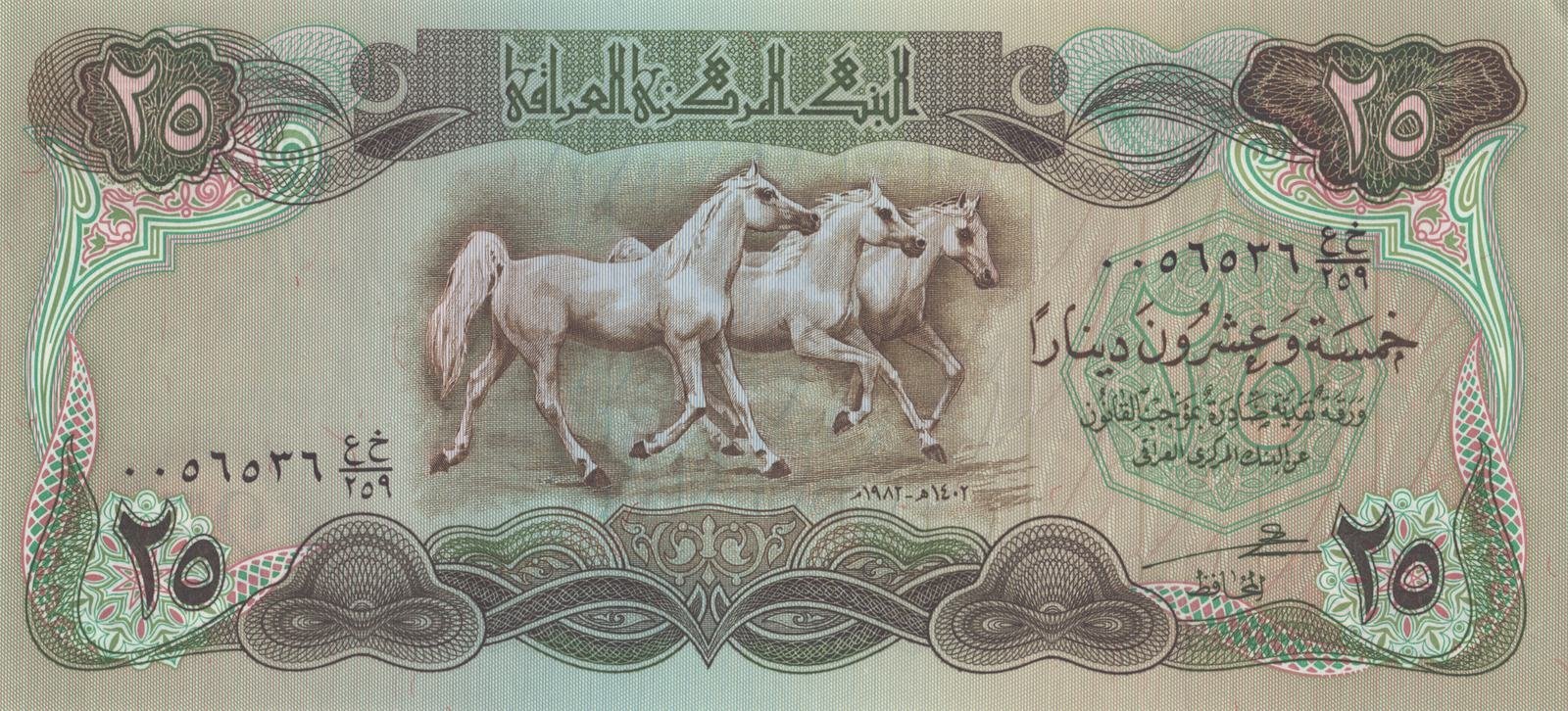
25 dinars · 1982 · P-72 · Front

25 dinars · 1990 · P-74b · Front
The date on the first note reads 1982 alongside the Islamic year 1402. The second pairs 1990 with 1411. Those inscriptions help identify the types; they do not establish the day an individual example was printed, issued or spent. The catalogue references are useful precisely because a date is only part of the identification.
The Banknote Book lists the earlier type with a solid security thread and a horse-head watermark, and records its demonetisation in 1993. It lists the later type without a thread or watermark, with a withdrawal date of 15 January 2004. Those are catalogue specifications, not findings from testing these notes: a normal reflected-light scan cannot demonstrate the absence of a watermark.
There is also a trap in the names. “Swiss dinar” was not a denomination printed on the paper. Nor should it be treated as a printer’s signature. The catalogue attributes this 1982 type to an unnamed printer in Russia. Accounts of the nickname’s origin differ; the name is useful here as a historical currency label, not proof of Swiss manufacture.
The comparison therefore needs two records: one identifying the physical type and another explaining the monetary arrangements in which it could be used. The words “Central Bank of Iraq” and “25 dinars” cannot supply the second record by themselves.
How the Currencies Parted
The separation developed in stages. After the 1991 Gulf War, Iraq’s Kurdish-controlled north was outside Baghdad’s effective administration. Older notes remained in use there, while subsequent issues served the rest of the country. This was not a neat transition in which a new currency name was printed across every note on a single date.
A particularly important event came in May 1993. In his account of the episode, Bank of England Governor Mervyn King describes the withdrawal of the old 25-dinar note with a short exchange period. People in the north could not exchange their holdings; the older currency continued to circulate there. The withdrawal concerned the old 25-dinar type, not the abolition of every banknote bearing that denomination. King’s discussion connects the administrative break with the survival of the older currency.
Our two notes make the distinction tangible. A catalogue entry assigning the 1982 type a 1993 demonetisation date does not mean that all Iraqi 25-dinar notes disappeared in 1993. The 1990 type has its own entry and a later withdrawal date. Equally, the printed year 1990 does not prove that this particular type was the replacement handed out during the May 1993 operation.
“Swiss” and “Saddam” became convenient names for the two currencies in economic accounts. Their meaning must be kept separate from a collector’s broad description of a political period. A banknote issued during Saddam Hussein’s rule is not necessarily part of the currency that those accounts call the Saddam dinar. The earlier horse-design note is a useful example of why the historical label needs an issue-specific definition.
The later exchange law supplied one. Coalition Provisional Authority Order 43, signed on 14 October 2003, defined Swiss dinars as Central Bank of Iraq banknotes and coins issued from 1959 through 1989. Its separate “1990 dinar” category covered banknotes issued from 1990 through the order’s effective date. Here, 1990 is included, not excluded by a vague phrase such as “after 1990”.
That legal definition provides the framework for the conversion. It should not be mistaken for a claim that Iraq had two wholly separate currencies throughout the entire period from 1959 onwards. The dates define which earlier issues fell into each category when the replacement was organised.
Why the Two Dinars Had Different Values
King contrasts a largely fixed, probably declining stock of older notes in the north with expanding currency issuance under Baghdad. He reports that the nominal value of currency in circulation rose from 22 billion dinars at the end of 1991 to 584 billion four years later. These are amounts of money, not counts of banknotes. They should not be read as a measure of bank deposits or as evidence that each note’s purchasing power changed in exact proportion.
The mechanism is easier to see if the printed numeral is put aside. Two notes can carry the same 25-unit denomination while the supply of one kind of unit grows much faster than the other. Once people stop treating the units as interchangeable, a price can develop between them. That price is an exchange rate, even though the notes retain the same currency name and issuer.
Christopher Foote, William Block, Keith Crane and Simon Gray, writing about the reconstruction of Iraq’s economy, report a rate near 100 Saddam dinars for one Swiss dinar from July 1998 to January 2002. It reached about 300 in January 2003 and was around 250 by the middle of that year. Their account also places a purchasing-power comparison nearer 100. These are distinct observations, not alternative ways of writing one fixed rate. See the Boston Fed version of their study, printed pp. 19–20.
A market exchange rate answers how many units of one currency people will give for another. A purchasing-power comparison asks how amounts relate to prices in the places where they are spent. Neither answers how much a surviving banknote is worth to a collector today. Confusing those questions would turn a historical conversion ratio into a misleading price guide.
The divergence also cannot be explained by paper quality alone. A thread, watermark or more elaborate printing may help identify a type and resist imitation, but it does not set the exchange rate between two monetary systems. Our scans reveal design and numbering; they cannot reveal what their holders expected the future government to do.
The 150:1 Conversion—and the 25-Dinar Exception
On 7 July 2003, the Coalition Provisional Authority announced a new currency to replace both systems. Its public explanation of the exchange set out the two conversion ratios and a three-month changeover. The replacement began on 15 October 2003 and the conversion period ran through 15 January 2004.
Why 150 rather than 100 or 250? Foote and his co-authors describe a compromise, following consultation, between the lower purchasing-power comparison and the higher market rate. The number was an administrative choice, not the simple average of two figures and not a finding that a Swiss dinar bought exactly 150 times as much everywhere.
1. Establish eligibility
Order 43 excluded Swiss 25-dinar notes from the general exchange. Their exchange required separate Central Bank instructions.
2. Apply the category’s rate
For notes eligible for the general exchange:
1 “1990 dinar” → 1 new dinar
1 Swiss dinar → 150 new dinars
Source: CPA Order 43, sections 4–5. These are historical official conversion rates, not present-day redemption offers or collector prices.
The two ratios in section 5 of Order 43 are straightforward. The qualification lies in section 4(2): Swiss 25-dinar notes were excluded from exchange during the general conversion period. Any exchange of those notes was left to separate Central Bank administrative instructions under section 4(3).
That matters directly to the 1982 type pictured above. Its catalogue identification and the order’s definition place it within the older category, but the general 150:1 rule cannot simply be multiplied by its face value. The exception has to be addressed first. The sources reviewed here do not establish the subsequent instructions or outcome for these notes; that gap is not proof that they were never redeemed.
The public exchange plan extended beyond cash: the CPA also explained that relevant bank balances and contracts would be converted at the applicable ratios. This is why replacing two currencies was more than exchanging one set of pictures for another. Amounts owed and recorded in the old units also needed a relationship to the new unit.
There are three dates to distinguish: the announcement in July, the start of the exchange in October and the end of the conversion period in January. Order 43 stated that only the new banknotes would be legal tender after 15 January 2004. It separately provided for later exchanges under Central Bank instructions. As our guide to when banknotes stop being legal tender explains, acceptance as money and eligibility for redemption are different questions.
For the 1990 note in our pair, the catalogue’s 15 January 2004 withdrawal date fits that general changeover. It still tells us nothing about whether this individual example was submitted for exchange. A surviving banknote carries evidence of its manufacture and type, not a complete record of every transaction involving it.
Old Designs, New Denominations
The replacement currency did not abandon every earlier image. Compare our one-dinar note dated 1979 with the 1,000-dinar note dated 2003. Both fronts use a gold-coin motif. On the reverses, the Mustansiriya Madrasa in Baghdad returns in a recognisable architectural view. The colour schemes and denominations differ sharply.

1 dinar · 1979 · P-69a · Front
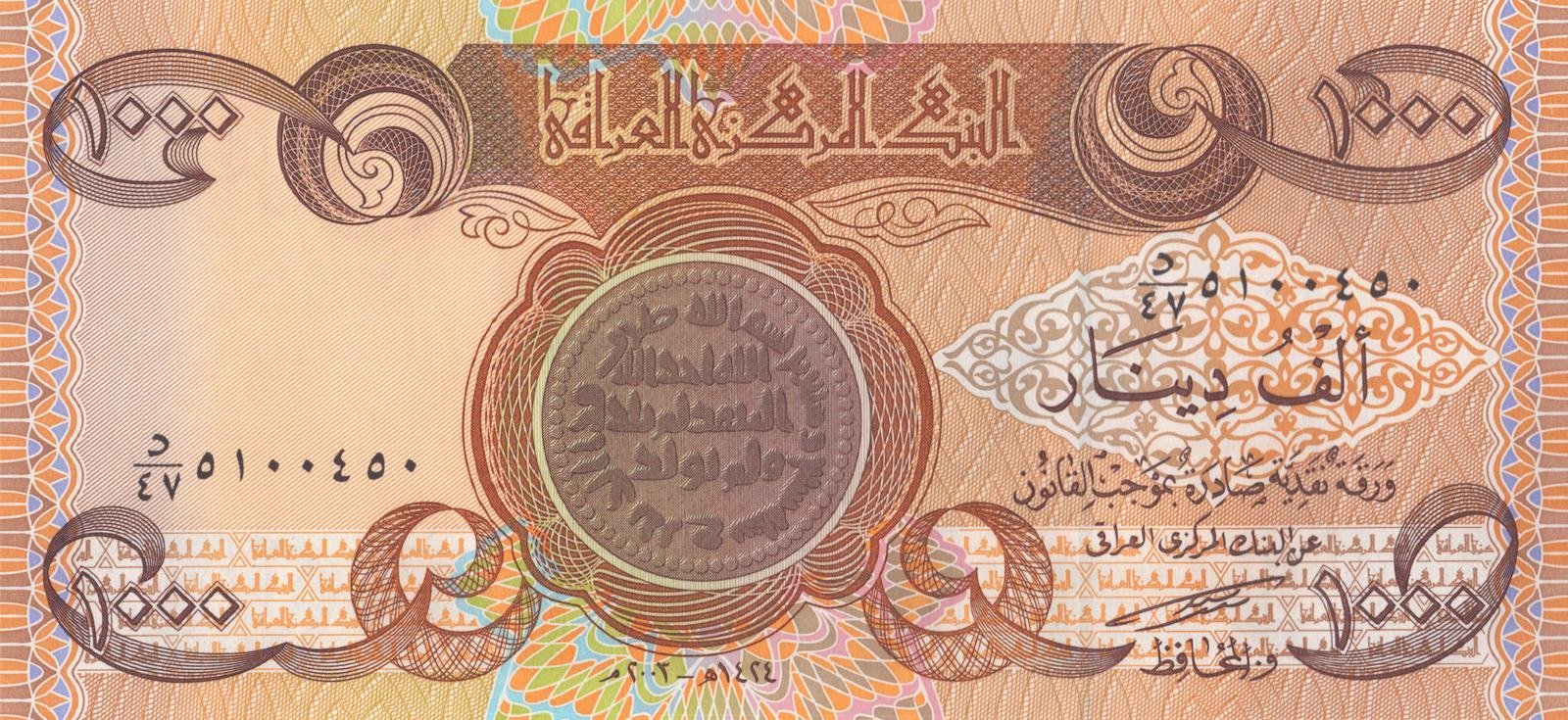
1,000 dinars · 2003 · P-93a · Front

1 dinar · 1979 · Reverse

1,000 dinars · 2003 · Reverse
Foote and his co-authors describe the use of modified plates from older designs for the replacement issue, with changes to denominations, colours and security features. The recurring motifs in these two notes provide a visible example of design continuity. The scans do not establish which individual physical plate produced either example.
The conspicuous change from 1 to 1,000 can suggest a different story if the images are read without the exchange documents. It was not a 1:1,000 conversion rule for Swiss dinars. A denomination is a value chosen for a particular note; a conversion rate relates the units of two currencies. Reusing a picture does not make those two numbers equivalent.
This is also why there need not be a one-to-one correspondence between the old and new denominations in a currency replacement. The new series can be organised around different amounts while balances are converted by a separate rule. Our wider guide to what happens when a country changes its currency examines that distinction across other reforms.
What to Record in a Collection
For the two 25-dinar notes, a useful description begins with the printed date and a precise catalogue reference. It can then add the type’s documented characteristics and withdrawal history. The term “Swiss” belongs in that historical explanation; it should not replace the type number or become an unsupported statement about the printer.
For example, the earlier note can be recorded as: Central Bank of Iraq, 25 dinars, dated 1982 / AH 1402, Pick P-72, The Banknote Book B329b. The catalogue records demonetisation in 1993. In the 2003 exchange framework, Swiss 25-dinar notes were subject to an exception requiring separate Central Bank instructions. The original place of use and exchange history of this individual example are unknown.
That description may appear more cautious than “worth 150 times the later issue”, but it preserves information that the shorter claim loses. It separates an object, a circulating currency, a historical conversion programme and today’s collectible. None is a substitute for the others.
The same-name problem is not unique to Iraq: our comparison of CFA francs and the Brunei–Singapore arrangement shows other ways in which currency names, parity and exchange rights can diverge. Iraq’s case is distinctive because a common monetary past left closely related designs on opposite sides of a practical currency divide.
The horses on the two 25-dinar notes survived that divide visually. The monetary relationship did not. What makes the pair worth studying is the distance between those two facts—and the unusually specific exchange provision that prevents the story from ending with a simple multiplication.
Frequently Asked Questions
What was the Iraqi Swiss dinar?
It was the name used for the older Iraqi currency that continued to circulate in the Kurdish-controlled north. For the 2003 conversion, Order 43 defined Swiss dinars as Central Bank of Iraq banknotes and coins issued from 1959 through 1989. The nickname is not a reliable statement of where an individual note was printed.
Were all Swiss dinar notes exchanged at 150:1?
Order 43 set a general rate of one Swiss dinar to 150 new dinars, but specifically excluded Swiss 25-dinar notes from the general exchange period. Their exchange depended on separate Central Bank instructions. The sources reviewed for this article do not establish the subsequent outcome for those notes.
Was the 1990 25-dinar note also a Swiss dinar?
The exchange order’s “1990 dinar” category began in 1990, while its Swiss category ended in 1989. The illustrated 1990 type, P-74b / TBB B331b, must therefore be distinguished from the earlier P-72 type despite their shared denomination and horse design. A broad political-era label is not enough to identify the monetary category.
Does the 2003 1,000-dinar design imply a 1:1,000 exchange?
No. The one-dinar and 1,000-dinar notes shown here share motifs, but their face values do not define the currency conversion. The official general ratios were 1:1 for the “1990 dinar” category and 150:1 for eligible Swiss dinars, with the separate Swiss 25-dinar exception.
Sources and Method
The four illustrated types were checked against original WorldBanknotes.eu scans and the Iraq chapter of The Banknote Book. Visible dates and motifs are distinguished from catalogue-derived security specifications and withdrawal dates. The illustrations preserve the original scans; display widths do not represent a common physical scale.
Order 43 is used for the legal categories and the 25-dinar exception. The earlier CPA public explanation supplies the announced plan but does not override that exception. King’s lecture and the study by Foote and his co-authors provide historical and economic accounts; they are not treated as wholly independent confirmations. Conflicting accounts of the length of the May 1993 exchange window are not resolved here. No later Central Bank instructions establishing the outcome for the excluded 25-dinar notes were located in the material reviewed.
- Coalition Provisional Authority: Order 43, New Iraqi Dinar Banknotes, 14 October 2003. Sections 1, 4, 5 and 6: definitions, exchange eligibility, conversion ratios and legal-tender transition.
- Coalition Provisional Authority: Iraq Currency Exchange. The public plan, including dates, ratios, bank accounts and contracts; and Currency Exchange Begins, 15 October 2003, for the start of the programme.
- Mervyn King: The Institutions of Monetary Policy, lecture delivered 4 January 2004, BIS Review 5/2004, pp. 7–11. The territorial and monetary separation, the old 25-dinar withdrawal and contrasting currency supplies.
- Christopher Foote, William Block, Keith Crane and Simon Gray: Economic Policy and Prospects in Iraq, Federal Reserve Bank of Boston Public Policy Discussion Paper 04-1, printed pp. 18–20. Exchange-rate observations, the choice of conversion ratio and production of the replacement notes.
- The Banknote Book: Iraq chapter, version dated 13 August 2026; entries B326a, B329b, B331b and B349a (Pick P-69a, P-72, P-74b and P-93a). Type identification, dates and specifications. Catalogue information does not establish the circulation history of the individual examples.
- Collection evidence: the four linked product records and their original front and reverse scans. Our catalogue methodology explains the distinction between observed details, reference information and interpretation.
About the Author
Audrius is the founder and curator of WorldBanknotes.eu, a catalogue and shop for collectible banknotes. His work focuses on banknote identification, catalogue structure, printing, design and the context behind individual issues. The catalogue methodology explains how observations, reference information and editorial classifications are distinguished.