
One Currency or Two? Reading Banknotes Across Borders
Two notes in our catalogue carry the number 500 and the words FRANCS CFA. One sits under Senegal; the other under Central African States. Their colours and pictures differ, but that alone would not settle the question: countries routinely put different designs on notes of the same currency. Are these two versions of one franc, or two different francs?
The answer is two currencies. Yet a pair of dollar notes from Brunei and Singapore leads to a different question. Those, too, belong to separate currencies, but an agreement connects their acceptance through the banking system. A shared exchange rate and an agreement to accept banknotes are not the same thing.
For a collector, the distinction affects more than a country label. It determines which currency a note belongs to, which institution issued it and what can reasonably be inferred from its wording. The examples below begin with the objects, then use official accounts to establish the relationships that the paper or polymer cannot show.
Two 500-Franc Notes, Two Currencies
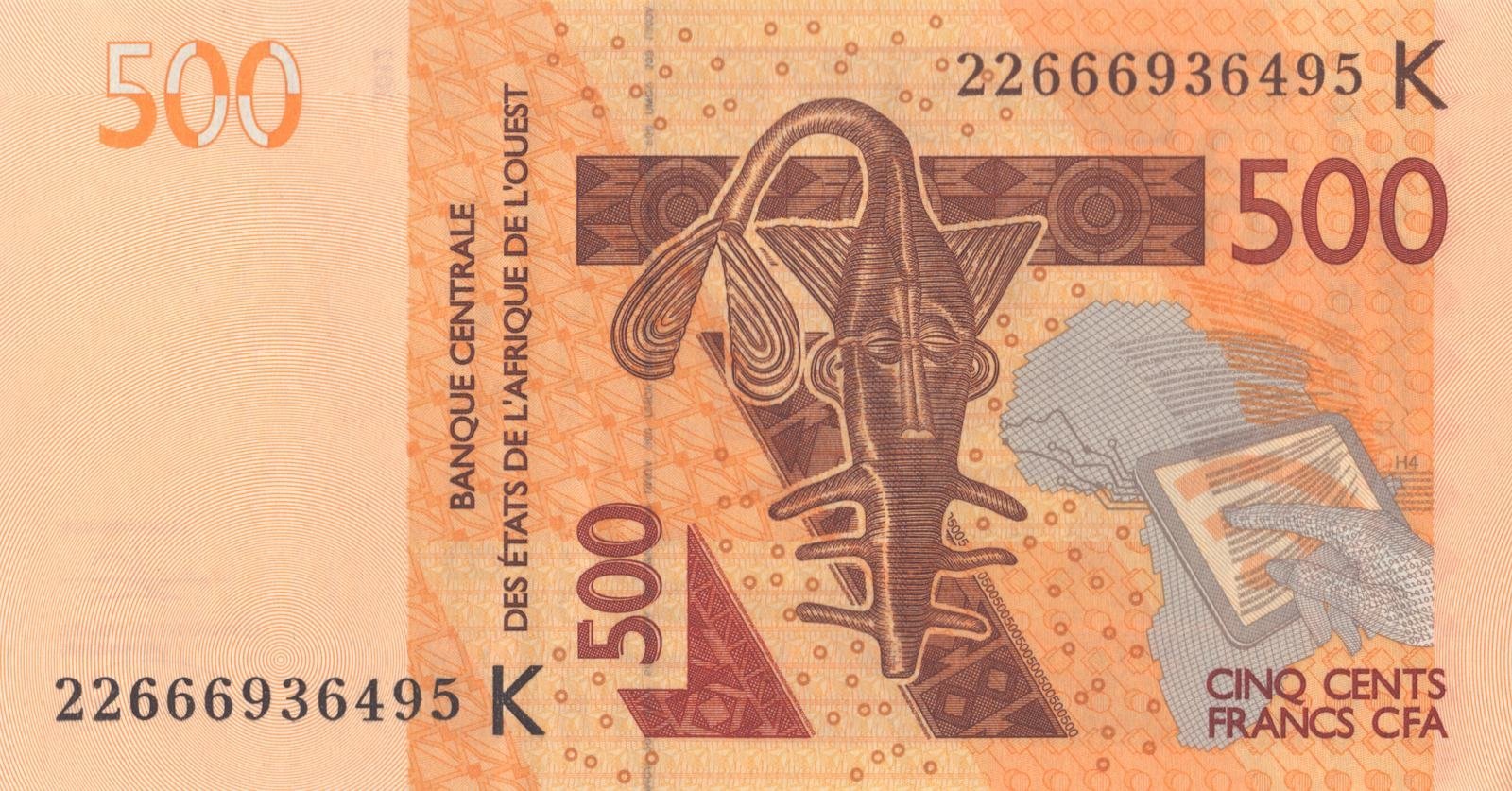
The orange West African note names the Banque Centrale des États de l’Afrique de l’Ouest (BCEAO). The Central African note names the Banque des États de l’Afrique Centrale (BEAC). Both use CFA in the denomination. The bank names, rather than the large numerals, provide the first useful distinction.
West African CFA franc — BCEAO
Central African CFA franc — BEAC

BEAC’s history of the CFA franc explicitly describes CFA franc as a name shared by two currencies. The Banque de France overview of the monetary arrangements identifies them separately as the West African CFA franc, XOF, and the Central African CFA franc, XAF. These codes distinguish monetary units; they are not additional denominations or words that must appear on the notes.
The initials also expand differently. For the West African currency, CFA refers to Communauté financière africaine; for the Central African currency, to Coopération financière en Afrique centrale. The similar abbreviations therefore conceal different institutional descriptions as well as different issuing banks.
This is not a matter of one country using an older design while another uses its replacement. Nor are the two notes merely regional printings of a single issuer’s issue. They belong to distinct monetary systems. The catalogue should preserve that distinction even when a short display title says only “500 francs”.
The country field needs its own care. “Senegal” is useful for locating this BCEAO variety, while “Central African States” groups the other note under a regional catalogue heading. One field names a state and the other a region; that difference in catalogue organisation does not decide how many currencies there are.
A Shared Rate Is Not a Banknote-Exchange Agreement
The similarity goes further than the name. The official histories of BCEAO and BEAC record the same euro parity from 1 January 1999: one euro to 655.957 CFA francs. Read with the two currency identities kept separate, that is EUR 1 = XOF 655.957 and EUR 1 = XAF 655.957.
At those stated parities, equal nominal amounts have the same euro equivalent. That is an arithmetic relationship between units. It does not, by itself, establish an obligation to accept another institution’s physical notes. The rate supplies no answer to who must take a note, through which channel, or under what conditions.
A Dated Example: the 1993 Repurchase Decisions
BCEAO’s historical account records two cross-zone decisions in 1993. BEAC suspended repurchases of its own notes exported to the West African monetary union, effective 17 September. BCEAO suspended repurchases of its own notes held in the Central African monetary union from 20 December. The direction matters: each decision concerned an issuing bank buying back its own currency notes from the other zone.
This historical evidence is more precise than saying that “the two francs could not be exchanged”. It identifies an institutional operation, the notes concerned and an effective date. It does not describe every possible private transaction, and it does not establish whether a commercial intermediary could arrange an exchange.
The modern examples discussed here are not evidence of what happened in 1993. Their inscriptions distinguish the two currencies; the historical account establishes the earlier repurchase decisions. Those decisions are dated examples, not a statement of the present availability or terms of cross-zone cash exchange.
There is a further distinction for a collecting catalogue: nominal parity is not collector-price parity. Two pieces can represent equal face amounts without being equivalent collectible objects. Their issue, variety, condition and provenance remain separate questions. Our guide to comparing banknote prices deals with comparing the objects offered for sale rather than converting their printed denominations.
Brunei and Singapore: Separate Currencies, an Agreement
Brunei and Singapore provide a useful contrast because an official agreement is part of the explanation. The relationship is not inferred from both countries using the word “dollar”, or from seeing the same symbol on their notes.
A joint historical account by MAS and Brunei’s monetary authority, published in April 2017, describes the change in 1967. On 12 June, Brunei, Malaysia and Singapore began issuing separate currencies in place of the shared Malaya and British Borneo dollar. The account describes interchangeability agreements between the participants, under which each undertook to accept the others’ currencies for exchange at par without charge.
It also records the agreements with Malaysia ending in May 1973, while the Brunei–Singapore arrangement continued. For this comparison, the important historical point is that separate currency issuance and continued cooperation existed together. Monetary separation did not necessarily mean ending every mechanism for accepting another territory’s notes.
The Brunei monetary authority’s account of its currency history calls the partner currency customary tender when it circulates in the country where it is not legal tender. The expression describes this arrangement; it should not be treated as a universal category applying to any foreign money that a shop happens to accept.
Two Names on One Brunei Note
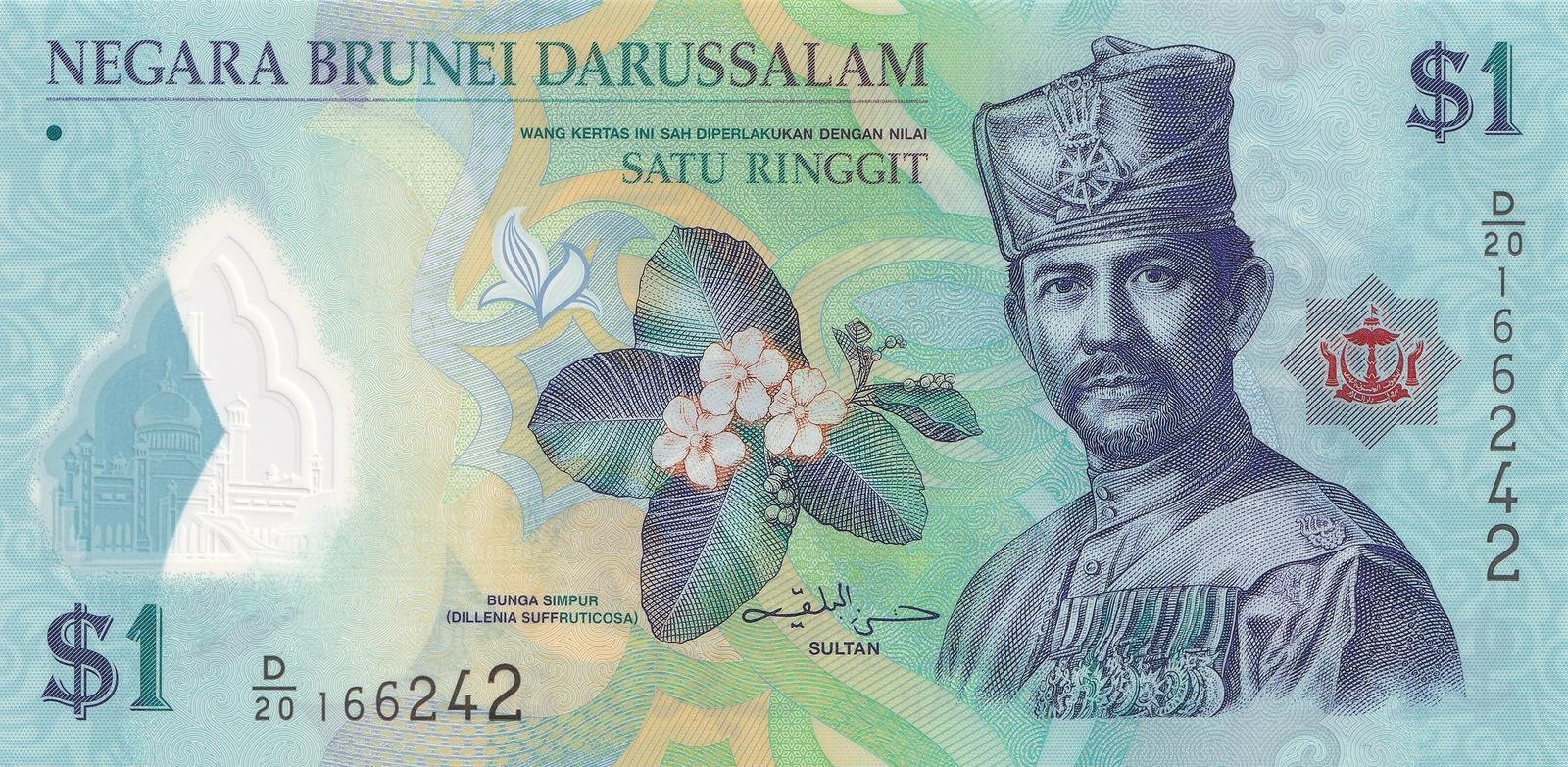
Our Brunei one-dollar note dated 2011 carries SATU RINGGIT on the front and ONE DOLLAR on the back. These are two language forms for the denomination on the same object. Reading “ringgit” alone and assigning the note to the Malaysian currency would discard the surrounding country name and the identity of the issue.
Front: SATU RINGGIT
Back: ONE DOLLAR
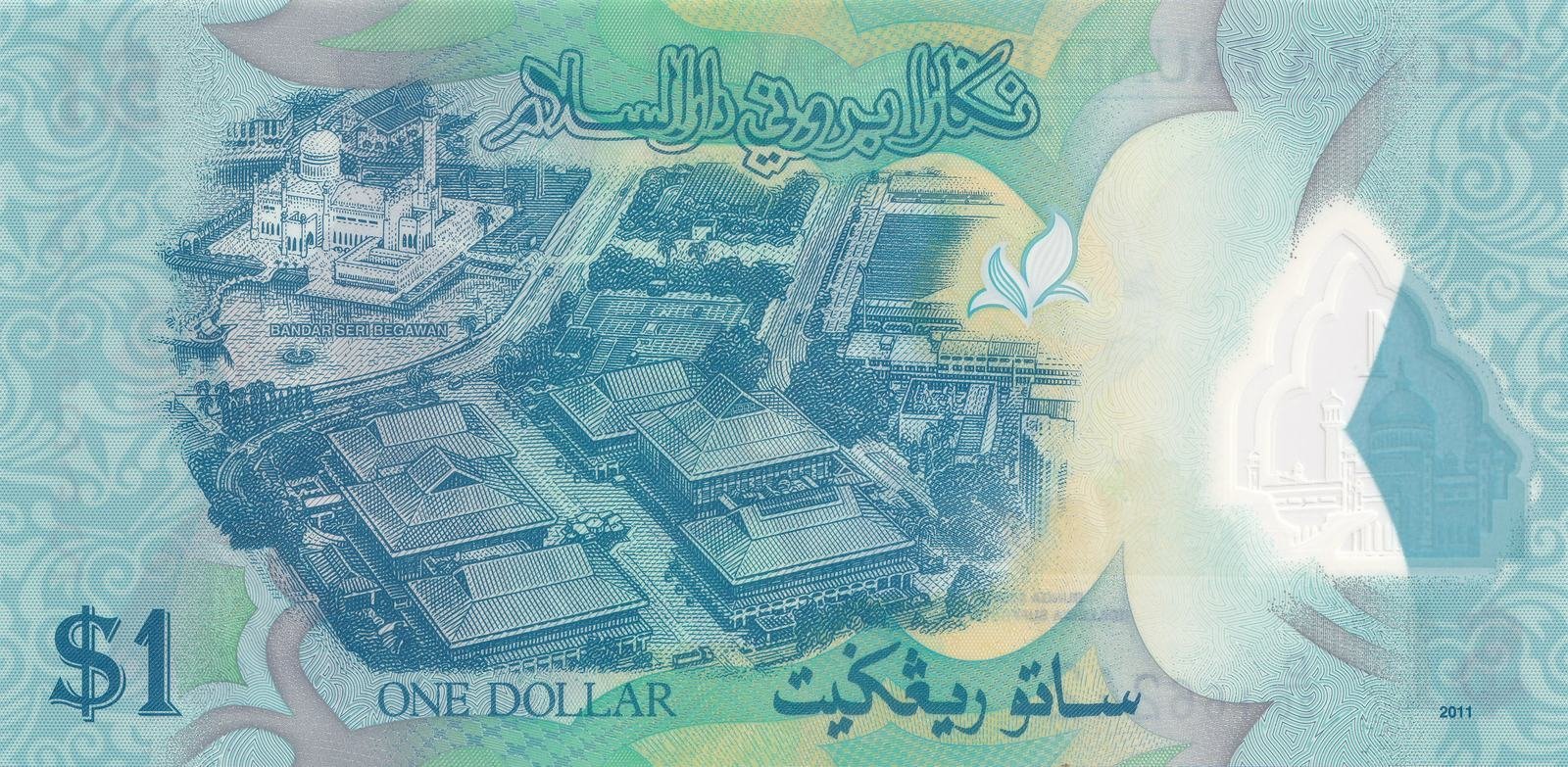
The country is easy to read; the issuing institution is less obvious. The Banknote Book places this 2011 type under Autoriti Monetari Brunei Darussalam, whose name is not printed on this issue. Here the inscription supplies a country, and the reference supplies the institution. Those are related observations, but they are not interchangeable.
The distinction also explains why a description should retain the original wording before normalising it into a catalogue field. A transcription can say SATU RINGGIT / ONE DOLLAR; the currency field can say Brunei dollar. Keeping both makes the identification easier to check. Our article on languages on banknotes explores the wider question of what changes between a note’s language versions.
Who Accepts the Other Currency?
The useful part of the Brunei–Singapore comparison is the allocation of responsibilities. MAS’s published description of the agreement separates two channels. The central banks accept the other’s notes and coins from banks and exchange them into their own currency at parity, without charge. Banks in the two countries accept the other currency for deposit from the public and businesses on the same nominal basis and without charge.
Those are not identical services. The first describes a central-bank operation involving banks. The second concerns a customer deposit. Neither wording should silently become a promise that any visitor can walk into any counter and demand any form of cash exchange. The source names the channel; a precise account should keep it.
The same care is needed with at par. In this account it means a one-for-one nominal relationship, not that every market use of the banknotes is indistinguishable. The expression does not remove the separate issuers or currencies. Nor does it turn the words “without charge” into a guarantee about every service a bank might provide.
Retail acceptance is another question. The MAS currency FAQs state that private individuals and businesses in Singapore cannot be forced to accept Brunei currency for goods or services. MAS encourages acceptance, but encouragement is different from an obligation. That statement is specifically about the Singapore side; it is not evidence for a matching conclusion about every merchant in Brunei.
What a Legal-Tender Inscription Does Not Tell You
The front of our Singapore one-dollar note, P-18a carries a legal-tender statement and identifies the Board of Commissioners of Currency, Singapore. Neither inscription sets out the terms of its treatment in Brunei. Reading the legend and reading the agreement are different research steps.
The institution’s name supplies a historical distinction, too. MAS’s currency history identifies the Board as the original issuer of Singapore dollars and dates its merger with MAS to 2002. The Banknote Book places P-18a in the earlier Board’s issues. Calling the note a Singapore dollar is correct; replacing its historical issuer with the institution responsible today would lose information.
That succession prevents another tempting shortcut: two issuer names do not always mean two currencies. The CFA examples involve different currencies; the Singapore example involves an institutional change within the same currency. The bank name is a clue to investigate, not a universal counting rule. For the broader distinction between circulation, acceptance and withdrawal, see our guide to what happens when a banknote stops being legal tender.
A Country Label Is Not a Currency Boundary
Return to the Senegal note. Its country allocation does not make it a separate Senegalese currency alongside a Togolese or Ivorian version. BCEAO’s communiqué on circulation within the monetary union explains that the country letters do not confine the legal-tender status of its notes to individual member states. This is the shared-currency case, rather than an agreement connecting two separate currencies.
The detailed reading of the Senegal letter and serial number is covered in our serial-number guide. Here it serves one narrower purpose: the territorial label in a catalogue can classify an issue without marking the limits of the currency itself.
These examples therefore require two kinds of restraint. Do not merge XOF and XAF merely because the notes share CFA wording. But do not split the West African CFA franc into national currencies merely because the catalogue separates its country allocations. The same habit—letting a short label decide the monetary identity—can produce opposite errors.
The general guide to banknote issuers explains the country–issuer distinction in more detail. In this comparison, it lets us keep the Senegal allocation without turning it into a separate currency.
Three Relationships to Keep Separate
| Comparison | Currency relationship | What establishes it | What not to infer |
|---|---|---|---|
| BCEAO country allocations | One West African CFA franc across the union | The common monetary system; the issuer’s circulation communiqué | A catalogue country letter creates a separate national currency |
| Brunei and Singapore | Separate dollars connected by an interchangeability agreement | The documented arrangement, including distinct banking channels | Every merchant must accept the partner currency |
| XOF and XAF | Two CFA francs with the same stated euro parity | Separate monetary systems and official parity accounts | The matching rate itself guarantees exchange of physical notes |
For an individual record, separate the wording on the note, its historical issuer, its currency and its catalogue allocation. Any claim about cross-border treatment comes after those four fields, not in place of them. Give that claim its own date and source rather than treating it as something visible in the scan.
The Senegal example can be recorded as 500 West African CFA francs; BCEAO; Senegal allocation, letter K; The Banknote Book B120Kk. The Central African example belongs in a different currency field: 500 Central African CFA francs; BEAC; Central African States; The Banknote Book B111a. The common word “francs” need not disappear, but it should not carry the whole identification.
For the Singapore example, the compact record is 1 Singapore dollar; Board of Commissioners of Currency, Singapore; P-18a / B119a. Its participation in the history of the Brunei–Singapore relationship is a further description, not a reason to change the currency to Brunei dollars or the issuer to today’s MAS.
A note’s wording is the starting point, not the complete monetary arrangement. The two CFA notes need their similar names separated; the Brunei note needs two language forms recognised as one denomination; the Singapore note needs its earlier issuer retained. Read that way, the banknotes remain individual objects while the documents explain the relationships between them.
Sources and Method
The object readings use original WorldBanknotes.eu scans, checked against the relevant country chapters of The Banknote Book. Catalogue entries establish issue identifications; official institutional sources establish the currency relationships described here. A note’s printed date is not used to date an agreement, and an issuer succession is not treated as a currency replacement.
The web sources were reviewed on 5 October 2026. The 1967 and 1973 developments and the 1993 repurchase decisions are historical accounts; the description of banking channels is attributed to MAS’s published explanation. This is not a current cash-exchange guide and does not certify that a particular old note is eligible for a present-day service.
- BEAC: Histoire du Franc CFA. Used for the two-currency distinction, regional issuers and parity history.
- Banque de France: Les coopérations monétaires Afrique-France. Separately identifies XOF and XAF and their issuing institutions.
- BCEAO: History of the CFA franc (parity and convertibility sections), and the communiqué on banknote circulation in the UMOA. The 1993 account concerns issuer repurchases, not all possible exchanges.
- MAS and AMBD: The Currency Interchangeability Agreement: Fifty Years On, Macroeconomic Review, April 2017, Box C, printed pp. 73–76 (PDF pp. 82–85). Institutional historical account, not the agreement text itself.
- MAS: Brunei–Singapore Currency Interchangeability Agreement, Currency FAQs and History of Currency in Singapore. Used separately for banking channels, retail acceptance and issuer succession.
- AMBD: 50 Years of Brunei Currency, Part 1, pp. 1–2. Used for the denomination and institutional history and the expression customary tender.
- The Banknote Book: Brunei, printed pp. 17–18 (AMBD introduction; B301 / P-35); Singapore, p. 10 (B119 / P-18); West African States, p. 33 (B120K / P-719K); Central African States, p. 14 (B111). Page numbers refer to the chapter copies consulted.
About the Author
Audrius is the founder and curator of WorldBanknotes.eu, a catalogue and shop for collectible banknotes. His work focuses on banknote identification, catalogue structure, printing, design and the context behind individual issues. The catalogue methodology explains how observations, reference information and editorial classifications are distinguished.