
What Is a Pick Number? How to Read Banknote Catalogue References

Two collectors describe the same banknote. One calls it a Costa Rican five colones with a portrait and some flowers. The other calls it Costa Rica P-236d, dated 1985. The second description can be looked up, compared and filed far more reliably.
A Pick number is a catalogue reference used to identify a banknote entry within the Standard Catalog of World Paper Money. It helps collectors distinguish similar notes, compare listings and organise collections, but it does not identify one individual banknote.
A complete Pick reference must be read together with the relevant country or issuing authority. P-20 alone is not globally unique: Netherlands Antilles P-20 and Qatar P-20 are unrelated notes found in separate catalogue sections.
A Pick number places a banknote within a catalogue. The date, signatures and other physical details determine how precisely that note has been identified.
This guide explains where the numbers come from, how the visible parts of a reference are constructed, which letters carry fixed meanings and which do not, what happens when a banknote has no Pick number at all, and where the system stops being able to help. It draws on the catalogue’s own account of its numbering practice, on the International Bank Note Society, and on catalogued examples from the WorldBanknotes.eu collection.
Table of Contents
What Is a Pick Number?
A Pick number, usually written as P-#, is the reference assigned to a banknote in the Standard Catalog of World Paper Money (SCWPM).
It is not normally printed on the banknote. It is added by the catalogue and then used by collectors, dealers, auction houses and collection databases.
A basic reference may look like this:
P-20
A more detailed or source-expanded reference may include a letter suffix, a prefix or a parenthetical subdivision:
Costa Rica P-236d
Cuba P-FX33
Fiji P-123(1)
Argentina P-364a(1)
The practical purpose is identification. “Costa Rica 5 Colones” describes a denomination, but it does not distinguish between the many 5-colón designs issued over time. “Costa Rica 5 Colones, P-236d” narrows the description to a particular catalogue family.
A Pick number does not tell you:
- the serial number of the individual note;
- its condition;
- whether it is genuine;
- how rare it is;
- what it should cost.
Those questions require separate evidence. Condition is a matter for grading, authenticity for examination of the note itself, and value for the market.
Collector’s Note: A Pick number is a catalogue identity, not a certificate of authenticity or value.
Why Is It Called a Pick Number?
The system is named after the German paper-money specialist Albert Pick (1922–2015).
Pick began collecting banknotes in Germany in 1930, when he was eight, and later studied philosophy, literature and history. By 1964 his private collection had reached some 180,000 notes, a scale beyond what a private collector could reasonably hold. It was taken over by the Bayerische Hypotheken- und Wechselbank, and Pick continued to expand it as the bank’s curator until his retirement in 1985. The International Bank Note Society recognises him as the author of the first comprehensive catalogue of world banknotes and credits him with establishing the modern shape of the hobby.
The Standard Catalog of World Paper Money was first published in 1975 and grew out of Pick’s earlier regional listings, including a paper-money catalogue of Europe from 1900 that appeared in 1970. His previously unpublished manuscripts on Africa, Asia and Oceania were folded into that first edition. The numbering system carried his name from then on, and it stayed attached to the catalogue even as later editors took over the editorial work.
The value of the system is shared communication. A full verbal description can be long and open to interpretation. A recognised catalogue reference gives collectors a concise starting point.
Instead of relying only on a description such as “the later Costa Rican five-colón note with Rafael Iglesias Castro and orchids”, a collector can begin with:
Costa Rica P-236d
The date, signatures and other catalogue details can then be added.
How Pick Numbers Are Assigned
Most collectors treat Pick numbers as if they were fixed facts about a banknote, in the way that a country name or a denomination is a fact. They are not. They are editorial decisions, and the catalogue is candid about this.
The 25th edition of Modern Issues describes the numbering as a proprietary system with a structure the editors follow when assigning numbers. Three consequences of that follow, and each one explains something collectors regularly find confusing.
Numbers are assigned with gaps. Countries do not release denominations in a convenient order. The editors therefore leave room for issues they expect to appear. When a country then releases a lower denomination than anticipated, the reserved space may not be enough, and the surrounding entries have to shift.
Renumbering happens. The catalogue states plainly that it tries to avoid changing a number once assigned, but does so when long-term logic requires it. New information from a contributor, the removal of a listing that turned out to be wrong, or the addition of a newly confirmed issue can all trigger a renumbering.
Style is not uniform across countries. The system has been maintained by many editors over five decades, each responsible for different parts of the catalogue. The result is that some country sections follow slightly different conventions, and the editors have chosen to preserve those local habits rather than rewrite large sections for consistency.
This matters more than it first appears. A Pick number encountered in a 1990s dealer list, an auction catalogue from 2008 and a current listing may not refer to the same entry. When an attribution looks unusual, the edition it came from is part of the evidence.
Collector’s Note: Record where a catalogue number came from, not only what it is.
How to Read a Pick Number

A Pick reference can often be divided into three visible parts, but it should not be treated as a universal decoding formula.
The P Prefix
The letter P conventionally marks a Pick or SCWPM catalogue reference.
It should not be confused with a serial-number prefix printed on the physical banknote. The catalogue itself does not print the P; in the book, entries appear under a number alone, sometimes shown with a hash. The P is a convention that grew up outside the catalogue, among dealers and collectors who needed to signal which numbering system they meant.
The Main Number
The numerical part identifies an entry within the relevant country, territory or issuing-authority section.
For example:
P-236
The number does not mean that this was the 236th banknote issued worldwide. It only has meaning inside its catalogue section. Nor does a high number indicate a modern note or a low number an old one in any absolute sense; it reflects how much material that particular country has generated and how the section has been reorganised over the years.
A Letter After the Number
A lowercase letter may separate a more specific catalogue subdivision:
P-236a
P-236b
P-236c
P-236d
These lowercase letters mark varieties within a listing. The catalogue assigns them chronologically and sets a threshold for inclusion: a difference must be of measurable significance and likely to affect value over time. A one or two millimetre difference in the spacing of a design element does not qualify.
The letters are intended to follow chronological order. When an earlier variety is reported only after later varieties have already been catalogued, the sequence may have to be reorganised. Depending on the catalogue entry, the distinction may involve a date, signature combination, printer, inscription, security feature, serial-number format or another recognised difference.
The letter itself is not a universal code. The suffix d does not always mean “fourth signature” or “fourth date”. Its meaning comes from the relevant catalogue entry.
Structural Letter Prefixes
A capital letter before the number, as in P-A47, is not a category of banknote. It is a structural device that lets the editors insert a new entry into a sequence that is already numbered, without renumbering everything after it.
The catalogue uses these letters when a printer changes, when a design or colour difference is too significant to treat as a variety but not large enough to be treated as a wholly new note, and most often when a previously unrecorded denomination in a series has to be fitted between numbers already assigned. P-A47 therefore sits between P-46 and P-47 rather than describing a kind of note.
Capital prefix letters do not encode a fixed category. Their exact reason must be read from the individual entry, while their structural role is to fit that entry into a sequence that is already numbered.
Structural Capital Suffixes
A capital letter can also appear after the main number, and this is easy to miss because it looks like a variety letter shouted in capitals. It is not. The 25th edition treats structural prefixes and structural suffixes as two separate devices.
A structural suffix is used to fit an entry into an established sequence, in the same circumstances as a prefix: a newly recorded denomination that has to sit between existing numbers, a printer change, or a design or colour difference too significant for a variety but not large enough to be treated as a wholly new note. The catalogue’s own cover copy for the 25th edition cites West African States #203Bf, where the capital B is a structural suffix and the lowercase f is the variety letter within it.
As with prefixes, the reason must be confirmed from the individual listing. What matters for a collector is reading the reference in the right order: number, then structural suffix, then variety letter.
Special-Purpose Prefixes: R, M and FX
Three prefixes work differently. They identify a category of issue rather than a position in a sequence, and their meaning is the same wherever they appear:
| Prefix | Meaning | Example |
|---|---|---|
| R | Regional issue, circulating in a defined area rather than nationally | P-R7 |
| M | Military issue | P-M32 |
| FX | Foreign exchange certificate | Cuba P-FX33 |
The Cuban example is worth holding on to. Foreign exchange certificates were not ordinary circulating currency; they were instruments issued for use by particular groups, often visitors or specific categories of transaction. Filing such a note in the ordinary numeric sequence would obscure what it is, which is why the catalogue separates it out.
Special Suffix Designations: s, r, p, ct and x
A small group of suffixes is reserved for particular kinds of catalogue entry rather than for varieties. Most have a standard meaning in the edition’s notation guide, but the individual listing still has to be checked, especially for r and for the older country sections where the conventions drifted.
| Suffix | Meaning |
|---|---|
| s | Specimen |
| r | Remainder or replacement-related entry (confirm from the listing) |
| p | Proof |
| ct | Colour trial |
| x | Error note |
A reference such as P-236s would identify a specimen associated with the P-236 entry rather than the next ordinary lettered variety. A specimen is an actual banknote overprinted or perforated with the word SPECIMEN in the language of the issuing country or of the printer, usually carrying zero or dummy serial numbers, and distributed to central banks, commercial banks and law-enforcement agencies so that the new issue can be recognised. Specimens are not legal tender or redeemable and therefore have no real face value, even though a denomination is printed on them. For some older high-denomination issues, a specimen may be the only form realistically available to collectors.
The suffix r needs particular care. The 25th edition’s notation guide gives it two meanings at once: replacement note and remainder note. These are entirely different objects. A replacement note is one substituted during production for a note rejected at inspection. A remainder is a note that was printed but never issued, often lacking signatures or serial numbers.
The suffix is therefore used for remainder or replacement-related entries, and its exact meaning must be confirmed from the individual listing and from the notation guide of the edition in hand. It is not a single universal category, and treating it as one will put two unrelated kinds of note in the same place in a collection.
Other Formats
References such as Fiji P-123(1) and Argentina P-364a(1) show that catalogue references do not all follow one simple pattern. Prefix letters, lowercase suffixes and parenthetical subdivisions may be used to preserve a more detailed attribution.
The parenthetical part needs care, because it is not described in the SCWPM’s own account of its notation. In Banknote.ws and in some dealer and database conventions, a parenthetical number marks a further subdivision below the variety letter, often a signature combination. Argentina P-364a(1) is the first Banknote.ws subdivision of P-364a, which is itself a variety of P-364.
Because it is not a universal SCWPM notation, its meaning and its source have to be recorded explicitly. A reference in that form signals that a source-expanded convention is being used, but it does not identify the source by itself. The database or catalogue still has to be named.
The safe rule is simple:
Record the full reference exactly as given by the source, and verify its meaning in that source’s relevant edition.
Truncating P-364a(1) to P-364 in a database loses information that cannot be recovered later without going back to the note.
Why the Same Pick Number Can Appear in Different Countries
Pick numbers are not globally unique when separated from their country or issuer.
Consider two real catalogue examples:
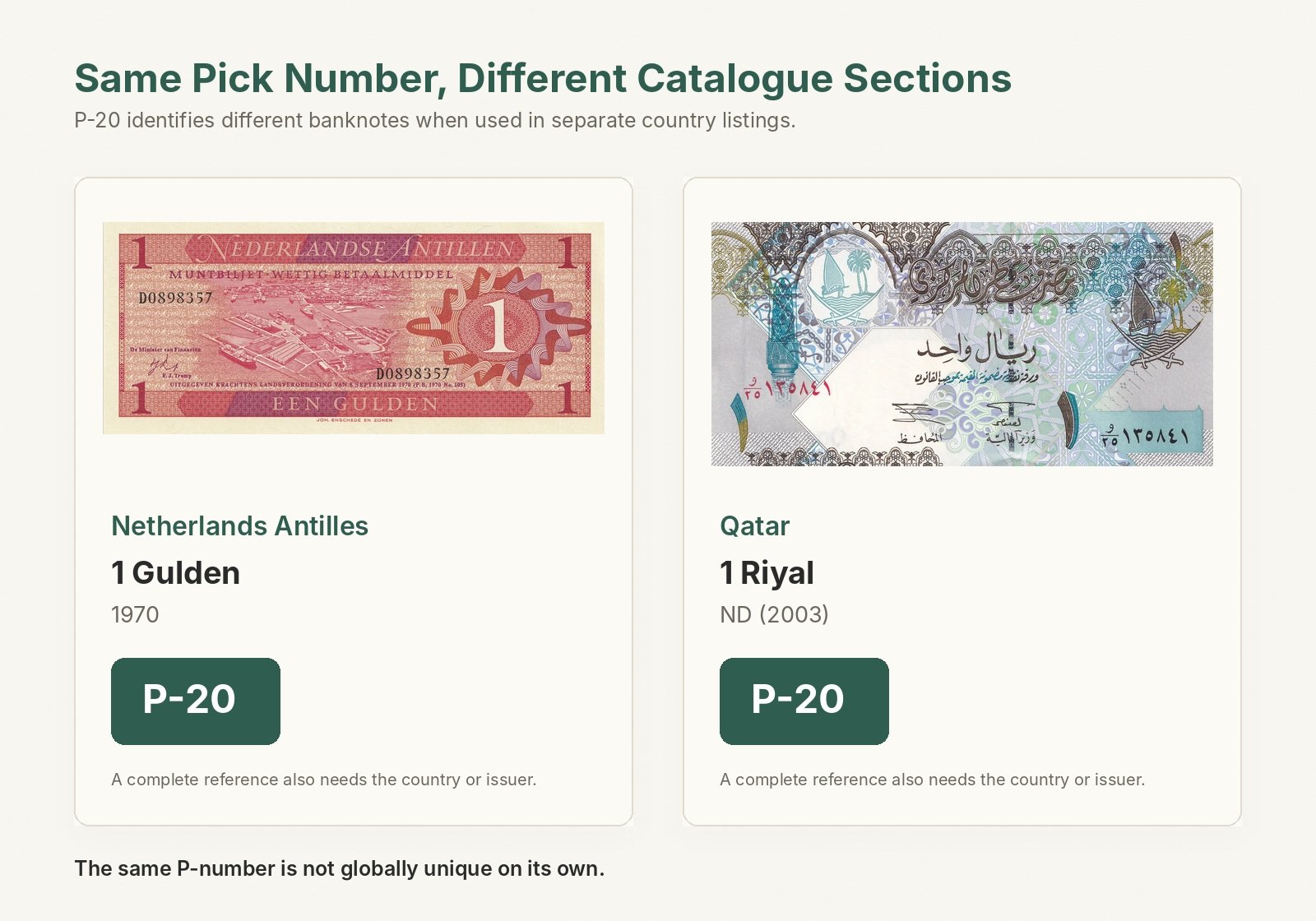
The notes have different issuers, currencies, designs and monetary histories. They both carry the reference P-20 because each appears in a separate catalogue section. One belongs to a Caribbean territory of the Kingdom of the Netherlands; the other to a Gulf state. Nothing connects them except their position in two unrelated catalogue sections.
For this reason, P-20 alone is incomplete. A useful description should include at least the country or issuing authority:
Netherlands Antilles P-20
Qatar P-20
A fuller sales or collection record may include:
Netherlands Antilles 1 Gulden 1970, P-20, UNC
Qatar 1 Riyal, ND (2003), P-20, UNC
“ND” means that no date is printed on the note; the year in parentheses is the attributed issue year. The catalogue also uses L or D where a note is dated by the law or decree that authorised it rather than by an issue date, and where several dates appear on one note, only the latest is used. Our guide to dating a banknote covers those cases in detail.
Because catalogue sections follow the historical country name rather than the current one, the section you need is not always the one you expect. Notes are listed under the state that issued them, so a territory that has since changed its name, merged or dissolved keeps its own section. Establishing the issuing authority is therefore the first step, not a detail to confirm afterwards.
Key distinction: The same P-number can identify unrelated banknotes in different country listings.
Banknote Types and Varieties
The difference between a type and a variety is central to catalogue work.
The exact boundary is not interpreted identically by every reference, but the general distinction is useful.
What Is a Banknote Type?
A new type is usually created by a substantial change such as:
- a new principal design;
- a different denomination;
- a change of issuing authority;
- a change in the currency unit;
- a major change in size;
- a major colour or structural redesign.
A type therefore describes the broader identity of the banknote. It is the level at which most collectors first organise a collection: one representative example of each catalogued design.
What Is a Banknote Variety?
A variety is usually a more limited difference within the same broader design or type. Common examples include:
- a different date;
- a different signature combination;
- a printer or printer-imprint change;
- a change in signatory title;
- a serial-number font or format;
- a change in printing method;
- a security-thread or other security-feature change;
- a minor inscription, design or colour difference.
| More likely to create a new type | More likely to create a variety |
|---|---|
| New principal design | Different signatures |
| Different denomination | Different date |
| New issuing authority | Different printer or imprint |
| Different currency unit | Serial-number format |
| Major size change | Security-feature change |
| Major colour redesign | Minor inscription or colour detail |
Replacement status can also define a catalogued variety, but the catalogue suffix and the marker printed in the serial number are different things. A terminal letter in a Pick reference does not prove replacement status on its own; the issue-specific test is explained in How to Identify a Replacement Banknote.
The boundary between the two columns is a judgement, not a rule. A change in substrate from paper to polymer is a good illustration: it usually comes with a redesign and produces a new type, but where an issuer has reprinted an otherwise identical design on a different material, catalogues have treated it as a variety.
This is why the wording “Other P-236 varieties” is appropriate on WorldBanknotes.eu. The block groups related notes without claiming that every item is a fundamentally different design type.
Why One Pick Reference Can Cover Several Dated Issues
The Pick number may not separate every date and signature combination into a different reference.
The catalogue is explicit about the reasoning. Where date spans can realistically be broken into individual listings, that is done. Where a series would generate too many dates with no meaningful difference in value, an inclusive date span is given instead and the individual dates within it are not listed separately. A date that does not appear is therefore not necessarily rare; it may simply not have been reported yet.
WorldBanknotes.eu records three Costa Rican 5-colón notes with the same Pick reference:
| Issue | Pick | TBB | Signatures |
|---|---|---|---|
| 1983 | P-236d | B522aa | Carlos Manuel Castillo Morales / Rigoberto Navarro Meléndez |
| 1985 | P-236d | B522ac | Eduardo Lizano Fait / Rodrigo Bolaños Zamora |
| 1986 | P-236d | B522ad | Eduardo Lizano Fait / Rodrigo Bolaños Zamora |

All three share the same principal design and Pick reference. The 1983 issue has a different signature pair, while the 1985 and 1986 notes share the same signatories but carry different dates.

The three TBB numbers record the distinctions that the Pick reference compresses. Where SCWPM has one entry, The Banknote Book distinguishes B522aa, B522ac and B522ad. Neither treatment is wrong. They answer different questions: one asks which catalogued design this is, the other asks which specific issue of that design.
This example shows why a Pick number can be the beginning of attribution without being the complete description.
A precise record may need:
- country;
- denomination;
- full Pick reference;
- issue date;
- signatures;
- printer;
- substrate;
- security features;
- another catalogue number, where useful.
The different TBB numbers in this example also show how a second catalogue can provide a more granular cross-reference while the Pick reference remains unchanged.
When a Banknote Has No Pick Number
This is a common situation with modern and incompletely catalogued issues. A note is issued, it circulates, it appears in dealer stock, and no Pick number exists for it.
The reason is structural. A catalogue is a snapshot of what was known when the edition was prepared. Between editions, central banks keep issuing notes. A recent issue may have been in circulation for years before it receives a number in a printed catalogue, and if editions become less frequent, that gap widens.
Two notations commonly describe the absence of a Pick assignment, and they are frequently treated as equivalent when they are not. A third row is added below because a later SCWPM edition may resolve the gap by inserting an official entry into the existing sequence:
| Notation | Origin | What it actually means |
|---|---|---|
| PNL or P-NL | General usage and specialist catalogues | No Pick number is listed in the reference being used. A statement about the source, not about the note. |
| W references | Banknote.ws and similar collector databases | Independent catalogue identifiers assigned to notes not covered by the established Pick sequence. Not official SCWPM assignments. |
| Possible later SCWPM assignment | Later SCWPM editions | Not a notation for absence. The gap may eventually be closed by an official entry, sometimes inserted into the sequence with a capital-letter prefix or suffix. |
The middle row is where mistakes happen. A W reference is not a provisional Pick number waiting to be confirmed. It is a separate database’s own identifier, assigned under its own editorial rules, and it may stay in use for many years without ever corresponding to an SCWPM assignment. Nothing guarantees that a note catalogued as W52 will one day become P-52, and nothing prevents the catalogue from placing it somewhere else entirely.
Recorded in the same field as Pick numbers, a W reference soon becomes indistinguishable from one. Recorded in its own field with its source named, it remains useful, because it may be the most practical identifier for a note not yet covered by the printed catalogue.
The safest practice when a note has no Pick number:
- record the Pick field as PNL rather than inventing a number, and note which reference and edition you checked;
- store any W reference or other database identifier in a separate field, named after its source;
- record the physical evidence in full, since the date, signatures and serial-number prefix are what will let the note be matched to a Pick number if one is ever assigned;
- note which sources you checked and when.
A note without a Pick number is not less collectable and not less real. It is simply ahead of its documentation, and it may stay that way.
Pick Number vs Serial Number, Series and TBB Number
These identifiers describe different aspects of a banknote.
| Identifier | What it describes | Example |
|---|---|---|
| Pick number | A catalogue reference for a banknote type or listed variety | P-236d |
| Serial number | One individual physical banknote | D51527170 |
| Series | A broader design or issue period | 1968–1992 Modern Colón Series |
| Denomination | The monetary face value | 5 Colones |
| Issue date | The printed or attributed date | 7 April 1983 |
| TBB number | A reference in The Banknote Book | B522aa |
The unit named in that last row matters as much as the figure beside it. Countries reuse both across reforms, and our guide to currency reform shows why two notes reading “50” can belong to different currencies.
Pick Number vs Serial Number
Many notes can share one Pick number. Each physical note normally carries its own serial number.
Two banknotes may therefore have the same Pick number, date and signatures but different serial numbers. They are separate examples of the same catalogue issue. The relationship runs one way: from a Pick number you cannot derive a serial number, but from a documented serial-number prefix you can sometimes narrow which catalogue variety a note belongs to.
Pick Number vs Series
A series is broader. It may contain several denominations, Pick numbers, dates and signature combinations.
The Pick number usually points to a more specific position within that wider series. A collector working through a series is really working through a set of Pick numbers, which is why an incomplete series is easy to see at a glance once the numbers are written down.
Pick Number vs TBB Number
Pick and TBB numbers belong to different catalogue systems.
The Banknote Book was begun in 2011 by Owen W. Linzmayer, formerly editor of the IBNS Journal, with an initial release of ten country chapters. It was acquired by CDN Publishing in 2021 and by 2024 had grown past 320 chapters and 9,600 pages, covering close to 100,000 types and varieties, published digitally by subscription rather than as fixed editions.
That publishing model is the source of the practical difference. Weekly digital revisions allow new information to be incorporated far more frequently than a fixed printed edition can. TBB references from The Banknote Book may therefore divide some modern issues more finely, as the Costa Rican example above shows.
Pick references nevertheless remain widely recognised in dealer listings, auctions and older collections, and half a century of published material is indexed to them. They should not be treated as direct translations of one another. Recording both can make a collection easier to compare across references.
The Wider Catalogue Landscape
Pick and TBB are two widely encountered reference systems, but they are not the only ones, and knowing what else exists prevents a lot of confusion.
The SCWPM itself is not one book. It is divided by period and by kind of issue: Modern Issues covering 1961 to the present, General Issues covering 1368 to 1960, and Specialized Issues covering state, local, municipal and company releases that circulated under recognised regional authority. A note that seems to be missing from the catalogue is sometimes in a different volume rather than absent.
Alongside these sit national and specialist catalogues, auction-house attributions, grading-service labels and collector databases, several of which maintain their own numbering. No single system governs all the others; each is authoritative only within its own editorial framework. They are parallel descriptions of the same objects, and the useful discipline is to record which system a number came from rather than to decide which system is correct.
How Collectors Use Pick Numbers
Pick numbers are practical tools.
Searching for a Banknote
A search for:
Costa Rica P-236d
is much more focused than a search for “Costa Rica 5 Colones”.
Adding the year makes it more precise:
Costa Rica P-236d 1983
Dealers write the same reference in several ways, so a search that returns nothing has not necessarily proved anything. P-236d, P236d, Pick 236d and #236d all appear in listings, and a search worth trusting has covered more than one of them.
Comparing Listings
Different sellers may describe the same note differently. The Pick number creates a common starting point for comparing:
- date;
- signatures;
- condition;
- printer;
- security features;
- price.
Where two listings carry the same Pick number at very different prices, the difference may reflect date, signatures, grade, seller pricing or a misidentified variety. The reference in a listing still needs to be checked against the image and technical description.
Organising a Collection
Pick numbers work well as structured fields in:
- spreadsheets;
- collection-management software;
- album labels;
- want lists;
- dealer inventories;
- sales records.
A useful collection record might contain:
Country — Issuer — Currency — Denomination — Date — Pick — TBB — Signatures — Condition — Serial Number — Purchase Price — Purchase Date
Tracking Missing Notes
A type collector may seek one representative note for each main Pick entry.
A specialist may go further and collect every date, signature, printer, prefix or recognised variety.
The catalogue provides the structure; the collector chooses the level of completeness. This is also where the limits of the catalogue become visible in a useful way: a specialist working through a series will often find issues that exist but are not listed, which is how new material reaches catalogue editors in the first place.
Recording Pick Numbers in a Database
As a collection grows, many collectors move it into a spreadsheet or a database, and at that point the Pick number stops being a label and becomes a data field. It is a difficult one, because it is not a number and does not sort correctly.
Four problems appear consistently:
Sorting. Sorted as text, P-100 comes before P-20. Sorting correctly requires the numeric part to be separated from the letters, which means the reference has to be stored in parts as well as whole.
Inconsistent notation. The same note arrives as P-236d, P236d, Pick 236d and #236d depending on the source. Normalising to one form on entry, while keeping the original string, prevents the same note appearing twice.
The country is not optional, and it is not sufficient either. Country or issuer plus the full catalogue reference is the minimum scope key; a database keyed on the reference alone will silently merge unrelated notes. But it is not always a unique issue key. Where several dates or signature combinations share one Pick reference, as the Costa Rican notes above do, the date and the relevant variety fields have to be part of the key as well. The reference system belongs in it too, because identical-looking numbers from different systems must not be merged:
Country or issuer + reference system + normalised full reference + date + canonical variant
Identifiers from other systems contaminate the field. As described above, a W reference or any other database identifier stored in the same column as SCWPM numbers will eventually be read as a Pick number by someone, including by your future self.
A structure that avoids all four keeps the reference in more than one column:
| Field | Holds | Example |
|---|---|---|
| Country or issuer | The catalogue section | Argentina |
| Reference system | System or database supplying the complete form | Banknote.ws, based on SCWPM P-364a |
| Original source string | Reference exactly as the source shows it | 364a(1) |
| Normalised reference | Standardised form used in the collection | P-364a(1) |
| Structural prefix | Capital insertion letter, such as A, B or C | empty |
| Category prefix | R, M, FX and other defined prefixes | empty |
| Main number | Numeric part only, for sorting | 364 |
| Structural suffix | Capital letter after the number | empty |
| Variety suffix | Lowercase variety letter | a |
| Parenthetical subdivision | (1), (2) and similar | (1) |
| Special designation | s, r, p, ct, x | empty |
| Source | Exact reference page or edition | Banknote.ws Argentina P-364 listing |
| Other reference system | Name of any second system used | not recorded |
| Other reference value | The number in that second system | not recorded |
Most of these fields stay empty for most notes, which is the point: the same structure holds P-236d, P-A47, P-FX33, West African States 203Bf and P-364a(1) without losing any part of any of them. Recorded this way, a collection can be sorted correctly, compared against a catalogue, matched across sources and searched by any of its parts. Recorded as a single free-text field, it can only be read.
Every WorldBanknotes.eu product page follows this principle: the catalogue reference is stored and displayed as its own field, and the country, issuing authority, currency, series, date and signatures are stored as theirs.
How to Identify a Banknote Correctly
Do not assign a Pick number by matching only the portrait or denomination. The sequence below moves from the widest evidence to the narrowest, which is the order that avoids the most mistakes. Our full identification guide covers each stage in more depth.
1. Establish the Country and Issuer
Identify the country, territory, central bank, currency board, treasury or private issuer. This determines which catalogue section to use, and getting it wrong makes every later step meaningless.
2. Confirm the Denomination and Currency
Read both the numeral and the written currency unit. Countries may reuse the same denomination after reforms or redesigns, and a currency reform that removes three zeros produces two very different notes with the same printed number.
3. Compare the Principal Design
Check the portrait, main vignette, reverse scene, size, dominant colours, layout and issuer name.
These features usually establish the broad type. Our guide to banknote design and symbolism explains what these elements are chosen to communicate.
4. Examine the Date and Signatures
The same design may exist with different issue dates, signatories or signatory titles.
These details often determine the precise variety. They are also often omitted from dealer listings, which is why photographing them is worth doing.
5. Check Printer and Security Details
Where relevant, compare:
- printer imprint;
- watermark;
- security thread;
- substrate;
- serial-number style;
- UV features;
- minor inscription changes.
Several of these become visible when the note is held up to a light source, as our guide to checking a banknote against the light describes. Others depend on knowing how the note was printed.
6. Verify the Full Reference
Compare the banknote with a recognised catalogue, specialist reference or confirmed example.
Collector’s Note: A seller’s catalogue number is evidence to verify, not proof by itself.
The Limitations of Pick Numbers
Pick numbers are useful, but they are not a complete description of every observable difference.
Not Every Difference Is Separately Catalogued
Specialists may identify differences in:
- plate position;
- paper or substrate;
- UV printing;
- serial-number ranges;
- colour intensity;
- minor engraving details;
- production batches.
Some may matter to collectors without receiving a separate Pick reference. The catalogue applies a threshold deliberately: a difference is listed if it is measurable and likely to affect value, which means that differences that are real but commercially insignificant are left out by design rather than by oversight.
Catalogue Editions Can Differ
A catalogue is a snapshot of the information available when that edition was prepared.
Later editions or specialist references may:
- add newly reported dates or signatures;
- change the treatment of a variety;
- insert a new entry;
- correct an earlier attribution;
- use a different level of detail.
Record the catalogue source and edition when an attribution is unusual or disputed. This is not pedantry. Two collectors quoting different numbers for the same note are often both right, and the disagreement dissolves the moment each states which edition the number came from.
A Pick Number Does Not Determine Value
A Pick number does not show that a note is rare, expensive or desirable.
Value depends on condition, scarcity, demand, variety and market context. The catalogue does print valuations, but it says of them what any careful source would: they are a guide, they were fixed at a cut-off point before printing, and regional demand and availability move them. A price in a book that has been on a shelf for several years is a historical record, not a quotation.
A Pick Number Does Not Prove Authenticity
A counterfeit, altered note or replica can be advertised with a genuine catalogue reference.
Authentication still depends on the physical banknote and its features. A correct catalogue number in a listing tells you the seller has identified what the note is supposed to be. It tells you nothing about whether the object in the envelope matches that description, which is a question for the security features of the note itself.
Common Mistakes With Pick Numbers
Most errors with catalogue references are not errors of knowledge. They are shortcuts that seemed reasonable at the time.
Recording the number without the country. Among the hardest errors to repair later, because a list of bare P-numbers cannot be reconstructed without going back to every note.
Dropping the suffix. P-236d is a specific variety within the P-236 listing. Shortening it in a spreadsheet reduces it to an incomplete base reference and loses the variety attribution, which is often the reason the note was worth buying.
Treating another system’s identifier as a Pick number. A W reference from a collector database is that database’s own number, not an SCWPM assignment waiting to be confirmed. Copied into a collection record without a source label, it soon becomes indistinguishable from a Pick number.
Assuming the letters always remain fixed. Variety letters are intended to follow chronological order, but newly reported information can force an existing sequence to be revised. Reading d as “fourth date” or a as “first signature” works often enough to be dangerous.
Assuming a missing date means a rare note. The catalogue states the opposite: an unlisted date may simply be one that has not been reported. Scarcity has to be established from the market, not from a gap in a list.
Trusting one source and stopping. A reference supported by multiple independent sources is stronger than one appearing in a single sales listing. Even then, the attribution should be checked against the physical note and the underlying catalogue entry.
Assuming a number is permanent. Renumbering is part of how the catalogue works. Numbers copied from older editions may no longer point to the same entry.
Final Thoughts
A Pick number is one of the most useful organising tools in world banknote collecting.
Its basic function can be summarised as:
Pick number = catalogue identity
Serial number = individual note identity
The essential skill is knowing when the Pick reference is not enough.
Country, issuer, date, signatures, printer and security features may all be needed for precise attribution. It is worth remembering what the system actually is: a set of editorial decisions, made over five decades by many hands, about how to impose order on objects that governments never intended to be catalogued. Its gaps, inconsistencies and renumberings follow from that, and so does its usefulness.
Used carefully, the Pick system becomes more than shorthand: it provides a framework for studying how banknotes evolve across designs, institutions and time. If you are building a collection from the beginning, recording references properly from the first note is one of the few decisions that costs nothing now and saves a great deal later.
Frequently Asked Questions
What does the P stand for in a Pick number?
The P conventionally identifies the Pick catalogue-reference system named after Albert Pick. It is a convention used by dealers and collectors rather than something printed in the catalogue itself.
Is the Pick number printed on the banknote?
Normally, no. It is assigned by a catalogue and used by collectors, dealers and auction houses.
Can two countries have the same Pick number?
Yes. Pick numbering is organised within separate country or issuer sections. Netherlands Antilles P-20 and Qatar P-20 are unrelated notes.
What do letters after a Pick number mean?
A capital letter immediately after the main number may be a structural suffix used to fit an entry into an existing catalogue sequence. A lowercase letter such as a, b or c normally identifies a variety within that entry. The reserved lowercase designations s, r, p, ct and x have special catalogue uses, while parenthetical subdivisions may come from another database or dealer convention. The exact meaning must always be checked against the named source and edition.
Can different dates share the same Pick number?
Yes. Costa Rica P-236d appears with several issue dates, including 1983, 1985 and 1986.
Is a Pick number the same as a serial number?
No. A Pick number identifies a catalogue entry shared by many notes. A serial number identifies one physical note.
Do all banknote catalogues use Pick numbers?
No. Pick is a widely recognised system, but specialist catalogues and databases may use their own numbering systems, including TBB references from The Banknote Book.
What does PNL mean in a banknote listing?
PNL means Pick not listed. It states that the reference being used does not assign a Pick number to that note. It does not explain why: the note may be recent, omitted, specialised, unissued or outside the scope of that catalogue.
Do Pick numbers ever change?
Yes. The catalogue leaves gaps for anticipated releases and renumbers entries when new information requires it. A number quoted from an older edition may not point to the same entry today, which is why the edition is worth recording alongside the number.
Should I record the Pick number or the TBB number?
Both, in separate fields. Pick references remain widely used in dealer listings and auctions, while The Banknote Book often distinguishes modern issues more finely. Recording each with its source makes a collection comparable across both systems.
Selected References
The sources below were consulted directly for this guide.
- International Bank Note Society — Albert Pick, for his biography, the 1975 first edition and his recognition as author of the first comprehensive world banknote catalogue.
- Standard Catalog of World Paper Money: Modern Issues, 1961–Present, 25th edition, edited by Tracy L. Schmidt, Krause Publications, 2019, for the catalogue’s own account of prefix and suffix letters, variety designations, renumbering practice and date policy.
- Numista — Standard Catalog of World Paper Money, for the publication history of the catalogue and its predecessor regional listings.
- CDN Publishing — The Banknote Book, for the history, scale and publication model of the TBB reference system.
- International Bank Note Society — Grading Standards, for the condition terminology used alongside catalogue references.
- International Bank Note Society, The IBNS Introduction to Banknotes & Banknote Collecting, for general background on banknote features, manufacture and collecting.
- Banknote.ws — Fiji dollar listings, for examples of W-prefixed database references used outside the established SCWPM sequence.
- Banknote.ws — Argentina P-364 listing, for the parenthetical subdivisions 364a(1), 364a(2) and 364a(3).
- Greysheet / The Banknote Book — Belarus B145a, for an entry carrying a separately assigned BNB reference recorded with Pick #: PNL.
Catalogue numbers and descriptive data are used here for identification and comparison only. The examples shown are notes documented from the WorldBanknotes.eu collection.
About the Author
Audrius is the founder and curator of WorldBanknotes.eu, a specialised catalogue and marketplace dedicated to collectible banknotes from around the world. His work focuses on banknote identification, catalogue structure, design, symbolism and the historical context behind individual issues. Every note offered is examined, photographed and catalogued individually, and the examples in this guide are drawn from that documented material.
Explore Banknotes by Catalogue Reference
Every WorldBanknotes.eu product page presents the recorded catalogue reference alongside its issuing authority, currency, series, date, signatures and other technical information. Where the reference is not an official SCWPM assignment, its source should be identified.