
When Leaders Disappear from Banknotes: What Actually Changes?
Jomo Kenyatta appears twice on our Kenyan 100-shilling banknote dated 16 July 2010. His portrait dominates the front. On the back, a statue of the same man sits beside the Kenyatta International Convention Centre. On the 2019 note, the portrait is gone, but the statue has become part of the main design on the front.
The change raises a more interesting question than who replaced whom. What, exactly, was removed: a face, a form of political representation, or the authority behind the money? And did removing the portrait make the older note invalid?
Original notes from Kenya, Zambia and Nepal let us follow those questions through three different changes. The images show what disappeared and what survived. Regulations, central-bank reports and a court judgment explain consequences that cannot be read from a missing face.
The Statue Already on the Back
Look first at the seated figure, rather than the large portrait. Our older Kenyan note places the monument within a view of the KICC complex on the reverse. The later design gives it much greater prominence on the front. The subject is the same, although the two renderings are different: this is not an identical engraving transferred between sides.
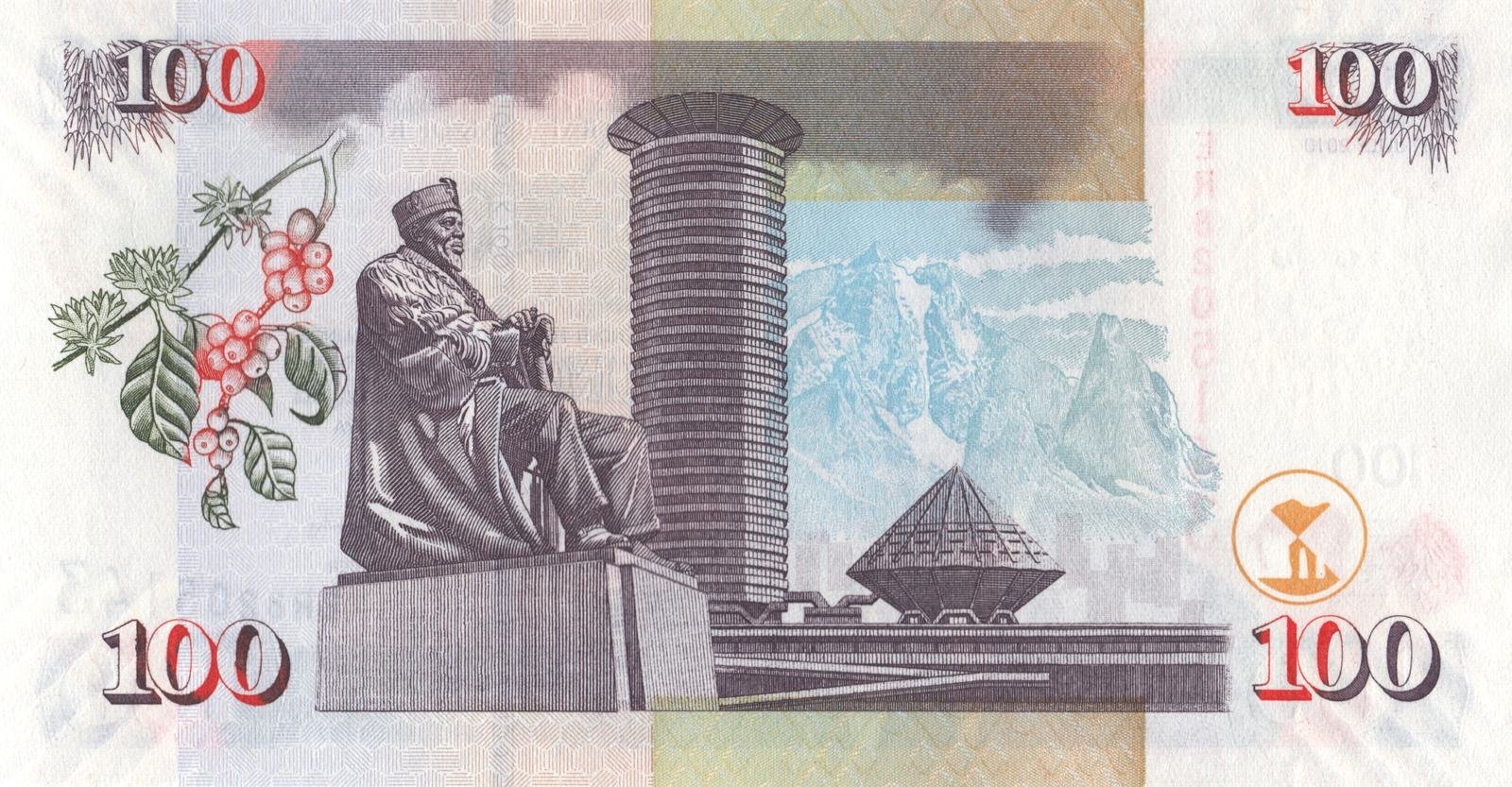
2010 note · Reverse detail
2019 note · Front detail
A catalogue description saying only “Kenyatta removed” would miss that continuity. A description saying “Kenyatta retained” would miss the disappearance of the portrait and the new legal setting. Both observations need to specify which image they mean.
This is also a useful distinction when comparing supposedly reused pictures. A monument can recur without the printer reusing the same engraved image. Our guide to shared images on banknotes separates the depicted subject from the source image and the final rendering. Here, that distinction became part of a constitutional dispute. First, however, consider a case in which the portrait itself entered a legal definition.
Zambia: A Portrait in a Legal Definition
Our two Zambian 20-kwacha notes are easy to distinguish at a glance. The undated P-32b has Kenneth Kaunda on the right and a flying fish eagle on the left. P-36a, bearing the printed date 1992, replaces the large portrait with a perched fish eagle and a tree. The composition changes substantially, but several elements connect the notes.

20 kwacha · P-32b · Undated

20 kwacha · P-36a · Printed date 1992
The eagle and national arms remain on the front, as does the promise to pay the bearer on demand. Both reverses show the Freedom Statue. Removing Kaunda did not require removing every familiar emblem or replacing the denomination. Those continuities can be observed directly, without assigning an unrecorded motive to the designer.
The legal connection appears in the 1993 Call in and Surrender of Currency Regulations. Regulation 2 distinguishes old currency bearing Kaunda’s portrait from new notes without it, together with specified denominations. The definition of new currency lists K20, K50, K100 and K500 notes. The old-currency definition covers a stated list of notes and coins. It is not a rule about every conceivable item with his face.
Our 20-kwacha comparison falls within those listed note denominations. In this case, the portrait was more than a convenient visual clue for a collector: its presence or absence formed part of the instrument’s description of the money being replaced.
Regulation 4 allowed surrender through commercial banks from 30 November 1993 to 31 January 1994. Separately, regulation 5 set 31 January 1994 as the date the defined old currency ceased to be legal tender. The consolidated text incorporates amendments made in 1993. The surrender period and the legal-tender provision are distinct, even though they share an endpoint.
The document does not tell us who chose the replacement design, why the eagle was given this position, or precisely when P-36a first entered circulation. The visible 1992 is a printed date, not evidence of a particular release day. The legal instrument supplies a later status change; it should not be made to supply a design history it does not contain.
Nepal: More Than the King’s Portrait
Our Nepalese 20-rupee pair presents a subtler comparison. The temple, column, denomination and much of the arrangement are familiar across both notes. Gyanendra’s portrait gives way to Mount Everest. Read the line above the promise text, however, and another change becomes visible.

20 rupees · P-47a · Undated

20 rupees · P-62b · Undated
P-47a · Royal-government guarantee
P-62b · Government of Nepal guarantee
The earlier line reads श्री ५ को सरकारको जमानत प्राप्त, naming the royal government in the guarantee. On the later note it reads नेपाल सरकारको जमानत प्राप्त, naming the Government of Nepal. Nepal Rastra Bank’s institutional catalogue of notes and coins translates the royal wording as a guarantee by His Majesty’s Government.
The change concerns the government named in the guarantee, not the name of the central bank. “Nepal Rastra Bank” remains on both notes. Treating every alteration as simply a portrait replacement would lose that distinction between the person pictured, the government named and the issuing institution.
The sequence was not a single clean swap. According to The Banknote Book, 5- and 20-rupee types introduced in September–October 2006 changed the government wording while still carrying the king’s portrait. Our later pair shows the two states clearly, but those intermediate catalogue entries establish why the text and portrait changes should not be assigned one date merely because they are seen together in a before-and-after illustration.
The Arms on the Reverse
Turn the same pair over. The earlier reverse includes arms with a royal crown on the right. On the later note that emblem is absent and the landscape occupies the area. The deer scene remains. A collector checking only the front would record the missing portrait but overlook a second royal image removed from the other side.

P-47a reverse · Royal arms
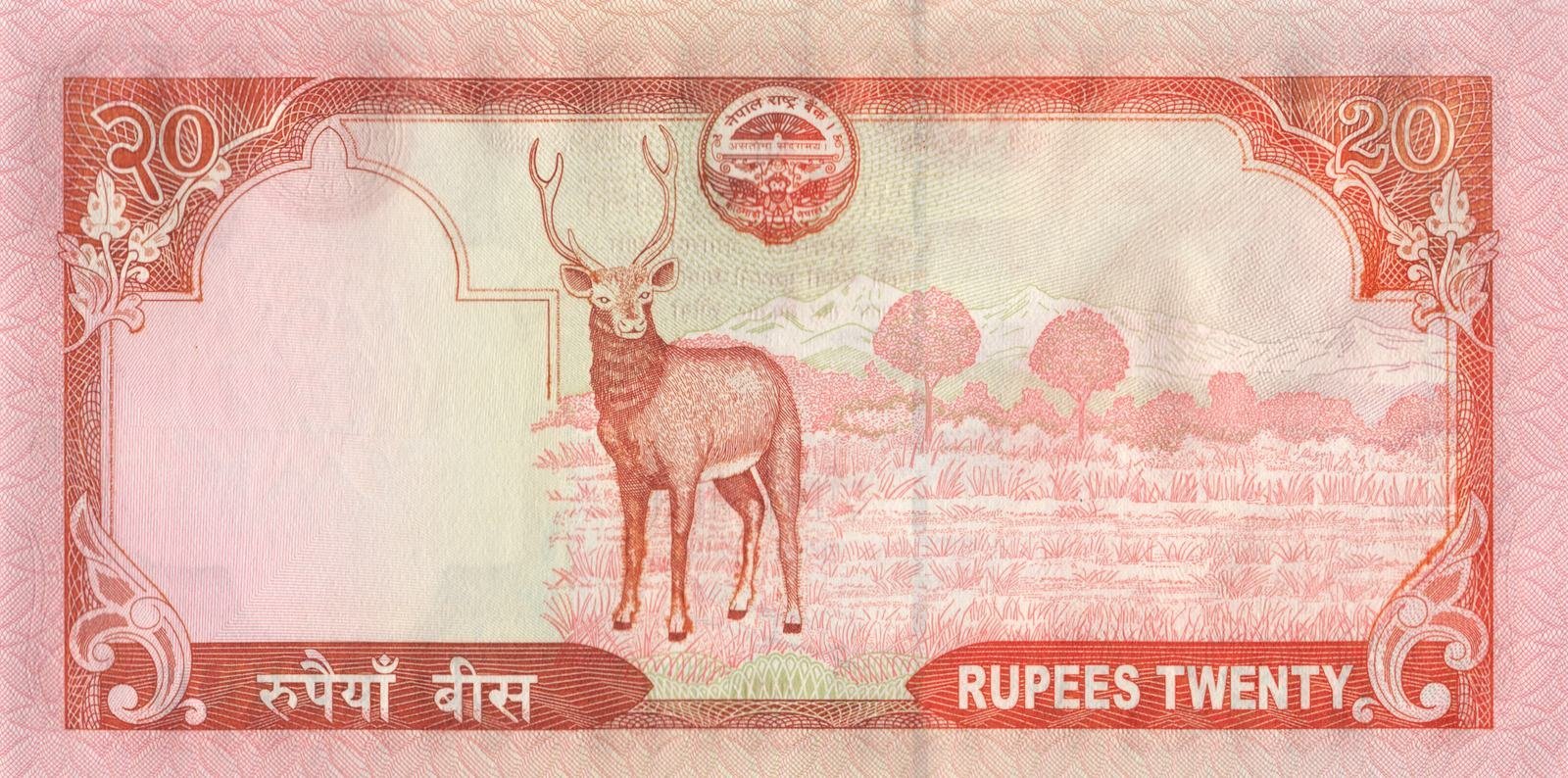
P-62b reverse · Landscape
These observations do not make the whole design new. The temple and Garuda column on the front, the bank name and the deer reverse provide substantial continuity. The useful collection description records the changed features alongside those that survive, rather than reducing the type to “king” or “Everest”.
An Approved Design Before the Republic
Nepal Rastra Bank’s report for fiscal 2006/07 describes new notes carrying Everest on the left with Government of Nepal approval. The passage on printed page 69, paragraph 2.129, describes the approved future design; it does not say that every denomination had already been issued.
The report’s submission letter is dated 30 March 2008. The approval was therefore recorded before the republic was declared on 28 May 2008. Neither the reporting period nor the letter supplies the exact date of the government’s underlying decision.
The following annual report specifically records redesigned 500-rupee notes entering circulation during fiscal 2007/08. Our P-62b is a later 20-rupee example, which The Banknote Book dates to introduction on 5 October 2010. It cannot stand for the first appearance of Everest on Nepalese currency.
The political declaration, design approval, release of a particular denomination and the date assigned to our surviving type are different entries in this history. Our banknote dating guide explains the recording problem; this pair shows why it matters in practice.
The Later Withdrawal Attempt
The disappearance of the king from new designs did not settle the fate of all the older cash. A Republica report dated 15 March 2011 describes NRB’s instruction to banks the previous day to stop accepting royal-portrait notes. Exchange at designated counters was to begin on 15 March. The report explicitly distinguished the withdrawal policy from demonetisation and said the notes retained their value.
A second Republica report, dated 16 March, said NRB had revoked the instruction following intervention by the Commission for the Investigation of Abuse of Authority. The commission’s secretary criticised the procedure and said a notice should have appeared in the Gazette. The report described people being allowed to use the notes again.
There was a further episode. A Kantipur report reproduced by ShareSansar on 1 April 2012 described a Cabinet committee allowing another two years to remove royal notes. The quoted NRB officials said they had not yet received the official letter. That qualification prevents a reported plan from becoming evidence of its completion.
These are contemporary press accounts, not the recovered NRB instructions themselves. They are enough to show why the catalogue notation “withdrawn 15.03.2011” should not be converted into a final legal-tender cancellation date. This article does not determine whether any particular royal note can now be spent or exchanged.
Kenya: A Portrait Ban Was Not a Recall
Kenya’s Constitution took effect on 27 August 2010. Article 231(4) permits images depicting or symbolising Kenya or an aspect of Kenya, but prohibits the portrait of any individual. The prohibition is not confined to presidents.
Crucially, section 34 of the Sixth Schedule says that this provision does not affect the validity of coins and notes issued before the Constitution’s effective date. A rule for imagery therefore did not, by itself, invalidate all the money already issued.

100 shillings · P-48e(1) · 16 July 2010

100 shillings · P-53 · Printed date 2019
The distinction is important for this comparison. Our older note has a printed date earlier than the Constitution, but the transitional provision concerns money issued before the effective date. The scan does not establish this individual piece’s first day of issue. It illustrates the older portrait design without turning its July inscription into an individual legal history.
CBK records issuing the new family on 31 May 2019 and presenting it publicly on 1 June. Those are the dates in its 2018/19 annual report. The nine-year gap between the Constitution and that family’s launch should not be mistaken for a nine-year deadline written into the portrait clause.
The Specific 1,000-Shilling Withdrawal
A separate instrument dealt with old 1,000-shilling notes. Gazette Notice 4849 of 31 May 2019 covered those issued under Legal Notices 17/1995, 88/1998 and 13/2004. It provided for exchange from 3 June and made the specified notes cease to be legal tender, and cease to be exchangeable, from 1 October 2019.
The First Schedule lists the 1,000-shilling denomination. That is the scope of this withdrawal notice, not evidence that every older portrait note was withdrawn with it. Nor did constitutional protection prevent a subsequent, separately enacted withdrawal.
In its annual report, CBK connected the withdrawal to illicit financial flows and counterfeiting. Those are the bank’s stated reasons. Replacing the portrait and withdrawing a specified high denomination belonged to the same period, but the cited documents do not make the withdrawal a consequence of the portrait prohibition.
When Is a Statue Not a Portrait?
The seated Kenyatta image brought the discussion back to the Constitution. In Mbugua and another v Central Bank of Kenya and others, decided on 27 September 2019, the High Court considered the challenge to the new notes.
The majority treated this as a side-on, full-length representation of a statue within the KICC complex, rather than an isolated frontal portrait. It rejected the argument that the particular image violated the portrait prohibition. This was an assessment of the image and its setting, not a general licence for every rendering of a statue.
Justice A. C. Mrima’s separate opinion accepted the majority’s interpretation of the portrait prohibition but disagreed about the other, permissive part of the clause. He considered a recognisable individual’s image outside what that part allowed. The final orders followed the majority.
That distinction makes the pair more revealing than a simple portrait-to-building comparison. The newer note did not erase every representation of the person. It presented a recognisable monument in a composition that the majority accepted under the constitutional wording.
For collectors, “portrait”, “statue” and “building scene” are useful descriptive terms, but a legal classification is not settled by choosing a catalogue heading. The whole image and the document’s wording mattered. Our ordinary portrait glossary entry describes the collecting term; the judgment answers a narrower question under a particular Constitution.
Recording the Change in a Collection
The three comparisons produce different records. Zambia’s legal definition expressly uses the portrait alongside denominations. Nepal’s visible changes include a guarantee line and royal arms, while a report documents approval before the republic. Kenya separates the new image rule from existing cash and later tests a particular statue image in court.
| Question | Zambia | Nepal | Kenya |
|---|---|---|---|
| Visible change | Kaunda’s portrait gives way to a perched eagle. | Everest, a changed guarantee line and the removal of royal arms. | A portrait gives way to the KICC composition with a statue. |
| Documentary evidence | 1993 regulations define old and new money by listed denominations and portrait. | NRB reports the government-approved future design before the republic. | The Constitution governs imagery; the 2019 judgment interprets this composition. |
| Older notes | The defined old currency ceased to be legal tender on 31 January 1994. | Press reports describe a 2011 instruction and its revocation; no final status date is inferred. | Transitional protection for money issued before the effective date; a separate notice withdraws specified old KSh1,000 notes. |
For the Zambian 20 kwacha, record the portrait-bearing type and the 1993 regulations’ treatment of the listed old currency. For the Nepalese pair, retain “undated” and keep the catalogue introduction information separate. For Kenya, distinguish the printed date, the family’s release and the scope of the specific withdrawal notice.
There is no need to infer a new monetary unit from a new face or a missing one. The compared notes retain their respective denominations and currency names. Equally, continuity in a promise clause or national emblem does not guarantee that an older note remained spendable. The relevant instrument, not visual resemblance, settles the historical status described here.
Our guide to banknote series changeovers covers the wider replacement process. The guide to when banknotes stop being legal tender separates withdrawal, legal-tender status and exchange. Neither question should be answered by treating the design alone as a notice of cancellation.
The most informative description of these notes therefore starts with the face, then keeps looking. The eagle survives. The government line changes. The royal arms disappear. A statue once placed on the back reappears prominently on the front. Each is visible evidence of a specific alteration; none, by itself, is the complete history of the money.
Frequently Asked Questions
Does removing a leader’s portrait make older banknotes invalid?
Not by itself. The legal consequences depend on the relevant documents. Kenya’s Constitution preserved the validity of money issued before its effective date against the new portrait rule, while Zambia’s 1993 regulations separately called in specified portrait-bearing currency and set its legal-tender endpoint. A design change and a withdrawal need separate evidence.
Why does Kenyatta’s statue appear on banknotes if Kenya bans portraits?
In the 2019 High Court case, the majority distinguished the particular side-on, full-length statue image within the KICC complex from a portrait. One judge disagreed about the clause’s permissive part. The ruling concerned that composition; it should not be extended to every possible image of a statue.
Did Mount Everest first replace Nepal’s king in 2010?
No. Our 20-rupee P-62b is a later example catalogued as introduced in 2010. NRB had already described the approved Everest design in its report submitted in March 2008, and its following report records redesigned 500-rupee notes issued during fiscal 2007/08. Neither note in our 20-rupee pair carries a printed date.
Were Nepal’s royal banknotes finally cancelled on 15 March 2011?
The catalogue notation is not sufficient evidence of a final cancellation. Contemporary Republica reports describe a bank-acceptance restriction and exchange arrangements, followed by revocation of the instruction on 16 March. The underlying NRB instructions were not recovered for this account. These reports do not determine the notes’ present spending or exchange status.
Sources and Method
This comparison combines original collection scans with the instruments governing currency imagery and withdrawal, central-bank reports, a court judgment and exact-type entries in The Banknote Book. Legal text, the issuing bank’s account, catalogue attribution and observations from scans are kept distinct. The three cases are selected comparisons, not a survey of every political portrait change.
The historical conclusions are deliberately bounded. Zambia’s precise design decision and P-36a release date remain unestablished. The Nepalese withdrawal episode is attributed to contemporary reporting because the underlying instructions were not recovered. No present-day spending or redemption advice is offered. Ordinary scans establish visible design and wording, not watermarks, physical dimensions or an individual note’s circulation history.
- Zambia: Bank of Zambia (Call in and Surrender of Currency) Regulations, SI 154 of 1993 as amended by SI 191 of 1993, in the published consolidated Laws of Zambia text, PDF pages 62–63. Regulations 2–5 establish the definitions, surrender arrangements and legal-tender date. The original unamended instrument’s publication details were not independently established.
- Nepal Rastra Bank: Annual Report 2006/07, printed page 69, paragraph 2.129, and submission letter dated 30 March 2008 at PDF page 4; Annual Report 2007/08, printed page 80, continuation of paragraph 2.92. Fiscal periods are not treated as exact decision or release dates. The Notes and Coins of Nepal publication supplies the royal guarantee’s institutional translation.
- Nepal’s 2011–2012 withdrawal episode: Republica, 15 March 2011 and 16 March 2011; Kantipur report reproduced by ShareSansar, 1 April 2012. These are press reports, not primary legal instruments. The republic’s declaration date, 28 May 2008, is also recorded in the Republic Day historical account.
- Kenya: Constitution of Kenya, 2010, Article 231(4), page 139, and Sixth Schedule section 34, page 191; Gazette Notice 4849, 31 May 2019, printed page 2115, paragraphs 1–4 and First Schedule. CBK’s Annual Report 2018/19, printed pages 33–34, records issue, launch and the bank’s stated withdrawal reasons.
- High Court of Kenya: Mbugua & another v Central Bank of Kenya & 2 others, 27 September 2019, majority paragraphs 116–122 and final orders at paragraph 195; Justice Mrima’s separate opinion, paragraphs 3–12. The article describes this decision, without claiming an exhaustive account of subsequent litigation.
- Owen W. Linzmayer, The Banknote Book: Zambia chapter, entries B133b/P-32b and B137a/P-36a; Nepal chapter, B255a/P-47a, B275b/P-62b and the 2006 wording-change entries B268/P-53 and B269/P-55; Kenya chapter, entries B139g and B145a. Pick references beside the illustrations follow the linked collection records. Used for type attribution and explicitly attributed introduction information, not to override legal instruments.
- Collection evidence: the six product records linked beside the illustrations and their original front and reverse scans. Detail windows crop existing scans; no lettering, portrait or emblem has been reconstructed. Our catalogue methodology explains the separation of observations, reference information and editorial interpretation.
About the Author
Audrius is the founder and curator of WorldBanknotes.eu, a catalogue and shop for collectible banknotes. His work focuses on banknote identification, catalogue structure, printing, design and the context behind individual issues. The catalogue methodology explains how observations, reference information and editorial classifications are distinguished.