
Who Issues Banknotes? Central Banks, Currency Boards and Multiple Issuers Explained
A banknote may carry the name of a country, a currency, a central bank, a commercial bank, a treasury, a monetary authority, a printer and several officials. All of those names can be relevant, but they do not describe the same role.
For collectors, this distinction matters because the institution legally responsible for a note is part of its identity. Two banknotes can share the same territory, denomination, date and commemorative theme while belonging to different issuing banks. A currency can remain unchanged while its issuing authority is renamed. One central bank can issue a common currency for several states. A government treasury can issue local notes without being a central bank at all.
The difficulty is therefore not simply reading the largest institutional name on the obverse. It is understanding the legal and monetary structure behind it.
Core principle: The issuing authority is the institution legally responsible for the banknote issue. It should not be confused with the country, currency, printer, distributor or person whose signature appears on the note.
This guide explains the principal issuing models encountered by collectors: national central banks, regional central banks, supranational systems, currency-board arrangements, authorised commercial banks and government treasuries. It also provides a practical method for recording the correct authority in a catalogue or collection database.
Table of Contents
What Is an Issuing Authority?
An issuing authority is the institution empowered to create and place a banknote issue into the monetary system. That power may come from a central-bank law, a currency act, a monetary-union treaty, a government decree, a note-issuing contract or another legal framework.
The authority may perform several functions. It can approve denominations and designs, determine quantities, authorise signatures, order production, place notes into circulation, withdraw old issues and maintain the promise or legal obligation represented by the note. Not every issuer performs every practical task itself, but the legal responsibility remains identifiable.
How those responsibilities developed, and what made different kinds of paper acceptable as money, is traced in the history of trust and issuing authority behind banknotes.
The most familiar arrangement is a national central bank. The Bank of Namibia, for example, issues the Namibian dollar for one state. Yet this straightforward model is only one part of the global picture.
A note may instead be issued by:
- a central bank serving several states;
- a supranational monetary system involving both a central institution and national central banks;
- a commercial bank authorised by law or contract;
- a government, treasury or finance ministry;
- a currency board or monetary authority operating through agent banks;
- an institution that has since been renamed, replaced or absorbed by a successor.
The country and the issuer are therefore separate catalogue fields. The country tells us the political or territorial context. The issuer identifies the institution responsible for the note. The currency identifies the monetary unit. The denomination identifies the note’s value within that unit.
The printer is separate again. A central bank may commission a state printer, a commercial security printer or a foreign banknote works. The presence of a printer’s imprint does not transfer issuing authority to the company that manufactured the paper or polymer note.
The same caution applies to signatures. A finance minister, governor, chief cashier or managing director may authorise a note in an official capacity, but the signatory is not the issuing authority as an individual. Signatures help date and classify the issue; they do not replace the institution named in the legal framework.
Finally, legal tender is related but not identical. Legal-tender status describes the note’s recognised use in settling payments or debts under a particular legal system. It does not by itself reveal whether the issuer is a central bank, commercial bank or treasury, nor whether the note circulated widely.
The Conventional Central-Bank Model
The simplest issuing structure is one state, one main currency and one central bank. The bank’s name appears prominently on the note, its governor or authorised officials sign the issue, and the institution manages the currency’s circulation within the country.
The Bank of Namibia provides a clear example. It is the national institution responsible for Namibia’s banknotes, while the Namibian dollar is the currency and Namibia is the country. These three labels describe connected but distinct parts of the same monetary system.
The Namibia 30 Dollars 2020 makes the relationship particularly visible. The note is a commemorative polymer issue, but its unusual denomination and special purpose do not alter the issuer. The Bank of Namibia remains the authority responsible for the note just as it is for ordinary circulation denominations.

This conventional model gives collectors a useful starting point. When the country, currency and bank name all align, identification is usually straightforward. Even here, however, three checks remain necessary.
First, use the authority active at the time of issue. A present-day central bank should not automatically be assigned to older notes issued by a colonial administration, state bank or predecessor institution.
Second, preserve the exact institutional wording where it changes the historical meaning. “National Bank”, “Reserve Bank”, “Central Bank” and “Bank of Issue” may reflect different legal periods, even when they belong to the same broad institutional lineage.
Third, do not infer the printer from the issuer. A national central bank may issue a note that was designed or manufactured abroad. The note remains an issue of the central bank, not of the printing company.
Regional and Supranational Issuers
A banknote does not always belong to a single national monetary system. Several regional organisations issue one currency across multiple countries or territories. These structures are especially important because the note’s design may be shared while collector identification still depends on member-state codes, signatures, prefixes or distribution arrangements.
Eastern Caribbean Central Bank
The Eastern Caribbean Central Bank is the monetary authority for eight island economies: Anguilla, Antigua and Barbuda, Dominica, Grenada, Montserrat, Saint Kitts and Nevis, Saint Lucia, and Saint Vincent and the Grenadines.
It issues the Eastern Caribbean dollar, a shared currency rather than eight unrelated national currencies. A collector may catalogue the notes under Eastern Caribbean States because the issuer and currency belong to the regional system as a whole.
The Eastern Caribbean States 5 Dollars 2021 demonstrates this model. The note is not issued independently by Saint Lucia, Grenada or any other single participating economy. The regional central bank is the issuing institution.

For collectors, the practical lesson is that the place where a note was obtained does not necessarily identify the issuing country. A banknote withdrawn from an ATM in one member economy may be equally valid across the wider currency union.
BEAC and the Central African CFA franc
The Bank of Central African States, commonly known by its French acronym BEAC, is the common central bank of six CEMAC states: Cameroon, the Central African Republic, Chad, the Republic of the Congo, Equatorial Guinea and Gabon.
BEAC issues the Central African CFA franc. The issuing institution and core design system are regional, but exact catalogue identification can still preserve country allocation, suffixes or coded variants.
The Central African States 500 Francs 2020 illustrates the difference between the regional issuer and the collector’s more granular classification. A shared banknote family does not mean that every catalogue variant is interchangeable.

When documenting a regional note, record the central institution first, then add any confirmed country identifier separately. Do not replace the regional issuer with the member state merely because the note was allocated or distributed there.
BCEAO and the West African Monetary Union
The Central Bank of West African States, or BCEAO, is the common issuing institution for the eight members of the West African Monetary Union: Benin, Burkina Faso, Côte d’Ivoire, Guinea-Bissau, Mali, Niger, Senegal and Togo.
BCEAO states that it has the exclusive right to issue currency throughout the Union. Its banknotes and coins are legal tender and redeemable across the member states. Here again, the authority is regional even though country-linked identifiers may remain relevant to catalogue attribution.
This creates a useful hierarchy:
- Issuer: BCEAO.
- Currency system: West African CFA franc.
- Member-state allocation: recorded only where confirmed by the note’s identifiers or reliable catalogue evidence.
- Printer and signatures: separate technical fields.
When a member-state identifier cannot be confirmed, catalogue the note under BCEAO and the West African CFA franc without assigning a national allocation. An unassigned note is preferable to an invented country attribution.
For a comparison of the two CFA francs and the Brunei–Singapore arrangement, see our guide to banknotes across borders.
The euro: legal issuance and physical circulation
The euro adds another layer. The European Central Bank and the national central banks of the euro area are legally entitled to issue euro banknotes. In practice, the national central banks physically issue and withdraw the notes, while the ECB coordinates and oversees the system.
This distinction is valuable because it shows that “issuer” can operate at more than one legal and operational level. The institution coordinating the banknote system is not necessarily the body handling cash at a national counter or vault.
Collectors should therefore resist overly simple labels such as “printed by the ECB” or “issued only by the country letter”. Euro banknotes belong to the Eurosystem, while production, allocation and circulation involve several national and supranational bodies.
Commercial Banks Authorised to Issue Banknotes
The word commercial does not make a banknote unofficial. In several monetary systems, private or commercial banks issue notes under legislation, regulatory supervision or formal agency contracts.
Scotland and Northern Ireland
The Bank of England lists three authorised note-issuing banks in Scotland: Bank of Scotland, Clydesdale Bank and the Royal Bank of Scotland. It also lists three in Northern Ireland: Bank of Ireland (UK), Northern Bank operating as Danske Bank, and National Westminster Bank operating as Ulster Bank in Northern Ireland.
These are commercial banks, yet their notes exist within a regulated statutory framework. The issuing banks must hold backing assets at least equal to the value of their notes in circulation. The Bank of England supervises compliance with those backing requirements, but it does not become the issuer of each Scottish or Northern Irish note.
The Scotland 1 Pound 2001 names the Royal Bank of Scotland because that bank is the issuing institution for the note. The printer that manufactured it and the regulator overseeing the regime occupy different roles.

This is one reason the broad label Scottish pound is not sufficient for exact cataloguing. A collector must also record which authorised bank issued the note. Bank of Scotland, Clydesdale Bank and Royal Bank of Scotland issues may share sterling value and geographic use, but they are separate banknote programmes.
Historical changes also matter. A bank may cease issuing notes, change its trading name or withdraw an earlier series while remaining responsible for redemption. The correct catalogue entry should preserve the institution printed on the specific note rather than rewriting history according to the latest list of authorised banks.
What a Currency-Board Framework Changes
A currency board is a rules-based monetary arrangement in which the domestic monetary base is issued against specified reserve assets, normally within a fixed exchange-rate framework. The institution maintaining the system may therefore be different from the banks whose names appear on individual banknotes.
In Hong Kong, the three note-issuing banks must obtain Certificates of Indebtedness from the Exchange Fund as backing for the banknotes they issue. The system-level monetary framework and the institution printed on each note should therefore be recorded separately.
Hong Kong’s currency-board framework
Hong Kong combines a currency-board system with multiple note-issuing banks. The Hong Kong Monetary Authority states that the HK$20, HK$50, HK$100, HK$500 and HK$1,000 notes are issued by three banks: Standard Chartered Bank (Hong Kong), Bank of China (Hong Kong), and the Hongkong and Shanghai Banking Corporation.
The Government issues the HK$10 paper and polymer notes, while the HK$20, HK$50, HK$100, HK$500 and HK$1,000 notes are issued by the three authorised note-issuing banks. This means that one currency can contain both government-issued and commercial-bank-issued notes.
A collector should therefore separate:
- the Hong Kong dollar as the currency context;
- the Hong Kong Monetary Authority as the system-level authority;
- the individual note-issuing bank named on most denominations;
- the Government as issuer of the modern ten-dollar paper and polymer notes;
- the printer and signatories as additional technical details.
The design systems of the three banks can be coordinated by denomination and series while remaining institutionally distinct. A complete type collection may therefore require one note from each bank, not merely one example of each face value.
Case Study: Macau’s Dual-Issuer System
Macau provides one of the clearest visual demonstrations of why issuer identity must remain visible in a banknote catalogue.
The Macau pataca operates within a public monetary framework overseen by the Monetary Authority of Macao. Yet the notes themselves are issued through two authorised agent banks: Banco Nacional Ultramarino and Bank of China.
Banco Nacional Ultramarino has issued notes in Macau since 1905. Bank of China became an authorised note-issuing bank in the 1990s. Both institutions continue to produce pataca banknotes under contracts with the Macau authorities.
The 2013 Year of the Snake notes make the structure especially clear. The Macau 10 Patacas 2013 issued by Banco Nacional Ultramarino and the Macau 10 Patacas 2013 issued by Bank of China share:
- the same territory;
- the same currency;
- the same ten-pataca denomination;
- the same year;
- the same zodiac programme;
- closely related commemorative purpose.
They do not share the same issuing bank or catalogue identity.
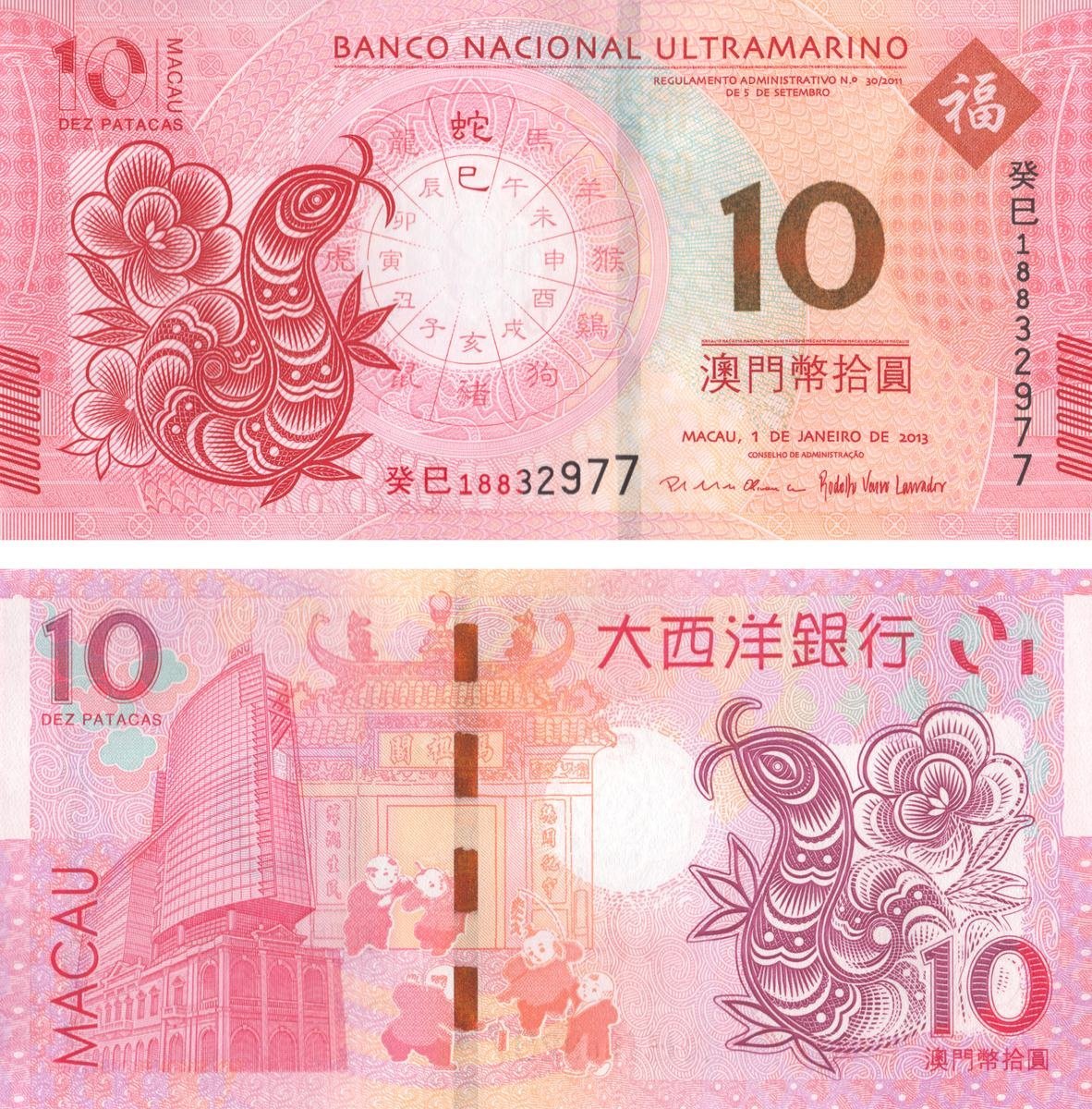

This difference is not a minor variety comparable to a signature change. The bank name is part of the institutional structure of the issue. Each issuer has its own visual language, serial-number arrangements, signatures and catalogue sequence.
For a database, the most useful fields are:
- Territory: Macau.
- Currency: Macau pataca.
- System-level authority: Monetary Authority of Macao.
- Note-issuing bank: Banco Nacional Ultramarino or Bank of China.
- Programme: Chinese Zodiac New Year.
- Denomination and year.
- Catalogue reference.
For cataloguing, record the Monetary Authority of Macao as the system-level authority and the bank printed on the note—Banco Nacional Ultramarino or Bank of China—as the note-issuing bank. These are complementary institutional layers rather than competing labels.
Governments and Treasuries as Issuers
Not every official banknote comes from an institution called a bank. Governments, treasuries and finance ministries can issue notes directly under local currency legislation.
Bulgaria’s 1951 notes provide a historical comparison of treasury-note and banknote titles, backing clauses and the Bank’s separate records.
Jersey
Legally, the power to issue Jersey currency notes and coins rests with the Minister for Treasury and Resources, while the States of Jersey Treasury manages their production and circulation within the local sterling-linked system.
The States of Jersey is therefore the relevant institutional authority for the Jersey pound. The Jersey 1 Pound 2018 is an official note even though no national central bank appears as issuer.

A catalogue entry that substitutes the Bank of England would be wrong. Jersey notes maintain parity with sterling, but parity does not transfer issuance to the Bank of England.
Isle of Man
The Isle of Man provides an even more explicit legal model. The Currency Act 1992 authorises the Treasury to issue government notes and coins in Manx currency and states that no other person may issue such notes.
The Isle of Man Treasury is therefore an issuing authority, while the Manx pound is the currency. The notes may be exchangeable at parity with Bank of England notes, but that relationship does not make them Bank of England issues.
Gibraltar
The Government of Gibraltar issues the Gibraltar pound. The Gibraltar 10 Shillings 2018 is a useful reminder that government issues can also adopt unusual commemorative or revival formats.
These treasury and government models establish a general rule:
A banknote is not unofficial merely because the issuer is a government department rather than a central bank. The correct question is whether the institution had the legal authority to issue it.
Issuer, Printer, Distributor and Signatory Are Different Roles
Four names can appear in the life of one banknote without describing the same function.
Issuer
The issuer carries the legal responsibility for the note. It authorises the issue and places it within the monetary system.
Printer
The printer manufactures the physical banknote. It may engrave plates, prepare substrate, apply security features and number the sheets. A printer can produce notes for many unrelated countries and authorities.
The separation is particularly clear in the United States. The Board of Governors of the Federal Reserve System is the issuing authority for Federal Reserve notes. It determines the required supply and submits the print order, while the Bureau of Engraving and Printing, part of the US Department of the Treasury, manufactures the notes for delivery to the Federal Reserve System.
The Bureau is therefore the printer, while the Board of Governors is the issuing authority.
This distinction also applies internationally. A note may carry a small printer imprint such as De La Rue, Giesecke+Devrient, Oberthur Fiduciaire or another security printer. That imprint should be recorded in the printer field, not used to replace the central bank or government in the issuer field.
For a broader production workflow, see How Banknotes Are Printed.
Distributor
Commercial banks, post offices, exchange counters and cash centres may distribute notes to the public. Distribution does not make them issuers. An ordinary bank branch can supply central-bank notes without having created or authorised the issue.
In some systems, however, the distributing bank is also an authorised note issuer. Scotland, Northern Ireland, Hong Kong and Macau show why the legal framework must be checked rather than inferred from the place of distribution.
Signatory
A signature records the official authorisation associated with a particular issue period. Governors, finance ministers, chief cashiers and managing directors sign in their institutional capacities.
Signatures can identify a date range or variety, but an individual official does not become the issuer. The note remains an issue of the institution represented by that office.
For collectors, the clean database structure is therefore:
| Field | What it records |
|---|---|
| Issuing authority | Institution legally responsible for the issue |
| Printer | Organisation that manufactured the physical note |
| Distributor | Institution or channel that released notes to users |
| Signatures | Officials authorising the issue in named roles |
One Authority Across Several Currency Reforms
An issuing authority can remain in place while the currency unit changes dramatically.
The Central Reserve Bank of Peru offers a strong example. During the modern period, Peru moved through the sol de oro, the inti, the nuevo sol and the sol. The institution’s continuity should be recorded separately from the changes in the monetary unit.
The Peruvian sol de oro was replaced by the Peruvian inti in 1985 at a conversion of 1 inti to 1,000 soles de oro. The nuevo sol followed in 1991, and the unit’s name was shortened to sol in 2015.
Three ten-unit notes make the institutional continuity visible:


The designs, currencies, purchasing values and catalogue families differ. The central issuing institution remains the Central Reserve Bank of Peru.
This leads to two separate catalogue questions:
- Which institution issued the note?
- Which currency unit was valid for that issue?
Combining those questions into one field creates errors. A 1976 sol-de-oro note should not be labelled simply “Peruvian sol” because that erases the historical monetary unit. Conversely, a change from sol de oro to inti does not automatically imply a new issuing institution.
For date fields, reforms also require care. The printed year, issue date, currency period and legal conversion date may not be identical. The method in How to Date a Banknote should be applied independently from issuer classification.
Issuer Changes and Successor Institutions
The reverse situation is also common: the territory and currency may continue while the issuing institution changes.
Burma and Myanmar provide a useful historical example. Notes issued under the Union Bank of Burma belong to that institution and period. Later issues may belong to the Central Bank of Myanmar.
The Burmese kyat and Myanmar kyat pages help preserve the site’s historical naming structure, but the exact authority printed on the note remains decisive.
Country-name changes on banknotes also need to be separated from changes in the issuing institution or currency.
Do not retroactively assign every historical issue to the modern successor. A successor may inherit redemption, monetary policy or archival responsibility, yet the original note was legally issued by the institution active at the time.
The same principle applies to colonial currency boards, nationalisation, central-bank renaming and monetary unions. When an authority changes, the catalogue should record:
- the institution printed on the note;
- the legal period in which it operated;
- its predecessor or successor where relevant;
- whether the currency continued, changed name or was replaced;
- whether old notes remained redeemable after the institutional transition.
How to Identify the Issuer on a Banknote
The issuing authority is often prominent, but not always obvious. A disciplined reading method avoids most errors.
1. Read the institutional name in full
Do not stop at the word bank. Record the complete wording, including territorial qualifiers, local-language forms and branch names where they distinguish issuers.
“Bank of China” and “Bank of China (Macau)” belong to a broader institution, but the Macau branch’s note-issuing role is tied to a specific jurisdiction. “Royal Bank of Scotland” should not be reduced to “Bank of England” merely because both notes are denominated in pounds sterling.
Indonesia’s 1964-dated sen notes show why the printed bank name must be read alongside the legal issuing framework: their fronts say Bank Indonesia, while the December 1965 act names Bank Negara Indonesia.
2. Identify the promise or legal statement
Many notes contain language such as “promises to pay”, “legal tender”, “issued under authority”, or an obligation to pay the bearer. The wording can reveal whether the note is a central-bank liability, government note or commercial-bank promise.
The promise should be interpreted in its historical legal context. Older sterling notes, colonial issues and currency-board notes may use language that differs from modern fiat-currency formulations.
3. Check seals, emblems and logos
A state coat of arms may identify the jurisdiction without identifying the issuer. A central-bank seal or commercial-bank logo is usually more specific. Treat national symbolism and institutional identity as separate visual layers.
4. Read the signature titles
Titles such as Governor, Chief Cashier, Minister of Finance, General Manager or Director-General can help identify the institutional structure. A finance minister’s signature may appear alongside a central-bank governor without making the ministry the sole issuer.
5. Confirm the currency and denomination
One institution may issue several historical currencies, as in Peru. Several institutions may issue the same currency, as in Scotland, Hong Kong or Macau. Currency and issuer should confirm each other without being treated as identical.
6. Establish the issue period
Compare the visible date, series, signatures and known institutional history. A note cannot belong to an authority that did not yet exist or had already ceased issuing.
7. Separate the printer imprint
Printer names are often small and located in the margin. Record them independently. Do not assume that a prominent security-printing company is the issuing institution.
8. Verify against an official or specialist source
Use central-bank, government, monetary-authority or authorised-bank documentation wherever possible. Product titles and dealer descriptions are useful search clues, not final legal evidence.
A broader visual method is provided in How to Identify a Banknote.
Common Misidentifications
“The country printed on the note is the issuer”
The country or territory is the jurisdiction. The issuing authority is the institution empowered to issue the note. Regional currencies and multiple-bank systems make the distinction essential.
“Every banknote is issued by a central bank”
False. Jersey, the Isle of Man and Gibraltar use government or treasury models. Scotland, Northern Ireland, Hong Kong and Macau include authorised commercial banks.
“A commercial bank’s note is private money”
Not necessarily. A commercial bank can issue official notes under legislation or contract. The legal framework and backing arrangements determine the status.
“The printer issued the note”
False. The printer manufactures the note. The Federal Reserve and Bureau of Engraving and Printing provide a clear separation of roles.
“One currency always has one issuer”
False. The Macau pataca, Hong Kong dollar and sterling systems all show multiple issuing institutions within one wider currency framework.
“One issuer always means one country”
False. ECCB, BEAC and BCEAO issue common currencies across several economies or states.
“The present central bank issued all historical notes of the country”
False. Predecessor institutions, colonial boards, state banks and government departments must be preserved in historical catalogue records.
“A signature identifies the issuer”
A signature identifies an authorised official and often a variety or period. The institution represented by that official remains the issuer.
Collector’s Issuing-Authority Workflow
- Record the exact note. Enter country or territory, denomination, currency, visible date, series and catalogue reference.
- Transcribe the institutional name. Preserve the complete name printed on the note before normalising it to an approved database value.
- Determine the legal model. National central bank, regional central bank, supranational system, authorised commercial bank, government, treasury or other authority.
- Separate the currency. Confirm the monetary unit independently from the issuer.
- Check the issue period. Ensure that the institution existed and held issuing authority when the note was released.
- Check for multiple issuers. This is essential for Macau, Hong Kong, Scotland, Northern Ireland and similar systems.
- Check for regional allocation. Record a member-state code, prefix or suffix only when it is confirmed for that issue.
- Record the printer separately. Use the exact printer name where reliably identified.
- Record signatures with roles. Governor, finance minister, chief cashier and other offices belong in the signature field.
- Add predecessor or successor information. Keep it as context rather than replacing the historical issuer.
- Link to the currency and authority pages. A strong catalogue should allow movement from note to issuer, currency and country without ambiguity.
- Preserve uncertainty. When the legal status is not confirmed, write issuer not confirmed or fact check required rather than guessing.
Issuing Models Reference Table
| Issuing model | Legal structure | Collector implication | WorldBanknotes.eu example |
|---|---|---|---|
| National central bank | One central bank issues for one state | Country, currency and issuer usually align | Bank of Namibia |
| Regional central bank | One institution issues for several states or economies | Country allocation may require separate codes or suffixes | ECCB; BEAC; BCEAO |
| Supranational system | Central and national institutions share legal or operational roles | “Issuer” may have more than one institutional level | Eurosystem |
| Authorised commercial banks | Commercial banks issue under law and regulatory supervision | Bank name is a primary type distinction | Royal Bank of Scotland; Hong Kong banks |
| Dual agent-bank system | Public authority oversees currency while two banks issue notes | Same year and denomination can produce separate issuer types | Macau BNU and Bank of China |
| Government or treasury | Government department issues under currency legislation | Do not substitute a nearby central bank | Jersey; Isle of Man; Gibraltar |
| Issuer–printer separation | Issuer orders and authorises; printer manufactures | Record both institutions in separate fields | Federal Reserve and BEP |
| Continuing authority through reform | Institution remains while monetary unit changes | Currency must be dated independently from issuer | Peru: sol de oro, inti and sol |
| Successor institution | New authority replaces or renames an earlier one | Preserve the authority active on the note | Union Bank of Burma / Central Bank of Myanmar |
Frequently Asked Questions
Who is legally responsible for issuing a banknote?
The institution legally empowered by the relevant law, treaty, decree or note-issuing contract is responsible for the issue. Depending on the monetary system, it may be a national or regional central bank, an authorised commercial bank, a government or a treasury.
Is the central bank always the issuing authority?
No. Many countries use a central bank, but Jersey, the Isle of Man and Gibraltar use government or treasury structures, while Scotland, Northern Ireland, Hong Kong and Macau include authorised commercial banks.
Can several banks issue the same currency?
Yes. The Macau pataca, Hong Kong dollar and sterling systems provide clear examples. Each bank’s notes should be catalogued under the correct issuer.
Can one central bank issue money for several countries?
Yes. ECCB, BEAC and BCEAO issue regional currencies across groups of participating economies or states.
Is the printer the same as the issuer?
Usually not. The issuer authorises and is legally responsible for the note. The printer manufactures it. The Federal Reserve and the Bureau of Engraving and Printing clearly demonstrate this separation.
Does the signature tell me who issued the note?
The signature identifies an authorised official and can help determine the issue period or variety. The issuing institution is the authority represented by that office, not the person signing as an individual.
Why can two notes with the same denomination and year have different issuers?
Some currency systems authorise more than one bank. Macau’s 2013 zodiac notes were issued by both Banco Nacional Ultramarino and Bank of China, creating separate catalogue types.
Should a historical note be assigned to the current central bank?
Only when the current institution was actually the issuer. Otherwise, preserve the predecessor, colonial authority, state bank, currency board or treasury printed on the note.
Does legal tender prove which institution issued a note?
No. Legal tender describes recognised payment status. The issuer must still be identified from the legal and institutional framework.
What is the most important field after country and denomination?
For institutional identification, the issuing authority is essential. It distinguishes notes that may otherwise share the same currency, value, date and territory.
Final Thoughts
A banknote is not only a national object. It is also an institutional document.
The issuer determines who stood behind the note, which legal framework supported it and where it belongs within monetary history. In a simple national system, that identity may seem obvious. In regional unions, currency boards, treasury issues and multiple-bank arrangements, it becomes one of the most important parts of classification.
The strongest catalogue entry therefore records more than country, denomination and date. It separates issuer from currency, printer, distributor and signatory; preserves predecessor institutions; and recognises when several authorities operate within one monetary system.
A collector who identifies the correct issuing authority does more than name the bank printed on the note. They reconstruct the structure that made the banknote possible.
Selected References
- Bank of England — Scottish and Northern Ireland Banknotes
- Hong Kong Monetary Authority — Notes
- Hong Kong Monetary Authority — 2018 Series Banknotes
- Eastern Caribbean Central Bank — Overview
- Eastern Caribbean Central Bank — Member Countries
- Bank of Central African States — The BEAC
- Central Bank of West African States — Presentation of BCEAO
- European Central Bank — Issuance and Circulation
- Banco Nacional Ultramarino — Bank Note Issuing
- Bank of China Macau Branch — Issuance of Banknotes
- Government of Jersey — Currency-Issue Authority
- Isle of Man Government — Currency Act 1992
- Federal Reserve Board — Currency
- Federal Reserve Board — Currency Print Orders
- Bureau of Engraving and Printing — Currency
- Central Reserve Bank of Peru — Inti
- Central Reserve Bank of Peru — Current and Former Monetary Units
- Central Bank of Myanmar — Background History