
How Afghanistan Replaced Its Banknotes in 2002–2003
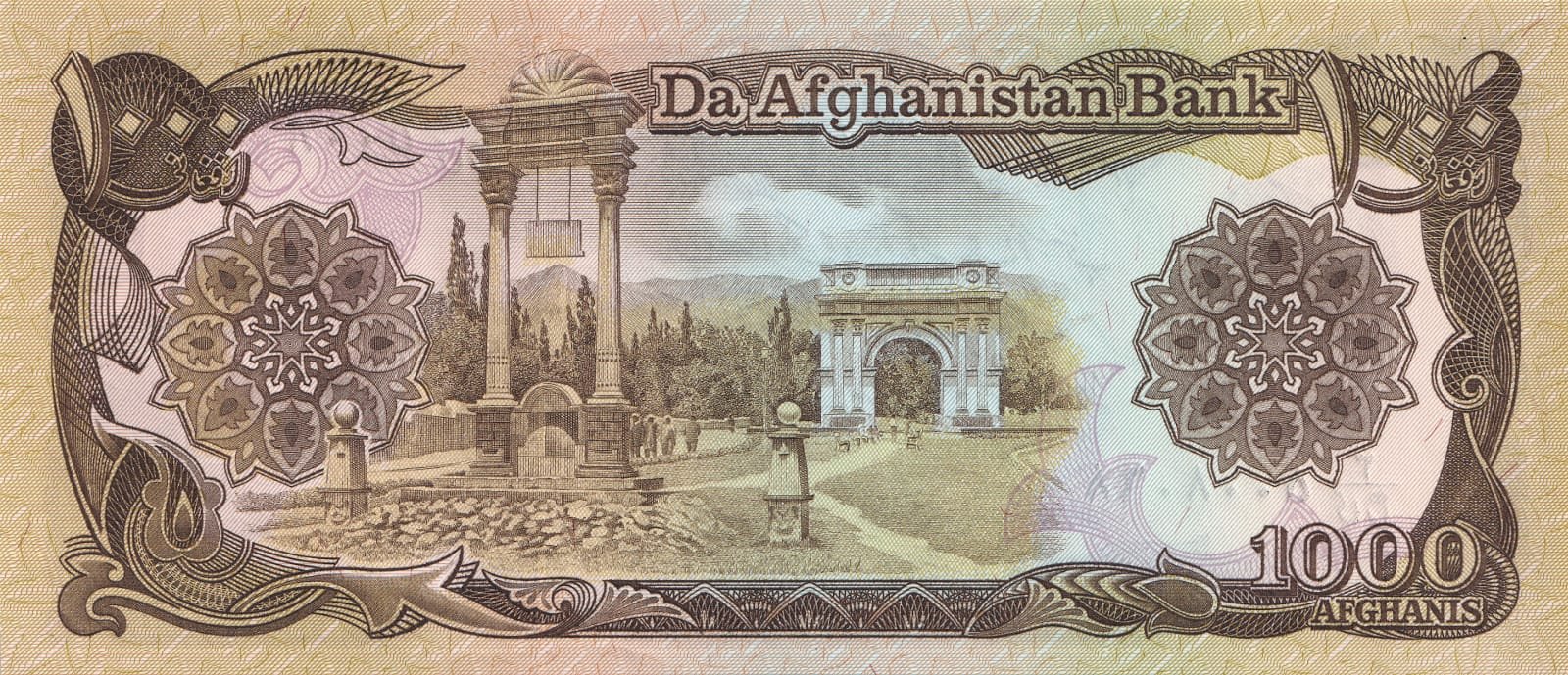
An old Afghan 1,000-afghani note carries two familiar landmarks: the Blue Mosque at Mazar-i-Sharif on one face and the Paghman arch on the other. In the new currency introduced in October 2002, the mosque appears on the one-afghani note and the arch on the two. The subjects survived a change in the scale of money.
Behind those small new values stood an enormous paper-handling operation. Almost 800 million new banknotes were ordered. The old currency collected across the programme was estimated at about five billion notes. It had to be received, checked, accounted for and destroyed while replacement cash reached exchange points around the country.
The Blue Mosque · Mazar-i-Sharif
Old 1,000 afghanis

New 1 afghani

The arch · Paghman
Old 1,000 afghanis
New 2 afghanis

Familiar Images, a New Unit
The new one and two retain Da Afghanistan Bank’s name and a Pashto promise to pay the holder the stated sum on demand. The currency is still called the afghani. Neither of these specimens prints the word “new” beside its denomination. Their small values belong to the replacement unit established by the exchange.
For the regular old-note category, 1,000 old afghanis became one new afghani. The operation also accepted two categories described in the IMF account as unofficial notes, at a 50 per cent discount. Those categories therefore required 2,000 old afghanis for one new afghani. The three old specimens shown in this article cannot be assigned to a conversion category from their scans.
The images offer a separate comparison. The old 1,000’s mosque and arch are distributed across two new denominations, with changed compositions. A small bank seal on the old note becomes a much larger element on the new one and two. The recurring landmarks do not establish that the same printing plates were used, or explain why those subjects were retained.
The date treatment changes too. The old 1,000 has a written Solar Hijri date with the year 1370; the old 5,000 and 10,000 show 1372 within their fuller dates. The new one and two have a small 1381. That year spans parts of 2002 and 2003 in the Gregorian calendar. It is not a manufacturing date recovered from either specimen. Our guide to dating a banknote explains why a printed date and an issue date need separate treatment.
Old 1,000 · full date includes SH 1370
New 1 · small year 1381

New 2 · small year 1381

Ordering Cash Before the Count Was Known
Planning began in earnest in early summer 2002. Before officials could replace the old banknotes, they had to estimate how much money would arrive for conversion. The IMF’s detailed operational account records an initial estimate of about 16 trillion old afghanis in circulation, including counterfeits. After allowing for the discount on unofficial notes, the expected conversion amount was around 13 trillion.
That estimate was expressed in old afghanis. The order for replacement banknotes was expressed in the new unit: Af 27.9 billion in face value, represented by almost 800 million individual notes weighing about 500 tons. Value, piece count and weight each describe a different part of the same order.
The authorities wanted to avoid exhausting the new stock before the old notes had been converted. The IMF account says the order also allowed for increased demand for money during at least the first year after introduction. Deliveries began in August 2002 and continued into January 2003. The announcement on 4 September 2002 therefore came after the first deliveries had begun. A contemporary IMF news brief welcomed the decision while describing preparations as already under way.
Almost 800 million is consequently the ordered quantity. It cannot simply be substituted for the number paid to people at exchange windows. The operational account records the conversion payout separately, in new-afghani value. This distinction matters whenever the size of the changeover is reduced to one large number.
Small Notes Dominated the Piece Count
The five smallest denominations ordered were 1, 2, 5, 10 and 20 afghanis. Together, according to the IMF account, they made up almost 90 per cent of the number of notes ordered but only 15 per cent of their total face value.
New banknotes ordered · the five smallest denominations
1 · 2 · 5 · 10 · 20 afghanis
Share of the number of notes: Almost 90%
Share of total face value: 15%
Green shows the five smallest values. The first bar is a schematic rendering of “almost 90%”, not an exact 90.0% measurement.
The illustrated one and two make the difference tangible. A thousand one-afghani notes and a single 1,000-afghani note represent the same new-currency value, but the first payment involves a thousand separate pieces of paper. A shipment’s face value therefore gives little sense of the number of bundles that have to be moved or handled.
These shares describe the supply ordered for the new currency. They do not show that every ordered note had entered circulation when the exchange ended. The IMF’s accompanying chart also records the denomination mix in circulation on 21 May 2003, several months after the conversion closed. Its two sets of bars distinguish the planned supply from the later circulating stock.
Small notes supplied much of the paper without supplying much of its nominal value. That is the practical distribution problem behind the broader question of why banknotes have different denominations. A conversion required the right kinds of cash as well as enough total value.
Forty-Seven Points, Seven Windows
An order at the printing works did not put money within reach of its holders. The IMF reports that most of Da Afghanistan Bank’s 89 branches failed even basic requirements for the operation. DAB set out to refurbish or build at least one distribution facility per province, and the system was organised around seven regions.
The exchange network comprised 47 points. Each point had between one and five units; each unit had seven windows, five taking in old money and two paying out new. Some 2,500 local staff were employed. The distinction between a point and a unit matters: seven was the number of windows per unit, not necessarily per location.
Transport brought its own constraints. The account says ground transport to distant locations was ruled out for security reasons. USAID provided two helicopters and an Antonov 32 aircraft, with an air-operations unit, while the Afghan Air Force also assisted. Aircraft arrived late. The documented air support explains part of the distribution effort, although it is not a complete itinerary for every shipment.
The people bringing money to the windows also mattered. The first two weeks were intended for money changers alone, but the public was admitted earlier. For money changers, the described procedure used a 10 per cent sample check, with the error rate deducted from the whole amount. That was a specific arrangement for their submissions; it should not be read as the rule applied to every individual customer.
Conversion began on 7 October 2002. Provincial points were intended to open on 21 October, but many were two or three weeks late. In mid-November, the bank announced an extension of the exchange period. The practical timetable had outgrown the original deadline.
| Date | Stage |
|---|---|
| 4 Sep 2002 | Currency change announced |
| 7 Oct 2002 | Conversion began |
| 4 Dec 2002 | Original deadline |
| 2 Jan 2003 | Exchange ended after extension |
IMF Box V.1 records an extension announced in mid-November. The final date describes completion of the exchange operation.
What the Old-Cash Totals Measure
The old 5,000 and 10,000 illustrate the higher values present in the preceding banknote families. Their larger numerals make them easy to separate from the new one and two, but a denomination alone does not identify the rate at which a particular note would have been accepted. The documentary categories and the surviving specimens must be kept distinct.
Old 5,000 afghanis · SH 1372

Old 10,000 afghanis · SH 1372

The IMF records 13.9 trillion old afghanis in regular notes exchanged, plus 3.3 trillion in unofficial notes accepted at half value. On the new scale, those components amount to approximately Af 15.6 billion issued through conversion. The discount is essential to that calculation: dividing the full old face value by 1,000 would overstate the new cash paid out.
A further 2 trillion old afghanis was absorbed through foreign-exchange auctions. This was an additional flow, separate from the conversion figures. Across these channels the account reports roughly 19 trillion old afghanis collected, represented by some five billion banknotes weighing more than 2,000 tons.
Nineteen trillion is the old currency’s face value; five billion is the estimated number of banknotes. Nor should the entire old-value total be described as money handed across the 47 exchange points: it includes the auction absorption. The new Af 15.6 billion conversion payout is likewise distinct from the total new money in circulation, which also reflected other payments.
The Last Task: Destroying the Paper
Receiving the old notes left a final physical problem. The planned process involved cancelling them with punches or drills, then shredding. Equipment arrived late and proved unreliable, according to the IMF account. Incineration became the principal method.
Local burning in simple ovens avoided the need for electricity. A schedule provided for weekly or fortnightly destruction, with national and international observers required to be present. The account describes the approach and the overall scale, rather than supplying a destruction inventory for every exchange point.
The exchange ended on 2 January 2003. Delivering the new stock, accepting the old paper and destroying it had been connected parts of one operation, each with its own timetable. The general stages of a banknote series changeover become unusually concrete in this record: aircraft, refurbished facilities, intake windows, samples and ovens.
The surviving notes preserve a different part of that history. The mosque and arch remain recognisable, the bank’s name continues, and the new one and two still contain a promise to pay. Their relationship is understood through the exchange that changed the unit around those familiar elements. Its scale lay as much in the billions of pieces of paper handled as in the zeros removed from their values.
Frequently Asked Questions
When did Afghanistan exchange its old banknotes?
Conversion began on 7 October 2002. The IMF account records an original end date of 4 December 2002, followed by an extension announced in mid-November. The exchange ended on 2 January 2003.
What was the old-afghani to new-afghani exchange rate?
The regular category was converted at 1,000 old afghanis to one new afghani. Two unofficial categories were accepted at a 50 per cent discount, equivalent to 2,000 old afghanis for one new afghani. The scans in this article do not establish which conversion category an individual old specimen belonged to.
How many banknotes were involved in the currency change?
The order for new banknotes was almost 800 million pieces. The IMF estimates the old currency collected across the programme at some five billion notes, with a face value of about 19 trillion old afghanis. That old-value total includes currency absorbed through foreign-exchange auctions.
Sources and Method
The visual comparisons use five WorldBanknotes.eu specimens: an old 1,000, 5,000 and 10,000, and the new one and two afghanis. Both faces of each were examined. Details come from the original scans without reconstructed lettering. Images are independently enlarged and are not shown at a common physical scale.
- International Monetary Fund, Islamic State of Afghanistan: Rebuilding a Macroeconomic Framework for Reconstruction and Growth, Country Report 03/299, September 2003, Box V.1 and Figure 1, printed pp. 100–102 (PDF pp. 101–103): the principal operational and quantitative source. All three relevant pages were read as rendered pages. The order, conversion payout, auction absorption and circulation figures are kept separate.
- Da Afghanistan Bank, Quarterly Bulletin, Combined Issue 1384 (2005–2006), April 2006, special feature, printed pp. 52–56 (PDF pp. 60–64): a separate central-bank retrospective. It also reports Af 15.6 billion issued through conversion, but its old-currency components differ from the IMF’s. The reason for those differences is not established; they have not been merged into the IMF ledger used above.
- IMF, news brief of 4 September 2002: contemporary confirmation of the announcement and preparations. Da Afghanistan Bank’s retrospective currency page also identifies the initial one-, two- and five-afghani banknotes alongside the higher values.
- Owen W. Linzmayer, The Banknote Book, Afghanistan, printed pp. 30–32 (PDF pp. 35–37): specimen-group identification, subjects and the new one and two’s 7 October 2002 introduction. The old 1,000 is used at the B345 group level; its finer printing-method attribution is unresolved. The other examples correspond to B346a, B347a, B348a and B349a. Catalogue dates do not establish when an individual illustrated note was manufactured.
The specimens establish visible wording, dates, denominations and subjects; institutional accounts establish the exchange operation. No illustrated old note is assigned to a faction, a conversion category or a documented transaction. The historical completion date is reported as the end of the operation, without making a claim about every subsequent acceptance or redemption arrangement.
About the Author
Audrius is the founder and curator of WorldBanknotes.eu, a catalogue and shop for collectible banknotes. His work focuses on banknote identification, catalogue structure, printing, design and the context behind individual issues.