
Bulgaria’s 1951 Notes: Treasury Notes and Banknotes
Just above ПЕТ ЛЕВА — five leva — the smaller Bulgarian note calls itself a Държавен съкровищен билет: a state treasury note. On the ten-lev note, the identifying name is on the back: Българска народна банка, the Bulgarian National Bank. Both papers are dated 1951, but they belong to different categories within the same issue.
The difference extends to the small print. One note names the property of the Republic as its backing; the other names precious metals and the Bank’s assets. Reading those clauses alongside the Bank’s records shows what the distinction was — and where the wording stops short of a promise to the holder.
5 leva · front · state treasury note

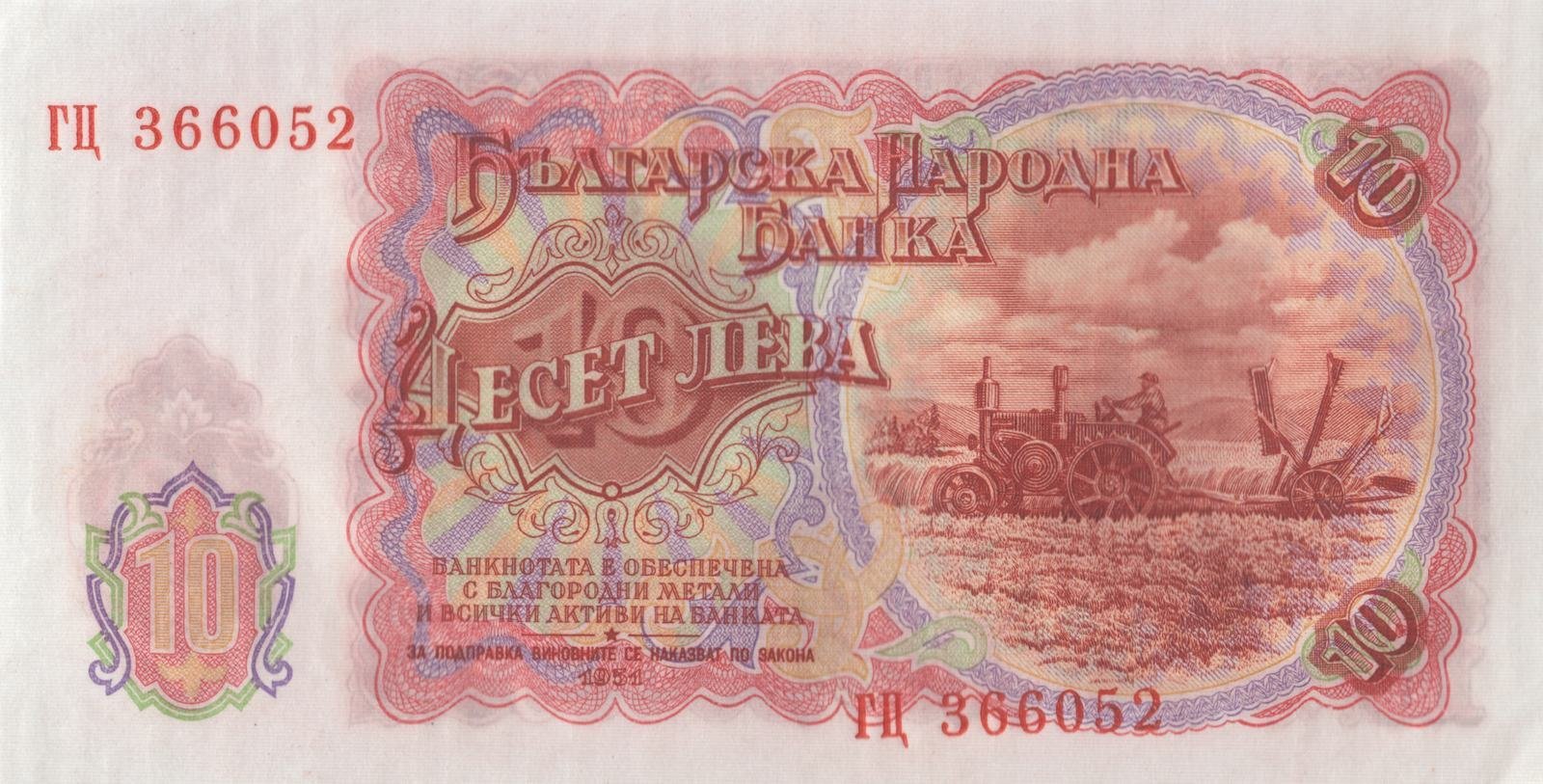
10 leva · back · Bulgarian National Bank
Where the Names Change
The issue’s 1-, 3- and 5-lev notes were state treasury notes. The 10, 25, 50, 100 and 200 leva were banknotes. The Bulgarian National Bank’s historical material distinguishes the two groups, although its banknote catalogue includes them together.
On the illustrated five leva, the treasury-note title appears on the front, below the state coat of arms. Neither side names a bank or ministry. The ten leva puts the Bank’s name across the upper part of the reverse. Its backing clause calls the paper a банкнота — banknote. Neither example carries an official’s signature.
These identifiers are more precise than calling one design “government money” and the other “bank money” on appearance alone. They are the terms printed on the objects themselves. Establishing an institution’s legal responsibility requires more than recognising its name, as our guide to who issues banknotes explains.
Two Backing Clauses
The five-lev treasury note combines a statement of backing with an instruction about acceptance. Its reverse reads, in translation:
“The state treasury note is secured by all the property of the People’s Republic of Bulgaria, and its acceptance at the stated value by all institutions, enterprises and persons is obligatory.”
The first part names the backing: всички имущества, all the property of the Republic. The second says who must accept the paper and at what value. It does not offer the bearer a share of that property or describe an exchange procedure.
The ten-lev banknote has a shorter clause:
“The banknote is secured by precious metals and all the assets of the Bank.”
Here the key words are благородни метали — precious metals — and активи на банката, the Bank’s assets. “Precious metals” should not be narrowed to “gold” in the translation. Nor should “secured by” be turned into “exchangeable for”.
5 leva · complete reverse

5 leva · property and compulsory acceptance
10 leva · precious metals and the Bank’s assets
No corresponding compulsory-acceptance sentence appears on the illustrated ten-lev banknote. That is a difference in the printed text, not evidence that someone was entitled to refuse it. Likewise, neither inscription promises redemption in metal or state property. The distinction between backing and an exchange promise matters here; it is discussed more broadly in How Banknotes Became Money.
Two Categories in the Bank’s Records
A May 1952 BNB reporting plan required exchange teams to report the value of new 1-, 3- and 5-lev treasury notes separately each day.
In his report of 5 June 1952, Bank chairman Atanas Mechkarov listed new money put into circulation in exchange for old money. Treasury notes and banknotes occupy separate sections of the table. The same Bank administered the exchange without treating the two labels as interchangeable in its reporting.
Proposing treasury notes again on 15 June 1989, BNB chairman Vasil Kolarov described them as direct state debt and banknotes as debt through the bank. His explanation was retrospective, not the legal basis for the 1952 issue.
3 leva · front · state treasury note

200 leva · back · Bulgarian National Bank

How Different Were They?
The Bank’s own catalogue adds an important qualification. Its general discussion of treasury notes says that, after the end of the gold standard and especially under the socialist monobank system, the two forms were practically alike.
The different inscriptions and the separate headings in the exchange report remain meaningful. They do not establish different ways of spending a lev or different redemption rights for the holders.
1951 on Paper, 1952 in Circulation
For all four illustrated notes, the BNB catalogue gives 12 May 1952 as the start of circulation and 31 March 1962 as the end. The Bank’s chronology places the currency exchange on 12–15 May 1952. The printed year 1951 identifies the issue; it does not establish when an individual example was manufactured.
A collection entry can preserve both pieces of evidence: dated 1951; introduced in 1952. It should also preserve the paper’s own designation. The three- and five-lev treasury notes need not be excluded from a banknote collection, but their title should not disappear into a generic description of the series.
Frequently Asked Questions
Were Bulgaria’s 1951 treasury notes money?
Yes. The 1-, 3- and 5-lev treasury notes formed part of the new money introduced in 1952. The designation identifies a category of paper money, not an interest-bearing treasury bill.
Did the ten-lev note promise payment in gold?
No such promise is printed on the note. Its clause names precious metals and the Bank’s assets as backing. That statement is not, by itself, a right to redeem the paper for gold or other metal.
Sources and Method
The illustrations use original WorldBanknotes.eu scans of the 3-, 5-, 10- and 200-lev notes dated 1951. Both sides of each were inspected. The translations of their inscriptions are editorial; the original lettering has not been reconstructed. Enlargements differ, and display sizes are not a common physical scale.
- Bulgarian National Bank, Catalogue: Banknotes, revised edition, 2022: page 8, the general explanation of treasury notes; pages 95–97 and 101, the four illustrated types and their circulation dates.
- BNB, Collected Documents, Volume V, 1948–1990, Part Three: document 608, page 604; document 611, pages 611–620, especially 619–620; document 591, pages 578–580. Page references are the printed numbers.
- BNB, Important Dates and Events: the May 1952 exchange and the treasury-note denominations.
- The Banknote Book, Bulgaria, printed pages 43–45: catalogue identification of the treasury notes and banknotes. Institutional documents, rather than a catalogue label alone, support the discussion of their treatment by the Bank.
The reform decree’s full text was not examined; no ministry is assigned formal issuing responsibility. The later explanations are distinguished from the 1952 records. Our catalogue methodology explains the separation of visible evidence, documentation and interpretation.
About the Author
Audrius is the founder and curator of WorldBanknotes.eu, a catalogue and shop for collectible banknotes. His work focuses on banknote identification, catalogue structure, printing, design and the context behind individual issues.