
Germany’s Loan-Office Notes: How They Worked
A German one-mark note dated 12 August 1914 carries the name Reichsschuldenverwaltung: the Reich Debt Administration. A five-mark note dated 1917 and another one-mark note dated 1922 name the same institution. None of the three prints a promise to pay its bearer. Their title, Darlehnskassenschein, identifies them as loan-office notes.
The explanation lies in the loans behind the paper. Under the law of 4 August 1914, Germany’s loan offices lent against pledged assets, and loan-office notes were issued for the amount of the loans granted. Public cash offices had to accept them at face value. The Reichsbank put them into circulation, while the law assigned loan-office interest income to losses and redemption. The institution named on the notes was one participant in that arrangement.
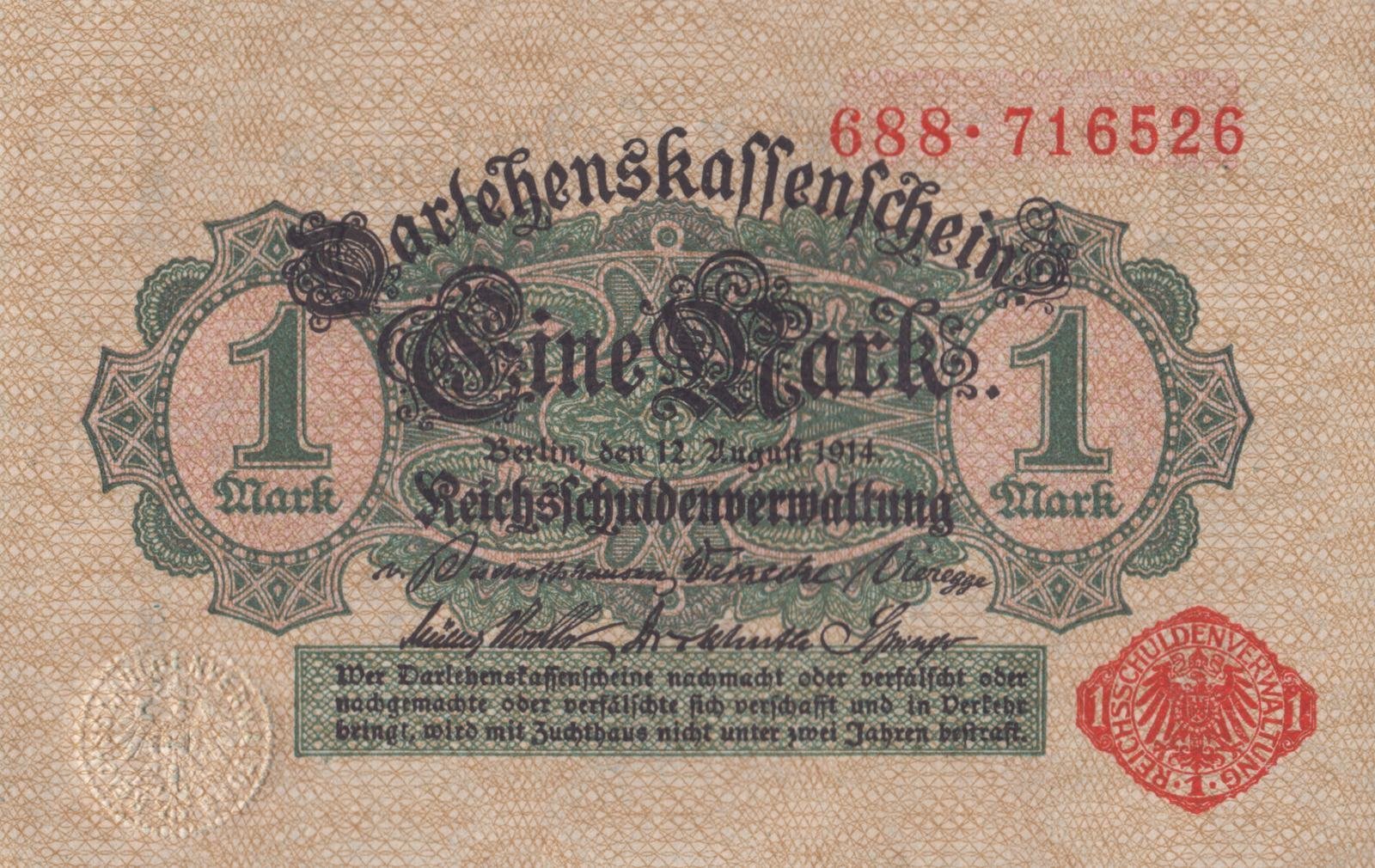
1 mark · dated 1914
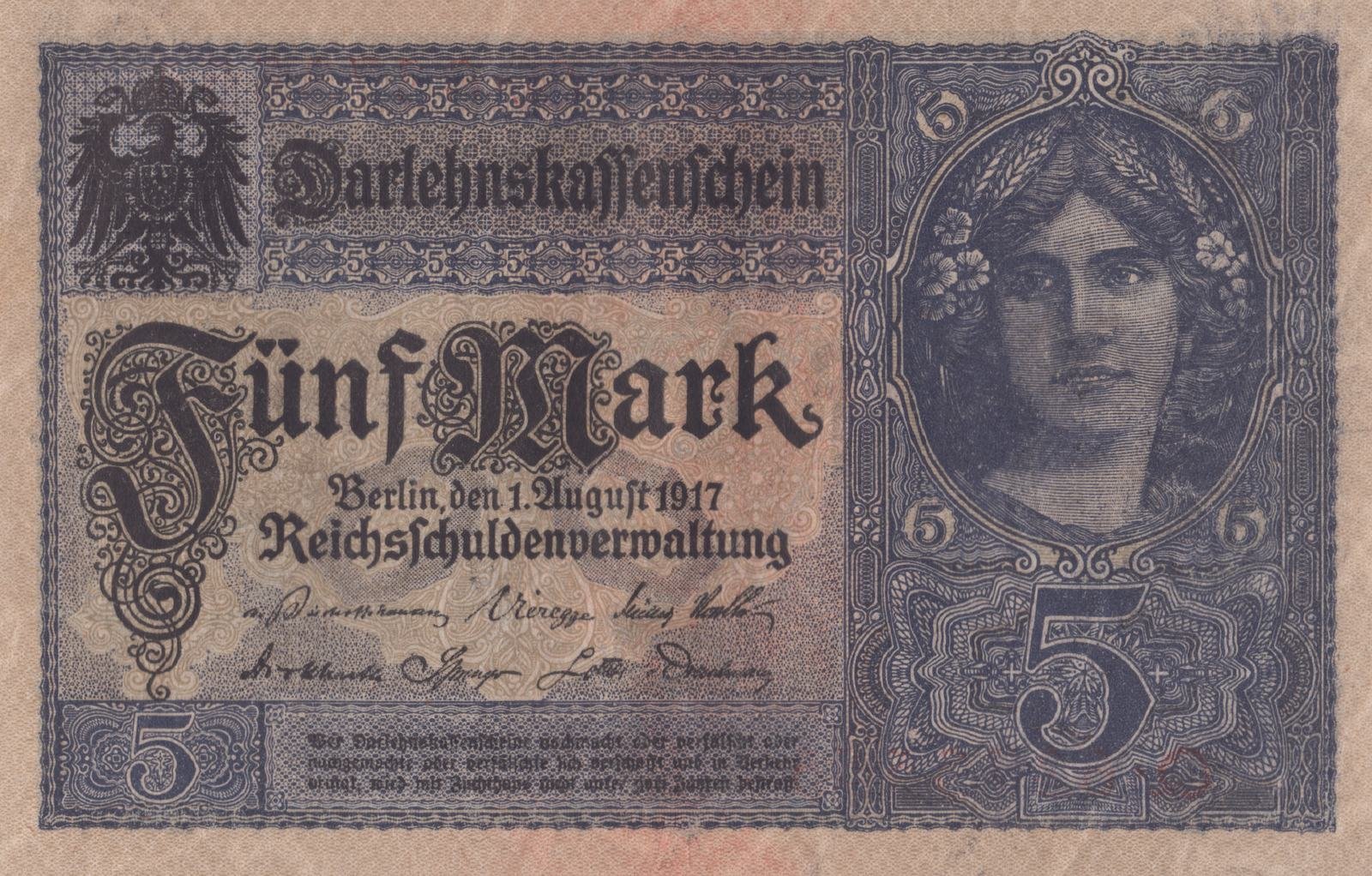
5 marks · dated 1917
1 mark · dated 1922

Three Dates, One Institution
The note bearing the 1914 date spells its title Darlehenskassenschein, with an extra e after Darleh. Its red series and number sit at the upper right; seven signatures appear beneath the Debt Administration’s name. A fine background pattern covers both faces. This is a later version retaining the original date: The Banknote Book places its B112 type in 1917.
The five dated 1 August 1917 uses the shorter spelling Darlehnskassenschein. It has eight signatures on the front and the red number Q·6373555 twice on the back. The one dated 15 September 1922 retains the shorter title but has a different arrangement: ten signatures, two Debt Administration seals on the front and no serial number on either face.
The changes are easy to see without treating the printed dates as first days of circulation. In particular, the 1914 inscription does not date the manufacture of the illustrated specimen. Nor does the spelling on the five establish a universal change in terminology in 1917. These are three identified examples of a monetary instrument whose institutional name continued across different designs.
The Loans Behind the Paper
The Darlehnskassengesetz of 4 August 1914 created loan offices to meet credit needs, particularly those of trade and industry. The law allowed them to lend against security. Non-perishable goods held within the Reich and eligible securities were among the assets that could be pledged.
A loan was normally limited to three months, exceptionally six, and could not be smaller than 100 marks. The lending value of goods was ordinarily no more than half their assessed value, with an exceptional ceiling of two-thirds. Thus, under the ordinary half-value limit, goods assessed at 200 marks could support at most a 100-mark loan. This is an illustration of the statutory limit, rather than a transaction documented for one of the surviving notes.
Section 2 connected that lending to the paper money: Darlehnskassenscheine were to be issued for the whole amount of the loans approved. The central administration could not issue them without sufficient security of the kinds specified in the law. The initial authorised ceiling was 1,500 million marks, which the Bundesrat could raise. That was a limit on the nominal amount authorised, not a count of printed notes.
The small face values served a different purpose from the minimum loan. A one-mark note was not evidence that someone had borrowed a single mark. It was a unit of the monetary issue associated with the loan offices’ larger lending operations. Its text did not identify a particular borrower, loan or pledged asset.
The lending and note-issue relationship
Loans approved against pledged assets
Loan offices · §§ 1–6
Loan offices · §§ 1–6
Notes issued for the amount of approved loans
Sufficient security required · § 2
Sufficient security required · § 2
Separate rules for acceptance and Reichsbank holdings
Public cash offices
Must accept the notes at full face value.
§ 2 · no compulsory private acceptance
Reichsbank holdings
May count toward the cover for the Reichsbank’s own banknotes.
§ 2 · Bank Act § 17 · Bundesbank
The pledge belonged to the relationship between borrower and loan office. The law gave the office security for principal, interest and costs, including provision for selling the collateral. It did not give the bearer of a one-mark note a stated right to select goods from that collateral. The distinction between an issue’s backing and a holder’s redemption rights is also visible in Bulgaria’s treasury notes and banknotes, although their acceptance rules were different.
Who Had to Accept Them?
Section 2 gave a precise answer. All Reich cash offices and all public cash offices in the federal states had to take Darlehnskassenscheine in payment at their full face value. In private transactions, the law imposed no obligation to accept them. Private use was permitted; acceptance was not compulsory.
The Bundesbank’s 1965 history of German paper money accordingly describes the loan-office notes as not legal tender, while stressing their compulsory acceptance by public cash offices. That combination is more informative than either label alone. A public cashier’s duty to take a note did not impose the same duty on every person receiving a private payment.
The notes’ usefulness also rested on their distribution. The Bundesbank records that the Reichsbank took them over and put them into circulation as money. Their use therefore cannot be inferred from the absence of a payment sentence on the paper. The statutory acceptance rule and the bank’s circulation role supply evidence that the inscriptions alone cannot provide.
A Reichsbanknote dated 9 August 1923 makes the contrast in wording visible. This 200,000-mark example states that the Reichsbank’s main cash office in Berlin pays the presenter against the note. It also provides for call-in from 1 September 1923 and exchange for other legal means of payment. Those are the terms printed on this particular Reichsbanknote; they are not a substitute for the loan offices’ separate legal arrangements.
Loan-office one · Debt Administration panel
Reichsbank 200,000 · payment and call-in wording

The Reichsbank’s Second Role
The Reichsbank did more than bring the loan-office paper into circulation. Notes it held could also count toward the legally required cover for its own banknotes. The 1914 law made Darlehnskassenscheine equivalent to Reichskassenscheine for specified purposes of the Bank Act, including its note-cover provision.
This gave the same piece of paper two possible positions in the system. In the hands of the public it could make payments, subject to the different public and private acceptance rules. In the Reichsbank’s holdings it could form part of the qualifying cover for Reichsbank notes. Eligibility in that reserve calculation was an additional institutional use.
The direction matters. Loan-office notes held by the Reichsbank were eligible cover for Reichsbank banknotes. The rule does not say that their bearers could obtain gold, or that the Reichsbank’s gold reserves were pledged to them. The Bundesbank uses the historical term Golddeckung for the cover calculation, but it does not turn the loan-office paper into a gold-redemption claim.
Our account of how banknotes became money separates acceptance, backing and convertibility. Here the separation can be followed through a single arrangement: borrowers provided security to loan offices; public cash offices had a duty to accept their notes; and the Reichsbank could hold those notes as cover for its own issue.
The Name Above the Signatures
Why, then, do the illustrated notes name the Debt Administration? Section 18 assigned the making out of Darlehnskassenscheine to the Reichsschuldenverwaltung. It passed them, on the Chancellor’s instruction and within the authorised limit, to the loan offices’ central administration, the Hauptverwaltung der Darlehnskassen. That central administration bore responsibility for their issue.
The Hauptverwaltung was a separate department within the Reichsbank. The bank administered the loan offices for the account of the Reich, keeping that business separate from its other operations. A further body, the Reich Debt Commission, controlled the preparation and issue of the notes. The law thus divided making out the paper, responsibility for issue, administration and oversight among named institutions.
Dated 1914 · seven signatures
Dated 1917 · eight signatures
Dated 1922 · ten signatures
The original denomination clause listed 5, 10, 20 and 50 marks. A notice of 31 August 1914 separately authorised the Debt Administration to make out one- and two-mark notes. The Bundesbank relates these small values to a shortage of small change in the first weeks of the war, especially in border areas. The printed 12 August date on the one-mark design should not be read as evidence of an issue before that authorisation.
The surviving name and signatures therefore identify one participant in the arrangement. They do not make the Debt Administration its only participant. This is a concrete example of why identifying who issues a banknote requires more than reading the most prominent institution on its face.
Redemption Beyond the Printed Promise
The absence of a bearer promise did not leave redemption unmentioned in law. Section 17 directed the loan offices’ interest income, after administrative costs, toward covering losses and redeeming Darlehnskassenscheine. Any surplus went to the Reich treasury. This was the prescribed use of income earned on loans, not a promise of interest to whoever held a note.
Section 19 provided for loan offices to be dissolved when no longer needed and for the notes to be withdrawn after the restoration of peace, under further directions. These provisions describe the framework for winding up the system. They do not supply a bearer with an on-demand claim to a particular pledged asset.
The Bundesbank’s illustrated catalogue captions give 29 April 1924 as the end of circulation for the loan-office types shown here; TBB records the same withdrawal date. A separate Finance Ministry notice, dated 17 March 1924, ordered the loan offices closed and dissolved with 30 April 1924. The reported withdrawal date and the offices’ closure are distinct events. They do not by themselves establish every subsequent exchange arrangement.
The one-mark notes return us to the original question. Their value did not have to be explained by a sentence promising payment to the bearer. The relevant provisions lay across the law: secured lending, an issue tied to approved loans, required acceptance by public cash offices and an allocation of income for redemption. The name above the signatures belongs to that larger system.
Frequently Asked Questions
Were Darlehnskassenscheine legal tender?
The Bundesbank’s 1965 history describes them as not legal tender. Under section 2 of the 1914 law, Reich and other public cash offices nevertheless had to accept them at full face value. Acceptance in private transactions was not compulsory; private use was not prohibited.
Did Germany’s loan-office notes pay interest to their holders?
The law assigned the loan offices’ interest income, after administrative costs, to losses and redemption. That provision concerned income earned by the loan offices. It did not promise interest to the bearer of a Darlehnskassenschein.
Was the illustrated one-mark note issued on 12 August 1914?
That is its printed date. The background printing and series identify the illustrated example with the B112 type, which The Banknote Book lists as introduced in 1917. The printed date does not establish this specimen’s manufacturing date or its first use in circulation.
Sources and Method
The comparisons use WorldBanknotes.eu scans of three loan-office notes, dated 12 August 1914, 1 August 1917 and 15 September 1922, and a Reichsbanknote dated 9 August 1923. Both faces of all four were examined. Details are taken from the scans without reconstructed lettering; equal display widths do not indicate equal physical dimensions.
- Darlehnskassengesetz, 4 August 1914, contemporary reprint in Badische Gewerbe- und Handwerkerzeitung, no. 33, 15 August 1914, pp. 851–852 (PDF pp. 2–3): sections 1–22, including lending, security, public acceptance, administration, issue and redemption. Both complete pages were checked as rendered images. The first printed page number is inferred from the following page’s 852.
- Deutsche Bundesbank, Das Papiergeld im Deutschen Reich 1871–1948, 1965, printed pp. 81–82, 93–97, 162–164 and 169–171: the institutional account, catalogue captions and selected legal reproductions. Appendix 12, p. 170, reproduces the 31 August 1914 authorisation of one- and two-mark notes; Appendix 13, p. 171, the 17 March 1924 closure notice. The relevant full pages were checked. These are reproductions, not directly examined Reichsgesetzblatt originals.
- Owen W. Linzmayer, The Banknote Book, Germany, printed pp. 7, 12, 14, 18–19 and 47: signature groups and identification of B112, B119, the 1922 one-mark group and B246. Introduction dates are catalogue statements. The finer colour/paper and fibre subvariants of the 1922 one and 1923 Reichsbanknote are not needed for the argument.
The printed dates are distinguished from introduction and manufacturing dates. The Bundesbank and TBB give different introduction chronologies for the 1922 family, which is left unresolved here; neither exact chronology is required for the comparison. The mechanism diagram shows statutory relationships, not a documented payment to an individual borrower. The 1914 acceptance rule, the Bundesbank’s later description and the wording on the specimens are treated as different kinds of evidence.
About the Author
Audrius is the founder and curator of WorldBanknotes.eu, a catalogue and shop for collectible banknotes. His work focuses on banknote identification, catalogue structure, printing, design and the context behind individual issues.