
After the Coin: Why Hong Kong Issued a New $10 Note in 2002
The green ten-dollar note names Standard Chartered Bank and promises to pay its bearer. The purple ten names the Government of the Hong Kong Special Administrative Region and declares itself legal tender in Hong Kong. Both are Hong Kong dollars. Both carry the same denomination.
The purple note entered circulation in 2002, almost eight years after Hong Kong introduced a $10 coin. It was the Government’s first ten-dollar banknote, but it did not replace the coin or invalidate the older bank notes. Why was a new note wanted, and why did the Government supply it rather than the banks?
Standard Chartered Bank · dated 1 January 1995

Government of the HKSAR · dated 1 July 2002
The Coin Did Not End the Note
The HKMA’s 1994 annual-report calendar records the new Bauhinia $10 coin on 1 November. It also records the intended treatment of the notes: gradual replacement, with their legal-tender status preserved.
Our Standard Chartered example is dated 1 January 1995, two months after the coin’s introduction. That is a date printed on the banknote, not a production record. It does not establish the day this particular piece was printed or handed out, nor does it date the end of ten-dollar note production.
By 2002, the Hong Kong Yearbook described the bank-issued tens as no longer printed but still legal tender. A Legislative Council question that April described the coin and banknotes as circulating concurrently. There was no vanished banknote form for the Government to recreate. There were older notes still in use and a demand for new ones.
This is the distinction between ending production and ending a banknote’s legal-tender status. A note can remain usable long after its printer has stopped making it.
Everyday Payments and Lai-See
On 28 June 2002, Financial Secretary Antony Leung announced the new government note. He gave two uses behind the renewed public demand: everyday payments and, particularly, Lunar New Year gifts.
Joseph Yam, then Chief Executive of the Hong Kong Monetary Authority, subsequently identified the latter as lai-see. Leung’s announcement explicitly preserved both the coin and the older green HSBC and Standard Chartered notes.
Why the Government Issued It
The banks had been asked. In a statement issued the following day, the HKMA explained that the note-issuing banks had been consulted during preparations for a new banknote generation. They expressed no interest in denominations outside their existing $20–$1,000 range. Before starting the ten-dollar project, the HKMA approached them again and discussed the Government’s proposal. The banks supported it.
In his 12 September account, Yam also described an alternative that had been examined: reissuing a former bank design. He considered only Standard Chartered’s suitable; HSBC’s had an “old colonial design”, and Bank of China had never issued a ten-dollar note. He did not explain why the Standard Chartered option was not pursued.
Yam also pointed to the Government’s existing role: the $10 coin had already extended its denomination range to ten dollars. Government banknotes had existed before, but for smaller amounts; the 2002 note was its first ten. Our guide to who issues banknotes explains the wider division between the Government, the HKMA and the commercial issuers.
Reading the Two Banknotes
The 1995 Standard Chartered note is P-284b, corresponding to B407c in The Banknote Book. Its issuer’s name appears above the promise to pay the bearer on demand at the bank’s office. The line below reads “By order of the Court of Directors”. The two signatories are identified by their offices: Head of Finance and General Manager.
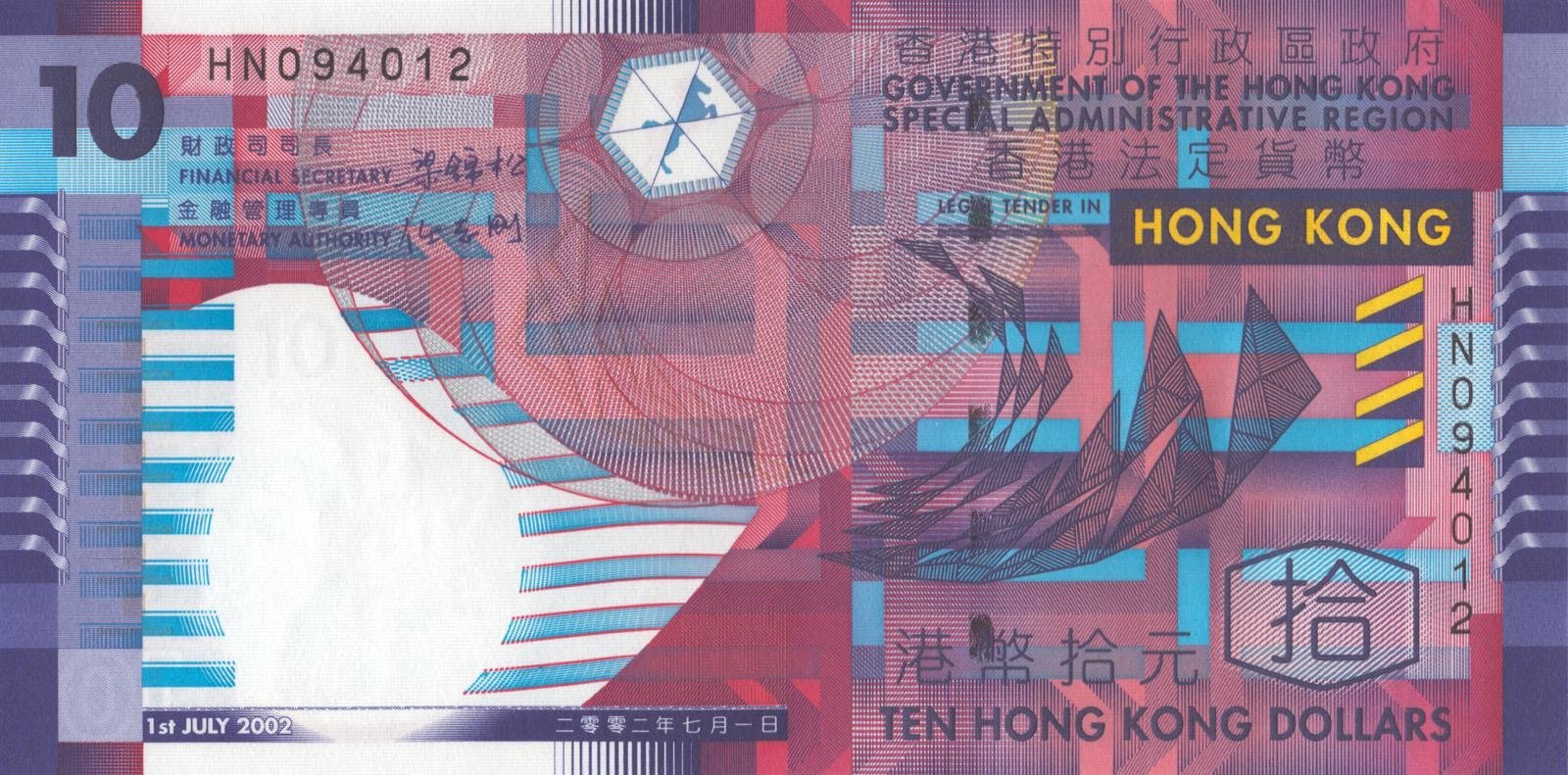
The 2002 government note is P-400a / B819a. Its heading names the Government of the Hong Kong Special Administrative Region. Beneath it is the legal-tender declaration. The signatures carry different titles: Financial Secretary and Monetary Authority.
1995 bank note · promise to pay
2002 government note · issuer and legal tender
Bank officers
Government and monetary officials
The green note’s dragon-fish and the purple note’s geometric design make the pair easy to separate. Their small print supplies the more precise comparison: a named commercial bank and its directors on one, the Government and its monetary officials on the other.
Both notes were legal tender. The difference in wording identifies the issuer and the form of the declaration, not unequal monetary status within the currency.
A July Date and a September Release
The government note bears the date 1 July 2002. Leung’s June announcement explained the choice: the fifth anniversary of the HKSAR’s establishment. The announcement also said that circulation would follow later, as supplies became available.
P-400a · English date at the lower left
| Date | Event and record |
|---|---|
| 28 June 2002 | Announcement. Financial Secretary announces the new government issue. |
| 1 July 2002 | Printed date. Date chosen for the fifth anniversary of the HKSAR. |
| 10 September 2002 | Circulation. Start recorded in the HKMA’s 2002 annual report. |
The HKMA’s 2002 annual report, page 28, gives the circulation date as 10 September. The distinction is unusually clear: an announcement on 28 June, an anniversary printed as 1 July and a public release in September. Our guide to dating banknotes explains why a printed date cannot automatically stand for all three events.
Initial stocks were limited. Yam described a low-key release and explained that overseas assistance was needed while the local plant prepared the next banknote generation.
By the end of 2002, the annual report recorded HK$498 million worth of the new notes in circulation. This is a year-end circulation value, not a banknote count or a production total.
The 2007 Polymer Trial
A later change concerned the material. The Government announced a trial polymer ten in 2007, with circulation beginning on 9 July. Our P-401a example is dated 1 April 2007: another printed date preceding release. The trial was to be evaluated over two years.
The comparison between the paper and polymer notes belongs in our banknote materials guide. The earlier decision was a different one: in 2002, a new government issue supplied ten-dollar banknotes while the coin and older bank notes remained valid. The change visible across our green and purple tens is therefore best read through the issuer, the wording and the circumstances of the issue, rather than as the replacement of one kind of money by another.
Frequently Asked Questions
Did Hong Kong’s $10 coin replace all ten-dollar banknotes?
No. The 1994 introduction planned gradual replacement, but the banknotes remained legal tender. In 2002 the Government added a new $10 note alongside the coin and the older bank notes.
Why is the 2002 ten-dollar note dated 1 July?
The printed date marks the fifth anniversary of the establishment of the HKSAR. The note began to circulate on 10 September 2002, not on the anniversary.
Was Hong Kong’s 2002 ten-dollar note made of polymer?
No. The 2002 issue was a paper note. A government polymer trial followed in 2007, with circulation beginning on 9 July. Our 2007 example is dated 1 April 2007.
Sources and Method
The illustrations use original WorldBanknotes.eu collection scans of the 1995 Standard Chartered ten-dollar note, P-284b / B407c, and the 2002 Government of the HKSAR ten, P-400a / B819a. Details remain linked to their complete original sides. Display widths do not represent a common physical scale.
- HKMA annual reports: 1994, Calendar of Events, page 63, for the coin’s introduction and treatment of the notes; 2002, Economic and Banking Environment, page 28, for the new note’s circulation date and year-end value.
- Government announcement and HKMA clarification: 28 June 2002, for the stated demand, coexistence of the issues and anniversary date; 29 June 2002, for the HKMA’s account of the banks’ position.
- Joseph Yam, HKMA: “The new ten dollar note”, 12 September 2002, for the design options considered and initial production arrangements.
- Earlier circulation and the later trial: Hong Kong Yearbook 2002, monetary system; Legislative Council question and reply, 24 April 2002; government announcement of 15 June 2007.
- Owen W. Linzmayer, The Banknote Book, Hong Kong: B407c, B819a and B820a for the catalogue identifications. The consulted chapter does not state an edition date.
The sources consulted do not establish the exact end of bank-note printing or why the Standard Chartered design was not reused. Names have not been assigned to the Standard Chartered signatures. The catalogue methodology explains how visible observations and reference information are distinguished.
About the Author
Audrius is the founder and curator of WorldBanknotes.eu, a catalogue and shop for collectible banknotes. His work focuses on banknote identification, catalogue structure, printing, design and the context behind individual issues.