
Kazakhstan’s First Tenge: Paper Tiyn and Portrait Notes
Both notes carry a large 1 and the year 1993. One reads БІР ТЕҢГЕ, one tenge; the other reads БІР ТИЫН, one tiyn. The portrait note has a signature. The smaller denomination has an ornamental value panel and no signature. They belong to the same currency, with a hundred tiyn to one tenge.
The year alone does not identify the printing either. Among the three portrait notes examined here, The Banknote Book assigns one to a British printing and two to later domestic varieties. The evidence lies in the serial prefixes, checked against the catalogue entry for each denomination.
1 tenge · front

1 tiyn · front

One Currency, Two Paper Units
The presidential decree of 12 November 1993 introduced the tenge at 08:00 local time on 15 November. It became the sole legal tender from 08:00 on 18 November. The same decree defined the relationship between the units: one tenge consisted of 100 tiyn.
The National Bank’s catalogue dates both paper groups to 15 November 1993. The portrait notes ran through 1, 3, 5, 10, 20, 50 and 100 tenge. The paper tiyn supplied six fractional values: 1, 2, 5, 10, 20 and 50.
Paper therefore served both the main unit and its small change. The two groups had different designs and denominations, but the bank name printed on the illustrated notes is the same. Their different appearance is not evidence of separate currencies.
Portraits and the Fractional Notes
Al-Farabi appears on the one-tenge note, the poet Suinbai Aronuly on the three, and the musician and composer Kurmangazy on the five. The National Bank describes the portrait programme in terms of figures who contributed to science, art, culture and education. That broad account does not explain every individual choice.
3 tenge · front

5 tenge · front
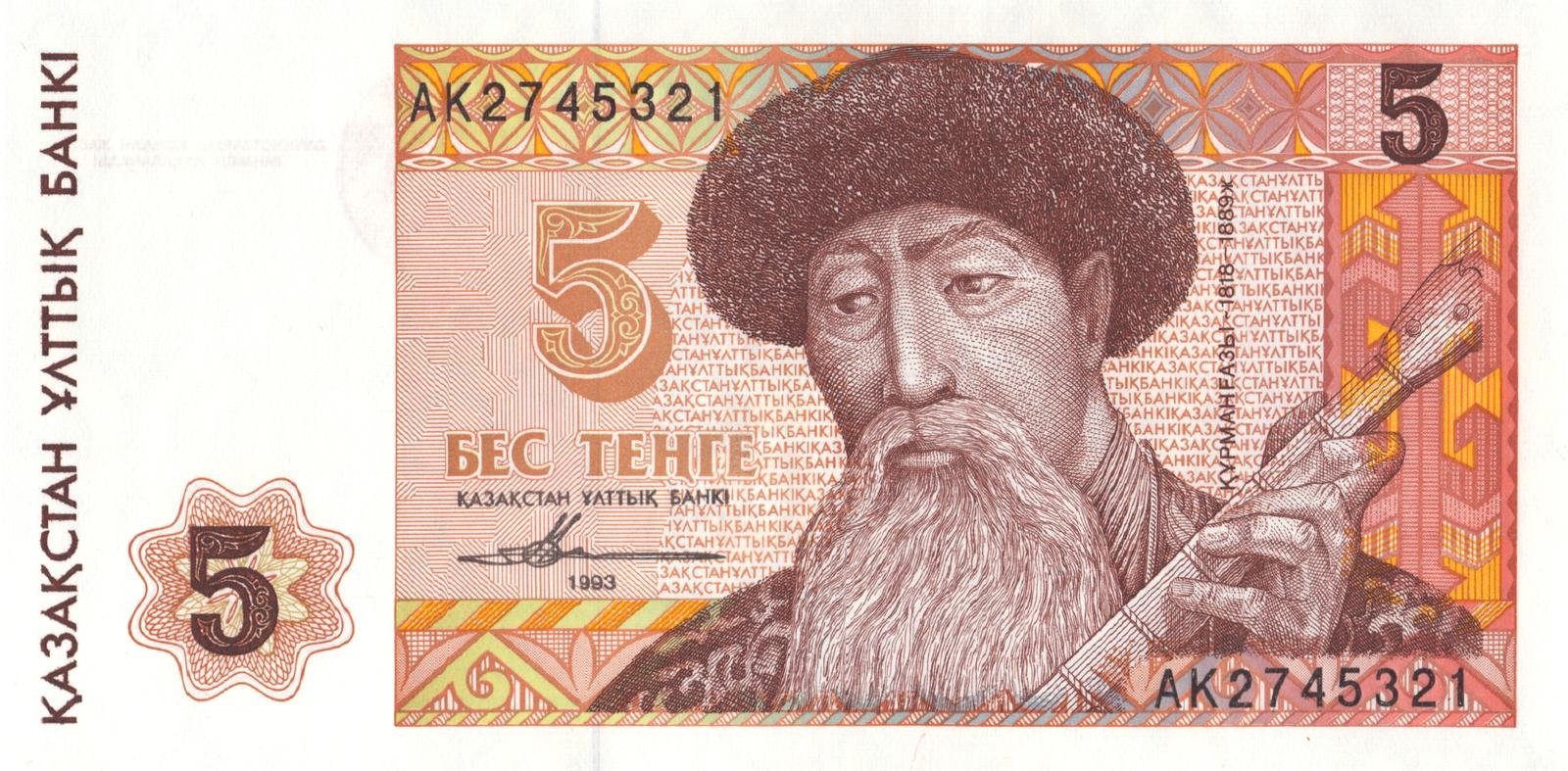
All three illustrated tenge notes carry the same signature above 1993. The one- and twenty-tiyn examples are unsigned on both sides. Their fronts organise the value within ornament; their backs give prominence to the state emblem. These distinguish the two paper groups within the same currency.
Three Prefixes, One Printed Year
The one-tenge example has prefix АМ; the three has АР; the five has АК. These are Cyrillic letters. On each note, the upper and lower serial numbers repeat the same prefix.
1 tenge · АМ
3 tenge · АР
5 tenge · АК
For the one tenge, the catalogue places АМ in its domestic group, B107b. For the three, АР falls in B108b, also domestic. Both varieties are catalogued as introduced in 1995. The five’s АК belongs to B109a, which the catalogue attributes to Harrison & Sons and dates from the initial November 1993 issue.
| Note | Prefix | Catalogue variety and introduction |
|---|---|---|
| 1 tenge | АМ | B107b · domestic printing · 1995 |
| 3 tenge | АР | B108b · domestic printing · 1995 |
| 5 tenge | АК | B109a · Harrison & Sons · 15 November 1993 |
The prefix must be read within the correct denomination’s entry. АК is not a universal printer code: it falls in the domestic range for the one-tenge type but in the British range for the five. Recognising two letters without checking the denomination would give the wrong answer.
These are catalogue attributions, not dates recovered from the objects. A variety introduced in 1995 does not supply the manufacturing date of an individual example. Nor does the five’s earlier catalogue group establish that it came from the first production batch. Our guide to dating a banknote explains the distinction between a printed year, an issue and a variety.
Britain and the Domestic Factory
The Banknote Factory’s own history says the first six tenge denominations were produced by British companies and later transferred to the domestic factory. It records the factory’s formal opening on 19 May 1995. Harrison & Sons is the more specific attribution supplied by the catalogue.
The illustrated one- and three-tenge notes retain 1993 and the same signature as the British-group five. Because the examples have different denominations, their pictorial differences cannot be treated as evidence of a change in printing technique.
The paper tiyn have a separate production history. The Banknote Book attributes them to a domestic unit it calls the Direction of Production Plants, later the Securities Printing Workshop of the Banknote Factory. The factory’s history confirms that a securities-printing workshop opened in June 1993, but does not identify the tiyn as its output. The specific printing attribution here remains the catalogue’s.
Coins After Paper Tiyn
In the National Bank’s 2013 history of the currency, D. S. Asanova places the introduction of the first coins in early 1994. She lists 1-, 3-, 5-, 10- and 20-tenge coins, together with 2, 5, 10, 20 and 50 tiyn to replace the paper fractional notes. The coins are described as the 1993-pattern series. Their pattern year and their circulation chronology are distinct.
That account does not say the paper tiyn all ceased to be legal tender when the coins appeared. Nor do the sources used here explain why the fractional notes were initially paper. Other documented uses of fractional paper money are examined in Why Was Small Change Printed on Paper?
For these early Kazakh notes, a useful collection entry records the unit, the printed year and the prefix separately. The year 1993 brings the designs together. The words tenge and tiyn distinguish their values, while the denomination-specific catalogue entries separate the portrait notes’ printing groups.
Frequently Asked Questions
Was one tiyn worth the same as one tenge?
No. The 1993 decree defined one tenge as 100 tiyn. The large numeral 1 appears on both illustrated notes, but the printed unit gives it a different value.
Were all Kazakhstan banknotes dated 1993 printed in that year?
The printed date alone does not establish that. The catalogue identifies the illustrated one- and three-tenge notes as domestic varieties introduced in 1995, although they still say 1993. The manufacturing date of each individual example is not established.
Sources and Method
The illustrations use original WorldBanknotes.eu scans of 1, 3 and 5 tenge and 1 tiyn. A twenty-tiyn note was also examined. Both sides of all five notes were inspected. The five-tenge identification follows its visible АК prefix and the relevant TBB entry; a Pick subtype has not been inferred from that attribution. Display sizes are not a common physical scale.
- Republic of Kazakhstan, Decree No. 1399 of 12 November 1993, paragraphs 1–2: introduction, sole legal-tender status and the relationship between tenge and tiyn.
- National Bank of Kazakhstan, Banknotes of 1993 and Paper tiyns of 1993: the initial denominations, designs and type-introduction dates.
- National Bank, History of the National Currency: the broad description of the portrait programme.
- Banknote Factory of the National Bank, About the Factory: British production, the transfer to the factory and the separate workshop/factory milestones.
- D. S. Asanova, “Становление национальной валюты в Республике Казахстан”, National Bank Economic Review, No. 3, 2013: the coin chronology, PDF page 5. The relevant passage was checked in the text layer.
- The Banknote Book, Kazakhstan, printed pages 2–5: prefix ranges, printing attributions and variety introductions, particularly B107b, B108b and B109a. The chapter’s publication date is not stated in the copy consulted.
The prefix comparisons identify catalogue groups rather than proving manufacturing dates or physical printing methods. Our catalogue methodology distinguishes visible evidence from documentary attribution.
About the Author
Audrius is the founder and curator of WorldBanknotes.eu, a catalogue and shop for collectible banknotes. His work focuses on banknote identification, catalogue structure, printing, design and the context behind individual issues.