
Laos’s Liberation Kip: How a Zone Currency Replaced the Vientiane Kip
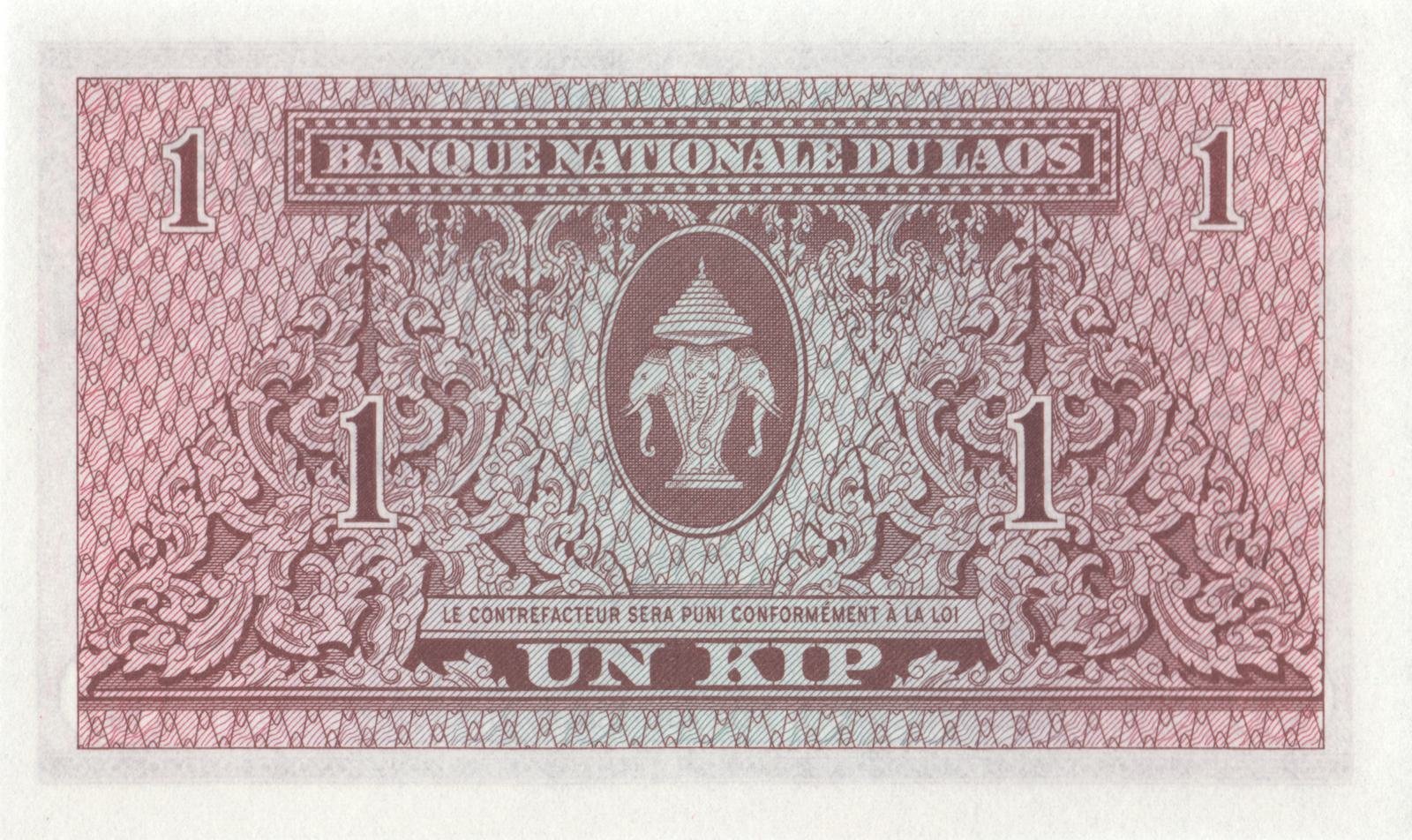
Both notes below say “one kip”. The brown note names the Banque Nationale du Laos in French; the green one carries Lao lettering above a clinic scene. They belong to different monetary systems, although the name of the unit is the same.
In June 1976, the government replaced the former Vientiane kip with the Liberation kip, a currency already circulating in the zone of the Lao Patriotic Front (NLHS). Money previously used in part of the country took on a wider role.
Banque Nationale du Laos · one kip · catalogue year 1962

Pathet Lao issue · one kip · catalogue year 1968


Two Undated One-Kip Notes
The brown note is catalogued as P-8b / B208b, in the 1962–1963 Banque Nationale du Laos group. Its front has two signatures, with the French titles UN CENSEUR and LE GOUVERNEUR beneath Lao text. On the back, BANQUE NATIONALE DU LAOS arches over the arms, and UN KIP states the denomination.
The green note is P-19A / B301a, catalogued by The Banknote Book under the Pathet Lao Government’s 1968 issue. Its front shows agricultural work and power pylons; the back shows medical care. A Lao heading occupies the space above that scene.
Brown front · one kip
Green front · one kip
Brown reverse · the French bank name
Green reverse · a heading in Lao
The dates used here come from the catalogue. Neither note carries a printed year. The brown example’s R prefix and signatures identify its variety; the green example carries EV 033004. Those marks help identify the paper, but they do not date the monetary change described below.
Money Already in Circulation
The Banknote Book places the beginning of Pathet Lao note circulation in April 1968, in northern and eastern areas under its control. That is a catalogue account of the issue’s early use, not a date printed on our green banknote.
The Bank of the Lao PDR’s later institutional history describes Vientiane kip circulating in the Vientiane-controlled zone and Liberation kip in the liberated zone during 1973–1975. It dates the subsequent replacement of the Vientiane kip to June 1976.
Political change came first. The same history dates the proclamation of the Lao People’s Democratic Republic to 2 December 1975, but describes the Vientiane kip remaining in use in the newly liberated zone before the June 1976 replacement.
The two currencies were therefore in use at the same time, in different zones. By June 1976, the incoming money already had a history of circulation. The change brought it into the area where the Vientiane kip had been used.
June 1976: Twenty to One
A World Bank report dated 26 February 1979 gives the mechanism. In June 1976, it says, the government demonetised the former Vientiane kip and replaced it with the kip de libération, which had circulated in the former NLHS zone. The conversion was twenty Vientiane kip to one Liberation kip.
At the stated rate, twenty Vientiane kip corresponded to one Liberation kip. Keeping the word kip did not make the two units interchangeable at one to one.
There is a limit to applying that account to our brown note. The Banknote Book calls its 1962–1963 group “Royal Khangkhai kip” and lists B208 as withdrawn on 15 June 1976. The institutional accounts use “Vientiane kip”. Their terminology has not been reconciled at the level of this particular type. The brown note is therefore an earlier royal-era comparison, not proof that twenty examples of it were exchanged for one of the green notes shown here.
Withdrawal and conversion are separate parts of a monetary change. Our guide to what happens when a country changes its currency explains the distinction.
The Banks, and a Later Kip
In Annex X, the World Bank describes the National Bank of Laos and its subsidiaries as established by statute in December 1975. The bank incorporated the former Vientiane-zone central bank, Banque de Pathet Lao, the commercial banks and the Development Bank of Laos.
These institutions had operated on different sides of the earlier division. Bringing them into one system was another part of the transition. The familiar words “National Bank” need to be read against that reorganisation, rather than taken as evidence of an unchanged institution.
The Banknote Book dates a further replacement to 16 December 1979, at one new kip for one hundred Liberation kip. The fifty-kip note below belongs to that later design family. Its paddy-field scene and hydroelectric dam give a different visual setting to a denomination still expressed in kip.
Fifty kip · later variety B505b · 1979 design family


The brown one-kip note, the green one-kip note and the later fifty kip can all be filed under Laos and kip. That arrangement is useful for a collection, but it compresses several monetary histories into two labels. In 1976, the decisive change was the wider use of a currency that already existed.
Frequently Asked Questions
Were the Vientiane kip and Liberation kip exchanged one for one?
No. The World Bank account gives twenty former Vientiane kip for one Liberation kip in June 1976. This does not establish a direct exchange between the two particular one-kip types illustrated here.
Are 1962 and 1968 printed on these one-kip notes?
No. Both examples are undated. The years are catalogue attributions, while the prefix and signature details identify the varieties. They are not printed dates of the 1976 currency replacement.
Sources and Method
The illustrations use original WorldBanknotes.eu scans of the Banque Nationale du Laos one-kip note P-8b / TBB B208b, the Pathet Lao one-kip note P-19A / B301a, and the later fifty-kip note P-29b / B505b. Both sides were inspected. Enlarged details are windows into the same scans, not reconstructed lettering. Display sizes are not a common physical scale.
- World Bank, Socialist Transformation in the Lao People’s Democratic Republic: An Economic Report, Volume II: Annexes, 26 February 1979: Report No. 2282-LA, Annex I, paragraph 5 (printed page 2; PDF page 6), for the conversion; Annex X, paragraph 15 (printed page 46; PDF page 50), for the banking reorganisation. The complete relevant pages were inspected. This is a near-contemporary institutional account, not the text of the conversion law or bank statute.
- Bank of the Lao PDR, V. Keomanisy, Background and Evolution of the Bank of Lao PDR: sections III.7–8, for the zonal circulation account and June 1976 replacement. The research read the text extraction; the editorial check could access indexed passages but not the complete PDF. This retrospective account supplies no 20:1 rate.
- Owen W. Linzmayer, The Banknote Book, Laos: B208 (printed page 6), the Pathet Lao Government introduction and B301 (page 12), and the 1979 issue introduction and B505 (pages 15–16). These supply the catalogue years, varieties, withdrawal entry and later conversion. The consulted chapter does not state an edition date.
No literal translation of the long Lao heading is used to establish the issuing organisation. The 20:1 rate is applied to the World Bank’s “former Vientiane kip”, not asserted as a demonstrated exchange between the two illustrated one-kip types. Our catalogue methodology explains the separation of visible features, catalogue attribution and documentary evidence.
About the Author
Audrius is the founder and curator of WorldBanknotes.eu, a catalogue and shop for collectible banknotes. His work focuses on banknote identification, catalogue structure, printing, design and the context behind individual issues.