
Mongolia’s 1993 Banknotes: Sükhbaatar Stayed, Chinggis Khaan Was Added
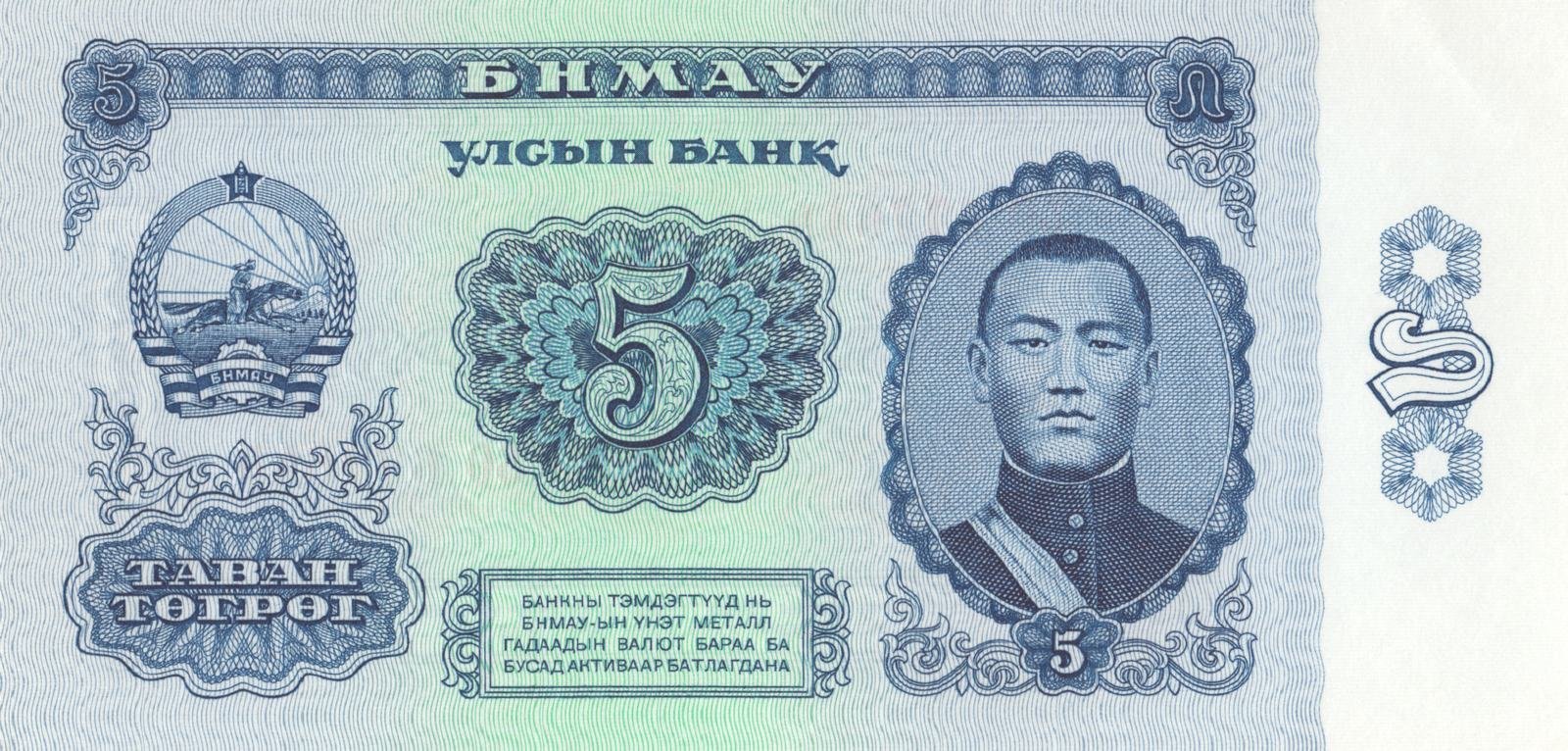
On the blue-green 5-tögrög note dated 1981, Sükhbaatar is bareheaded and wears a high-collared tunic. On the red five catalogued under 1993, he wears a tall hat with a tassel. The portrait has moved from right to left. Both notes depict Damdinii Sükhbaatar, the Mongolian revolutionary leader.
That pair complicates the idea that Chinggis Khaan simply replaced Sükhbaatar on Mongolia’s new money. The redesigned family kept Sükhbaatar on the 5, 10, 20, 50 and 100 tögrög. Chinggis appeared on the new 500 and 1,000 denominations. Comparing the same values, rather than choosing one old note and one new note, reveals how the change actually worked.
Two Fives, the Same Man
The earlier example is P-44 / B310b in The Banknote Book, with 1981 printed on its back. The later five is P-53 / B405a, an undated note of the family catalogued as 1993. For that note, 1993 comes from its catalogue identification, not a year printed on the paper.
1981 · P-44 · front
Undated · 1993 family · P-53 · front

Earlier portrait
New portrait of the same person
The earlier portrait has a diagonal band across the tunic. The later one has a tall pointed hat and a different collar, with the figure set against a densely patterned red field. “Sükhbaatar stayed” therefore describes the identity of the subject, not the survival of an unchanged portrait.
The distinction matters when comparing banknotes across a political transition. A new portrait can depict the same person, just as an apparently familiar composition can carry different official wording. Our guide to shared images on banknotes separates the subject of an image from its particular rendering.
Where Chinggis Khaan Appeared
The denomination list is the simplest test of the replacement story. The 1966–1983 family stopped at 100 tögrög. Its successor continued six values, dropped two and added 500 and 1,000. Those additions carried Chinggis Khaan.
| Value | Earlier family | 1993 family |
|---|---|---|
| 1 | State emblem; no human portrait | Lion on front; Soyombo on back |
| 3 and 25 | Present | Not continued |
| 5, 10, 20, 50 and 100 | Sükhbaatar | Sükhbaatar in a different portrait |
| 500 and 1,000 | Not part of this family | Chinggis Khaan |
Among the continued denominations, none exchanged Sükhbaatar for Chinggis Khaan. The five Sükhbaatar values kept him; the one-tögrög note remained without a human portrait. The 3 and 25 did not continue into the new family, so their absence should not be described as a portrait replacement either.
The Bank of Mongolia’s banknote catalogue identifies the same division between the lower portrait-bearing values and the Chinggis group. Our 500-tögrög example below is a later, dated 2011 version. It shows how that division continued, not every detail of the first 1993 issue.
2011 version · 500 tögrög · P-66c

The 2011 note retains a portrait at the left, a Soyombo medallion to its right and a tall script-bearing cartouche farther across. It also has a small mounted warrior and a windowed security thread. TBB distinguishes those later features from the first 500-tögrög type. The year and signature belong to the particular later variety shown here.
The One-Tögrög Exception Began Earlier
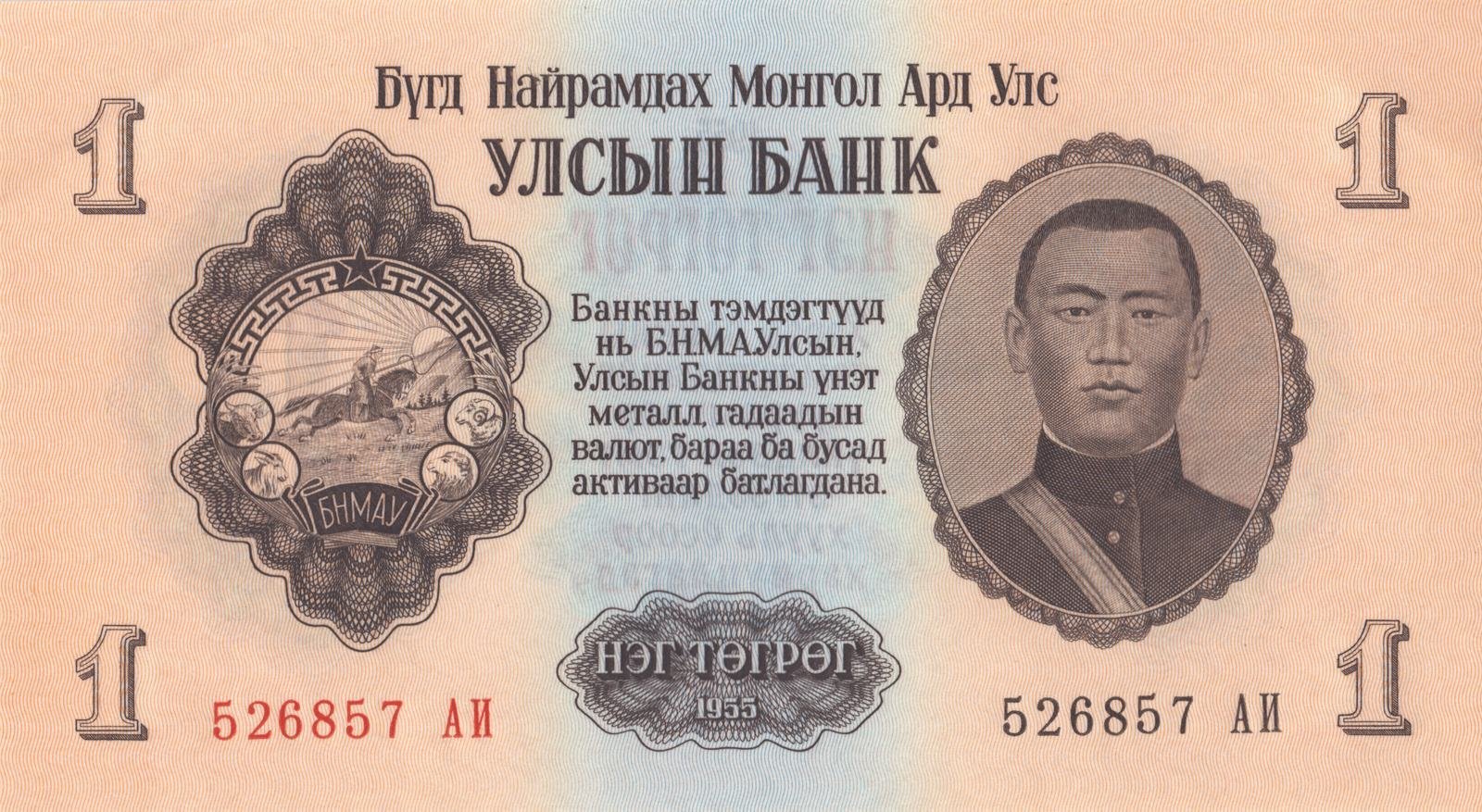
The one-tögrög note needs a longer comparison. A 1955 example, P-28 / B301a, carries Sükhbaatar at the right. The 1966 P-35 / B308a does not: the state emblem and a large denomination dominate its front. The loss of the portrait therefore predates the 1993 redesign by decades.
1955 · P-28 · front
1966 · P-35 · front

Undated · 1993 family · P-52 · front

The undated P-52 / B404a places a lion inside a roundel. Mongolbank calls it a lion; TBB uses the term chinthe. On the back, a large Soyombo occupies the centre. This is a different arrangement from the portrait-bearing notes, which place the Soyombo on the front.
A left-hand script block, a tall cartouche and a signature column still connect the one to the other new designs. But those shared elements do not make the layouts identical. The lion is not a third human-portrait group, and its appearance did not remove Sükhbaatar from a denomination that still carried him immediately before the change.
New Names and Different Symbols
On the 1981 five, БНМАУ sits above УЛСЫН БАНК. The first is the abbreviation of the Mongolian People’s Republic; the second reads “State Bank”. On the new five’s back, the heading is МОНГОЛ УЛС, while МОНГОЛБАНК runs vertically inside the tall cartouche. Both the wording and its position have changed.
1981 · state and bank names · front
1993 family · state name · back

1993 family · bank name · back
These are observable changes in the printed state and bank names. The inscriptions alone do not settle the bank’s legal identity across the transition. The broader distinction between a country name, a bank name and a currency remains useful even when several change together.
The emblem comparison is equally specific. The older five carries the full socialist arms, including the star and the БНМАУ ribbon. Its successor carries a Soyombo medallion. Calling that medallion Mongolia’s new coat of arms would overlook the rest of the emblem defined in Article 12 of the 1992 Constitution, which includes a horse and other elements as well as the Soyombo.
1981 five · socialist state emblem
1993-family five · Soyombo
One tögrög · Soyombo on the back

Mongolbank describes the left-hand device on the portrait-bearing notes as the white banner of the unified Mongolian state, combined with “Монгол улс” in folded script. The Constitution distinguishes the traditional Great White Banner, a ceremonial state symbol, from the national flag. They should not be treated as interchangeable names for the device.
The bank also names a paiza associated with Chinggis Khaan’s decree. The tall tablet-shaped cartouche appears to be the element described: it contains traditional script on the front and МОНГОЛБАНК on the back, in mirrored positions. This identification follows the bank’s description; the two ordinary scans do not establish a see-through security feature. The main front text uses traditional Mongolian script, while the principal headings on the back use Cyrillic.
The comparison with Yugoslavia’s 1990–1992 notes is instructive. There, a closely similar portrait continues through changed inscriptions. Here, the same person receives a different portrait, while another person enters on newly added values. In neither case does the portrait alone describe the whole redesign.
Approved in 1992, Authorised in Stages
The constitutional and banknote dates belong to different records. Mongolia adopted its new Constitution on 13 January 1992; it entered into force on 12 February. Mongolbank’s retrospective history links the need for new notes to the changed state name, emblem and flag.
The contemporary documentary starting point is Small State Khural Resolution No. 32, dated 19 May 1992. It approves the new currency’s design and specifications according to an appendix and instructs the government to resolve the foreign-exchange expenditure for printing. The appendix was not available in the text consulted, so the resolution is not evidence here for the choice of either portrait.
Later resolutions of the State Great Khural declared particular denominations legal tender and authorised Mongolbank to issue them. They did not cover the entire family in one decision.
| Resolution date and number | Banknotes covered |
|---|---|
| 20 May 1993 No. 38 | 500 tögrög |
| 9 July 1993 No. 54 Applies from 20 July | 50 and 100 tögrög |
| 11 October 1993 No. 69 | 5 and 1,000 tögrög |
| 3 January 1994 No. 2 | 1, 10 and 20 tögrög; 10, 20 and 50 möngö notes |
The July resolution explicitly applies from 20 July 1993. The other three texts bear the dates shown but do not give a separate commencement clause. None of these records, by itself, documents the first day on which a bank handed a particular note to the public.
There is also a source disagreement worth keeping visible. Mongolbank’s history says the 1, 10 and 20 tögrög, along with the other values up to 1,000, were printed and circulated in 1993. The resolution covering those three smaller tögrög notes is dated 3 January 1994. The sources reviewed do not reconcile that difference. “1993 family” is therefore useful catalogue shorthand, not a printed date or a proven first-circulation date for every denomination.
For a collector, the practical order is to identify the type, read any date actually printed on the specimen, then consult the relevant catalogue and legal record. Our guide to dating a banknote explains why those dates need not coincide.
The records establish the approved redesign and its sequence of authorisations. They do not explain why Sükhbaatar was retained, why his image changed or why Chinggis Khaan appeared on the higher values. The notes nevertheless make the result clear: a comprehensively altered family could retain the same person on the same denominations while making room for another historical figure.
Frequently Asked Questions
Did Chinggis Khaan replace Sükhbaatar on Mongolia’s 1993 banknotes?
Not on a denomination continued from the earlier family. The 5, 10, 20, 50 and 100 tögrög kept Sükhbaatar in a different portrait. Chinggis Khaan appeared on the new 500 and 1,000 denominations. The one-tögrög note already had no human portrait.
Do these banknotes carry a printed 1993 date?
The first varieties shown here of the one- and five-tögrög notes are undated. Their 1993 designation is a catalogue-family year. It should not be confused with a date printed on the specimen or the date of a parliamentary authorisation. The separate 500-tögrög example is a later variety dated 2011.
Is the Soyombo the complete Mongolian coat of arms?
No. Article 12 of the 1992 Constitution includes the Soyombo within a larger state emblem. The standalone medallion on these notes is not that complete emblem. On the one-tögrög note shown here it appears on the back, rather than beside a portrait on the front.
Sources and Method
The comparisons use original WorldBanknotes.eu collection scans of P-44 and P-53 for the five-tögrög pair; P-28, P-35 and P-52 for the one-tögrög sequence; and P-66c as an explicitly dated 2011 continuation of the 500-tögrög design. Full sides and detail views remain linked to their original scan images. Display widths are comparable, not a common physical scale.
- Owen W. Linzmayer, The Banknote Book, Mongolia: B301, B308 and B310 for the earlier examples; B404–B411 for the first new tögrög family; B432 for the 2011 example. The consulted chapter does not state its edition date. Type and variety information is attributed to the catalogue, not inferred from a filename.
- Bank of Mongolia: Mongolian currency history and its English version, especially the 1966–1983 and post-1993 sections. These are two language versions of one retrospective institutional account. The banknote catalogue also identifies the principal subjects, but its combined security-feature lists are not applied wholesale to the first issue.
- Constitution of Mongolia: Article 12 and the final commencement provision, for the distinction between the full emblem, Soyombo, Great White Banner and national flag, and for the constitutional dates.
- Parliamentary records: Small State Khural No. 32 of 1992; State Great Khural No. 38, No. 54 and No. 69 of 1993, and No. 2 of 1994. The Legalinfo database texts were consulted, not original-gazette facsimiles or the unavailable design appendix.
Small inscriptions that could not be read securely have not been reconstructed. The traditional-script passages are not transcribed here. Political motives, exchange ratios and first-circulation dates are not inferred from the visible redesign. The catalogue methodology explains the separation between scan observations and reference information.
About the Author
Audrius is the founder and curator of WorldBanknotes.eu, a catalogue and shop for collectible banknotes. His work focuses on banknote identification, catalogue structure, printing, design and the context behind individual issues. The catalogue methodology explains how observations, reference information and editorial classifications are distinguished.