
Who Earns Money from Issuing Banknotes?
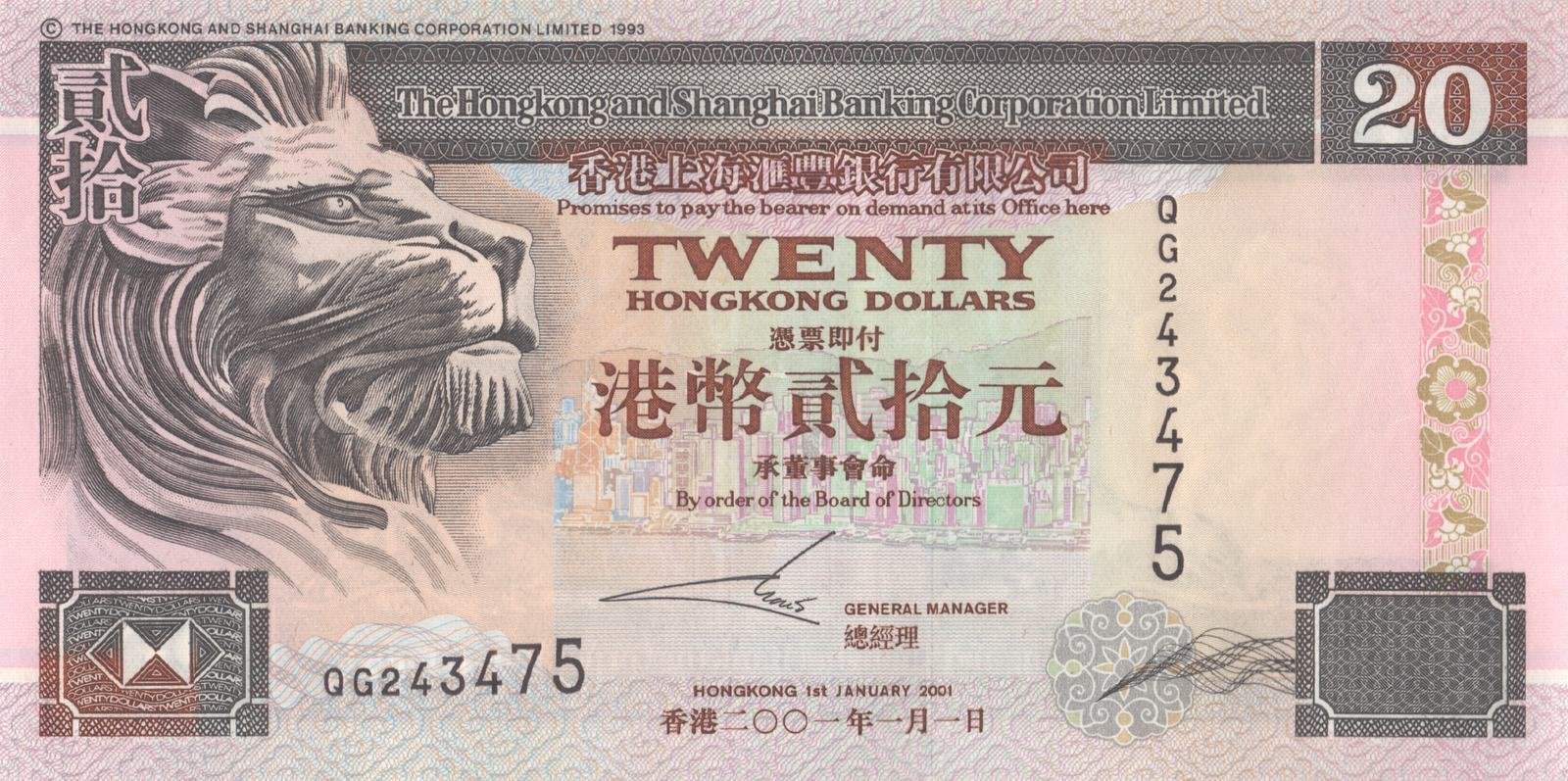
A Hong Kong 20-dollar note in our collection names The Hongkong and Shanghai Banking Corporation and promises payment to the bearer. It is dated 1 January 2001. The bank’s name is easy to find; the financial return behind the issue is not. In that year, HSBC and the other note-issuing banks had to hold certificates that paid them no interest, while the Exchange Fund held the foreign-currency backing.
That arrangement complicates a familiar question: if a banknote costs much less to manufacture than its face value, who keeps the difference? The question treats the note as something sold at a large mark-up. But an issued banknote is an obligation in the issuing system, not a product whose printed amount becomes sales income.
The more useful questions are who holds the assets behind the issue, what those assets earn, which expenses follow and where the remaining income goes. This article follows the Bank of England’s separate note-issue account, a commercial-bank note from Hong Kong, and the European Central Bank’s distinction between banknote income and its overall result. The figures belong to specified reporting periods; they illustrate how the arrangements work, not a forecast of future earnings.
Why the Face Value Is Not the Profit
Imagine subtracting the cost of manufacturing a £20 note from £20 and calling the remainder the issuer’s profit. The calculation leaves out the obligation represented by the note. It also misses the transaction through which the note enters circulation.
The Bank of England’s explanation of that transaction starts with a commercial bank obtaining additional cash. The bank’s reserve balance at the Bank of England falls by an equal amount. Reserves are money the commercial bank holds at the central bank; from the central bank’s perspective, they are a liability. The extra banknotes are another liability. The transaction changes the form of that obligation rather than earning the printed amount.
A change in liabilities, not a £1,000 sale
Illustrative Bank of England transaction: a commercial bank obtains £1,000 in additional notes.
Reserve liability
−£1,000
The commercial bank’s balance at the Bank of England falls.
Banknote liability
+£1,000
Additional notes replace that amount of reserve balances.
Nor does each withdrawal require the Bank to buy a fresh investment. In the mechanism described by the Bank, assets that previously supported reserves instead support the additional notes. Its separate Issue and Banking Departments record an internal deposit to balance their accounts. That internal asset and liability would cancel if the departments were combined; it is not a second external investment created by the printing press.
This is the Bank of England’s arrangement, not a universal instruction for every issuer. It is enough to show why the manufacturing calculation fails. Printing a note, issuing it and earning a return are different events. Our guide to when a banknote enters circulation follows the first two boundaries in more detail.
Where Seigniorage Comes From
A holder of an ordinary Bank of England note is not paid interest for keeping it. The assets held against the banknote obligation can nevertheless earn a return. That difference is the starting point for understanding seigniorage: income associated with issuing money, rather than the face value collected as a one-off profit.
The word needs a little care. The ECB’s explanation of seigniorage describes the income generated through lending or assets acquired in connection with banknote issuance. The Bank of England’s definition describes the return on assets backing its notes after production costs. A figure described as seigniorage may therefore already have some costs deducted, or may refer to income before those deductions.
Before comparing two amounts, read their labels and ask what has been included. A return on assets, a net result from issuing notes, the profit of the whole central bank and a payment to government are not interchangeable measures.
There are four questions to follow: who owes the obligation represented by the note; who holds the assets behind it; who receives their return; and what determines the amount retained or passed on. The answers may name the same institution more than once. In Hong Kong, however, following only the bank named on the note would leave part of the arrangement unexplained.
The printer is a separate participant. Manufacturing the physical note is a service, not ownership of the currency value printed on it. The accounts used here do not establish a printer’s margin on an individual order. A printer’s imprint can help identify who made a banknote, but it does not answer who receives the income from its issuance. Our guide to who prints the world’s banknotes covers that production role.
Even where the notes carry no interest, a positive financial result is not guaranteed. The Bank of England specifically identifies its Issue Department’s exposure to changes in interest rates. The note in a collection may stay physically unchanged while the income associated with the wider issue varies from year to year.
Following the Bank of England’s Income
The Bank of England provides a useful worked example because its 2025/26 annual report presents a separate Issue Department account. For the year ending 28 February 2026, that account records £3,877 million in income and profits. After £61 million of charges and an £8 million buffer, it reports £3,808 million in net seigniorage income paid to the National Loans Fund.
The recipient is therefore not inferred from the portrait, signature or denomination of a note. It is identified in the accounts. The account notes state that Issue Department profits are payable to the National Loans Fund; the Bank’s explanatory article describes this as payment to HM Treasury.
| Reported item | Amount |
|---|---|
| Income and profits¹ | 3,877 |
| Production charge | (26) |
| Issue, custody and payment charge | (29) |
| Other charges | (6) |
| Total expenses charged² | (61) |
| Buffer retained by the Bank³ | (8) |
| Net seigniorage income paid to the National Loans Fund³ | 3,808 |
Reconciliation: 3,877 − 61 − 8 = 3,808. Parentheses identify deductions. The three expense components make up the £61 million total; they are not deducted a second time.
¹ The income figure includes a £1 million gain from revaluing securities. It is not entirely interest income.
² The £61 million is the Banking Department’s charge relating to £70 million of costs incurred, adjusted for amounts collected in excess or short of costs in previous years.
³ Retained buffers are paid to the National Loans Fund in the following year but excluded from that following year’s reported net-income figure. The £3,808 million line therefore does not represent every cash transfer made during the year.
Source: Annual Report 2026, printed p. 189, with notes 1–2 on printed p. 191. Layout prepared for this article.
What the Production Charge Does Not Measure
The production line is small beside the income figure: £26 million divided by £3,877 million is approximately 0.67%. That is a comparison between two annual account lines. It is not the cost of making one note, a profit margin of 99.33%, or evidence that the Bank earns almost the whole face value of each note it issues.
There is no individual banknote in that calculation. The numerator is an annual production charge; the denominator is annual income and profits. Neither is the face value of the notes manufactured during the year. Substituting a print-run figure would introduce another mismatch rather than solve it.
The distinction matters to collectors who encounter a claim such as “this note cost pennies but earned the issuer twenty pounds”. A low manufacturing cost can be true while that earnings claim is false. To establish the latter, one would need an appropriate account of the obligation, the income and the period—not just the cost of the physical object.
Hong Kong: HSBC’s Name, the Exchange Fund’s Assets
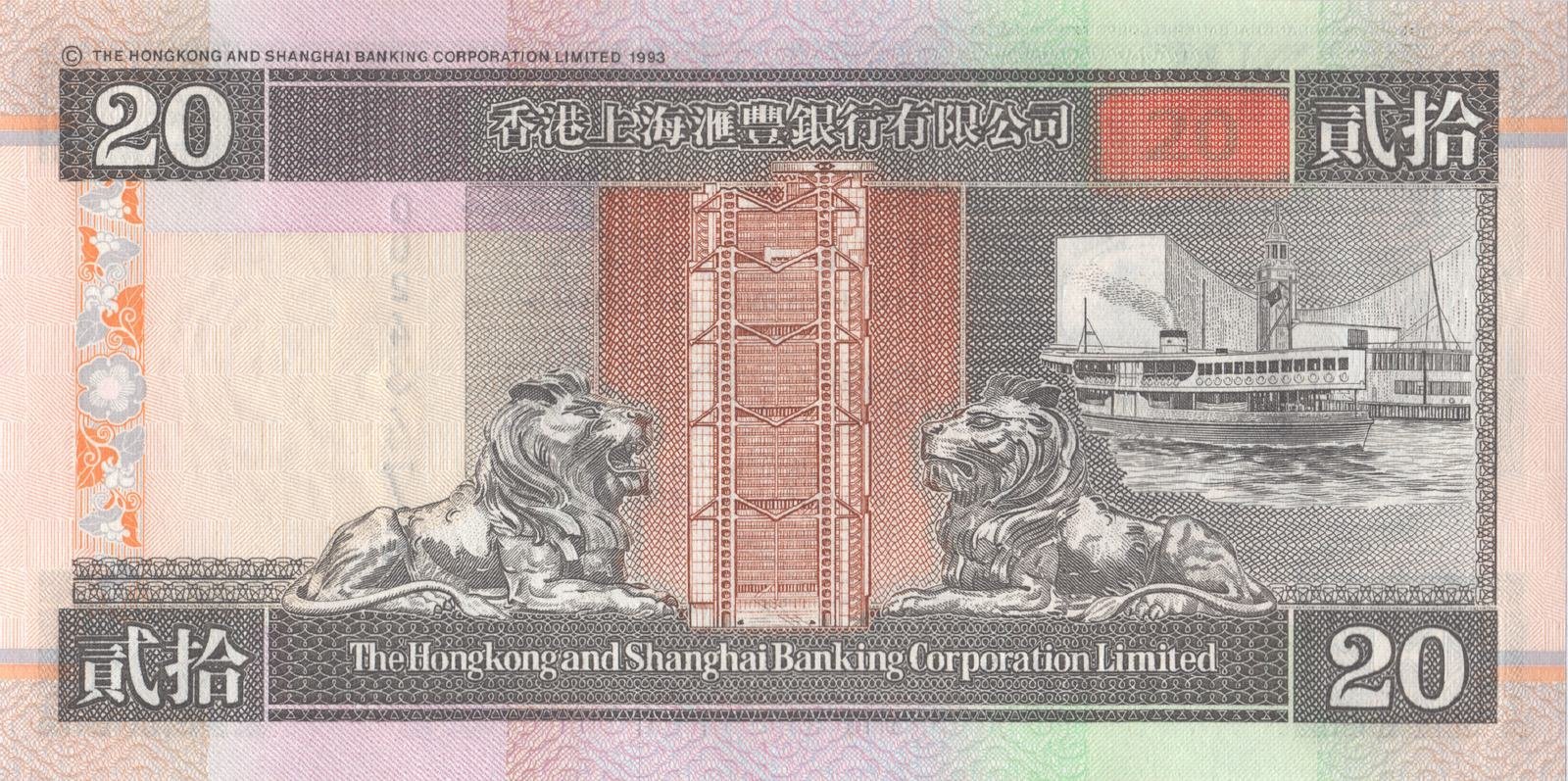
The HSBC 20-dollar note dated 1 January 2001 makes the issuer visible in several ways. Its upper edge carries the corporation’s name and a 1993 copyright date. The face has a promise to pay the bearer, the authority of the board of directors and the title “GENERAL MANAGER”. Lower down is the separate 2001 date. These inscriptions belong to the object; they do not identify an investment return.
The Certificate Paid the Issuing Bank No Interest
For the financial arrangement, we need a different source. The HKMA’s 2001 Exchange Fund accounts, note 14, say that each note-issuing bank had to hold a non-interest-bearing Certificate of Indebtedness issued by the Financial Secretary as backing for its notes. Payments for issue and redemption against these certificates were made in US dollars at US$1 to HK$7.80.
“Non-interest-bearing” is the important detail. The bank named on the note did not receive interest on that certificate. It had exchanged US dollars for a backing instrument that met the requirements for its note issue; the return on the foreign-currency assets cannot simply be attributed to HSBC because HSBC’s name appears on the paper.
The 2025 accounts describe the same non-interest-bearing CI arrangement. They also describe designated US-dollar assets supporting the monetary base through the Exchange Fund’s Currency Board Operations. These are two levels of backing: the issuing bank holds a CI, while the Fund manages the foreign-currency assets supporting the wider arrangement.
The issuer and the asset manager are different participants
Hong Kong banknote issuance · CI principle documented in 2001 and 2025
Note-issuing bank
Issues its banknotes.
Holds Certificates of Indebtedness as backing.
The CI itself pays the bank no interest.
Exchange Fund
Receives US dollars against the CI arrangement.
Manages designated backing assets.
The 2025 Currency Board segment covers the whole monetary base.
What the Accounts Do Not Isolate
The word wider matters. In the 2025 report, the Currency Board Operations segment covers the whole monetary base, including certificates backing banknotes, government currency, banking-system balances and Exchange Fund Bills and Notes. Its result is not a published profit figure for commercial-bank notes alone. The reviewed report does not provide a banknote-only income or result that can be assigned to the pictured $20 note.
Expenses complicate the story further. The 2001 accounts already described reimbursements to note-issuing banks within the combined banknote-and-coin expense line. For a separately dated example, the 2025 report records HK$297 million in combined note and coin expenses. That includes reimbursements to banks and the Fund’s direct expenses for government-issued currency notes and coins. It is not all compensation to banks, not all printing costs, and not HSBC’s income.
We can therefore answer one question firmly: the certificate held by a note-issuing bank paid no interest. We cannot turn that answer into “the bank made no money from issuing notes”. The latter would require a broader account of its income and costs, which these sources do not supply.
For the collector, the useful discovery is a separation of roles. A note may prominently carry a commercial bank’s promise while the management of the foreign-currency backing sits elsewhere. The issuer’s name is the starting point for the inquiry, not the answer to every financial question behind the issue.
The ECB: Banknote Income Without a Profit Distribution
The European Central Bank provides a shorter contrast. Its financial statements announcement for 2025 records €2,900 million in interest income on claims related to the allocation of euro banknotes. Yet its overall result was a loss of €1,254 million, and there was no profit distribution to euro-area national central banks for that year.
Those figures answer three different questions. The first is income from a particular source. The second is the institution’s result after its wider income and expenses. The third concerns distribution. A positive number at the first stage does not guarantee a payment at the last.
The allocation itself is an accounting concept. The ECB’s seigniorage explainer assigns it 8% of the value of euro banknotes. This does not mean it physically manufactured or handed out 8% of the notes in collectors’ albums. The 2025 figures above concern the ECB, not the combined results of every institution in the Eurosystem.
Placed beside the Bank of England example, this makes a comparison rule clear: match the accounting measure before comparing amounts. One report’s net note-issue payment cannot be compared directly with another institution’s gross banknote interest and labelled a difference in printing profitability.
What This Adds to a Banknote Collection
A banknote can show an issuer’s name, a payment promise, a printed date and sometimes a printer’s imprint. It cannot show the annual return earned on the assets behind the issue. Nor does its date establish precisely when the individual piece was manufactured or released. Those questions require supporting records.
The HSBC example suggests a useful way to record the distinction. An object entry might say: “Hong Kong 20 dollars, HSBC, dated 1 January 2001; P-201d.” A separate contextual note could add: “The HKMA’s 2001 accounts record that note-issuing banks were required to hold non-interest-bearing Certificates of Indebtedness, with issue and redemption against US dollars at 7.80.” The first statement describes and identifies the note. The second describes the system documented for that year.
Neither statement implies that the particular note can be matched to a particular certificate, asset purchase or amount of profit. Keeping the two kinds of evidence separate makes the entry more informative without giving the object a financial history that has not been recovered.
When following the money behind another issue, a short checklist is more useful than a presumed profit per note:
- Identify the issuer. Read the institution named on the note and check its role. A central bank, commercial bank and government need not use the same arrangements.
- Identify the period. Find rules and accounts relevant to that issue. A later report can illustrate a later year without proving that every detail applied when the note was dated.
- Identify the asset and its holder. Ask whether the named issuer itself holds an interest-bearing asset or instead holds an instrument, such as a non-interest-bearing CI, within a wider system.
- Keep the measures separate. Record income, charges, net result and distribution under their own labels. Preserve the units, dates and scope of the reporting institution.
- Stop where the evidence stops. An aggregate account does not automatically reveal a profit per denomination, serial number or printing order.
Our guides to banknote issuers and what print-run figures measure address the identification and production questions. The longer history of the obligation is covered in how banknotes became money.
So who earns money from issuing banknotes? In the Bank of England example, the Issue Department records the income and the net amount reported as paid to the National Loans Fund. In Hong Kong, the commercial issuer’s CI pays no interest, while the Exchange Fund manages the foreign-currency backing. At the ECB, banknote-related interest can coexist with an overall loss and no profit distribution. Following those relationships gives a better answer than subtracting a printing cost from the number on the note.
Frequently Asked Questions
Does a bank earn the face value of every note it issues?
No. In the Bank of England mechanism described here, additional banknotes replace an equal amount of commercial-bank reserve balances. The face value does not become sales income. Income can arise from assets held against the banknote obligations, subject to the issuing system’s costs and rules.
What is seigniorage on banknotes?
It is income associated with issuing money, but definitions differ in which costs they deduct. The ECB’s explainer describes income from lending or acquired assets; the Bank of England’s definition deducts production costs from the return on the assets backing its notes. Check the source’s definition before comparing figures.
Do Hong Kong’s note-issuing banks earn interest on their backing?
The Certificates of Indebtedness they hold as backing are non-interest-bearing, as documented in the HKMA’s 2001 and 2025 accounts. That answers the question about CI interest, not the profitability of the banks’ entire issuing activity. The Exchange Fund manages the designated foreign-currency backing assets.
Sources and Method
This article uses published institutional explanations and completed-period financial accounts. The Bank of England example covers the year ended 28 February 2026; the later Hong Kong and ECB examples cover calendar 2025. The HSBC note is dated 2001, and its historical CI context is checked against the 2001 Exchange Fund report. No later earnings figure is assigned to that individual note.
The £1,000 liability illustration is hypothetical; the reconciliation and percentage are calculations from the stated report lines. The diagrams are explanatory layouts, not reproductions of institutional artwork. They do not allocate an individual investment to each banknote. Collection photographs show the original notes without redrawing; catalogue references identify the object, not its financial return.
- Bank of England: The promise to pay: what backs banknotes?, 17 September 2026, especially Boxes B and C and the qualification on asset-liability matching. Used for the reserve-to-banknote mechanism, the internal Issue Deposit and the Bank’s explanation of seigniorage.
- Bank of England: Annual Report and Accounts 2025/26, Issue Department account, printed p. 189; explanatory notes, pp. 191–192. PDF pages are two pages ahead of the printed numbering. The expense adjustment, buffer treatment and revaluation gain are retained beside the article’s table.
- Hong Kong Monetary Authority: Annual Report 2001: Exchange Fund, note 14, printed p. 88, for Certificates of Indebtedness and the 7.80 issue/redemption rate; note 3(a), p. 81, for the scope of banknote-and-coin expenses.
- Hong Kong Monetary Authority: Annual Report 2025: The Exchange Fund, note 2.6.2.8, p. 194; expense note 4(e), p. 209; operating segments and their scope, note 31, pp. 242–244. The Currency Board segment is not treated as a banknote-only account.
- European Central Bank: What is seigniorage?, 7 April 2017, for its explanation of income and the ECB’s banknote allocation. Historical comments about the direction of interest rates are not used as present-day claims.
- European Central Bank: Financial statements of the ECB for 2025, 26 February 2026, for the banknote-allocation interest line, the overall loss and the absence of profit distribution to national central banks.
- Collection and catalogue identification: original HSBC Hong Kong 20-dollar scans and the WorldBanknotes.eu record for P-201d, corresponding to The Banknote Book B681j. The visible 1993 copyright line and the printed 2001 date are not treated as interchangeable dates.
About the Author
Audrius is the founder and curator of WorldBanknotes.eu, a catalogue and shop for collectible banknotes. His work focuses on banknote identification, catalogue structure, printing, design and the context behind individual issues. The catalogue methodology explains how observations, reference information and editorial classifications are distinguished.