
Banknote Grading Explained: UNC, aUNC, EF, VF and Other Grades
Banknote grading is the structured assessment of a note’s physical condition. It describes how closely a banknote retains its original appearance, how much handling or circulation it has experienced, and whether defects such as folds, stains, tears, pinholes or repairs limit its grade.
Collectors commonly use two related systems:
- adjectival grades, such as UNC, aUNC, EF, VF and Fine;
- numerical grades, usually expressed on a 1–70 scale by professional grading services.
These systems overlap, but they are not exact translations of one another. A banknote described as UNC by a collector or dealer should not automatically be assumed to equal a particular PMG or PCGS Banknote numerical grade.

Grading describes condition. It does not, by itself, prove authenticity, rarity or market value.
Table of Contents
What Is Banknote Grading?
Banknote grading is an attempt to describe condition consistently. It is a collector’s assessment, not an issuing authority’s operational decision about whether a note is fit for another circulation cycle; that separate process is examined in When Is a Banknote Too Worn to Circulate?
A grade considers the whole note, including:
- folds and creases;
- handling marks and counting crinkles;
- paper or polymer firmness;
- original surface quality;
- corners and margins;
- edge wear and splits;
- stains, writing and discolouration;
- tears, holes and missing pieces;
- centring and print registration;
- embossing and overall eye appeal;
- evidence of cleaning, pressing or repair.
No single feature should be assessed in isolation. A note may look bright and crisp from the front while transmitted or angled light reveals a centre fold, repaired tear, thinning or a cluster of pinholes.
The International Bank Note Society (IBNS) uses the familiar adjectival sequence from Uncirculated to Poor. Professional services such as PMG and PCGS Banknote use more granular 70-point systems with additional designations for originality, eye appeal or serious problems.
Collector’s Note: The most important defect can limit the final grade. A high-grade-looking note should not be assessed by averaging its strongest and weakest features.
Why Banknote Condition Matters
Condition affects how a banknote is collected, compared and valued.
Two notes with the same country, denomination, date, catalogue number and signatures may have very different collector demand if one is crisp and original while the other is heavily folded, stained or repaired.
Condition influences:
- visual appeal;
- long-term preservation;
- scarcity within a particular grade;
- suitability for a type collection;
- comparison with recent sales;
- whether professional certification is economically sensible.
A grade is not the same as value. A common modern banknote in superb condition may remain inexpensive, while a major rarity can be desirable even in a low grade.
The relationship is therefore:
Identification tells you what the banknote is.
Grading tells you what condition it is in.
Market evidence helps determine what it may be worth.
Collectors who are still learning to identify countries, issuers and catalogue references should begin with How to Identify a Banknote.
How to Examine a Banknote Before Grading
A reliable grade begins with a consistent inspection method.
1. Use Clean, Dry Hands
Handle the note by its edges whenever possible. Avoid creams, food, moisture and adhesive surfaces.
For valuable or fragile notes, a clean inert sleeve can reduce unnecessary contact during examination.
2. Inspect Under Neutral Light
Use bright, even light rather than strongly coloured household lighting.
Look at the banknote:
- face-on;
- from a low angle;
- against transmitted light;
- from both sides.
Low-angle lighting can reveal folds, surface waviness, embossing and pressing that may not be obvious in a flat image.
3. Check the Whole Note Before Focusing on Details
Begin with the overall impression:
- Does the banknote lie naturally?
- Is the colour even?
- Are the margins complete?
- Does the paper or polymer look original?
- Is the note unusually flat, glossy or dull?
Then inspect the corners, edges, centre, serial-number areas and signature zones.
4. Distinguish Handling from a Fold
Professional grading systems distinguish minor handling from folds.
Handling may include teller counting marks, crinkles or gentle bends that do not create a strong line through the design. A fold is more substantial and may cross the printed area. A crease is generally sharper and more damaging because the surface has been strongly compressed or broken.
This distinction is especially important between UNC, aUNC and EF.
5. Examine Both Sides Against Light
Transmitted light can reveal:
- pinholes;
- edge splits;
- repaired tears;
- thinning;
- erased writing;
- washed areas;
- hidden folds;
- disturbed fibres.
A banknote cannot be assessed reliably from the obverse alone.
Why a Flat Scan Can Hide Condition
A flatbed scan is excellent for identifying a banknote and recording fine printed detail. It is not always sufficient for grading.
The same Finland 5 markkaa note dated 1963 was recorded both with a flatbed scanner and with a camera under natural light. In the scan, the surface appears comparatively even. In the photograph, the paper texture, gentle waviness and handling become much easier to see.
If those records will be published or used commercially, image quality is only one issue. Issuers apply different conditions to photographing, scanning and reproducing banknotes, including rules on size, colour, markings, attribution and permission.
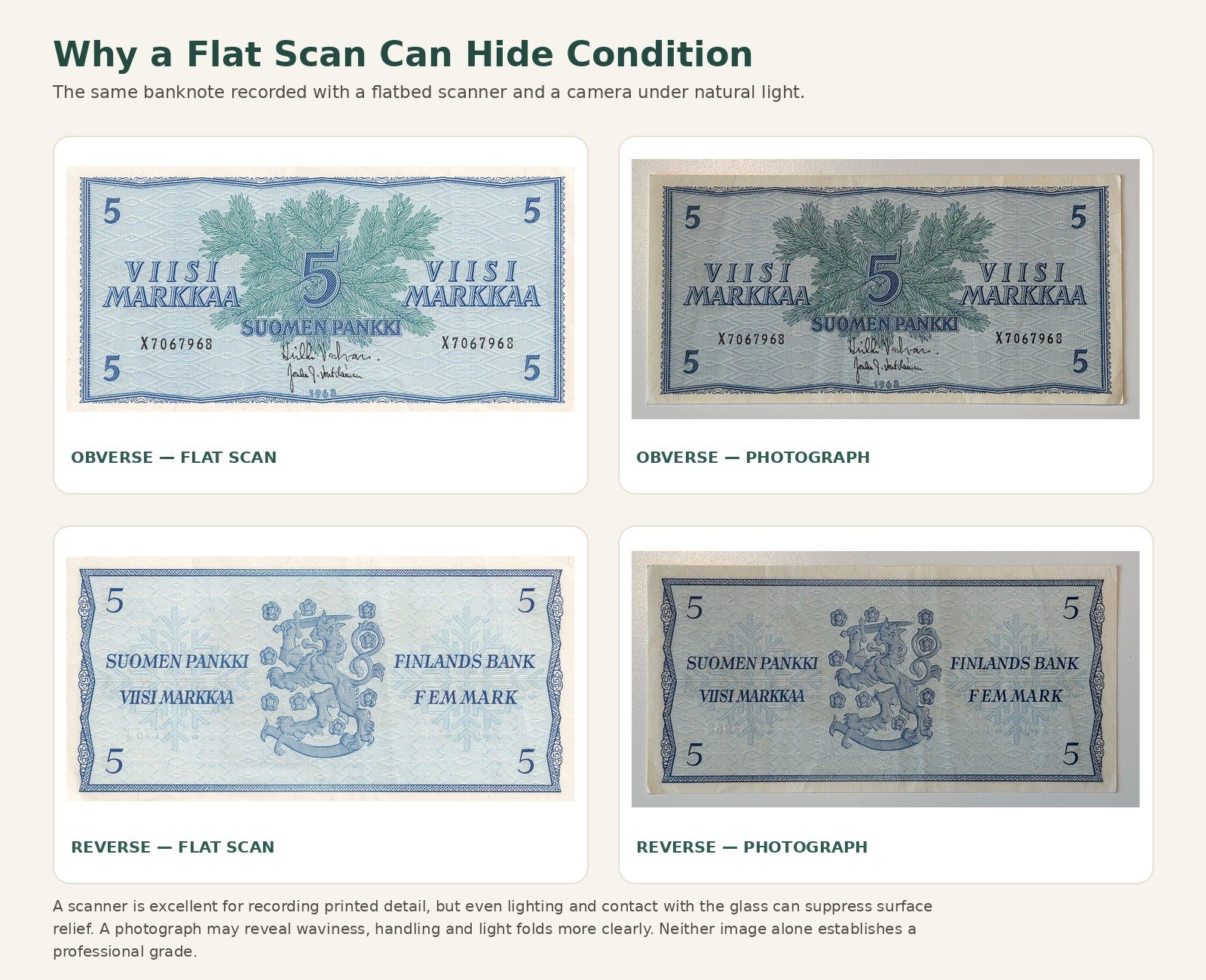
Try the comparison. Both obverse views show serial number X7067968. Compare the paper beside the large central 5 and along the upper edge: the photograph makes the uneven surface easier to see. Before buying a note described as nearly UNC, request an angled view of the actual note if a light fold would affect your decision. This comparison supplies no numerical grade.
This comparison demonstrates three important principles:
- scanner lighting and contact with the glass can suppress surface relief;
- a front-facing image can hide light folds and handling;
- a photograph that reveals more texture still does not establish a professional grade by itself.
The banknote is therefore not presented here as a definitive aUNC specimen. Its value is methodological: it shows why a collector should examine the physical banknote under direct, angled and transmitted light before assigning a grade.
Finland 5 markkaa, 1963. Original scans and photographs supplied by WorldBanknotes.eu.
The Traditional Adjectival Grading Scale
The IBNS grading sequence is:
| Grade | Common abbreviation |
|---|---|
| Uncirculated | UNC |
| About Uncirculated | AU or aUNC |
| Extremely Fine | EF or XF |
| Very Fine | VF |
| Fine | F |
| Very Good | VG |
| Good | G |
| Fair | Fair |
| Poor | PR or Poor |
These words describe broad condition levels. They remain useful in dealer lists, auctions, private collections and databases because they can be applied without third-party encapsulation.
Adjectival grading still requires judgement. Two experienced collectors may agree that a banknote is VF while differing on whether it is a strong VF or closer to Fine.

UNC – Uncirculated
An Uncirculated banknote should retain the appearance of a note that has not suffered meaningful handling.
Typical UNC characteristics include:
- no folds or creases;
- clean and firm paper or polymer;
- original natural sheen;
- sharp, square corners;
- no discolouration;
- no rounded corners caused by wear;
- no tears, pinholes or missing pieces.
UNC does not necessarily mean that the banknote has never physically entered circulation. The term describes condition. A note can have been released but preserved carefully enough to remain Uncirculated, while a note taken directly from a bank bundle can fall below UNC if it was mishandled.
UNC Does Not Mean Perfect
Under strict IBNS standards, UNC describes a perfectly preserved note without discolouration or mishandling. Professional numerical grading uses a broader Uncirculated range, in which grades 60–64 may show handling or other distractions while remaining free of circulation folds through the design.
- imperfect centring;
- a light counting crinkle;
- a slightly disturbed corner tip;
- weak embossing;
- a printing imperfection;
- a minor manufacturing ripple.
This is one reason professional grading services divide the Uncirculated range into several numerical levels.
Crisp, Choice and Gem Uncirculated
Terms such as CU, Choice UNC and Gem UNC describe progressively stronger Uncirculated notes.
In general:
- Uncirculated confirms the absence of circulation folds;
- Choice Uncirculated suggests better-than-average presentation;
- Gem Uncirculated requires especially strong centring, margins, originality and eye appeal.
Their precise thresholds vary between written standards and should not be used without identifying the grading system.
aUNC or AU – About Uncirculated
About Uncirculated is a near-UNC grade with limited handling.
An aUNC or AU note may show a small number of counting wrinkles, a light corner fold, or one light fold through the centre. Under the IBNS standard, a corner fold and a centre fold should not both be present, and the note cannot have a sharp crease.
The note should remain clean and bright with original sheen, and its corners should not be rounded.
Why aUNC Is Often Misunderstood
A banknote can look almost perfect in a front-facing scan while still being aUNC because of one light fold. Conversely, a note with no central fold may fail to qualify as aUNC if it has rounded corners, surface damage, significant staining or evidence of processing.
The difference between UNC and aUNC is not simply “new” versus “used”. It is a question of visible physical condition.
EF or XF – Extremely Fine
EF and XF describe the same broad grade; the preferred abbreviation varies by market.
An Extremely Fine banknote remains attractive, clean and relatively crisp but shows clear evidence of light circulation.
Typical characteristics include:
- several light folds or one crease;
- only slight soiling;
- good colour;
- mostly sharp corners;
- strong overall eye appeal;
- no major tears or heavy damage.
The IBNS standard allows a maximum of three light folds or one crease. If folds become more numerous, the material loses firmness or edge wear becomes more obvious, the grade moves towards VF.
VF – Very Fine
Very Fine is an important collector grade because many older and scarcer notes remain attractive in VF condition.
A VF banknote may have:
- several vertical and horizontal folds;
- light soiling;
- mild colour smudging;
- slight edge wear;
- corners that show wear without becoming fully rounded;
- paper that remains relatively crisp rather than limp.
Under the IBNS standard, tears should not extend into the border area at this grade.
VF does not mean nearly new. It means clearly circulated but still complete, presentable and structurally sound.
A note with numerous folds can still be VF if the paper remains firm and the defects are not severe. Conversely, a banknote with fewer folds may grade lower if it has a serious stain, tear or repair.
Fine, Very Good, Good, Fair and Poor
Fine – F
A Fine banknote shows considerable circulation.
Typical features include:
- many folds and wrinkles;
- some loss of crispness;
- mild edge wear;
- minor border tears that do not enter the design;
- clear but no longer bright colours;
- occasional staple holes;
- material that remains solid and substantially complete.
Fine notes can remain desirable, particularly for scarce types.
Very Good – VG
Very Good sounds stronger than it is. In banknote grading, VG describes a heavily used note that is still intact.
A VG note may show:
- limp paper or a heavily crumpled polymer substrate;
- rounded corners;
- staining or discolouration;
- pinholes and staple holes;
- edge nicks;
- tears extending into the design;
- a small centre hole caused by repeated folding.
Under the IBNS standard, no pieces should be missing.
Good – G
A Good banknote is heavily worn and may have:
- strong multiple folds;
- dirt and discolouration;
- stains;
- edge tears;
- a centre hole;
- rounded corners;
- graffiti;
- pinholes or staple holes.
Despite the name, Good is a low grade.
Fair
A Fair note is extremely worn, dirty and limp or severely crumpled. Larger tears or missing pieces may be present, but enough of the note remains for attribution.
Poor – PR
A Poor banknote has severe damage. It may have:
- large holes;
- substantial missing areas;
- tape;
- heavy staining;
- major graffiti;
- trimming;
- extensive repairs.
Poor notes are usually collected only when the type is very rare or when no better example is available.
Understanding the 70-Point Numerical Scale
PMG and PCGS Banknote both use 70-point numerical systems, but each company applies its own written standards and designations.
A simplified orientation is:
| Numerical range | General description |
|---|---|
| 70 | Highest numerical grade; terminology varies by service |
| 69–67 | Superb Gem Uncirculated |
| 66–65 | Gem Uncirculated |
| 64–60 | Choice Uncirculated to Uncirculated |
| 58–50 | About Uncirculated |
| 45–40 | Extremely Fine |
| 35–20 | Very Fine |
| 15–12 | Fine |
| 10–8 | Very Good |
| 6–4 | Good |
| 3 | About Good |
| 2 | Fair |
| 1 | Poor |
This table explains the broad structure of numerical grading. It is not a conversion chart for raw IBNS grades.
What Separates 60 from 70?
Inside the Uncirculated range, professional graders evaluate factors such as:
- centring;
- margins;
- face-to-back registration;
- handling;
- corner quality;
- embossing;
- ink strength;
- originality;
- eye appeal.
A banknote can have no folds and still grade only 60–64 because of poor centring, handling, weak paper quality, staining or other distractions.
At the highest levels, a note must combine preservation with exceptional production quality and presentation.
PMG: EPQ, Star and NET
PMG uses three important grade-related designations.
EPQ – Exceptional Paper Quality
PMG describes an EPQ note as completely original in the opinion of its graders. It must not have been physically, chemically or materially processed to create the appearance of a higher grade.
PMG evaluates notes graded VF 20 and above for EPQ. A note must qualify for EPQ to grade 65 or higher.
EPQ does not mean the note is flawless. Normal wear consistent with the assigned numerical grade can still be present. The designation concerns originality.
PMG Star Designation
The PMG Star is awarded for exceptional eye appeal within the assigned grade.
PMG associates the Star with characteristics such as:
- strong plate or overprint embossing;
- vibrant colour;
- particularly attractive paper quality;
- presentation that exceeds normal expectations for the grade.
A Star does not replace the numerical grade. It supplements it. PMG requires a grade-70 note to qualify for both EPQ and the Star designation.
NET
PMG uses NET when problems are more severe than the numerical grade alone can communicate.
The label identifies the significant problem. PMG states that the grade portion of its guarantee does not apply to NET notes; they are guaranteed genuine only.
PCGS Banknote: PPQ and DETAILS
PCGS Banknote uses different terminology.
PPQ – Premium Paper Quality
PCGS requires PPQ for grades 65 through 70.
PPQ reflects originality appropriate for the grade. For intaglio-printed notes, remaining design or overprint embossing is relevant. For lithographed and other notes, ink strength and original appearance are considered.
A note is not automatically PPQ merely because it has no obvious fold.
PCGS states that a banknote that would otherwise appear Gem but has a minor issue such as a pinhole, slight margin tear, ink mark, foxing or flat intaglio printing cannot grade above 64.
DETAILS
PCGS uses DETAILS when damage or problems exceed what a standard numerical grade can express.
The banknote receives a numerical assessment based on its other attributes, while the specific problem is stated on the label. PCGS states that its grade guarantee does not cover DETAILS notes; they are guaranteed genuine only.

Why Adjectival and Numerical Grades Are Not Directly Convertible
Collectors often ask whether:
- UNC equals 65;
- aUNC equals 55;
- VF equals 30.
The answer is: not automatically.
An adjectival grade and a third-party numerical grade may occupy broadly similar condition ranges, but the systems apply different levels of detail.
For example, two raw UNC notes may both be free of folds:
- one may be poorly centred with narrow margins and handling;
- the other may have broad margins, strong embossing and exceptional eye appeal.
Both may reasonably be called UNC in a broad adjectival system, yet they can receive materially different numerical grades.
Professional services also use company-specific designations. PMG’s EPQ and PCGS’s PPQ both concern originality, but they are not interchangeable labels.
When comparing certified notes for purchase, read the company, number and designations together. A problem label such as NET or DETAILS must remain part of the description. Match the certification number, banknote identification and stated grade with the grading company’s verification record. A matching record is one check. Also compare the pictured note and holder, and keep any disclosed problem in your own collection record.
Safe practice: Record the grade exactly as assigned and name the grading system.
Examples:
UNC – seller-assigned
IBNS EF
PMG 58 EPQ
PCGS 64 PPQ
Originality, Pressing, Washing and Repairs
Originality is one of the most important—and most misunderstood—parts of grading.
Pressed Banknotes
Pressing can flatten folds and make a circulated banknote appear sharper.
Warning signs may include:
- an unnaturally flat surface;
- reduced embossing;
- fold lines visible under angled light;
- disturbed fibres;
- corners that do not match the apparent flatness.
Pressing does not erase the history of a fold.
Washed or Chemically Treated Banknotes
Washing may reduce dirt or stains but can alter:
- colour;
- texture;
- sheen;
- fluorescence;
- ink strength;
- smell.
A bright banknote is not necessarily original.
Repaired Banknotes
Repairs may include:
- closed tears;
- filled holes;
- replaced corners;
- added paper;
- recolouring;
- trimmed edges;
- reinforced folds.
A skilful repair can improve appearance without restoring original condition.
Why Processing Matters
Processing can make a banknote look better in a photograph while reducing collector desirability.
Professional designations such as PMG EPQ and PCGS PPQ help communicate originality, while NET or DETAILS labels disclose more serious problems.
Foxing, Toning and Staining
Age-related colour changes should not automatically be confused with circulation wear.
Toning
Toning is a general change in the paper’s colour. It may be relatively even or concentrated around the margins. Possible causes include age, storage materials, humidity and environmental exposure.
Foxing
Foxing usually appears as scattered yellow-brown or reddish-brown spots on paper. It is a surface condition issue and can occur on a banknote that otherwise has no circulation folds.
Staining
A stain is a localised mark caused by contact with moisture, oils, ink, adhesives or another substance.
A note can therefore be free of folds yet still receive a lower numerical grade, fail to receive EPQ or PPQ, or receive a problem designation depending on the severity and the grading service’s rules.
Do not describe a banknote as aUNC merely because it is yellowed or spotted. aUNC principally concerns limited handling or folds, while toning, foxing and stains are separate condition factors.
Paper vs Polymer Banknote Grading
Traditional grading language was developed mainly for paper notes.
Polymer banknotes behave differently. They may show:
- crumpling rather than paper softness;
- ink loss;
- scratched transparent windows;
- surface scuffs;
- damaged or stretched corners;
- persistent bends;
- heat distortion.
A polymer banknote can remain structurally firm while showing significant surface wear.
IBNS applies the same overall grade sequence to paper and polymer while acknowledging that traditional paper attributes do not fit polymer perfectly.
When grading polymer, pay particular attention to:
- window clarity;
- ink adhesion;
- surface scratches;
- permanent bends;
- edge and corner deformation;
- missing printed detail;
- heat-related shrinking or distortion.
Common Banknote Grading Mistakes
Grading From One Photograph
Flat photographs often hide folds, embossing, repairs and pinholes.
Looking Only at the Obverse
Damage may be clearer on the reverse or under transmitted light.
Assuming Bright Means UNC
A washed or pressed note can look brighter than an original circulated note.
Ignoring Corners
Rounded, softened or repaired corners can limit a grade even when the centre looks clean.
Counting Folds Without Assessing Severity
One sharp crease can be more serious than several gentle bends.
Treating Every Manufacturing Feature as Damage
Some banknote issues are naturally found with printing ripples, cutting irregularities or production characteristics. The note should be judged in the context of its issue.
Using “Good” as Everyday Language
In grading terminology, Good is a low grade.
Converting Raw Grades Directly Into Numerical Grades
A seller’s UNC description is not a prediction of PMG 65 or PCGS 65.
Treating a Grade as a Complete Description
Specific defects should be disclosed separately. “VF with several pinholes” is more useful than “VF” alone.
Raw vs Professionally Graded Banknotes
A raw banknote is not encapsulated by a third-party grading service.
A professionally graded banknote has been examined, assigned a grade and sealed in a labelled holder.
Advantages of Raw Banknotes
- easier direct examination;
- lower acquisition cost in many cases;
- no grading-service fees;
- suitable for albums and type collections;
- the collector retains control over storage.
Advantages of Professionally Graded Banknotes
- third-party authentication;
- standardised numerical grade;
- disclosure of recognised problems;
- protective holder;
- easier comparison in some markets;
- certification number and population data.
Limitations of Professional Grading
- submission and shipping costs;
- turnaround time;
- differences of expert opinion remain possible;
- a label does not replace personal examination;
- certification may not add enough value to a common note.
IBNS also notes that third-party grading services do not use the IBNS standard, so collectors should read the written standards of the company named on the holder.
When Professional Grading May Be Worthwhile
Professional grading may be sensible when a banknote is:
- rare or historically important;
- frequently counterfeited;
- valuable enough to justify the cost;
- unusually high grade;
- difficult to sell confidently in raw form;
- intended for a recognised registry collection;
- affected by a problem that needs expert disclosure.
It may be less worthwhile for a common modern note when grading and shipping costs approach or exceed the banknote’s market value.
The decision should consider:
- expected value in the likely grade;
- grading fees;
- postage and insurance;
- liquidity;
- collector preference;
- the risk of receiving a lower grade than expected.
A Practical Collector’s Grading Checklist
Before assigning a grade, record:
| Area | What to check |
|---|---|
| Surface | sheen, texture, embossing, pressing, stains |
| Folds | number, direction, strength, whether the design is crossed |
| Corners | sharpness, rounding, bends, repairs |
| Edges | splits, tears, fraying, trimming |
| Paper or polymer | firmness, limpness, crumpling, thinning |
| Colour | fading, washing, ink loss, discolouration |
| Holes | pinholes, staple holes, centre holes |
| Printing | centring, margins, registration |
| Alterations | cleaning, pressing, tape, added paper, recolouring |
| Eye appeal | overall balance and attractiveness |
Then:
- identify the strongest limiting defect;
- compare the note with written standards;
- use the lower grade when genuinely uncertain;
- disclose defects separately from the grade;
- state whether the grade is seller-assigned or professionally certified.
Final Thoughts
Banknote grading is not simply a count of folds.
A reliable assessment combines:
- technical condition;
- originality;
- structural integrity;
- centring and production quality;
- overall eye appeal.
The adjectival scale remains practical for everyday collecting. Numerical grading provides greater precision, particularly within the Uncirculated range. Neither removes the need for careful examination.
The most trustworthy description combines the grade with a clear statement of defects.
For example:
About Uncirculated, with one light centre fold and otherwise clean original paper.
That description is more useful than an unexplained grade alone.
Readers beginning a collection can continue with How to Start a Banknote Collection.
Frequently Asked Questions
What is the difference between UNC and aUNC?
UNC should have no circulation folds or creases. aUNC allows limited handling, such as a light fold or a small number of counting wrinkles, while retaining a nearly new appearance.
Are EF and XF the same grade?
Yes. Extremely Fine is commonly abbreviated EF in British and international usage and XF in American usage.
Does UNC mean the banknote has never circulated?
Not necessarily. UNC describes condition rather than documented circulation history.
Is a PMG 65 the same as an IBNS UNC?
Not exactly. PMG 65 is a professional Gem Uncirculated grade requiring EPQ. IBNS UNC follows a different written standard and has no automatic numerical equivalent.
What do EPQ and PPQ mean?
PMG uses EPQ for Exceptional Paper Quality. PCGS Banknote uses PPQ for Premium Paper Quality. Both concern originality, but they are separate designations governed by company-specific standards.
Does a pressed banknote become UNC?
No. Pressing can flatten folds but does not restore original condition. Evidence of processing can reduce the grade or prevent an originality designation.
Is a banknote with foxing automatically aUNC?
No. Foxing is a surface condition problem, not a definition of handling. A fold-free note can have foxing, while an aUNC note is principally limited by light handling or folds.
Can a stained banknote still be Uncirculated?
Possibly, but the stain must be disclosed. A fold-free banknote may retain an Uncirculated level of handling, yet significant staining can prevent a strict IBNS UNC assessment, reduce its numerical grade, or disqualify it from EPQ or PPQ.
Is professional grading always worth the cost?
No. It is generally most useful for rare, valuable, high-grade or frequently counterfeited notes. Common inexpensive notes may not justify submission costs.
Can professional grading services assign different grades?
Yes. Written standards improve consistency, but grading still involves expert judgement. Small differences between services or submissions are possible.
About the Author
Audrius is the founder and curator of WorldBanknotes.eu, a specialised catalogue and marketplace dedicated to collectible banknotes from around the world. His work focuses on banknote identification, catalogue structure, condition, design and the historical context behind individual issues.
Explore Uncirculated World Banknotes
WorldBanknotes.eu presents collectible banknotes with structured information on country, issuer, currency, denomination, date, signatures, catalogue references and condition.
Explore the Banknote Catalogue →