
How New Banknotes Replace Old Ones: Inside a Series Changeover
On issue day, a new banknote seems to appear all at once. It does not. By the time the public sees it, equipment suppliers may have held test notes for months, commercial banks may already have received stocks, cash depots may be working to a new transport plan and thousands of machines may be waiting for an update.
The design and manufacture of the note are only the beginning. A series changeover is the separate operation that places new notes into a working cash system while old ones are still moving through bank branches, shops, cash-in-transit networks and ATMs. The issuer has to decide who gets the notes first, whether denominations launch together, how long old and new issues overlap, what the public must be told and how success will be measured.
This guide compares documented changeovers in nine monetary systems. The closest evidence comes from Sweden, the United Kingdom, Switzerland, India, Japan, Australia, Mexico and South Africa, with Croatia used as a boundary case involving a change of currency. The cases were selected to expose different operating choices. They are not a statistical sample, and they do not show how frequently any one method is used worldwide.
The difficult part is not announcing a new banknote. It is changing the cash system without requiring every participant in that system to change on the same day.

Sweden, 20 kronor, 2015. A note from the series launched in two stages in 2015 and 2016. The scan illustrates the issued note; it does not evidence the Riksbank’s system-wide return figures.
Table of Contents
A Changeover Starts Before Issue Day
A banknote programme begins much earlier, with the institutional decisions, design work and production trials described in How Is a Banknote Created?. The changeover begins when preparation becomes visible outside the issuing authority: notes are released to equipment makers, agreements are signed with banks, or the first operational instructions reach businesses that handle cash.
Sweden provides the most complete published record. Before its 2015–2017 changeover, the Riksbank estimated that about 20,000 pieces of equipment would need adjustment. Slightly more than half were cash-handling systems used by the trade sector. Equipment suppliers received access to coins three years before the coin changeover and to banknotes just over eighteen months before the first new notes appeared. About thirty technology suppliers in Sweden and abroad were able to borrow notes and coins or bring equipment to a Riksbank test centre.
Those early notes were not ordinary circulation stock. They existed so validators, sorters and counting equipment could recognise the new series before customers met it. Producing them early imposed a cost, and the Riksbank records that it accepted that additional expense. The published result closes an unusually clear loop: after the changeover, the Bank reported only minor incidents and no practical problems with mechanical sorting, counting or authentication.
A currency replacement shows the wholesale step even more visibly. Croatia signed frontloading agreements with all commercial banks on 30 September 2022, began transferring euro cash from the Croatian National Bank to those banks on 18 October and introduced the euro to the public on 1 January 2023. Croatia is not a same-currency series changeover, so its two-week dual-circulation period should not be compared directly with Sweden’s timetable. It does, however, make one distinction unmistakable: moving banknotes into the distribution network is not the same event as issuing them to the public. The competing legal, physical and accounting boundaries are compared in When Does a Banknote Enter Circulation?
The Cash Industry Can Shape the Timetable
A central bank may own the notes, but it does not operate every branch, cash depot, checkout or ATM that must handle them. Sweden treated those organisations as part of the planning system. The Riksbank consulted the cash-depot company BDB Bankernas Depå AB, the Swedish Bankers’ Association, major banks, trade organisations, cash-in-transit companies, ATM operators and equipment suppliers. The cash market submitted a timetable proposal in April 2012; the Riksbank’s Executive Board adopted it the following month.
The adopted sequence was not the simplest one for the public. It created separate dates for different denominations and for coins. The Riksbank acknowledged the inconvenience but judged the cash market’s operating needs more important. That is a revealing division of authority: the issuer made the decision, yet the calendar was built around constraints reported by the organisations that would physically carry it out.
The Bank of England made the same dependency visible before its move to polymer. Its 2013 announcement said polymer would require greater changes to cash-handling practices than a new paper note and scheduled an Industry Forum for February 2014. This establishes consultation and intent, not how many machines were converted or how long the work ultimately took. The three Bank of England documents reviewed for this comparison do not provide those measurements.
| Participant | Operational question |
|---|---|
| Issuing authority | What launches, when, and under which public rules? |
| Commercial banks and cash depots | Where will new stock be held, and how will old notes return? |
| Cash-in-transit and ATM operators | How quickly can routes, cassettes and machine estates be converted? |
| Equipment suppliers | How much lead time and test material are needed? |
| Retailers and public bodies | What must change at tills, vending machines and service counters? |
| The public | When can the new notes be obtained, and how long can the old ones still be used? |
Consultation does not mean that every cost moves back to the central bank. Swedish trade organisations asked to be compensated for the changeover. The Riksbank refused on the stated principle that each means of payment should carry its own costs. It made one practical exception, procuring and funding a coin-packaging solution for the cash-in-transit companies. The boundary between public and private responsibility was therefore argued, recorded and adjusted rather than assumed.
Why Issuers Stagger Denominations
Issuing a complete family on one day is visually tidy and operationally demanding. Several authorities instead introduce denominations in stages, but the same outward pattern can conceal different reasons. The separate question of why a monetary system uses those values is examined in Why Do Banknotes Have Different Denominations?
| System | Published sequence | What the reviewed source establishes |
|---|---|---|
| Sweden | Four notes in October 2015; two notes and three coins in October 2016 | The cash market proposed the timetable around logistics and machine conversion |
| Australia | $5 and $10 first; $50 third | The RBA wanted the lower denominations accepted before the most widely circulated, ATM-heavy $50 |
| Mexico | Six family G denominations released from 2018 to 2021 | Design, production, storage and distribution could not all be completed simultaneously |
| United Kingdom | Polymer denominations introduced separately over several years | The sequence is documented; the three Bank of England documents reviewed here do not state one complete operational rationale for it |
| South Africa | The upgraded denominations were to be introduced incrementally | The reviewed SARB statement does not provide a denomination timetable |
Australia’s $50 explains how risk can determine order. Governor Philip Lowe said the Bank was keen for the new $5 and $10 to be well accepted before launching the $50. The RBA worked with businesses, cash handlers and machine operators to minimise disruption, while identifying the $50 as the denomination primarily used in ATMs. The release records an intention and a working method; it does not claim that acceptance or machine performance had already been proved.
Mexico gives a different answer. Banco de México explained that design, production, storage and distribution across all denominations take several years and cannot be done at once. Sweden’s sequence came from cash-market logistics; Australia’s managed launch risk; Mexico’s reflected the production and storage chain. “Staged issue” describes the result, not the reason.
Issue Date and Public Availability Are Not Always the Same
Banknote dates are often compressed into a single event. Banco de México publishes a finer distinction for every denomination of family G: the date placed into circulation and the date distribution to the general public began. In all six cases, public distribution started one day later.
| Family G denomination | Placed into circulation | Public distribution began |
|---|---|---|
| 500 pesos | 27 August 2018 | One day later |
| 200 pesos | 2 September 2019 | One day later |
| 100 pesos | 12 November 2020 | One day later |
| 1,000 pesos | 19 November 2020 | One day later |
| 20 pesos commemorative | 24 September 2021 | One day later |
| 50 pesos | 28 October 2021 | One day later |
The same Mexican document sets an expected interval of three to six months from issue until a new note could be used in ATMs. That is a forecast, not a measured conversion time. It cannot be treated as equivalent to Sweden’s observed equipment programme, which identifies machine numbers, supplier numbers and the result after completion.
The early weeks create another problem rarely preserved in changeover records: refusal of the new note rather than the old one. Mexico tells the public that a retailer’s refusal can be reported to the consumer-protection authority PROFECO, with a reporting channel also available through Banco de México. That small procedural detail reveals why legal issue alone is not enough. A note can be valid and still fail at a counter if staff, machines or customers are not ready for it.

Mexico, 50 pesos, dated 27 June 2024, from family G. This later variety illustrates the family, not the first 50-peso issue placed into circulation in October 2021.
Old and New Notes Can Share Circulation in Different Ways
Parallel circulation is not one standard interval between two launch dates. Its meaning depends on the event being measured, whether the duration was planned or observed, and what the issuer says will happen to the older notes.
| System | Kind of event | Published overlap | Status of the figure |
|---|---|---|---|
| Sweden | Same-currency series replacement | Nine months in each of two stages | Observed timetable |
| Mexico | Same-currency series replacement | Eight to thirteen years for families F and G overall | Forecast, not an outcome |
| South Africa | Upgraded series introduced alongside earlier issues | No terminal interval under the stated policy | The SARB explicitly says it does not demonetise its currency |
| Croatia | Replacement of the kuna by the euro | Two weeks | Observed boundary case; not directly comparable with a series replacement |
Mexico’s range is especially easy to misreport. The eight-to-thirteen-year figure is an expectation for the two families as a whole. The same document gives separate forecasts by denomination, from two years for the 1,000-peso note to seven to thirteen years for the 500-peso note. It also answers what appears to be the same question about the 20-peso commemorative note as four to six years on one page and four to seven on another. Both answers belong in the record; neither should be silently selected as the correct one.
South Africa is different again. The South African Reserve Bank states plainly that it does not demonetise its currency and that previously issued circulation notes retain their face value alongside upgraded ones. A statement that an old series “remains valid after issue” would establish only continued validity at that moment. The SARB’s wording is stronger: it describes an institutional policy.

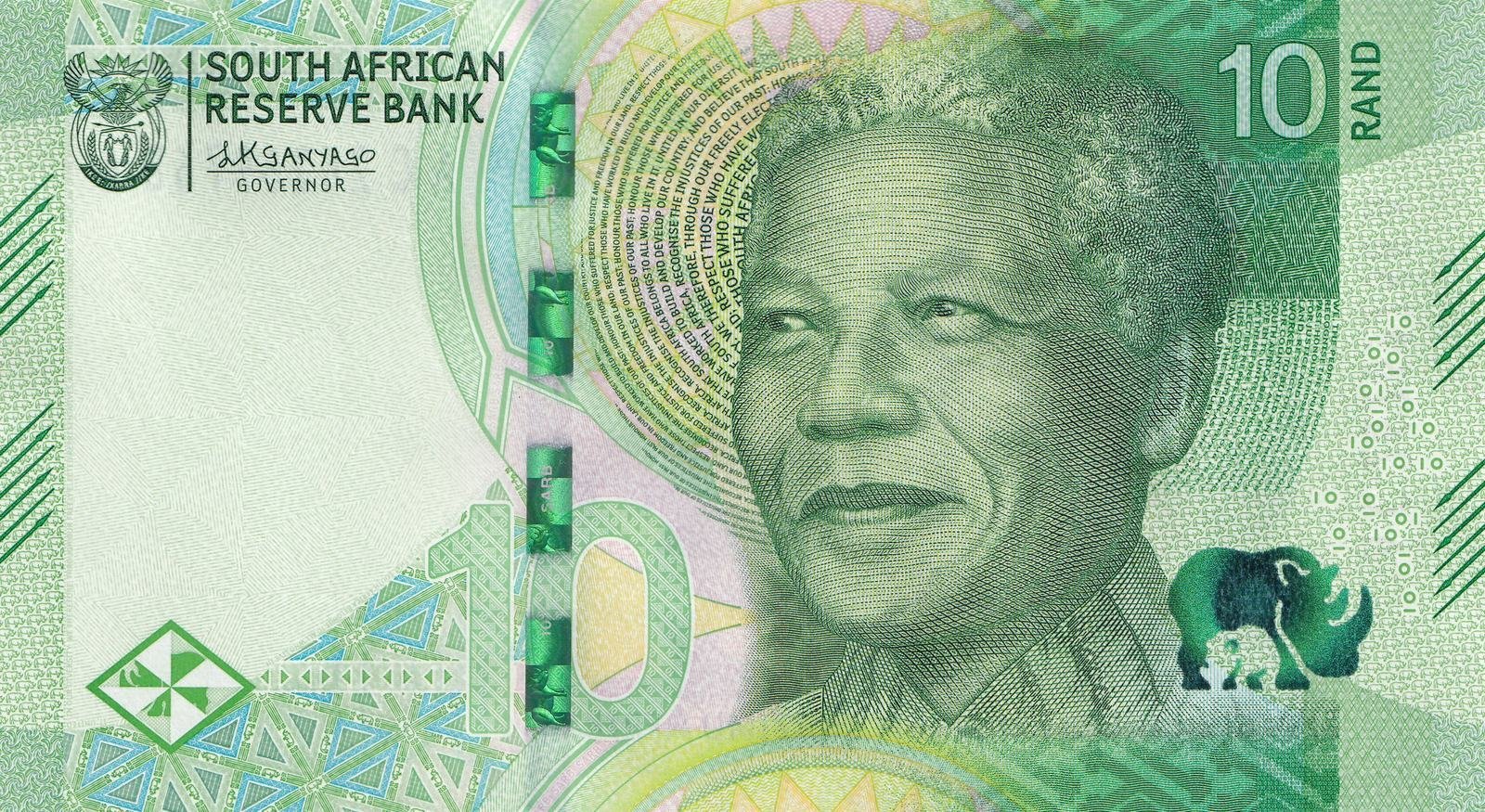
South Africa, 10 rand, 2015, and 10 rand, 2023. Under the SARB’s stated non-demonetisation policy, the earlier note should not be described as a withdrawn or exchange-only issue.
There is one narrow operational exception at the other end of a changeover. When Switzerland recalled its eighth series in 2021, ordinary legal-tender use ended on 30 April, but the public cash offices of the Confederation — SBB/CFF and Swiss Post — continued accepting the notes until 30 October. A holder could no longer spend one in an ordinary shop but could still use it at a named public counter. The wider questions of legal status, bank acceptance and later issuer exchange are separate and are covered in When a Banknote Stops Being Legal Tender.
A Changeover Can Be Corrected While It Is Happening
A launch plan is a hypothesis about how institutions and the public will behave. Sweden’s evaluation shows what happens when the evidence arrives. By 31 December 2015, only 31% of the value of the old 20-, 50- and 1,000-krona notes had returned. The Riksbank responded with an additional information campaign in May and June 2016 and later ran two more campaigns in spring 2017.
The Bank also changed an operating rule. From 1 June 2017 it stopped redeeming old notes presented by retailers, coin dealers and bureaux de change because those businesses continued accepting invalid notes. The change did not redesign the banknote or alter the launch date. It altered the route by which the old notes were being drawn back.
India provides a different correction. The ₹2,000 note was withdrawn from circulation in May 2023 while remaining legal tender. Banks received four days to prepare before deposit and exchange facilities opened, and the original bank-branch window was later extended from 30 September to 7 October. Sweden changed its communication and one return channel; India changed an operational deadline. They are both mid-course changes, but they are not the same intervention.
Public information also has to anticipate false claims. About five years before Japan’s new notes were due, the Ministry of Finance warned of fraud based on assertions that the current notes and coins were invalid. That warning is useful precisely because the new series had not yet arrived. Communication is part of the changeover infrastructure, not publicity added after the technical work is complete.
A Return Rate Is Meaningless Without Its Denominator
A percentage looks more comparable than it usually is. To interpret a return rate, four elements must remain attached to it: whether the basis is value or number, the population used as the denominator, the date of that denominator and the date on which returns were measured. This is the same measurement discipline used in Banknote Print Runs Explained: quantities that sound related are not interchangeable.
| Case | Published result | What the percentage measures | Status |
|---|---|---|---|
| Sweden | 92% | Value of invalidated banknotes returned by 31 December 2017, compared with value in circulation on 30 September 2015 | Stated by issuer |
| India | 97.62% | Value of ₹2,000 notes returned by 29 February 2024, against ₹3.56 lakh crore in circulation on 19 May 2023 | Stated by issuer |
| United Kingdom, paper £20 | 86.9% | Returned divided by returned plus outstanding, from the polymer £20 issue to 30 September 2022 | Calculated, not a Bank of England rate |
| United Kingdom, paper £50 | 69.5% | Returned divided by returned plus outstanding, from the later polymer £50 issue to the same end date | Calculated, not a Bank of England rate |
The Swedish and Indian figures share a basis — value — but describe different events. Sweden counted notes that had become invalid; India counted a denomination that remained legal tender throughout. They can be compared as definitions, not ranked as equivalent performances.
The Bank of England disclosure gives returned and still-outstanding quantities, not a return rate. The calculations above assume that returned plus outstanding approximates the paper-note population when each polymer replacement appeared. Even then, the £20 and £50 cannot be cleanly merged: the £20 accumulated returns for about 31 months and the £50 for about 15. A combined headline would hide two different clocks.
Coins must also stay separate. Sweden reported 52% of the old coin value returned, but measured it to 30 November 2017 rather than the banknote measurement date of 31 December. Adding the two would combine different objects, denominators and dates.
What Does a Successful Changeover Mean?
The Riksbank’s post-project report is valuable because it refuses a single answer. Mechanically, the changeover worked: sorting, counting and authentication produced no practical problems beyond a small number of minor incidents. Financially, 92% of the invalidated banknote value had returned by the measurement date. Yet the result varied sharply by denomination — 96% for the 1,000-krona note and only 59% for the 20-krona note.
Public understanding was weaker. A 2017 survey found that only a small proportion of the public knew how to check the new security features despite extensive information work. The machinery could recognise the notes more reliably than the people using them. Operational success, public recognition and return performance were three different outcomes.
The provenance of that judgement also matters. The evaluation was produced by the Riksbank’s Payments Department, which states that the comments and conclusions are its own. The figures can be checked as reported measurements; the interpretation remains an issuer’s self-evaluation.
A series changeover is complete only on paper. In practice it succeeds at different speeds in machines, bank networks, shop counters and public habits — and each of those outcomes needs its own evidence.
Frequently Asked Questions
What is a banknote series changeover?
A banknote series changeover is the operational process of introducing new notes into an existing cash system while managing the distribution, machine preparation, public communication, parallel circulation and return of earlier notes. It is separate from designing and printing the new series.
Do new banknotes become available everywhere on their issue date?
Not necessarily. Banco de México publishes separate dates for placing each family G denomination into circulation and beginning distribution to the general public; in all six documented launches, public distribution began one day later. Availability through individual banks and ATMs can take longer.
Why are new banknote denominations introduced in stages?
The reason depends on the programme. Sweden adopted a timetable proposed by the cash market, Australia introduced lower denominations before the ATM-heavy $50 to manage launch risk, and Mexico said design, production, storage and distribution across all denominations could not happen simultaneously.
How are ATMs and cash machines prepared for new banknotes?
Where the process is disclosed, equipment suppliers may receive notes well before public issue and may test their machines at an issuer facility. Sweden reported roughly 20,000 units, about thirty suppliers and more than eighteen months of banknote lead time. Mexico instead published a planned three-to-six-month interval from issue to ATM use.
Can old and new banknotes remain in circulation together?
Yes, but the arrangement varies. Sweden used nine-month changeover stages; Mexico forecast an eight-to-thirteen-year overlap for families F and G; and the South African Reserve Bank states that it does not demonetise previously issued circulation banknotes. Planned and observed periods should not be confused.
How is a banknote return rate calculated?
A defensible return rate needs a consistent basis, a defined population, a dated denominator and a measurement date. An issuer may state the percentage, as Sweden and India did, or publish figures from which a rate can be calculated. A calculated rate must show its assumption and must not combine incompatible time windows.
Does a high return rate prove that a changeover succeeded?
It proves only one part of the operation. A changeover can also be assessed through machine performance, public recognition, distribution, fraud prevention, cost and the handling of notes that remain outside the banking system. Sweden’s evaluation found strong mechanical performance but weak public knowledge of the new security features.
Selected References
This guide relies on documents published by issuing authorities. Figures are described as stated, calculated, planned or observed according to the source. A missing detail means it was not found in the documents reviewed for this comparison, not that the issuer has never published it elsewhere.
- Sveriges Riksbank — Banknote and Coin Changeover in Sweden: Summary and Evaluation, March 2018 (PDF), for the timetable, equipment preparation, distribution, campaigns, returns and post-project findings.
- Bank of England — paper £20 and £50 notes returned or still in circulation at 30 September 2022, for the denomination-level quantities and different accumulation windows.
- Bank of England — New Bank of England Banknotes to Be Printed on Polymer, 18 December 2013 (PDF), for the Industry Forum, note-size rationale and education commitment.
- Swiss National Bank — Recall of Banknotes from Eighth Series, 28 April 2021 (PDF), for the six-month acceptance tail at Confederation cash offices.
- Reserve Bank of India — ₹2,000 denomination withdrawal FAQ and status release of 1 March 2024, for the preparation interval, continuing legal-tender status and stated return rate.
- Reserve Bank of Australia — Next Generation of Banknotes: $50 Enters General Circulation, 17 October 2018, for the launch order, ATM significance and stated coordination method.
- Banco de México — Preguntas y respuestas: familia G (PDF), for the six launch pairs, coexistence forecasts, planned ATM interval, series-validity information and consumer recourse.
- South African Reserve Bank — upgraded banknotes and coin media statement, 3 May 2023 (PDF), for incremental introduction, unchanged dimensions and the stated policy of non-demonetisation.
- Ministry of Finance, Japan — Issuance of Bank of Japan Notes and the 500-yen Coin in New Forms, 9 April 2019, for the advance fraud warning and unchanged dimensions.
- European Central Bank — Croatia’s euro changeover, used only as a boundary case for frontloading and dual circulation during a currency replacement.
About the Author
Audrius is the founder and curator of WorldBanknotes.eu, a specialised catalogue and shop for collectible banknotes from around the world, and a long-time collector and researcher of paper money. His work focuses on banknote identification, catalogue structure, printing, design and the historical and institutional context behind individual issues.
Continue Through the Banknote Life Cycle
To follow the earlier stages, begin with How Is a Banknote Created? and continue to How Banknotes Are Printed. For the measurement problem behind production, issue, circulation and destruction figures, read Banknote Print Runs Explained. The material choices that affect both production and machine handling are compared in Paper, Polymer and Hybrid Banknotes. The next operational stage — fitness sorting and the destruction or disposal of rejected notes — is covered in When Is a Banknote Too Worn to Circulate?
You can also browse the WorldBanknotes.eu catalogue by country, currency, issuing authority or printer.