
Paper, Polymer and Hybrid Banknotes: Materials, Security and Collecting
Two Mauritius 100-rupee notes in our catalogue carry the same portrait and a closely related red-brown design. The example dated 2022 is paper; the one dated 2024 is polymer. The change is easy to overlook if the description records only the country, denomination and portrait. Put the two together, however, and the window, printed layout and material classification become part of the comparison.
The material beneath the printing is the substrate. It affects how a banknote accepts ink, carries security features and responds to handling. This guide distinguishes four useful families—security paper, coated paper, full polymer and layered composites—with original scans of paper–polymer pairs from Mauritius, Hong Kong and Thailand, and documented case studies from The Bahamas and Switzerland.
For feature-by-feature checks, see Banknote Security Features Explained and How to Authenticate a Banknote. Here, the question is how the note’s construction changes the evidence a collector should look for.
Table of Contents
Why Banknote Substrate Matters
The substrate is the structural body of the banknote before most of the visible design is applied. It may be a fibrous sheet, a polymer film or a layered composite. During manufacture, some security elements can be incorporated directly into that structure, while others are printed, transferred or applied later.
Substrate influences:
- the tactile character of the note;
- the range of embedded security features available;
- the way printing inks and foils interact with the surface;
- resistance to soiling, moisture, folding and tearing;
- the kinds of damage likely to appear in circulation;
- the way collectors should examine, grade and store the note.
It also affects design. A traditional watermark requires a paper-forming process capable of creating controlled variations in fibre density. A large transparent window requires a substrate that can retain a clear area or expose a transparent internal layer. These are not merely additions placed upon a neutral sheet; they arise from the material system itself.
The European Central Bank states that euro banknotes are printed on pure cotton-fibre paper and that watermarks and embedded threads form part of the paper. The United States Bureau of Engraving and Printing describes U.S. currency paper as 75% cotton and 25% linen. These two familiar currencies are both described as paper money, yet their fibre recipes are not identical. European Central Bank: Banknote Production · U.S. Bureau of Engraving and Printing: How Money Is Made
The material description should therefore be recorded as precisely as reliable sources allow.
The Main Families of Banknote Material
Collectors commonly encounter four broad material families.
| Material family | Basic construction | What collectors should distinguish |
|---|---|---|
| Security paper | A fibrous sheet, commonly cotton-based | Watermarks and embedded threads can be built into the paper; fibre recipes vary. |
| Coated or durable paper | Security paper with a protective surface treatment | An original coating can change gloss and wear without making the note a layered hybrid. |
| Full polymer | Polymer film with opaque printable areas | Clear windows can form part of the film; watermark-like images are not traditional paper watermarks. |
| Hybrid or composite | Paper and polymer bonded in layers | A paper core protected by films differs from paper surfaces surrounding a polymer core. |
These are useful families, not universal catalogue laws. Issuers and manufacturers sometimes use branded terminology, and the same everyday word may cover more than one architecture. The safest practice is to preserve the official wording and then explain the construction separately.
A collector should avoid assigning hybrid merely because a note feels unusual, appears coated or contains a clear area. Material classification should follow documented structure, not visual impression alone.

Traditional Security Paper
Cotton-Fibre Paper
Many modern paper banknotes are produced from cotton fibre rather than ordinary wood-pulp writing paper. Cotton provides long, strong fibres and can produce a sheet with the firmness, flexibility and wear resistance required for repeated handling.
Euro banknotes are an official example. The ECB describes the Europa series as printed on pure cotton-fibre paper, giving the notes their characteristic crispness and resistance to wear. The material is not simply chosen for touch. It supports the controlled integration of watermarks, threads and other paper-stage features. European Central Bank: Banknote Production
A clean cotton-paper banknote may feel crisp and dry, but this sensation is not universal. Age, humidity, circulation, washing, pressing and surface treatments can all change the feel. Tactility is evidence only when compared with a documented example of the exact issue.
Cotton and Linen Mixtures
U.S. currency demonstrates that banknote paper can use a fibre mixture. The Bureau of Engraving and Printing specifies a composition of 75% cotton and 25% linen, with randomly distributed red and blue fibres. The paper is manufactured specifically for U.S. currency production. U.S. Bureau of Engraving and Printing: Currency FAQs
The presence of linen should not be generalised to other currencies. Each issuing system selects material according to production methods, security requirements, circulation conditions and available suppliers.
Other Fibre Formulations
Not all security paper must be pure cotton, and not all modern durable paper excludes cellulose from wood. Manufacturers continue to develop fibre mixtures intended to reduce environmental impact or improve performance. Louisenthal, for example, describes the paper core of its Green Banknote concept as combining certified organic cotton with FSC-certified European-grown cellulose fibres. That formulation belongs to a specific product system; it should not be projected onto unrelated notes. Louisenthal: Designing Sustainable Security
The collector’s lesson is simple: paper describes a family, not one recipe.
WorldBanknotes.eu Paper Examples
The following original scans show how modern paper notes can combine large watermark fields, windowed threads, registration devices and tactile printing while retaining an opaque fibrous substrate:
- Namibia 50 Dollars 2025, P-22, UNC
- Malaysia 20 Ringgit 2024, P-54d, UNC
- Rwanda 5000 Francs 2024, P-45, UNC
- São Tomé and Príncipe 100 Dobras 2024, P-74, UNC
How Security Features Become Part of Paper
During paper manufacture, the moving fibre suspension can be shaped, compressed and combined with security components before the sheet is finished. This allows features to become physically integrated rather than merely printed on the surface.
Watermarks
A traditional watermark is created by varying the density and thickness of fibres while the sheet is being formed. When held against transmitted light, thinner areas appear lighter and denser areas darker. A multi-tone watermark can produce soft modelling and tonal transitions that are difficult to imitate with ordinary surface printing.
An electrotype watermark creates a sharper, often lighter numeral or symbol within the broader watermark field. The exact structure varies by issue.
Embedded and Windowed Threads
A security thread can be introduced into the paper during manufacture. It may remain fully embedded or emerge periodically at the surface to create a windowed effect. Its width, position, inscription, optical behaviour and machine-readable properties belong to the exact banknote specification.
The ECB explicitly identifies watermarks and embedded threads as features that form part of euro banknote paper itself. European Central Bank: Banknote Production
Fibres, Taggants and Machine-Readable Materials
Security fibres may be visible, fluorescent or detectable only by specialised equipment. Other materials can provide magnetic, infrared or chemical responses. Their presence should never be inferred from a general substrate category; official issue-specific documentation remains essential.
The important distinction is between:
- substrate-integrated features, created or inserted while the material is made;
- surface-applied features, added during later printing or finishing stages.
Both may be genuine and sophisticated, but they occupy different physical relationships with the banknote.
Coated and Durable Paper
A paper banknote can receive varnish, lacquer or another protective surface treatment intended to slow soiling and abrasion. Such notes remain structurally paper-based even though their surface behaviour changes.
Louisenthal distinguishes durable cotton-paper solutions from its polymer-film-protected Hybrid products. Its LongLife concept uses a protective treatment, while Hybrid places an ultra-thin polymer film around a cotton core. The practical boundary is architectural: a protective coating does not necessarily create the same layered construction as a paper–polymer composite. Louisenthal: High-Tech Banknote Paper · Louisenthal: Hybrid ADDvance and Hybrid
Terminology should nevertheless follow the issuer or manufacturer. A collector should not rename a documented substrate simply to fit a preferred taxonomy.
What a Coating Can Change
A protective surface can:
- reduce the rate at which dirt and oils enter the fibres;
- change gloss, friction or tactile response;
- protect printed areas from abrasion;
- alter how scratches and surface wear appear;
- affect fluorescence or other examination under specialised light.
Coatings can also complicate grading. A glossy patch may be part of the original finish, circulation wear or later treatment. Comparison with a genuine reference is therefore more reliable than a generic rule.
What Is a Full Polymer Banknote?
A full polymer banknote uses a specialised plastic film as its principal substrate rather than a fibrous paper sheet. Many modern polymer systems are based on biaxially oriented polypropylene, usually abbreviated BOPP, although polymer banknote is a broader category than one commercial product or one chemical formulation.
The Bank of Canada describes its Polymer series notes as made from a single piece of polymer with transparent areas. The Bank of England describes polymer as a thin, flexible plastic material. Bank of Canada: Polymer Note Security Features · Bank of England: How to Check Your Banknotes
The transparent film is not left clear across the whole banknote. It is converted into an opaque, printable field while selected areas remain transparent or translucent.
The Basic Layering Principle
A simplified polymer construction may include:
- a clear polymer film;
- opacifying layers that create the pale printable body of the note;
- printed design layers;
- transparent windows where the base film remains exposed;
- foils, optical elements, raised print and protective coatings.
CCL Secure describes GUARDIAN as beginning with a highly specialised polymer film. Its sister company identifies the relevant films as biaxially oriented polypropylene, or BOPP, produced through a dedicated orientation process. CCL Secure: GUARDIAN · CCL Secure: Innovia Films
This diagram is necessarily simplified. Commercial substrate recipes and production sequences are proprietary, and different suppliers do not use identical constructions.

Transparent Windows
The clear window is the most visible expression of polymer substrate, but it must be interpreted carefully.
In a genuine full-polymer note, the window is integral to the substrate. It is not an opening cut into the note and covered with a separate household plastic patch. Printing, metallic elements, diffraction structures or transparent inks may be applied to or around the window, but the underlying clear area belongs to the banknote’s material system.
A transparent window does not, however, prove that the entire banknote is full polymer. Composite substrates such as Durasafe can also expose a transparent polymer core. Some paper constructions use apertures, foils or other window-like devices. The collector must identify the exact architecture rather than classify the note from one feature.
For practical authentication, inspect:
- whether the clear area is correctly integrated;
- the exact shape and position;
- edge transitions between opaque and transparent regions;
- printed and metallic details within the window;
- consistency on both sides;
- comparison with official documentation.
A genuine window is one part of a coordinated system, not a universal proof of authenticity.
WorldBanknotes.eu Polymer Examples
These original scans illustrate different approaches to integrated clear areas and modern polymer design:
- New Zealand 5 Dollars 2015, P-191, UNC
- Costa Rica 5000 Colones 2018, P-282, UNC
- Namibia 60 Dollars 2025, P-19, UNC
- Fiji 20 Dollars 2026, P-127, UNC
For more full-polymer issues from around the world, browse our polymer banknotes for sale.
The Same Denomination on Paper and Polymer
A continuing design provides a useful starting point for comparison. What remains recognisable, what moves, and which features depend on the new material? Three pairs in the WorldBanknotes.eu catalogue show different answers. They document particular transitions, not a ranking of materials by security, value or longevity.
The comparisons use original WorldBanknotes.eu scans, displayed for design comparison rather than at physical scale. Select an image to inspect the original. A pale window area in a reflected-light scan does not demonstrate transparency, and a single image cannot show a tilt effect or the feel of raised printing.
Mauritius 100 Rupees: A Familiar Design Around a New Window
Both notes below retain the portrait of Renganaden Seeneevassen, the central denomination in three scripts and the red-brown colour scheme. The right-hand field changes substantially. On the polymer note, the window occupies space above the horizontal serial number; the number sits much closer to the lower edge than on the paper example.


The Bank of Mauritius introduced the polymer Rs100 on 20 June 2025. Its notice identifies a transparent window and a dodo image with a Swing™ feature, and states that the new polymer notes would circulate alongside the paper issue. These feature and circulation statements come from the issuer, not from an optical or handling test of the photographed note. Bank of Mauritius: Rs100 polymer issue notice
The printed 2024 beneath the signatures and the 2025 introduction therefore belong in different fields of a collector’s record. Neither the retained portrait nor the catalogue year makes the two notes the same material variety. The date is visible on the object; the introduction date requires a separate source.
Hong Kong 10 Dollars: Watermarks and Shadow Images
Our catalogue includes a paper ten-dollar note dated 2002 and a polymer example dated 2007. Their abstract composition and blue, purple and red fields are closely related. The classification difference is clearer when the official security descriptions are read together.
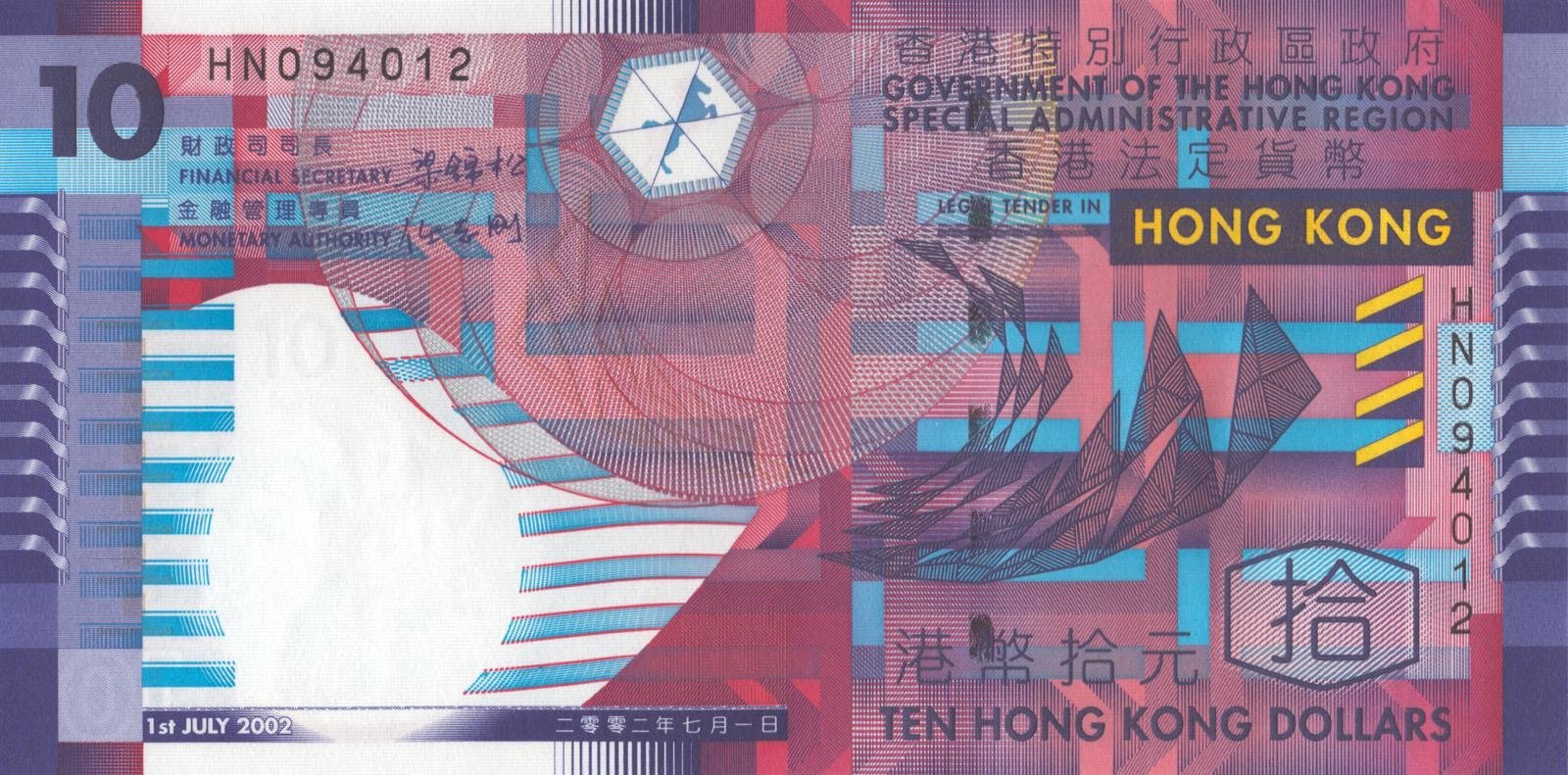

The Hong Kong Monetary Authority describes a bauhinia-and-numeral watermark in the paper note. For the polymer issue, its terms are a clear window and shadow images resembling watermarks. That wording preserves an important distinction: a motif seen against light does not necessarily arise from variations in paper-fibre density. HKMA: paper-note features · HKMA: polymer-note features
The polymer design also retained features such as the see-through horse and concealed denomination, while adding the window’s colour-changing ribbon. A material transition can therefore retain some security checks and alter others. It does not mean every feature was invented again, or that the familiar-looking paper issue should be examined using the polymer checklist.
Thailand 20 Baht: Keeping the Theme, Adding Windows
The 2018 paper 20-baht issue and 2022 polymer issue preserve the green design and portrait of King Vajiralongkorn. In its January 2022 announcement, the Bank of Thailand explicitly described continuity of the design theme, with clear windows added to the polymer version.


The Bank specified a yellow-to-red effect in the lower window and embossed “20” numerals in the upper one. It scheduled the polymer issue for 24 March 2022 and said the paper notes would remain legal tender. Its stated reason for the change was cleaner, more durable notes in a heavily used denomination—not a claim that the portrait or denomination itself needed replacing. Bank of Thailand: polymer 20-baht announcement
For a collector, the three comparisons suggest a manageable record: identify the exact issue, record the documented substrate, distinguish the printed date from the introduction date, and use the security instructions for that version. A photograph helps locate features; it does not establish every property of the material.
For comparison within one currency, see our Macedonian 10, 50 and 100-denar identification guide, which places the paper and polymer 10- and 50-denar notes side by side.
Australia and the Development of Polymer Currency
Australia occupies a central place in the history of modern polymer banknotes. Polymer technology was developed through cooperation between the Reserve Bank of Australia and the Commonwealth Scientific and Industrial Research Organisation.
Australia released a commemorative ten-dollar polymer note in 1988. The Reserve Bank later issued its first complete polymer series between 1992 and 1996, becoming the first country to convert a full national banknote series from paper to polymer. Reserve Bank of Australia Museum: The Reinvention of Banknotes · Reserve Bank of Australia: History of Banknotes
The significance was not simply that plastic replaced paper. Polymer changed the relationship between material and security design. Large transparent areas, substrate-based optical devices and new public-checking methods became central elements rather than additions to a conventional paper note.
The RBA states that polymer technology was introduced to improve resistance to counterfeiting and that the substrate enables a range of security features. Reserve Bank of Australia: Banknotes in Circulation · Reserve Bank of Australia: Security Features
Australia’s experience also demonstrates why broad historical claims need careful wording. The 1988 commemorative note was an important first issue, while the complete series followed over several years. A single date cannot describe the entire transition.
Polymer Does Not Mean Indestructible
Polymer banknotes generally resist moisture and surface soiling better than untreated cotton paper, and many issuers report longer circulation lives. Yet durability is not immunity.
The Bank of England states that its polymer notes last at least two and a half times as long as the paper equivalents they replaced, while also warning that polymer notes can still wear and suffer foil damage. The Bank of Canada similarly cautions that small nicks and tears can grow even though polymer is stronger than paper. Bank of England: Why Are New Banknotes Made of Polymer? · Bank of England: Banknote FAQs · Bank of Canada: Employee Handbook
For condition assessment, longer circulation life and an undamaged collectible are different things. A note can remain fit for use while carrying a permanent crease, a scratched window or worn printing. The ageing section below distinguishes these forms of damage.
A crumpled polymer note may recover part of its shape, but that does not restore original condition. Nor should a collector deliberately test strength by pulling, twisting or washing a collectible note.
Durability claims must also be issue-specific. Denomination, climate, handling habits, sorting standards and circulation intensity all affect real service life.
São Tomé’s five- and ten-dobra notes offer a documented change in the other direction: cotton-paper replacements followed the 2018 polymer versions in 2021. The comparison separates the bank’s explanations from what the paired scans can demonstrate.
What Does “Hybrid Banknote” Mean?
Hybrid is often used as though it described one standard recipe. In reality, it covers materially different combinations of paper and polymer.
At least two major architectures should be distinguished:
- paper or cotton core protected by ultra-thin polymer films;
- paper outer layers fused around a transparent polymer core.
Both combine paper and polymer, but the position and function of the materials are reversed.
This distinction matters because it changes:
- what the surface feels like;
- where watermarks and threads can be located;
- how transparent areas are created;
- which layer provides mechanical strength;
- how wear appears at edges and surfaces;
- how the note should be described in a catalogue.

Architecture One: Cotton Core with Polymer Protection
Louisenthal’s Hybrid substrate uses a cotton core that can contain watermarks, security threads and machine-readable elements. The core is encased in an ultra-thin polyester film intended to improve resistance to soiling, tearing and creasing while retaining the tactile character and print processes associated with cotton banknote paper. Louisenthal: Hybrid ADDvance and Hybrid
The important structural sequence is:
polymer protection → cotton security core → polymer protection
The protective film is extremely thin in relation to the paper body. This is not the same as a full-polymer note with an opacified plastic film, nor is it merely an ordinary varnish.
Because the security core remains fibrous, traditional paper-stage features can still be integrated. The outer film is primarily protective rather than the main structural sheet.
Architecture Two: Paper Layers with a Polymer Core
Landqart’s Durasafe uses the opposite arrangement. Two outer layers of security paper are fused to a central core of transparent polymer. The paper layers can incorporate watermarks, fibres and threads, while the central film adds strength and enables transparent or one-sided windows. Landqart: Durasafe
The structural sequence is:
security paper → transparent polymer core → security paper
The Swiss National Bank explains that the ninth-series banknotes have two thin cotton-paper layers on the front and back, with a polymer layer inside. The polymer becomes visible where selected paper layers are removed. Swiss National Bank: Life Cycle of the Ninth Series
This arrangement preserves a paper surface while giving the designer access to genuine transparent areas within a composite sheet.
Two notes may therefore both be catalogued as hybrid or composite, yet their construction, feel and window logic may be fundamentally different.
WorldBanknotes.eu Hybrid Examples
The following original scans show how visually paper-like notes can belong to documented hybrid substrate systems:
Case Study: Bahamas One Dollar — Hybrid to Hybrid Green
The Bahamian one-dollar note provides a valuable collector case because the same general design family appears on two related substrate generations.
The Central Bank of The Bahamas introduced the CRISP Evolution one-dollar note in 2017 using Giesecke+Devrient’s Hybrid substrate. The Bank’s annual report described it as the first Bahamian banknote printed on a substrate other than cotton and identified the choice as a durability measure intended to resist soiling. Central Bank of The Bahamas: 2017 Annual Report
The Series 2024 one-dollar banknote entered circulation in February 2025. The Central Bank states that it is printed on Giesecke+Devrient’s Hybrid Green substrate, described as a more environmentally conscious development of the earlier Hybrid technology. The note retains the principal design while introducing brighter green tones and a wider security thread. Central Bank of The Bahamas: Series 2024 One-Dollar Banknote
For collectors, the case illustrates three separate layers of identity:
- design continuity — both notes belong to the CRISP Evolution visual language;
- issue distinction — the years and catalogue varieties differ;
- substrate development — Hybrid gives way to Hybrid Green.
The material should not be reduced to a colour change. It represents a documented production revision within a continuing design.
WorldBanknotes.eu examples:
Louisenthal describes its broader Green Banknote concept as using a lower-plastic Hybrid structure and a more sustainable fibre mix. Those product-level specifications should not be treated as a complete technical disclosure of every issued note unless the issuer or manufacturer confirms the exact implementation. Louisenthal: Designing Sustainable Security

Case Study: Swiss Durasafe
The ninth series of Swiss banknotes demonstrates the paper–polymer–paper architecture at national-series scale.
The Swiss National Bank describes Durasafe as a three-layer substrate made from two thin outer layers of cotton paper and a central polymer core. Security threads and other features are incorporated during production of the paper layers. Selected areas are then cut away so that the transparent centre becomes visible. Swiss National Bank: Life Cycle
This structure allows several effects:
- a familiar paper surface;
- traditional embedded paper features;
- increased mechanical strength from the inner film;
- fully transparent windows where both paper layers are removed;
- one-sided openings where only one paper layer is removed;
- protection and presentation of internal security elements.
Landqart calls the fully transparent version Thrusafe and the one-sided opening Viewsafe. These brand names describe specific window constructions within Durasafe rather than universal terms for every composite note. Landqart: Durasafe
The Swiss example is particularly useful because the issuing authority publishes an unusually clear production account. It shows that a transparent window can belong to a composite note whose visible surfaces still behave like security paper.
Zambia’s 2025 banknotes provide a denomination-by-denomination comparison: the Heritage family combines Durasafe ten- and twenty-kwacha notes with paper higher values.
How Substrate Changes Printing
Banknote production is not one printing process. A modern note may combine offset, intaglio, screen printing, numbering, hot stamping, foil application, perforation and protective finishing.
The ECB lists offset, intaglio, hot stamping and screen printing among the processes used for euro banknotes. The Swiss National Bank describes a multi-stage sequence on Durasafe that includes offset, screen printing, foil application, intaglio on both sides, perforation, numbering and final varnishing. European Central Bank: Banknote Production · Swiss National Bank: Life Cycle
Full polymer notes can also carry raised intaglio print, metallic elements and complex optical features. The presence of raised print therefore does not prove that a note is paper. The Bank of England and Bank of Canada both instruct the public to feel raised print on polymer banknotes. Bank of England: How to Check Your Banknotes · Bank of Canada: Polymer Note Security Features
Substrate still affects engineering. Inks, primers, coatings, drying conditions and pressure must be compatible with the surface. A fibrous sheet absorbs and anchors ink differently from a smooth polymer film. A composite may provide paper tactility while relying on an internal polymer layer for stability.
Collectors should therefore distinguish:
- the substrate material;
- the printing process;
- the surface finish;
- the applied security device.
A polymer note can have intaglio. A paper note can have a glossy foil. A hybrid note can carry a traditional watermark. No single printing effect defines the substrate.
Touch, Flexibility and Sound
Experienced collectors often notice material before reading the catalogue. Paper, polymer and composite notes can feel and move differently, but sensory clues require restraint.
Paper
A fresh cotton-paper note may feel crisp, dry and slightly fibrous. Intaglio relief may be pronounced. As the note circulates, the sheet can soften, become limp, pick up grime and develop fibre breaks along folds.
Polymer
Polymer usually feels smoother and less absorbent. It may spring back from gentle bending more readily than paper. Clear windows and glossy printed fields can create local changes in friction.
Hybrid or Composite
A cotton-core Hybrid note may retain much of the familiar paper feel despite its protective film. Durasafe presents paper on both surfaces, so its tactile character may be closer to traditional security paper than to full polymer.
Sound can be suggestive, especially when comparing crisp examples, but it is too subjective for reliable identification. Thickness, size, humidity, condition and handling all change the sound a note makes. Do not bend or flick a valuable banknote merely to test it.
The material should be identified by documentation and coordinated physical evidence, not by a single sensory impression.
How Different Materials Age
Substrate changes the vocabulary of wear.
Paper Wear
Common paper-related changes include:
- softening and loss of original crispness;
- fibre disruption along folds;
- edge fraying;
- tears and pinholes;
- staining, foxing and toning;
- thinning from abrasion;
- loss of intaglio relief through handling or pressing.
Paper responds to moisture in the environment. It expands and contracts as humidity changes, and persistent damp encourages mould and chemical deterioration.
Polymer Wear
Polymer does not absorb moisture like paper, but it remains vulnerable to:
- sharp creases;
- scratches, especially in windows;
- edge cuts and growing tears;
- surface ink or foil loss;
- heat distortion;
- pressure impressions;
- cloudy or abraded transparent areas.
A polymer note may appear clean while carrying significant structural creasing. Conversely, a paper note may be toned or stained without having circulated heavily. Material and handling history must be considered together.
Hybrid and Composite Wear
Hybrid wear depends on architecture. A protective-film Hybrid note may resist soiling but still show creasing, surface abrasion or edge damage. A paper-faced composite may develop conventional paper-surface wear while its polymer centre continues to provide mechanical support.
Collectors sometimes use delamination loosely for any surface irregularity. That term should be reserved for genuine separation between bonded layers. A scratch, lifted ink, foil loss or worn coating is not automatically delamination.
No universal damage pattern applies to every hybrid note. The exact issue, construction and condition must be examined.

Grading Paper, Polymer and Hybrid Notes
The grading scale does not change merely because the substrate changes, but the evidence used to apply it does.
A fold in paper may break fibres and disturb the printed surface. A polymer crease may create a sharp line, whitening or permanent distortion without the same fibrous break. A scratch across a transparent window can be visually prominent even when the rest of the note remains flat and clean.
When grading, inspect:
- central and corner folds;
- counting bends and handling waves;
- edge damage;
- surface abrasion;
- window scratches;
- ink and foil integrity;
- deformation or heat damage;
- evidence of pressing, washing or other treatment.
Do not assume that a clean polymer note is Uncirculated. Do not assume that a naturally glossy surface is processing. Do not flatten a composite note under heavy pressure in an attempt to remove curvature.
The complete grading method is covered in Banknote Grading Explained: UNC, aUNC, EF and VF.
Storage Implications
All banknotes need chemically suitable holders, stable conditions and protection from unnecessary handling. Substrate changes the emphasis, not the need for care.
Paper
Paper benefits from stable moderate humidity, protection from pollutants and support that prevents bending. Persistent damp, rapid fluctuations and unsuitable plastics can accelerate deterioration.
Polymer
Polymer resists water better than paper but can scratch, deform under heat and acquire pressure marks. Clear windows should not rub against rough surfaces. A sleeve that is chemically safe but too tight can still place damaging pressure on the note.
Hybrid and Composite
Treat hybrid notes according to the most vulnerable parts of their construction. Protect paper surfaces from humidity and abrasion, while avoiding heat and pressure that could affect polymer layers or bonded regions.
Collectors should not use unknown soft plastic, adhesive laminates or improvised heat sealing for any substrate family.
Detailed recommendations appear in How to Store Banknotes Safely.
Environmental Claims Require Context
It is tempting to ask which material is environmentally best. A responsible answer cannot be reduced to paper is natural or polymer lasts longer.
A life-cycle assessment may include:
- raw-material production;
- substrate manufacture;
- printing and finishing;
- transport;
- circulation life;
- sorting and replacement rates;
- destruction, recycling or disposal;
- the denomination and intensity of use.
The Bank of Canada’s life-cycle study notes that banknote lifetimes vary widely between countries because of climate, handling habits, distribution patterns and fitness standards. This makes direct international comparisons difficult. Bank of Canada: Life-Cycle Assessment of Polymer and Cotton-Paper Banknotes
The Bank of England concluded that polymer offered a lower environmental impact for the denominations and assumptions in its own assessment, strongly influenced by longer circulation life. That conclusion should not be presented as a universal law for every currency system. Bank of England: Life-Cycle Assessment of Paper and Polymer Banknotes
The Swiss National Bank has separately assessed its Durasafe series, while manufacturers publish studies for durable paper and hybrid concepts. Each result belongs to its methodology.
If the issuer has documented that rationale, a catalogue description can attribute it:
The issuer selected this substrate to improve durability and reduce environmental impact within its banknote programme.
Less defensible language is:
This material is always greener than every alternative.
Collector Reference: What to Examine
| Material | Condition checks | Interpretation limit |
|---|---|---|
| Security paper | Folds, fibre breaks, softening, frayed edges and staining. | Paper feel alone does not establish the fibre recipe or authenticity. |
| Coated or durable paper | The paper beneath the finish, surface wear and whether gloss is original to the issue. | A protective coating does not by itself make the note a layered hybrid. |
| Full polymer | Permanent creases, window scratches, edge nicks, distortion and foil or ink wear. | Resistance to moisture does not make the note immune to damage or safe to wash. |
| Hybrid or composite | Paper-surface condition, exposed windows and any visible disturbance between layers. | Check the documented architecture; do not try to peel or separate layers. |
None of these materials proves authenticity on its own. Avoid heat, solvents and deliberate bending as identification tests; match the note to the issuer’s feature guide and use non-destructive examination.
Common Myths About Banknote Materials
“All Banknotes Are Made from Paper”
False. Many modern currencies use full polymer or paper–polymer composites.
“Banknote Paper Is Ordinary Wood-Pulp Paper”
Usually false for major modern security papers, but the exact fibre recipe varies. Cotton, linen and controlled cellulose mixtures all exist.
“Polymer Is Simply Clear Plastic with Ink”
Misleading. A polymer banknote is a specialised multilayer security product with opacifying fields, complex printing and integrated features.
“Every Clear Window Means Full Polymer”
False. Composite substrates can expose a transparent polymer core, and other constructions can create window-like effects.
“Every Hybrid Banknote Has the Same Layers”
False. Hybrid can mean a cotton core protected by thin films or paper surfaces surrounding a polymer core.
“Coated Paper Is Automatically Hybrid”
Not necessarily. A coating can improve durability without creating the same layered construction as a documented hybrid substrate.
“Polymer Banknotes Cannot Tear”
False. They are durable, but edge nicks and cuts can grow into tears.
“Polymer Notes Do Not Need Sleeves”
False. They can scratch, crease, deform and suffer surface wear.
“Paper Is Always More Secure” or “Polymer Is Always More Secure”
Both are oversimplifications. Security depends on the complete banknote system, not one material label.
“The Material Proves the Note Is Genuine”
False. Counterfeits can imitate texture or use incorrect material convincingly in photographs. Authentication requires issue-specific agreement between substrate, printing, security features and controlled identifiers.
Collector’s Substrate Identification Workflow
- Identify the exact country, issuer, denomination and series. Material claims are meaningful only for a specific issue.
- Check official issuer information. Central-bank releases and technical guides take priority over seller descriptions.
- Preserve the official terminology. Record polymer, Hybrid Green, Durasafe or another documented term accurately.
- Separate brand from structure. Explain what the branded substrate physically consists of where reliable documentation exists.
- Inspect both sides in reflected light. Note gloss, texture, coatings, windows and edge transitions.
- Use transmitted light. Check whether a watermark, thread or transparent core belongs inside the material.
- Examine windows under magnification. Confirm correct print, foil, clarity and integration.
- Compare tactile evidence cautiously. Feel can support identification but should not replace documentation.
- Record uncertainty. Use substrate not confirmed rather than assigning hybrid from appearance alone.
- Cross-check with a known genuine example. Material, design, printing and security must agree.
Collector’s rule: Name the substrate only as precisely as the evidence permits. A cautious, documented description is more valuable than a confident but invented classification.
Frequently Asked Questions
What are banknotes made from?
Banknotes can be made from cotton-based security paper, fibre mixtures, specialised polymer film, coated paper or layered paper–polymer composites. The exact material depends on the issuing authority and series.
Is banknote paper made from wood pulp?
Many widely used security papers are made primarily from cotton or cotton blends rather than ordinary wood pulp. However, material recipes vary, and some modern sustainable formulations include certified cellulose fibres. Check the exact issue.
What is a polymer banknote?
A polymer banknote uses a specialised plastic film as its main substrate. Opaque printable layers cover most of the film while selected areas can remain transparent.
What does BOPP mean?
BOPP means biaxially oriented polypropylene. It is a strong, stable polymer film used in several modern banknote-substrate systems. Not every polymer banknote should be described by one brand or formulation without confirmation.
Is every banknote with a clear window polymer?
No. Full-polymer notes commonly use integral clear windows, but composite substrates such as Durasafe can also expose a transparent polymer core.
What is a hybrid banknote?
A hybrid banknote combines paper and polymer in one substrate. The layers may use a cotton core protected by thin polymer films or paper outer layers surrounding a polymer centre.
Is coated paper the same as hybrid substrate?
Not automatically. A lacquer or surface coating can improve paper durability without creating the multi-layer architecture of a documented hybrid or composite substrate.
Do polymer banknotes last longer than paper notes?
Many issuers report longer circulation life for polymer, but the ratio varies by denomination, climate, handling and fitness standards. It should not be treated as one universal number.
Are polymer banknotes harder to counterfeit?
Polymer enables distinctive windows and other integrated features, but material alone does not determine security. Advanced paper and composite notes can also be highly secure.
Which substrate is best for collectors?
There is no universally best material. Collectors value paper, polymer and hybrid notes for different technological, historical and aesthetic reasons. Accurate identification and condition matter more than choosing one material family.
Final Thoughts
The Mauritius pair makes the practical point: a familiar portrait and denomination can continue across a change from paper to polymer. Hong Kong’s watermark and shadow-image terminology shows why the feature description also matters. The Bahamas and Swiss examples go further, requiring a distinction between different layered constructions rather than a simple choice of paper or plastic.
A useful catalogue record identifies the exact issue, preserves the issuer’s material terminology and separates visible evidence from properties established by documentation or physical examination. It also records condition in terms appropriate to the substrate: a paper-fibre break, a scratched polymer window and separation between composite layers are not interchangeable observations.
Selected References
- European Central Bank — Banknote Production and Stocks
- U.S. Bureau of Engraving and Printing — How Money Is Made
- Reserve Bank of Australia — History of Banknotes
- Reserve Bank of Australia Museum — The Reinvention of Banknotes
- Bank of Canada — Polymer Note Security Features
- Bank of England — Why Are New Banknotes Made of Polymer?
- CCL Secure — GUARDIAN Polymer Substrate
- Louisenthal — Hybrid ADDvance and Hybrid Substrates
- Landqart — Durasafe
- Swiss National Bank — Life Cycle of the Ninth Banknote Series
- Central Bank of The Bahamas — Series 2024 One-Dollar Banknote
- Bank of Canada — Life-Cycle Assessment of Polymer and Cotton-Paper Banknotes
- Hong Kong Monetary Authority — Ten-Dollar Paper Note and Ten-Dollar Polymer Note
- Bank of Thailand — Polymer 20-Baht Announcement, 20 January 2022
- Bank of Mauritius — Rs100 Polymer Issue Notice, 20 June 2025
About the Author
Audrius — WorldBanknotes Curator researches world banknotes through their design, printing, security, history and material construction. WorldBanknotes.eu combines a curated UNC banknote catalogue with detailed collector guides and original banknote imagery.
Explore the WorldBanknotes.eu banknote catalogue to compare paper, polymer and hybrid issues from around the world.