
Who Prints the World’s Banknotes? A Collector’s Guide
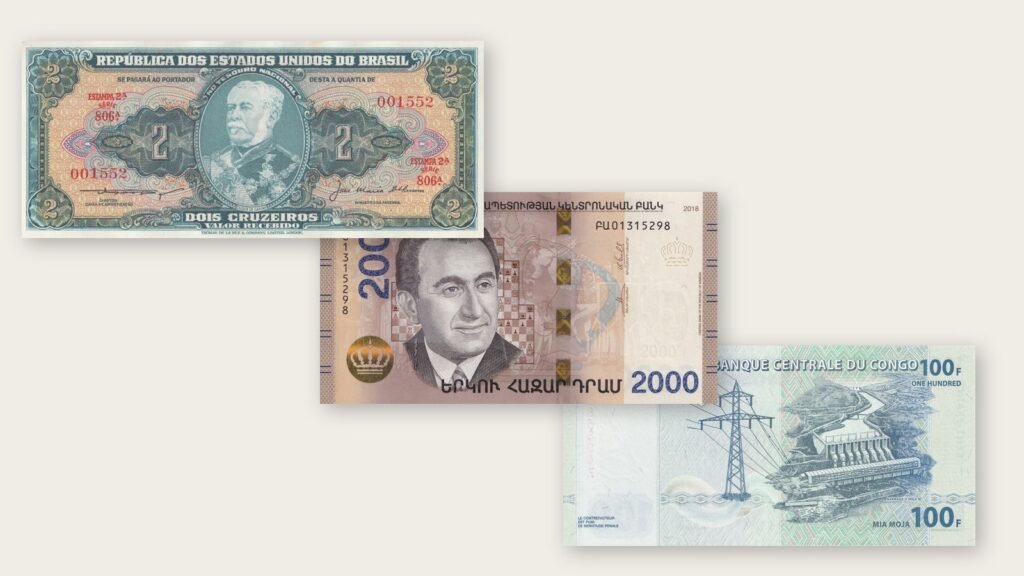
The most prominent institutional name on a banknote is the issuer, not the printer. A note says Banco Central do Brasil or Banque Centrale du Congo, and that institution is responsible for it. The physical object — the paper, the engraving, the security thread, the numbering — may have been produced somewhere else entirely, and the company that produced it is identified, if at all, in type a few millimetres high.
International banknote production is concentrated among a relatively small group of specialist printers, working alongside national and central-bank-owned works that serve their own currencies. Some are private companies, some belong to states, and some belong to the central banks whose notes they print.
The issuing authority defines and approves the banknote. The printing works turns those specifications into a manufactured security document. They are usually two different organisations, and separating them is the first step in reading a banknote properly.
This guide explains who those printers are, why so much production is outsourced, how to find the printer on a note, what to do when there is no imprint at all, and how a change of printer relates to catalogue varieties.
Brazil runs through the whole article as a worked example, because a single country page in this catalogue happens to contain the entire story: notes printed in New York, notes printed in London, and notes printed in Rio de Janeiro, each signed in a different way.
Table of Contents
What a Banknote Printer Actually Does
A banknote printer is the organisation that manufactures the note. Where production is outsourced, it acts as a contractor to the issuing authority; where the works belongs to the state or to the central bank itself, the relationship is internal. Printing and issuance are separate functions. Even where one institution performs both, manufacturing the note is distinct from assuming the legal liability it represents, and a banknote attributed to De La Rue or Giesecke+Devrient remains the obligation of the central bank named on its face.
For the institutional history behind that distinction — why the issuer’s promise or authority made the manufactured object acceptable — see how issuing institutions made banknotes credible.
What the printer supplies is the physical realisation of that obligation, and the scope varies enormously between contracts.
| Stage | What happens | Who may do it |
|---|---|---|
| Design and origination | Artwork, engraving, plate preparation | Printer’s studio, issuer, or an independent designer |
| Substrate | Cotton paper, polymer film or hybrid | Often a separate supplier |
| Security features | Threads, windows, optical devices | Specialist manufacturers |
| Printing | Offset, intaglio, letterpress | The printing works |
| Finishing | Numbering, inspection, cutting, packing | The printing works |
This division matters more than it looks. A modern banknote can involve a design team in one country, paper from a second, a security thread from a third and final printing in a fourth. The single name that appears on the note, if any appears, describes only part of that chain.
The mechanics of the printing itself — why intaglio feels raised, why offset does not — are covered separately in our guide to how banknotes are printed. This article is about the organisations rather than the presses.
Who Owns the Presses
Banknote printers fall into three broad groups, and knowing which group a works belongs to explains a great deal about how it behaves.
Commercial Security Printers
Private companies that compete for contracts worldwide. De La Rue traces its printing business to 1813 and records 1860 as the start of its banknote work; it was listed in London for decades and passed into the ownership of Atlas Holdings in 2025. Giesecke+Devrient was founded in Leipzig in 1852 and remains family-controlled. Oberthur Fiduciaire began as a printing house in Rennes in 1842 and entered banknote production only in 1940, when the Banque de France needed additional capacity.
Because they compete for work, these firms have a commercial reason to be identifiable, and their imprints are the ones collectors see most often. Contracts are typically awarded through tender and subject to security, financial and regulatory conditions that vary by issuer.
State Printing Works
Publicly owned institutions that print primarily for their own government. Casa da Moeda do Brasil descends from a mint founded in 1694 and became a federal public company under a law of 1973. Goznak in Russia, Bundesdruckerei in Germany and the Bureau of Engraving and Printing in the United States belong to the same category.
Several of them also take export work, which is a useful corrective to the assumption that state works only serve their own currency. Casa da Moeda do Brasil, for instance, is identified by the Central Reserve Bank of Peru as the printer of the Peruvian 50 intis dated 26 June 1987.
Central Bank Printing Works
Plants owned by the issuing authority itself, printing that authority’s own notes. The Reserve Bank of Australia’s Note Printing Branch was renamed Note Printing Australia in 1990 and became a separately incorporated, wholly owned subsidiary of the Reserve Bank on 1 July 1998. Several central banks in Africa, Asia and Latin America run comparable facilities.
Here the printer and the issuer belong to the same institutional family, although as the Australian case shows they are not necessarily the same legal entity. The issuer still sets the specification; the works manufactures to it.
Why Many Countries Do Not Print Their Own Money
Printing your own currency sounds like a basic attribute of sovereignty. In practice many states outsource some or all of their banknote production, often for reasons of scale, technology, continuity and procurement.
Scale. A banknote line is an expensive, specialised factory. Intaglio presses, secure storage, controlled destruction of waste and the surrounding infrastructure only make economic sense above a certain volume. A country needing a few million notes a year may find it difficult to justify what a country needing billions can.
Technology. Modern security features are developed by a handful of suppliers and are protected commercially. Access to a current optical thread or a windowed polymer substrate usually means contracting with the organisation that owns it.
Continuity. A national plant has to keep skilled engravers, machinists and inspectors employed between orders. A commercial printer spreads that workforce across many clients.
Procurement and resilience. A commercial contract brings audit terms, defined delivery obligations and, in some arrangements, more than one qualified supplier. Whether that is preferable to an internal works depends on the issuer’s circumstances.
One visible consequence is that a note from a small state can carry engraving of the same quality as one from a large one, because both may have come off the same press.
Designer, Supplier and Printer
Three roles are routinely collapsed into one, and separating them prevents most attribution errors.
The designer creates the artwork. This may be a studio inside the printing works, an independent artist commissioned by the issuer, or a competition winner. Robert Kalina, who worked at the Austrian state security printing works, designed the first euro series and later the modern Azerbaijani manat. That authorship explains a family resemblance between two currencies with no political or cultural connection whatsoever.
The supplier provides materials and features: the substrate, the security thread, the optically variable ink, the foil. These are products with their own manufacturers, sold to multiple printing works. A note may carry a feature developed by one company, use a substrate made by a second, and be printed by a third.
The printer puts ink on the substrate and finishes the note. This is the role the imprint refers to, when an imprint exists.
Our comparison of banknote designers and engravers reads the small artistic credits on Czech and Italian notes alongside the evidence for who performed each role.
The distinction has practical consequences. Identifying a familiar thread or a recognisable optical device tells you which supplier’s product is present, not which works ran the press. A familiar engraving style may suggest a design connection, but identifying a particular studio requires supporting evidence. Neither observation, on its own, establishes the printer. Our comparison of shared portraits and engravings shows why visual resemblance and documented attribution must be kept separate.
Some organisations occupy all three roles at once. A large commercial printer may design the note, supply its own substrate and security features, print it and deliver it — and in that case the imprint really does describe the whole chain. But this cannot be assumed, and integrated producers create their own attribution problem: a note printed elsewhere may still use their paper or their thread.
What a Banknote Works Requires
Acquiring a press is the smaller part of the problem.
- Intaglio capability. Where it is used, intaglio provides raised, tactile printing and requires specialised presses, engraved plates and operators trained on them. It is one of the most technically demanding traditional banknote processes, and it produces a result that ordinary commercial printing cannot reproduce convincingly.
- Controlled materials. Security substrate, specialist inks and features are supplied under contract and accounted for. A works must be able to prove where every sheet went.
- Accounted waste. Misprints, trial sheets and offcuts are as sensitive as finished notes. Destruction must be documented and witnessed.
- Vetted staff and physical security. Access control, screening and audit apply to everyone from engravers to cleaners.
- Continuity of skill. Engraving and inspection are trades learned over years. A plant that runs intermittently loses them.
A commercial printer amortises all of this across many clients. A national works must justify the same infrastructure primarily against domestic demand, even where it also takes export work, and against the alternative of simply buying notes.
It also explains why the decision is rarely reversed casually. Once a country closes a national works, restarting it means rebuilding not only the equipment but the people, and the two are not equally easy to procure.
How Concentrated the Industry Is
The scale of the concentration is easier to show than to describe. The figures below come from the notes in this catalogue, where each product records its printer as a separate field.
| Printer | Countries represented | Notes in this catalogue |
|---|---|---|
| De La Rue | 59 | 215 |
| Giesecke+Devrient | 21 | 51 |
| Oberthur Fiduciaire | 18 | 40 |
| Note Printing Australia | 6 | 14 |
| Crane Currency | 5 | 12 |
| Goznak | 4 | 12 |
One British company appears in the currency of 59 different countries and territories. Those three firms together account for about 52 per cent of the notes here that have a recorded printer, and about 45 per cent of the catalogue as a whole, since roughly one note in seven carries no printer attribution.
Catalogue snapshot: 7 August 2026. These figures change as the catalogue grows.
This is a sample rather than a census. It reflects what one dealer has acquired, weighted towards Africa, Asia and the Caribbean, and it does not represent the production volumes of large domestic systems such as China, India and the United States in proportion to their output. The direction of the finding is nevertheless consistent with how the international side of the industry is generally described.
For a collector the practical consequence is subtle. Notes from unrelated countries can share an engraving style, a portrait treatment or a border construction because the same studio worked on them, while similar threads, windows or optical devices may instead reflect a common technology supplier. Attributing either resemblance to cultural influence rather than procurement is one of the commonest errors in reading design, and it is discussed further in our guide to banknote design and symbolism.
How the Industry Has Changed
The list of names on the world’s banknotes is much shorter than it was a century ago, and the reasons are worth understanding, because they explain why older notes are so much more informative about their makers than new ones.
Consolidation
The nineteenth and early twentieth centuries supported a crowded field of private engravers. Britain alone had Bradbury Wilkinson, Waterlow & Sons, Harrison & Sons and De La Rue competing for the same colonial and foreign commissions. In the United States, American Bank Note Company was itself the product of an 1858 merger of several firms, with a corporate lineage traced to 1795.
Most of those names have since disappeared into others, and often into the same one: De La Rue’s own history records the acquisition of Waterlow & Sons, Bradbury Wilkinson & Co. and Harrison & Sons. Security printing rewards scale, and each generation of security feature raises the cost of remaining competitive.
For collectors, this makes historic imprints unusually valuable as evidence. A Waterlow or Bradbury Wilkinson imprint places a note within a bounded period simply because the company no longer existed after it.
New National Capacity
Running against consolidation is a second trend: states building their own works. Decolonisation produced a wave of national printing plants from the 1960s onward, and the pattern continued through later independences and currency reforms.
The consequence is a currency map that is less centralised than the headline figures suggest. A country may use a commercial printer for one series, a state works for the next, and both simultaneously during a transition — which is precisely what the Brazilian sequence shows.
Substrate and Specialisation
Polymer changed the supplier map again. The substrate and the final printing do not have to come from the same organisation: specialised polymer film has been sold to issuers that print their own notes as well as to commercial works. Some issuers changed printer when they adopted polymer; others bought the substrate and kept their existing or domestic printing works.
Either way, the substrate on a note is not by itself evidence of who printed it. The differences between the materials are covered in our guide to paper, polymer and hybrid banknotes.
Ownership Keeps Moving
Even the largest names are not fixed. De La Rue was a publicly listed British company for decades and passed into private ownership under Atlas Holdings in 2025. Giesecke+Devrient remains family-controlled. Oberthur Fiduciaire sits within a wider group with roots in a nineteenth-century Rennes printing house.
A note records the name at the moment of printing. Describing a 1958 note as the product of a company that acquired the printer in 2025 is a small error, but it is the kind that accumulates into an unusable record.
When a Country Brings Printing Home
Countries do move production. The pattern usually follows independence, a currency reform or an industrial policy decision, and it is rarely as abrupt as it appears in a catalogue.
Brazil is the clearest documented example available here, because notes from all three phases sit on the same page.
| Period | Printer | Where |
|---|---|---|
| 1950s | American Bank Note Company | New York |
| 1950s–1960s | Thomas De La Rue & Company | London |
| From 1961, overlapping with imported production | Casa da Moeda do Brasil | Rio de Janeiro |
The important detail is the overlap. Official histories identify 1961 as the year of the first banknote produced entirely by Casa da Moeda do Brasil, yet the 1 centavo of 1967 in this catalogue still carries a London imprint, and the earliest domestically printed note here is the 10 cruzeiros of 1979.
Capability arrived years before the transition was complete. For a period Brazil was printing at home and importing at the same time.
Other countries have taken the same step. The Sudan Currency Printing Press states that it was established and began banknote production in 1994. The motive behind such decisions is seldom stated publicly, and capability, cost and sovereignty are usually impossible to weigh from the outside.
Several circumstances tend to be associated with such moves.
- Independence. A new state inherits a currency arrangement it did not choose. Establishing a national works is expensive, but so is depending on a former metropolitan power for the physical money.
- Currency reform. A redenomination requires an entirely new series anyway. If a country is going to reprint everything, that is a practical moment to change where it is printed.
- Industrial policy. A banknote plant is a high-skill employer with a continuing source of domestic demand, and its capability can be extended into passports, stamps, excise labels and identity documents.
The movement runs the other way as well, and less visibly. A country can close a national works and return to commercial supply, for reasons that may include cost, under-utilisation or the expense of upgrading security technology. That direction leaves a fainter trace in a collection, because notes stop carrying a familiar domestic imprint and start carrying a foreign one, or none at all.
How to Tell Who Printed a Note
The printer’s name, when present, is called the imprint. It is deliberately unobtrusive, and there is no international convention governing where it goes or how it is written.
Three Brazilian notes from the same catalogue demonstrate three entirely different approaches.

The 2 cruzeiros of 1958 carries AMERICAN BANK NOTE COMPANY. centred beneath the denomination, in type roughly a millimetre high. The 2 cruzeiros of 1956 carries THOMAS DE LA RUE & COMPANY, LIMITED, LONDON. in the same position, on both faces. The 10 reais of 2019 carries CASA DA MOEDA DO BRASIL rotated ninety degrees along the right margin, accompanied by the mint’s own emblem.
Where to look, in rough order of likelihood:
- along the lower margin of either face, centred or offset;
- in a bottom corner, sometimes in a colour close to the background;
- vertically along a side margin;
- worked into the border ornament, where it reads as decoration until you look directly at it;
- as initials rather than a name.
The last case deserves attention, because abbreviations are where attribution most often fails. American Bank Note Company’s imprint may appear in full, as American Bank Note Co., New York, or in abbreviated form. Older British houses used TDLR, BWC and W&S. Without a reference list these read as meaningless letter groups, and they are easy to mistake for a plate or series code.
The abbreviations below are among those a collector is most likely to meet. The list is not exhaustive, and the same works may sign in full on one issue and in initials on another.
| Imprint | Works | Base |
|---|---|---|
| TDLR | Thomas De La Rue | United Kingdom |
| BWC | Bradbury, Wilkinson & Co. | United Kingdom |
| W&S | Waterlow & Sons | United Kingdom |
| ABNC | American Bank Note Company | United States |
| CBNC | Canadian Bank Note Company | Canada |
| BABN | British American Bank Note Company | Canada |
| G&D | Giesecke & Devrient | Germany |
| F.C.O. | François-Charles Oberthur | France |
Where an abbreviation cannot be resolved, the alternative names recorded on each profile in the printer index are the quickest place to check, because most works have signed under several forms across their history.
The wording itself can also date a note. Thomas De La Rue & Company, Limited is a historical form of a company now trading simply as De La Rue, so the phrasing of the imprint narrows the period before any printed date is consulted — a useful cross-check when dating a banknote.
A Method for Finding the Printer
The following sequence works on any note and takes a few minutes. It moves from what the object shows to what a source confirms, which is the order that keeps the conclusion defensible.
- Identify the note first. Country, issuer, denomination, date and catalogue reference. Printer attribution built on a misidentified note is worthless.
- Scan both lower margins. Hold the note flat under a raking light and read the full width of the bottom edge on each face. This is where most imprints are.
- Check the corners and side margins. Some printers sign in a bottom corner, some vertically up one side. Rotate the note ninety degrees and look again.
- Read the border ornament. A name can be worked into the decorative frame at a size that reads as pattern until you focus on it.
- Treat letter groups as candidates. Two to five capitals in a margin may be a printer abbreviation, a plate number or a series code. Note it; do not decide yet.
- Check the catalogue and the issuer. Specialised catalogues record printers for many issues, and central bank annual reports and tender notices sometimes name the supplier directly.
- Record the source, not just the answer. Write down whether the attribution came from the note, from a catalogue or from the issuer. The three are not equally strong.
- Leave it blank if nothing is established. An unfilled field is accurate. A guess will be copied by whoever reads the record next.
Step three is the one that most often produces a result. On a modern Congolese 100 francs note examined for this article, the lower margin appears empty, and the imprint turns out to sit in the bottom right corner, printed in a tone barely distinguishable from the background, reading OBERTHUR FIDUCIAIRE. Nothing in the design points to it. It is found only by looking there on purpose.
On issues like this one the imprint is doing more than signing the work: catalogues may use it to separate two varieties of an otherwise identical note. If the imprint on a note contradicts the printer recorded against the reference you have assigned, the first thing to check is whether the note is a different variety — not whether one of the sources is wrong.
When There Is No Imprint at All
A great many notes carry no printer’s name anywhere. In this catalogue, 90 notes across 22 countries carry no printer attribution at all.
There is no international requirement for a banknote to carry a printer imprint. Its absence may reflect the issuer’s design convention, the terms of the contract or the structure of production, and the reason cannot be established from the note alone.
It is tempting to read an unsigned note as the product of a state or central-bank works, on the reasoning that such an organisation has no commercial reason to advertise. The Brazilian 10 reais shows why that inference fails: it is state-printed and carries a full imprint. Signed or unsigned, the note reports a convention, not an ownership structure.
Where no imprint exists, attribution has to come from elsewhere: central bank annual reports and tender records, printer client lists, specialist catalogues, or the technical fingerprint of the note itself. That last route is the least reliable. A characteristic thread or a familiar engraving style suggests a supplier; it does not establish one.
The honest position, and the one used throughout this catalogue, is that a printer is recorded when it can be documented and left blank when it cannot.
When a Printer Change Creates a Catalogue Variety
This is where the subject stops being background and starts affecting what a note is worth. It is also where collectors most often reason too quickly.
Two Brazilian 2 cruzeiros notes, both dated 1958, illustrate the problem well:
| P-151b | P-157Ac | |
|---|---|---|
| Denomination and date | 2 cruzeiros, 1958 | 2 cruzeiros, 1958 |
| Portrait | Duque de Caxias | Duque de Caxias |
| Reverse | Escola Militar de Rezende | Escola Militar de Rezende |
| Signatures | Souza Lemos / Lucas Lopes | Souza Lemos / Lucas Lopes |
| Size | 157 × 67 mm | 157 × 67 mm |
| Issue marking | — | Estampa 2ª |
| Printer | American Bank Note Company | Thomas De La Rue |
At first glance these look like the same note from two works, and that is the conclusion many collectors draw. It is not quite right.
The two belong to different design generations. P-151 is catalogued within the first Treasury design; P-157A within a second printing, which carries the marking Estampa 2ª on the face. The printer differs, and so does the issue state — and the note announces the second in much larger type than the first.
The general point is worth stating carefully. A change of printer can coincide with other production changes. A new contract may also bring a different design state, different paper, a different colour balance, a different numbering style or a separate series allocation. Which of those a catalogue is actually keying on has to be established from evidence rather than inferred from the imprint.
Syrian 50-pound notes dated 2009 and 2021 provide a different comparison: the principal design remains recognisable, neither carries a printer imprint, and The Banknote Book attributes them to OeBS and Goznak respectively.
The catalogue records them as separate printings, each with its own reported print run and series-block range: about 23.5 million and blocks 901–1135 for the P-151b, about 14.5 million and blocks 901–1045 for the P-157Ac.
So what does the printer contribute to the distinction? It is one attribute among several, and it is usually the easiest of them to verify, because it is printed on the note in words rather than encoded in a colour or a block number. That makes it a good starting point and a poor conclusion.
Whether any given difference earns a separate catalogue number depends on the catalogue. Cataloguers record distinctions that are consistent, documented and identifiable, and different references draw the line in different places. How those judgements are expressed in a reference number is the subject of our guide to Pick numbers and catalogue references.
The practical habit: when a note does not match a catalogue image, check the imprint early, because it is quick. Then keep looking, because it may not be the only thing that changed.
Common Mistakes in Printer Attribution
Printer attribution goes wrong in a small number of repeatable ways.
- Treating design similarity as evidence. Two notes can look related because they came from the same studio, and two notes from the same studio can look completely different. Robert Kalina designed both the first euro series and the modern Azerbaijani manat; the resemblance is authorship, not imitation.
- Reading a feature name as a printer name. A security thread, a window or an optical device is a product, often licensed and used by several works. Its presence identifies a technology supplier, not necessarily the company that printed the note.
- Reading meaning into an absent imprint. Every note was manufactured somewhere. An unsigned note tells you neither who printed it nor why the name was omitted.
- Assuming one printer for a whole series. Denominations within one family can be split between works, and a long-running series can change supplier partway through without any visible announcement.
- Applying the modern company name to an old note. Firms merge, rename and are acquired. An imprint records the name at the time of printing, which may no longer exist.
- Trusting a marketplace listing. Printer fields in online listings are frequently inherited from a template or guessed from the design. They are not sources.
The safeguard is the one that applies to identification generally: record what the note shows, record where any further attribution came from, and leave the field empty when neither is available.
Collecting by Printer
Printer is an unusual axis for a collection, and a rewarding one, because it cuts across every other category.
A De La Rue collection can span six continents and a century and a half without leaving one company. A collection built around a single national works — Goznak, Casa da Moeda do Brasil, Orell Füssli — becomes a study of one house style across the countries it served.
Three approaches work particularly well:
- One printer, many countries. Shows how a single studio adapts to different national briefs.
- One country, many printers. The Brazilian sequence in this article is exactly that, and it documents an industrial transition in five notes.
- Close pairs. Two notes of the same denomination and date from different works, such as the two Brazilian 2 cruzeiros of 1958. Comparing them teaches you to separate what the printer changed from what changed alongside it.
A printer-based collection also has a practical advantage: it is one of the few themes where the defining attribute is printed on the object itself. A wildlife collection depends on your judgement about what counts. A De La Rue collection depends on a line of type.
What to record for each note, beyond the usual identification:
- the imprint exactly as printed, including the historical company form and any punctuation;
- where on the note it appears, and on which face or faces;
- whether the attribution came from the note, a catalogue or the issuing authority;
- the substrate, since a change of material often accompanies a change of supplier;
- whether another note of the same design exists from a different works.
The last item is the one that turns a list into a study. Close pairs appear more often than expected once you look for them deliberately.
Every note in this catalogue records its printer as a separate field where one can be established, and the printer index lists the works represented, each with its founding, ownership, technical role and sources.
Final Thoughts
The imprint occupies a few millimetres of margin, in type smaller than anything else on the note, and it is often the most direct textual clue to where the finished note was manufactured.
Reading imprints changes how a collection looks. Notes from unrelated countries turn out to share a factory. A national currency turns out to have been manufactured abroad for decades. Two notes that appear identical turn out to belong to different production runs.
None of it requires equipment — only knowing that the line exists, knowing the few places it hides, and being willing to leave the field blank when the note does not answer the question.
Start with any note in your collection and look along the bottom edge. If you are building a collection from the beginning, this is one of the quickest ways to make an ordinary note interesting.
Frequently Asked Questions
Who prints most of the world’s banknotes?
A small number of specialist works handle most internationally contracted production. Among the notes in this catalogue, De La Rue appears in the currency of 59 countries and territories, followed by Giesecke+Devrient and Oberthur Fiduciaire; together they account for about 52 per cent of the notes here with a recorded printer. Large domestic systems such as China, India and the United States produce enormous volumes for their own currencies, and those volumes are not represented proportionally in this catalogue.
Why do many countries outsource banknote printing?
Mainly for industrial reasons. A banknote line is an expensive specialised factory that only makes economic sense above a certain volume, current security features are controlled by a few suppliers, and a national plant has to keep skilled staff employed between orders.
Where is the printer’s name on a banknote?
Most often along the lower margin of either face, in very small type. It can also sit in a corner, run vertically up a side margin, be worked into the border ornament, or appear only as initials. Many notes carry no imprint at all.
What does it mean if a banknote has no printer’s name?
Nothing definite can be inferred from the absence of an imprint alone. It may reflect the issuer’s design convention, the terms of the contract or the structure of production. Attribution has to come from documentary sources rather than from the silence of the note.
Can two identical banknotes have different printers?
Yes, although apparent twins usually differ in more than the printer. Two Brazilian 2 cruzeiros notes of 1958 share portrait, reverse, signatures and dimensions but belong to different plate generations, one printed by American Bank Note Company and the other by Thomas De La Rue.
Does a change of printer create a new catalogue number?
Sometimes. A printer change can define a separate catalogue variety where the catalogue treats it as a consistent, documented and identifiable distinction. It does not automatically create a new number, and it may coincide with other production changes that the catalogue is also recording.
What do abbreviations like TDLR and BWC mean?
They are printer imprints in shortened form: TDLR for Thomas De La Rue, BWC for Bradbury Wilkinson & Co., W&S for Waterlow & Sons. Without a reference list they read as meaningless letter groups and are easily mistaken for plate or series codes.
Do state printing works ever print for other countries?
Yes. Casa da Moeda do Brasil, for example, is identified by the Central Reserve Bank of Peru as the printer of the Peruvian 50 intis dated 26 June 1987. State ownership does not mean domestic work only.
Selected References
Company histories, founding dates and ownership in this guide are drawn from the printers’ own published material and from issuing-authority sources, recorded individually on each profile in the printer index.
- De La Rue — Our history, for the 1813 origin, 1860 as the start of banknote work and the company’s present structure.
- Giesecke+Devrient — History, for the Leipzig founding of 1852 and continued family ownership.
- Oberthur Fiduciaire — The group, for the Rennes printing house of 1842 and the entry into banknote production in 1940.
- Casa da Moeda do Brasil — More Than 330 Years of History, for the 1694 founding and the move to full domestic production.
- Casa da Moeda do Brasil, Commercial Catalog (p. 3), for 1961 as the year of the first banknote developed entirely by Casa da Moeda do Brasil.
- Law No. 5,895 of 19 June 1973 (Brazil), for the constitution of Casa da Moeda do Brasil as a federal public company.
- Reserve Bank of Australia — Note Printing, Annual Report 1998, for the incorporation of Note Printing Australia as a wholly owned subsidiary on 1 July 1998.
- European Monetary Institute, 1997, for the selection of the winning design for the first euro series.
- Smithsonian National Postal Museum — American Bank Note Company, for the 1858 consolidation.
- Presidential Library of Azerbaijan, for Robert Kalina as designer of the modern manat.
- Sudan Currency Printing Press, for the company’s own statement of its 1994 establishment.
- Central Reserve Bank of Peru — banknote publication (PDF), for the 50 intis of 26 June 1987 and its printer.
Printer attributions for individual notes are recorded on each product page, and are left blank where no imprint is visible and no documentary source establishes one.
About the Author
Audrius is the founder and curator of WorldBanknotes.eu, a specialised catalogue and shop for collectible banknotes from around the world, and a long-time collector and researcher of paper money. Every note in the catalogue is examined directly, and its printer is recorded as a separate field, taken from the imprint where one is visible and from documented sources where it is not. The imprint photographs in this article were made from notes in the collection.
Explore Banknotes by Printer
Reading imprints is easier when the notes are placed side by side, because the same works signs differently in different decades and different countries.
The printer index lists every works represented in this catalogue, each with its founding, ownership, technical role, alternative imprint forms and sources, together with the notes attributed to it. De La Rue spans the widest range of countries; Casa da Moeda do Brasil and Harrison & Sons show how a state works and a historical British house each signed their output.
The Brazilian country page used throughout this article holds all three phases in one place, and the full catalogue records the printer on every note where one can be established. Take any note you own and look along the bottom edge first.