
Zambia’s 2025 Banknotes: One Family, Two Materials
The security thread on Zambia’s ten-kwacha note appears in one long, unbroken window. The twenty repeats that arrangement. On the fifty, the thread emerges through four separate windows, with paper between them. All three notes carry the date 2024 beneath the governor’s signature.
These are members of the Heritage family introduced in 2025. The ten and twenty use Durasafe, a paper–polymer composite; the fifty uses paper.
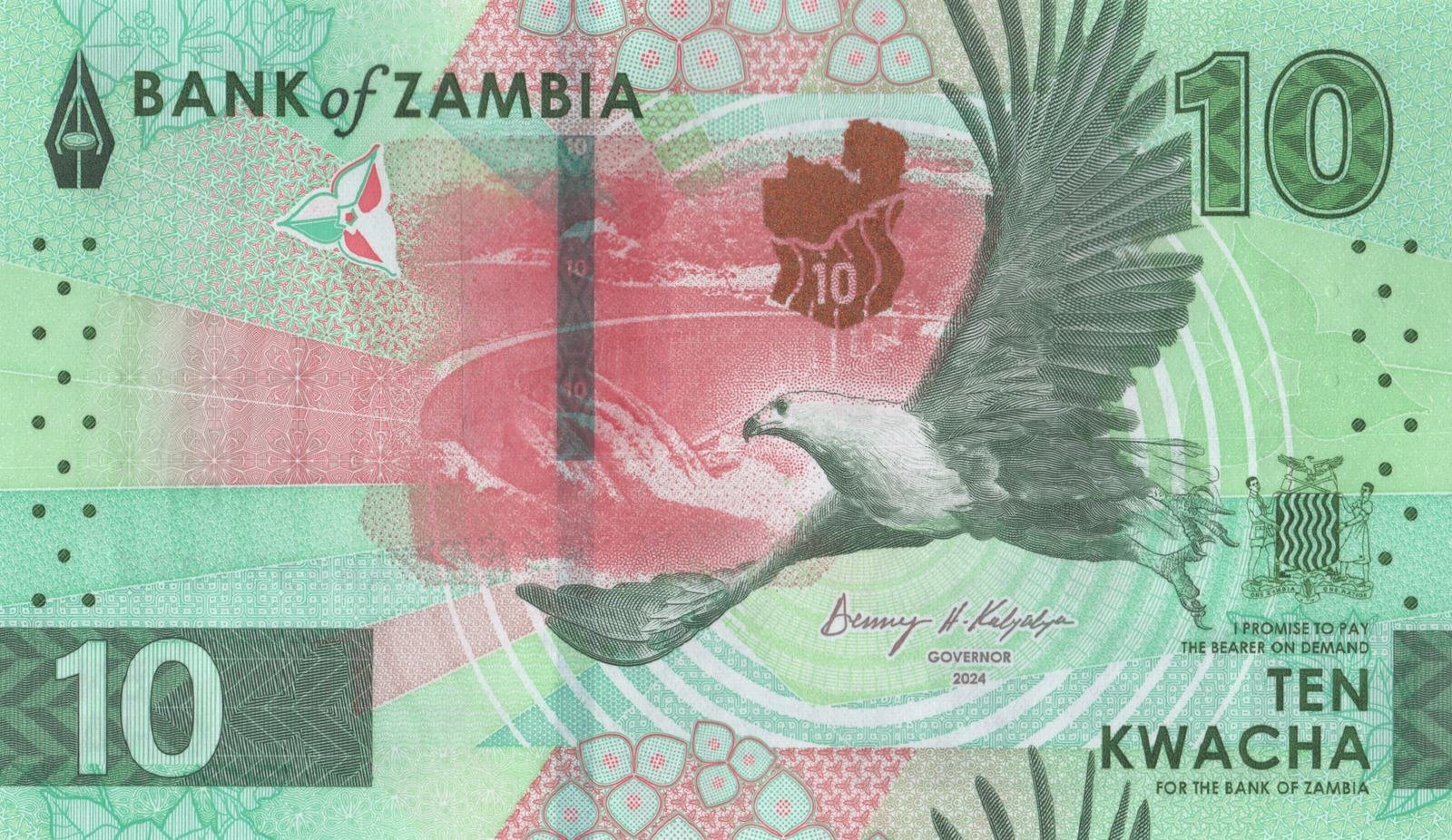
10 kwacha · front · P-62
20 kwacha · front · P-63

50 kwacha · front · P-64

The Split Within the Heritage Family
The three fronts follow a common arrangement. An African fish eagle spreads its wings across the right-hand part of the note. An economic scene sits behind it: a dam on the ten, a tractor on the twenty and a mining truck on the fifty. The map, coat of arms, signature and vertical thread zone retain their places as the colours and subjects change.
The material division cuts across this shared layout. Landqart, the manufacturer of Durasafe for the ten and twenty kwacha, confirms its use on those two denominations. The Banknote Book describes the four higher values — 50, 100, 200 and 500 kwacha — as printed on cotton paper with a protective varnish.
Durasafe also has paper surfaces. Its two outer layers of security paper are bonded to a transparent polymer core. The paper can carry watermarks and security threads; the core adds strength and permits different window constructions. Our guide to paper, polymer and hybrid banknotes explains the wider distinction between these materials.
One Long Window, Four Separate Windows
The clearest comparison is close to the centre of each front. On the ten and twenty, a continuous strip exposes the thread across much of the economic scene. On the fifty, four green patterned sections are separated by stretches of printed paper. Enlarging this area makes the difference visible without needing to identify the substrate by touch.
10 kwacha
20 kwacha
50 kwacha
Angela Chileshe, the Bank of Zambia’s Director of Banking and Currency, identifies the low-value notes’ thread as Crane Currency’s RAPID HD. She describes its presentation as a single long window. The catalogue identifies the fifty’s thread as RollingStar i+. The comparison therefore involves different thread technologies as well as different ways of exposing them.
These details are photographed in reflected light. They show the exposed areas and the patterns captured by the scanner. Movement when tilted is a separate property: the Bank’s public description says the fifty’s thread appears to move and changes from green to magenta. A still image records only one view of it.
The long opening around a thread should also be distinguished from a transparent window through the whole note. Neither these scans nor the sources used here establish that the Zambian opening is a see-through window. The difference matters when examining banknotes against the light.
What the Bank Wanted from Its Small Notes
In a December 2025 interview published by Crane Currency, Chileshe explains the Bank’s priorities for the ten and twenty: preserve familiar security features while improving durability, lower overall costs and strengthen confidence in the currency.
Her account links the material to the visible design. The extended viewing area makes the thread’s movement easier to check at a glance. She also points to the smooth thread surface and over-varnishing, while noting that the composite notes retain watermarks and a paper feel.
The interview explains the design objectives. It gives no comparative service-life figures or quantified savings for these notes.
The Same Denomination Before the Heritage Family
The preceding 2022 ten kwacha, P-58 (B167c), provides a useful control for the 2024-dated ten, P-62 (B171a). The denomination and issuing bank remain the same. The Banknote Book classifies the earlier note as paper and the later one as Durasafe. The new material arrives with a complete redesign of both sides, giving collectors several changes to record alongside the substrate.
On the earlier front, the fish eagle perches beside a musuku tree. The date 2022 sits in the coat-of-arms roundel at lower left, while separate dark thread windows interrupt the patterned strip left of centre. On the new front, the eagle flies across the dam scene, the date moves beneath the governor’s signature and one continuous thread band is exposed.
2022 · paper · P-58

2024 · Durasafe · P-62
The watermark entry is a useful check against assuming that a material change removes paper features. The Banknote Book records the same fish-eagle-head watermark with an electrotype 10 and an additional fish eagle for B167 and B171. It also identifies Kalyalya as governor on both dated varieties. These are retained catalogue descriptions; their placement, execution and appearance against the light are separate matters that this reflected-light comparison does not establish.
For a collection record, this is consequently more than a substrate variety of one unchanged design. The paper note belongs to the preceding family; the Durasafe note belongs to the Heritage family, with a new composition and different thread presentation. Recording only “10 kwacha” or only the material would hide part of that change. Denomination, dated variety, family, substrate and visible thread arrangement together make a more useful comparison.
2024 on the Notes, 2025 in Circulation
The printed year is the same on all three examples, but their circulation dates are not. The Heritage family was launched on 31 March 2025, when the ten and twenty entered circulation. The fifty followed on 1 September 2025, alongside the hundred. The Bank’s own announcement confirms that later release.
10 kwacha · printed date
50 kwacha · printed date
| Denomination | Printed year | Entered circulation |
|---|---|---|
| 10 kwacha | 2024 | 31 March 2025 |
| 20 kwacha | 2024 | 31 March 2025 |
| 50 kwacha | 2024 | 1 September 2025 |
Calling this the 2025 family identifies its introduction, while 2024 records the year printed on the notes. Neither label establishes the day an individual example was manufactured. The fifty’s later release also means that a single launch date should not be assigned to every denomination.
What to Record in a Collection
A catalogue entry for this family needs a denomination-specific substrate and circulation date alongside the printed year.
The thread windows offer a second, visible comparison. One long opening and four separate openings occupy much the same place in the family layout, yet belong to different technical combinations. A shared design can make a currency recognisable while allowing its denominations to be built differently.
Frequently Asked Questions
Are Zambia’s 2025 banknotes polymer?
The family uses more than one construction. The 10 and 20 kwacha use Durasafe, which combines outer layers of security paper with a polymer core. The catalogue describes the 50, 100, 200 and 500 kwacha as cotton-paper notes.
Why do the notes say 2024 if the family was introduced in 2025?
2024 is the year printed on the illustrated notes. The 10 and 20 kwacha entered circulation on 31 March 2025; the 50 followed on 1 September. A printed year and a circulation date record different things.
Sources and Method
The illustrations use original WorldBanknotes.eu scans of the 2022 ten-kwacha note (P-58) and the ten-, twenty- and fifty-kwacha notes dated 2024 (P-62, P-63 and P-64). Both sides of these four examples were inspected. Detail windows enlarge regions of the complete scans; the display sizes are not a common physical scale.
- Bank of Zambia, Heritage Series public information post: the September 2025 release and the fifty-kwacha thread’s behaviour when tilted.
- Crane Currency, interview with Angela Chileshe, 9 December 2025: the Bank’s reasoning for its low-denomination combination.
- Landqart, Launch Kwacha 10 and 20 and Durasafe: the two denominations’ substrate and the material’s general construction.
- The Banknote Book, Zambia, printed pages 28 and 30–31: the preceding and 2024-dated issues, catalogue identifications, material classifications, watermark descriptions, governor and thread names.
Our catalogue methodology explains how visible details, documentary evidence and interpretation are distinguished.
About the Author
Audrius is the founder and curator of WorldBanknotes.eu, a catalogue and shop for collectible banknotes. His work focuses on banknote identification, catalogue structure, printing, design and the context behind individual issues.