
Bosnia and Herzegovina Dinar
The Bosnia and Herzegovina dinar reflects a wartime currency born from necessity amid the collapse of Yugoslavia and the struggle for statehood.
Quick Facts
Country: Bosnia and Herzegovina
Code: BAD
Symbol: Din.
System: Decimal (1 Dinar = 100 Para)
Status: Withdrawn
The Story of the Bosnia and Herzegovina Dinar
With the disintegration of Yugoslavia in the early 1990s, Bosnia and Herzegovina moved away from the Yugoslav Dinar as war reshaped both territory and institutions. Introduced during conflict, the Bosnian dinar functioned as a provisional monetary system under extreme conditions of fragmentation. Competing regional authorities issued parallel versions of the currency, reflecting the political and territorial divisions of the war. Rapid inflation, supply shortages and logistical disruption defined its circulation until the post-war monetary reform replaced it with the Convertible Mark under international supervision.
Design & Symbolism
The visual identity of the Bosnian Dinar is defined by austerity and emergency production. Early 1992 issues are notable for their minimalist geometry, featuring the historical coat of arms with six lilies (fleur-de-lis), a symbol of the Kotromanić dynasty. The reverses often depict the Stari Most in Mostar—a bridge that became a global symbol of the conflict’s destruction. Due to wartime blockades, many notes were produced using basic offset printing on low-grade paper, resulting in a tactile coarseness and a muted color palette that reflects the era’s resource scarcity. The design language is one of survival, where functional typography replaced the complex engraving of the pre-war period.
For collectors
For collectors, the Bosnia and Herzegovina Dinar is a study in monetary fragmentation. The series is divided into three distinct spheres: the issues of the Sarajevo central government, the Republic of Srpska (Dinar Republike Srpske), and the Croatian Republic of Herzeg-Bosnia. Collectors specifically hunt for provisional overprints on Yugoslav banknotes, where local stamps were used to validate currency in besieged enclaves. The rarity of high-denomination notes from 1993, often rendered worthless by hyperinflation, makes them highly sought-after relics of the Balkan conflict. This is a field where serial number varieties and paper watermarks tell the story of a nation’s physical and financial rupture.
Formed in conflict, the dinar reflects a fragmented monetary system shaped by wartime necessity.
Explore the Bosnia and Herzegovina Dinar Banknotes Collection
-

Bosnia and Herzegovina 1000 Dinara 1992, P-8r, UNC
3,99 € -

Bosnia and Herzegovina 10 Dinara 1992, P-10, UNC
1,49 € -

Bosnia and Herzegovina 25 Dinara 1992, P-11, UNC
1,49 € -

Bosnia and Herzegovina 50 Dinara 1992, P-12, UNC
0,99 € -

Bosnia and Herzegovina 100 Dinara 1992, P-13, UNC
1,49 € -

Bosnia and Herzegovina 1.000 Dinara 1992, P-15, UNC
1,49 € -

Bosnia and Herzegovina 100000 Dinara 1993, P-34a, UNC
2,49 € -

Bosnia and Herzegovina 1 Dinar 1994, P-39, UNC
4,99 € -

Bosnia and Herzegovina 10000 Dinara 1993, P-53e, UNC
3,99 € -
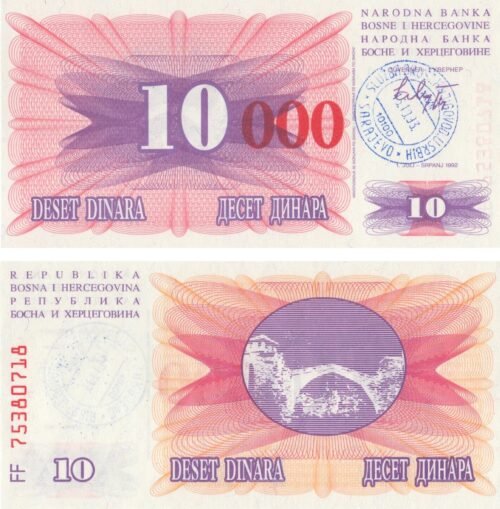
Bosnia and Herzegovina 10000 Dinara 1993, P-53f, UNC
3,99 € -

Bosnia and Herzegovina 10000 Dinara 1993, P-53g, UNC
3,99 € -

Bosnia and Herzegovina 10000 Dinara 1993, P-53h, UNC
3,99 € -

Bosnia and Herzegovina 25000 Dinara 1993, P-54a, UNC
3,99 € -

Bosnia and Herzegovina 50000 Dinara 1993, P-55h, UNC
3,99 €