
Brazilian Cruzeiro
The Brazilian cruzeiro reflects a currency that moved from classical monetary stability to one of the most visible collapses of value in modern economic history.
Quick Facts
Country: Brazil
Code: BRE
Symbol: Cr$
System: Decimal (1 Cruzeiro = 100 Centavos)
Status: Withdrawn
Issuers: Central Bank of Brazil, National Treasury of Brazil
The Story of the Brazilian Cruzeiro
Introduced in 1942 to replace the mil-réis, the cruzeiro established Brazil’s modern decimal monetary system and served as the foundation of the national economy for decades.
During its early period, the currency operated within a relatively stable framework, supporting industrial growth and institutional development.
From the late 20th century, however, the cruzeiro became increasingly affected by accelerating inflation, leading to repeated monetary reforms, redenominations and structural adjustments.
By the 1980s and early 1990s, hyperinflation dominated the system, forcing rapid issuance of higher denominations and ultimately resulting in its replacement by successive currencies, including the cruzado.
Design & Symbolism
Brazilian cruzeiro banknotes display a clear transition between two distinct design eras. Early issues are characterized by high-quality intaglio engraving, produced by international printers such as the American Bank Note Company and Thomas De La Rue, featuring figures like Getúlio Vargas and Santos Dumont.
Reverse designs from this period highlight national development and natural identity, including infrastructure such as the Itaipu Dam and native flora and fauna.
As inflation intensified, later banknotes shifted toward simplified layouts and faster production methods, with reduced engraving depth and flatter color application reflecting economic pressure.
This contrast between precision engraving and functional mass production creates a visible record of changing monetary conditions.
For collectors
For collectors, the Brazilian cruzeiro offers a strongly defined dual collecting structure based on stability versus inflation.
Early engraved issues from ABNCo and De La Rue represent the classical phase of Brazilian banknote production and are valued for their technical and artistic quality.
In contrast, later hyperinflation-era notes—particularly high-denomination issues and transitional overprints associated with reforms such as the Collor Plan—document the collapse of monetary value and provide a distinct collecting category.
For collectors, the cruzeiro stands as a complete narrative currency, where a single series captures both the peak of traditional banknote craftsmanship and the visible effects of economic breakdown.
From engraved precision to inflation-driven simplification, the cruzeiro reflects Brazil’s full monetary cycle.
Explore the Brazilian Cruzeiro Banknotes Collection
-

Brazil 1 Cruzeiro 1955, P-150b, UNC
2,99 € -

Brazil 1 Cruzeiro 1956, P-150c, UNC
2,99 € -

Brazil 2 Cruzeiros 1958, P-151b, UNC
4,99 € -

Brazil 2 Cruzeiros 1956, P-157Ab, UNC
3,99 € -

Brazil 2 Cruzeiros 1958, P-157Ac, UNC
3,99 € -

Brazil 5 Cruzeiros 1962, P-176a, UNC
1,49 € -
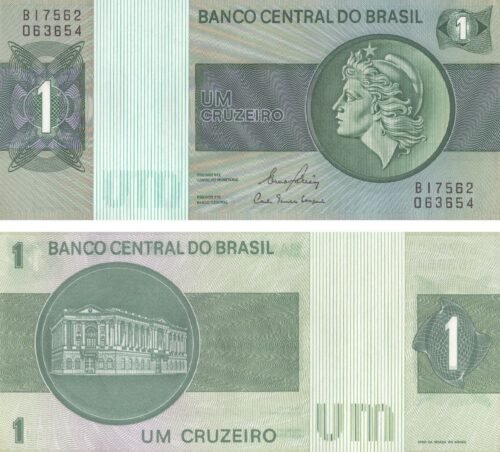
Brazil 1 Cruzeiro 1980, P-191Ac, UNC
1,49 € -

Brazil 10 Cruzeiros 1979, P-193c, UNC
3,99 € -

Brazil 100 Cruzeiros 1981-1984, P-198a, UNC
2,49 € -
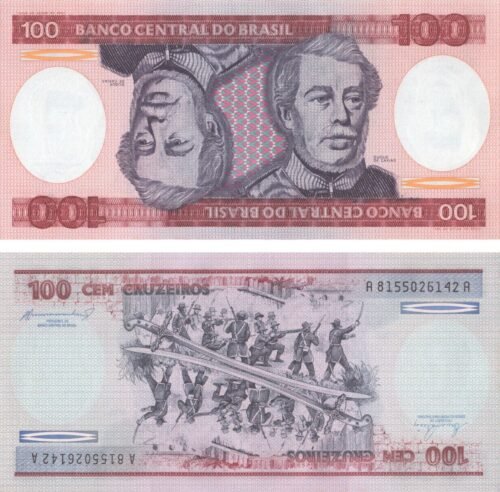
Brazil 100 Cruzeiros 1981-1984, P-198b, UNC
2,49 € -

Brazil 200 Cruzeiros 1981, P-199a, UNC
2,49 € -

Brazil 200 Cruzeiros 1984, P-199b, UNC
2,49 € -
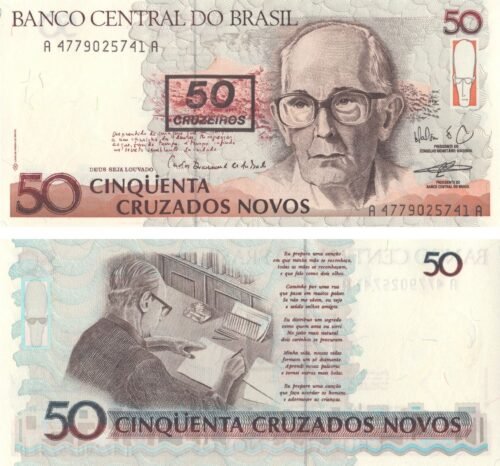
Brazil 50 Cruzeiros on 50 Cruzados Novos 1990, P-223, UNC
2,49 € -

Brazil 200 Cruzeiros on 200 Cruzados Novos 1990, P-225b, UNC
2,49 € -

Brazil 500 Cruzeiros on 500 Cruzados Novos 1990, P-226b, UNC
2,49 € -
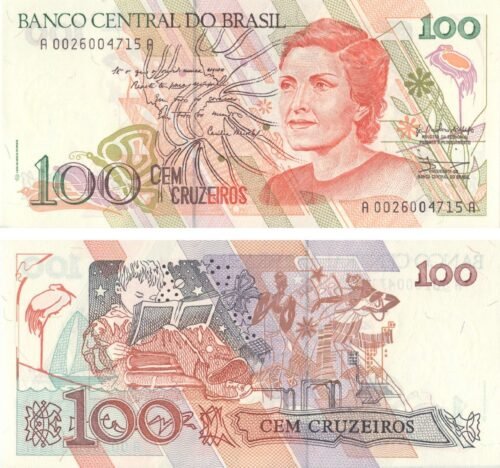
Brazil 100 Cruzeiros 1990, P-228, UNC
2,49 € -
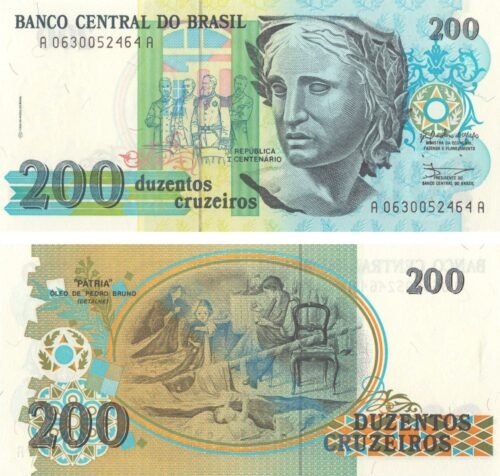
Brazil 200 Cruzeiros 1990, P-229, UNC
2,99 € -
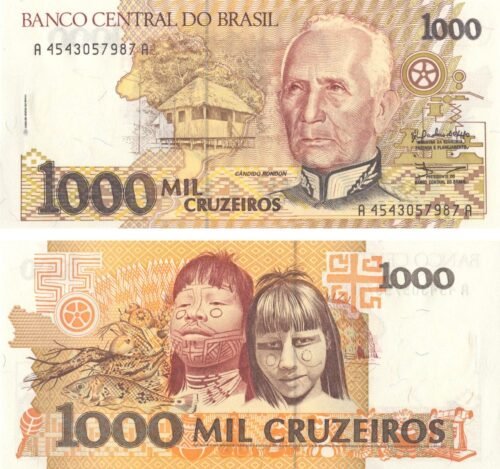
Brazil 1000 Cruzeiros 1990, P-231a, UNC
2,99 €