Brazilian Real
The Brazilian real represents the stabilising monetary reform of 1994 and a durable banknote system built around national identity and native fauna.
Quick Facts
Country: Brazil
Code: BRL
Symbol: R$
System: Decimal (1 Real = 100 Centavos)
Status: In circulation
Issuer: Central Bank of Brazil
The Story of the Brazilian Real
The Brazilian real entered circulation on 1 July 1994 as the final monetary stage of the Real Plan. One real equalled 2,750 cruzeiros reais, the value of one Unidade Real de Valor on the preceding day. The reform replaced the cruzeiro real and established a new decimal unit divided into 100 centavos.
The real did not emerge from a simple removal of a fixed number of zeros. Prices and contracts had first been expressed through the URV, a temporary unit of value designed to separate everyday accounting from rapidly changing nominal prices. On conversion day, one URV became one real.
The Central Bank of Brazil issued the first banknote family from 1994. The currency survived the institutional and economic changes that followed, making it markedly more durable than the cruzeiro, cruzado and other units that preceded it during the late twentieth century.
A second family began in 2010 with redesigned dimensions and stronger security features while preserving the central themes of the original series. The real remains Brazil’s current currency under ISO code BRL.
Design & Symbolism
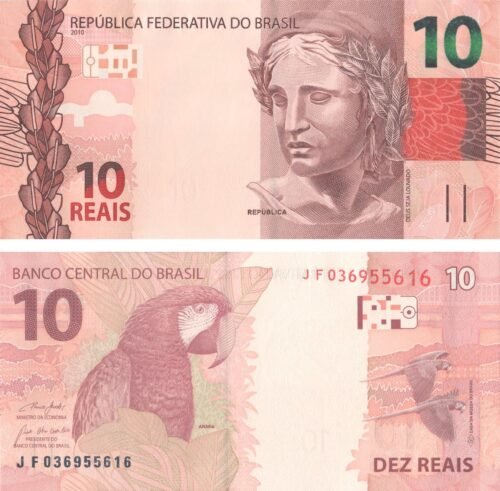
Both principal banknote families use the Effigy of the Republic on the obverse, presenting the currency through an allegorical image of the Brazilian state rather than a sequence of political portraits.
The reverses are organised around native fauna. Sea turtles, herons, macaws, golden lion tamarins, jaguars and groupers connect each denomination with Brazil’s ecological diversity. The animal themes also give the family a clear visual hierarchy.
The second family retains this symbolic programme but differentiates denominations through changing sizes, stronger colour separation and updated tactile and optical security features. The continuity makes comparisons between the first and second families especially instructive.
Official inscriptions distinguish the federal state and the issuing institution: República Federativa do Brasil appears on the front, while Banco Central do Brasil appears on the reverse.
For collectors
The real offers two closely related collecting structures. A type collection can compare equivalent denominations from the first and second families, while a specialist collection can follow dates, signature combinations, series, replacement notes and security revisions.
The 1994 issues are central to the monetary-reform story because they represent the immediate conversion from the cruzeiro real. Later notes show how the same currency developed without another redenomination.
Introduced on 1 July 1994 at R$1 = CR$2,750; the Brazilian real remains in circulation.