Croatian Kuna
The Croatian kuna represents a period of consolidation, where identity was articulated through knowledge, architecture and disciplined European design.
Quick Facts
Country: Croatia
Code: HRK
Symbol: kn
System: Decimal (1 Kuna = 100 Lipa)
Status: Withdrawn
Issuer: Croatian National Bank
The Story of the Croatian Kuna
Introduced in 1994, the Croatian Kuna replaced the transitional Croatian Dinar, marking the beginning of long-term monetary stability. Its name—derived from the historical use of marten pelts—revived medieval economic traditions while anchoring modern sovereignty. Over nearly three decades, the Kuna accompanied Croatia through reconstruction, institutional consolidation and integration into the European Union, ultimately concluding its lifecycle with the adoption of the Euro in 2023. As a fully realized national currency, it represents the most stable and mature phase of Croatia’s monetary evolution.
Design & Symbolism
The visual identity of the Croatian Kuna is built on a precise system of intellectual and architectural pairing. Each banknote connects a key historical figure with a location tied to their legacy, forming a coherent cultural narrative across the series. The 500 Kuna features Marko Marulić paired with Split’s Diocletian’s Palace, while the 1000 Kuna presents Ante Starčević alongside the monument of King Tomislav and the Zagreb Cathedral. This structured pairing system transforms the series into a curated cultural map of Croatia. Produced by the German security printer Giesecke & Devrient, the notes exhibit exceptional print quality, intaglio precision and a tactile character closely associated with the final series of the Deutsche Mark, reinforcing their status among Europe’s most refined modern banknotes.
For collectors
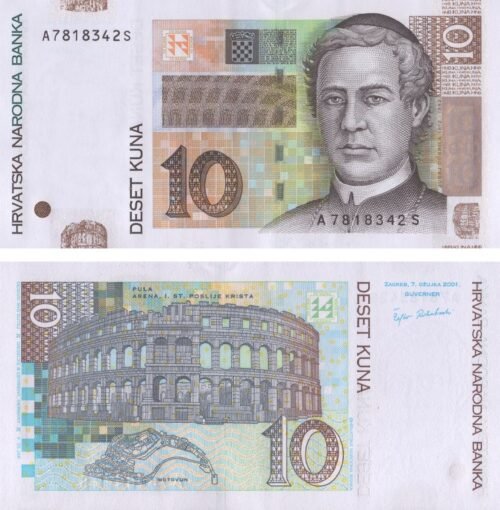
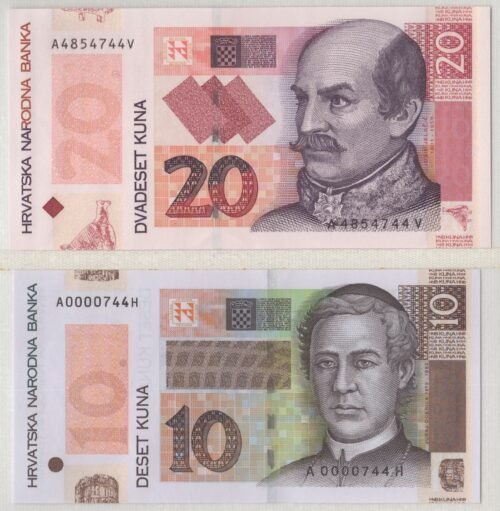
For collectors, the Croatian Kuna is a closed modern series with clear entry points and specialized targets. A key rarity is the 10 Kuna banknote from 1995, originally printed in a grey-green tone and quickly replaced with a brown variant due to confusion with the 1000 Kuna—making the initial issue highly collectible. Commemorative 10 and 20 Kuna notes from 2004, issued for the Croatian National Bank anniversary and featuring a distinctive golden holographic element, are also strongly sought after. High denominations such as 1000 Kuna remain desirable due to lower circulation volumes and complex design. Since the Euro transition in 2023, the Kuna has become a finite series, significantly increasing demand for UNC examples as collectors recognize its place as one of the most cohesive and intellectually structured currencies of modern Europe.
A complete European series defines the kuna, where scholarship and architecture shape monetary identity.