
Georgian Kuponi
The Georgian kuponi was the country’s temporary post-Soviet currency of 1993–1995, a short-lived monetary bridge between the collapse of the rouble area and the introduction of the lari.
Quick Facts
Country: Georgia
Code: GEK
Symbol: GEK
System: Temporary non-decimal currency (no subsidiary unit)
Status: Withdrawn
Issuer: National Bank of Georgia
The Story of the Georgian Kuponi
Georgia introduced the kuponi in 1993 as temporary money while the country prepared a permanent national currency. The National Bank of Georgia’s own catalogue describes the coupon as an interim currency created in response to the monetary conditions of 1991–1992 and circulating in Georgia during 1993–1995.
The kuponi emerged during an exceptionally difficult economic transition. The currency depreciated rapidly as Georgia dealt with the breakdown of Soviet-era monetary arrangements, severe fiscal pressure and inflation. By the end of 1994, National Bank research records an exchange rate of about 2.5 million coupons to one U.S. dollar, illustrating the scale of the loss in purchasing power.
A permanent national currency was prepared in parallel. Lari banknotes and coins entered circulation in September 1995, and on 2 October 1995 the lari became Georgia’s sole legal tender. The kuponi was converted at one lari to one million coupons, closing a brief but historically important monetary phase.
For WorldBanknotes.eu, the kuponi is therefore treated as a distinct currency entity rather than as an early form of the lari. Its legal status, denomination structure, design programme and inflationary context belong to the 1993–1995 temporary currency system.
Design & Symbolism
The earliest kuponi issues use a repeated architectural programme centred on old Tbilisi and Mount Mtatsminda on the obverse, with the Vardzia cave complex on the reverse. King Vakhtang Gorgasali’s equestrian monument appears within the Tbilisi panorama, linking the temporary currency to the historical capital and to Georgian state tradition.
Later 1993 issues move away from landscape views toward medieval ornament. The Borjgali solar symbol is flanked by griffins adapted from Samtavisi Cathedral, while grape-vine carvings form the principal reverse decoration. These motifs give the high-denomination notes a strongly Georgian visual identity even as inflation forced rapid changes in face value.
The 1994 issues retain this ornamental language while introducing larger denominations and identifiable production changes, including the printed 1994 date and a vertical grey strip beside the watermark area on the relevant types. The progression from architecture to symbolic ornament makes the kuponi unusually varied for a currency that circulated for only a little more than two years.
Across the series, design continuity is often stronger than denomination continuity. Closely related notes can share the same principal imagery while differing in colour, value, prefix structure or date, making careful visual attribution essential.
For collectors
The kuponi offers a compact but technically rich field. A basic collection can follow the major 1993 and 1994 design groups, while a specialised collection can separate prefix structures, replacement notes, colour changes, dates and individual Pick varieties.
The early Tbilisi–Vardzia types reward close attention to the fractional prefix. Some regular issues use denominator 1, later forms use denominator 2, and replacement notes may use denominator 10. These small numbering differences can be more important for attribution than the shared artwork.
The later Borjgali-and-griffin issues introduce another collecting path. Replacement notes beginning with serial digit 9, dated 1994 continuations and high denominations up to one million kuponi document the final inflationary stage of the currency.
Collectors should keep Georgian Kuponi and Georgian Lari as separate Currency entities. The 1995 conversion explains their monetary relationship, but the kuponi belongs to a distinct temporary issue system with its own designs, numbering conventions and historical context.
Introduced in 1993 as a temporary currency; replaced in 1995 at 1 GEL = 1,000,000 GEK.
Explore the Georgian Kuponi Banknotes Collection
-

Georgia 10 Kuponi 1993, P-26, UNC
3,99 € -
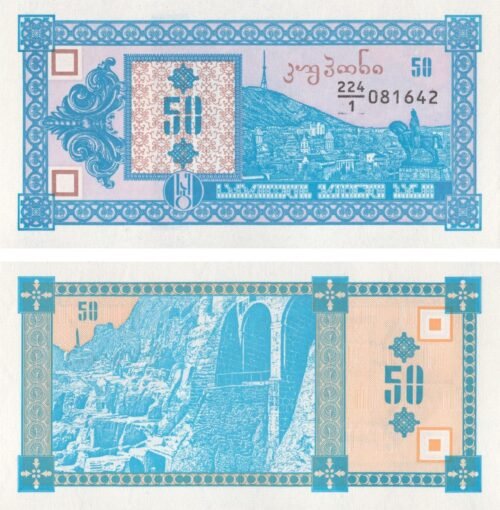
Georgia 50 Kuponi 1993, P-27, UNC
6,49 € -

Georgia 5000 Kuponi 1993, P-31, UNC
3,99 € -

Georgia 1 Kuponi 1993, P-33, UNC
1,49 € -
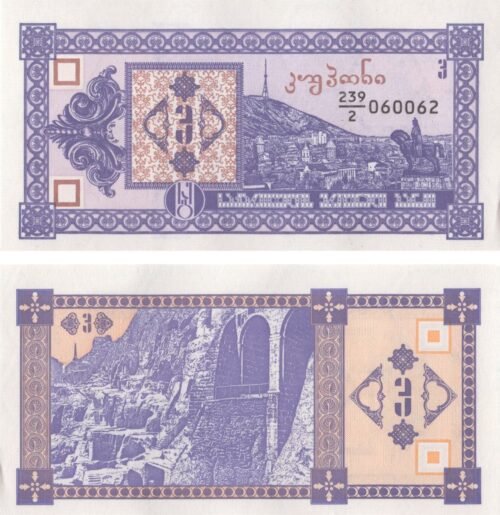
Georgia 3 Kuponi 1993, P-34, UNC
1,49 € -
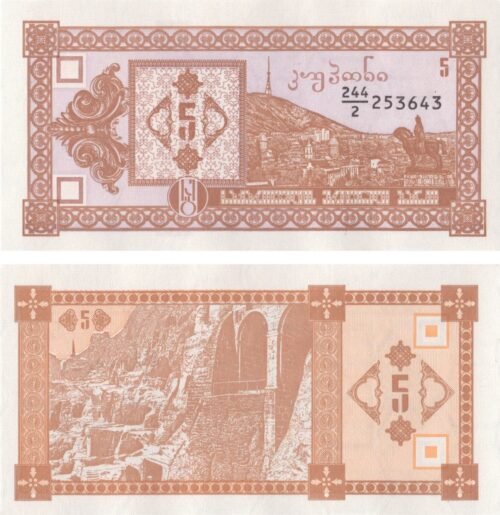
Georgia 5 Kuponi 1993, P-35, UNC
3,99 € -

Georgia 10 Kuponi 1993, P-36, UNC
3,99 € -

Georgia 50 Kuponi 1993, P-37, UNC
2,99 € -

Georgia 100 Kuponi 1993, P-38, UNC
2,99 € -

Georgia 250 Kuponi 1993, P-43, UNC
2,49 € -

Georgia 3000 Kuponi 1993, P-45, UNC
2,49 € -

Georgia 20000 Kuponi 1994, P-46b, UNC
1,49 € -
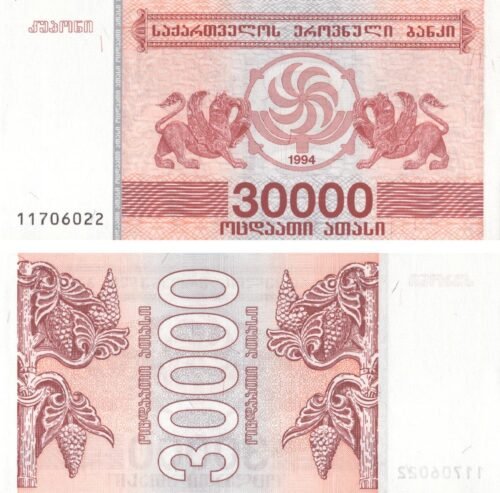
Georgia 30000 Kuponi 1994, P-47, UNC
1,49 € -

Georgia 250000 Kuponi 1994, P-50, UNC
2,49 € -
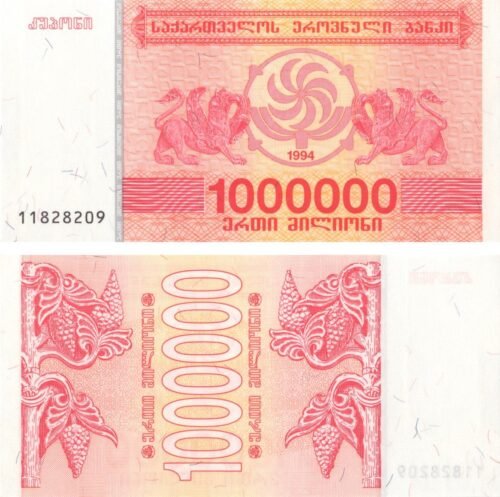
Georgia 1000000 Kuponi 1994, P-52, UNC
2,99 €