
Iranian Rial
The Iranian rial carries the layered gravity of Persia—calligraphy, turquoise domes and a civilisation where poetry and power move side by side.
Quick Facts
The Story of the Iranian Rial
The rial emerged in the early 20th century, but its modern identity was forged through the 1979 Islamic Revolution, which transformed the visual language of the currency from imperial portraiture to ideological symbolism. In the decades that followed, inflation and economic isolation created a "high-zero" environment, where transactions expand into millions of rials. Alongside this, the informal use of the toman (1 toman = 10 rials) persists in daily life.
Design & Symbolism
Iranian banknotes are deeply rooted in cultural heritage. Portraits of Ayatollah Khomeini dominate modern issues, while earlier series featured Shah Mohammad Reza Pahlavi—creating a clear visual divide. Architectural imagery includes the Imam Reza Shrine and the Azadi Tower. Design is defined by ornamental precision, with dense guilloche structures and fine line engraving that resemble Persian carpets and illuminated manuscripts.
For collectors
For collectors, the Iranian Rial presents a field shaped by contrast. Pre-revolution banknotes featuring the Shah are increasingly sought after as artefacts of a vanished political era, while post-1979 issues document a significant ideological transformation. High-denomination notes reflect inflationary history, and uncirculated examples—especially from earlier decades—are far less common than their nominal abundance suggests.
The Iranian rial remains the official currency of Iran, defined by its revolutionary transformation and high-denomination structure.
Explore the Iranian Rial Banknotes Collection
-

Iran 100 Rials 1982, P-135, UNC
5,99 € -

Iran 200 Rials 1987, P-136b, UNC
2,49 € -

Iran 200 Rials 1997, P-136d, UNC
1,49 € -

Iran 200 Rials 2004, P-136e, UNC
1,49 € -

Iran 500 Rials 2003-2009, P-137Aa, UNC
1,49 € -

Iran 500 Rials 2003-2009, P-137Ab, UNC
1,49 € -

Iran 500 Rials 2003-2009, P-137Ad, UNC
1,49 € -

Iran 1000 Rials 1991, P-138f(1), UNC
3,99 € -

Iran 100 Rials 1987, P-140c, UNC
1,49 € -

Iran 100 Rials 1991, P-140d, UNC
1,49 € -

Iran 2000 Rials 1993, P-141j, UNC
2,49 € -
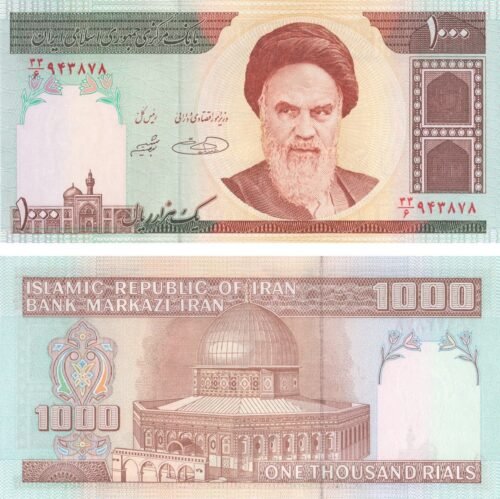
Iran 1000 Rials 2004, P-143d, UNC
1,49 € -

Iran 1000 Rials 2007-2008, P-143g, UNC
1,49 € -

Iran 2000 Rials 2005, P-144a, UNC
0,99 € -

Iran 2000 Rials 2005-2013, P-144d, UNC
1,49 € -

Iran 5000 Rials 2010, P-145f, UNC
2,49 € -

Iran 10000 Rials 1997, P-146d, UNC
2,99 € -

Iran 10000 Rials 2007, P-146h, UNC
1,49 € -

Iran 10000 Rials 2015, P-146i, UNC
1,49 € -

Iran 5000 Rials 2009, P-150, UNC
2,49 € -

Iran 100000 Rials 2013, P-151b, UNC
2,49 € -

Iran 100000 Rials 2019, P-151e, UNC
2,49 € -

Iran 5000 Rials 2015, P-152b, UNC
0,99 € -
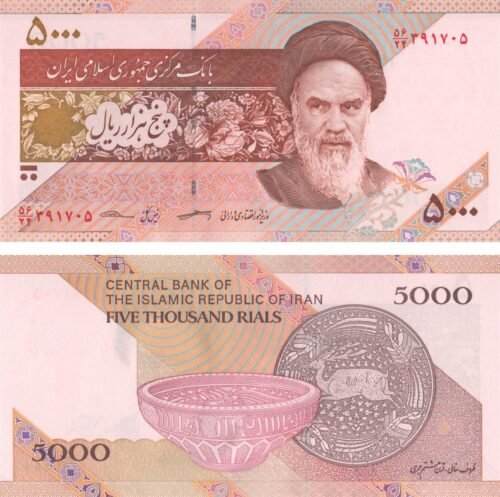
Iran 5000 Rials 2018, P-152c, UNC
0,99 €