Israeli New Shekel
The Israeli new shekel marks the 1985 stabilisation reform, removing three zeros while retaining the historic shekel name as Israel’s enduring modern currency.
Quick Facts
Country: Israel
Code: ILS
Symbol: ₪
System: Decimal (1 New Shekel = 100 Agorot)
Status: In circulation
Issuer: Bank of Israel
The Story of the Israeli New Shekel
The new shekel became Israel’s currency on 4 September 1985. One new shekel equalled 1,000 old sheqalim, a redenomination designed to simplify calculations, cash payments and financial records after severe inflation.
The reform retained the name shekel rather than introducing an unrelated unit. This preserved the historical and linguistic identity established by earlier legislation while clearly distinguishing the new monetary scale. The currency is divided into 100 agorot and is issued exclusively by the Bank of Israel.
The first banknote series circulated from 1985 and included denominations from 1 to 200 new sheqalim. A second series entered circulation in 1999 with updated security features, followed by the third series from 2014, which introduced a new visual programme and advanced accessibility features.
The currency remains in circulation under ISO code ILS. In everyday usage it is often called simply the Israeli shekel, but the Currency page should retain the full canonical name Israeli New Shekel to distinguish it from the withdrawn 1980–1985 unit.
Design & Symbolism
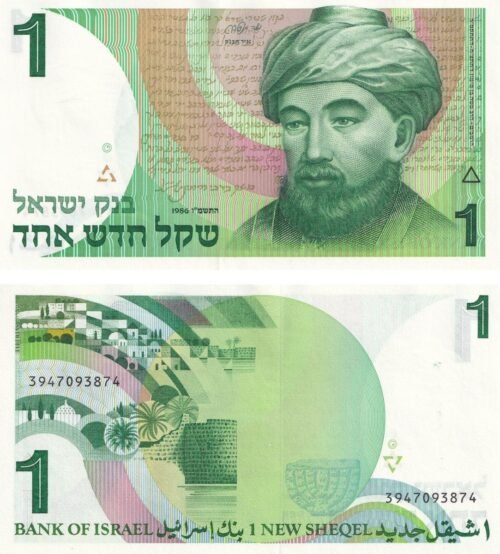
The first new-shekel series continued Israel’s tradition of honouring major figures in Jewish intellectual, political and cultural history. The 1 New Shekel note depicts Maimonides beside manuscript material, with Tiberias and historical religious imagery on the reverse.
The second series retained portraiture while introducing a more modern and standardised security structure. Uniform design principles, improved anti-counterfeiting elements and clearer denomination differentiation marked the transition into a mature contemporary banknote system.
The third series centres on Hebrew poets and connects their work with landscapes, plants and lines of verse reproduced in microtext. Rachel appears with the Sea of Galilee, Shaul Tchernichovsky with citrus imagery, Leah Goldberg with almond blossoms, and Nathan Alterman with moonlit flora.
Across the series, trilingual inscriptions, tactile features, colour differentiation and increasingly sophisticated security devices combine institutional continuity with changing cultural emphasis.
For collectors
The new shekel contains several distinct collecting layers within one continuing currency. First-series notes document the immediate post-inflation reform, second-series notes show the security transition of 1999, and third-series notes form a coherent modern group based on literature and landscape.
The first-series banknotes have been withdrawn and are no longer exchangeable, even though the new shekel itself remains the current currency. Collectors should therefore record both the Currency entity and the legal status of the individual series.
The WorldBanknotes.eu 1 New Shekel 1986 example is an early reform note and should be reassigned from Israeli Pound to Israeli New Shekel. Its modest denomination carries direct evidence of the three-zero redenomination.
Introduced on 4 September 1985 at 1 new shekel = 1,000 old sheqalim; the currency remains in circulation.