Israeli Shekel
Israel’s first shekel transformed the lira system in 1980, preserving familiar designs while inflation rapidly expanded the denomination structure.
Quick Facts
Country: Israel
Code: ILR
Symbol: IS
System: Decimal (1 Shekel = 100 New Agorot)
Status: Withdrawn
Issuer: Bank of Israel
The Story of the Israeli Shekel
The Israeli shekel entered circulation on 24 February 1980, replacing the Israeli pound at a rate of one shekel to ten pounds. The new unit was divided into 100 new agorot and restored the ancient Hebrew name chosen by the Sheqel Currency Law.
The first banknotes were closely connected to the preceding lira series. Existing design concepts were retained while one zero was removed from the former denominations, making the reform immediately recognisable to the public. The initial values were 1, 5, 10 and 50 sheqalim.
Inflation soon reshaped the system. Between 1981 and 1985, the Bank of Israel added 100, 500, 1,000, 5,000 and 10,000 sheqalim, creating the largest banknote series issued by the state up to that point. The progression from compact reform notes to very high denominations records the accelerating loss of purchasing power.
On 4 September 1985, the new shekel replaced the old shekel at a rate of 1,000 to one. The original shekel is now withdrawn and its banknotes are no longer exchangeable by the Bank of Israel.
Design & Symbolism
The first shekel series continued the portrait-and-architecture language of the final lira issues. Prominent figures appear on the obverse, while gates, buildings and landscapes associated with Jerusalem and national history structure the reverse.
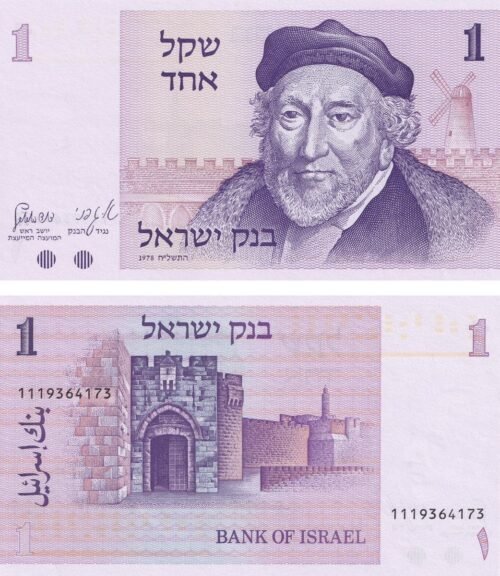
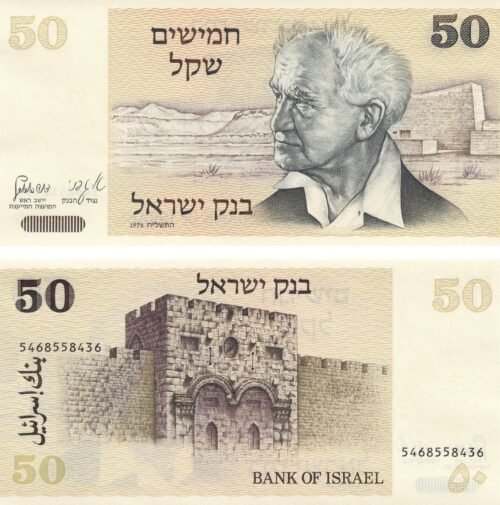
The 1-shekel note pairs Sir Moses Montefiore with Mishkenot Sha’ananim and Jaffa Gate. The 50-sheqalim note combines David Ben-Gurion with Sde Boker and the Golden Gate. Hebrew, Arabic and English inscriptions place the notes within Israel’s multilingual monetary system.
Watermarked portraits, detailed line engraving and controlled colour differentiation help separate denominations. The visual continuity with the lira was deliberate: the reform changed the unit of account without discarding the established national iconography.
As inflation intensified, larger denominations joined the same broad design family. The resulting series allows the collector to see monetary expansion through changing values rather than through a complete stylistic break.
For collectors
The Israeli shekel is a compact but exceptionally instructive reform currency. The notes dated 1978 were placed into circulation only in 1980, so the printed year and the currency’s actual introduction date must be recorded separately.
A representative collection can begin with the low denominations carried over from the lira designs and continue through the inflation-era 500, 1,000, 5,000 and 10,000 sheqalim. Signatures, issue dates, watermarks and printer differences provide additional levels of classification.
WorldBanknotes.eu examples include the 1 Shekel and 50 Shekalim notes dated 1978. They should be assigned to Israeli Shekel rather than Israeli Pound, because their denomination and legal currency period belong to the 1980–1985 shekel system.
Introduced at 1 shekel = 10 Israeli pounds and replaced at 1 new shekel = 1,000 old sheqalim.