
Jordanian Dinar
The Jordanian dinar carries the authority of a high-value currency, where Hashemite lineage and the stone of Petra converge into a stable system.
Quick Facts
Country: Jordan
Code: JOD
Symbol: د.ا
System: Decimal (1 Dinar = 1000 Fils)
Status: In circulation
Issuer: Central Bank of Jordan
The Story of the Jordanian Dinar
Introduced in 1950, the dinar marked Jordan’s step beyond the British Mandate. Managed initially in London, early issues retained the discipline of British tradition. Over time, the currency became one of the strongest in the region, anchored by a long-standing peg to the US dollar. It is recognised globally for its stability under the Hashemite dynasty, standing as a monetary exception within a volatile geopolitical landscape.
Design & Symbolism
Banknotes present a dialogue between dynasty and history, featuring Hashemite rulers and landmarks like the Treasury of Petra. In the latest series, the Sinai Rosefinch appears as a refined national emblem. Produced by De La Rue, the notes feature pronounced intaglio printing and advanced SPARK Live optical features on higher denominations, marking Jordan’s position within modern high-security banknote production.
For collectors
For collectors, the Jordanian Dinar represents “stable prestige.” Its consistent valuation has preserved design integrity across decades. Particular focus falls on early Jordan Currency Board issues and the long-running King Hussein era. High-grade uncirculated examples from the 1960s–1980s are increasingly scarce, offering a compelling intersection of historical continuity, technical quality and long-term regional stability.
The Jordanian dinar remains the official currency of Jordan, reflecting a rare balance of dynastic continuity and stability.
Explore the Jordanian Dinar Banknotes Collection
-
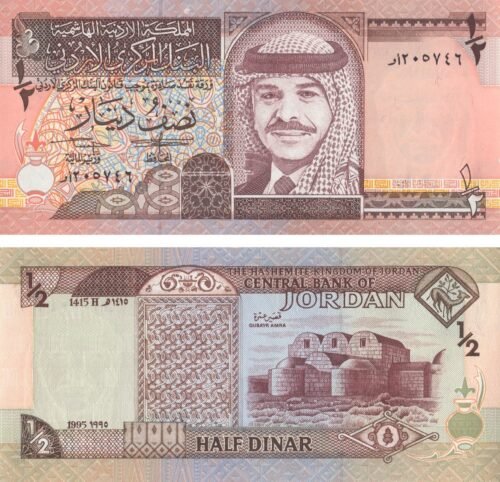
Jordan 1/2 Dinar 1995, P-28a, UNC
4,99 € -

Jordan 1 Dinar 1996, P-29b, UNC
7,99 € -

Jordan 1 Dinar 2021, P-34, UNC
3,99 € -

Jordan 1 Dinar 2022, P-39, UNC
3,99 € -
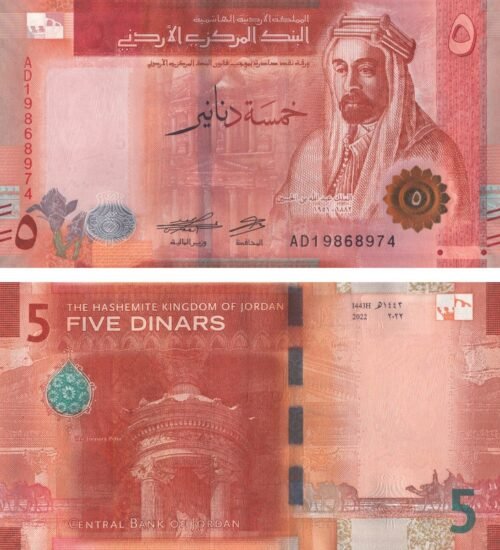
Jordan 5 Dinars 2022, P-40, UNC
14,99 € -
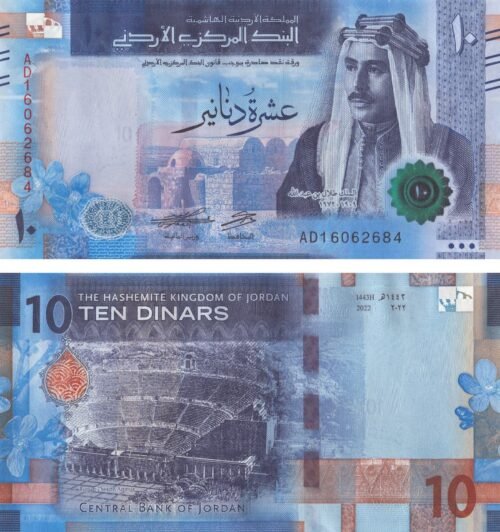
Jordan 10 Dinars 2022, P-41, UNC
30,99 €