
Myanmar Kyat
The Myanmar kyat reflects a nation where shifting political power and gradual reopening have shaped a complex and layered currency identity.
Quick Facts
Country: Myanmar
Code: MMK
Symbol: K
System: Decimal (1 Kyat = 100 Pyas)
Status: In circulation
Issuer: Central Bank of Myanmar
The Story of the Myanmar Kyat
The Myanmar kyat represents both continuity and rupture within Southeast Asian monetary history. Originally introduced after independence to replace the Indian rupee, the kyat established a sovereign monetary system aligned with national identity. However, its evolution was repeatedly disrupted by political intervention and economic isolation.
One of the most defining chapters occurred under the socialist regime of General Ne Win, whose reliance on numerological beliefs led to sudden demonetizations and the issuance of unconventional denominations such as 15, 35, 45 and 90 kyat banknotes. These abrupt reforms erased savings and destabilized public trust, embedding the kyat deeply within the country’s political narrative.
Following the 1989 transition from Burma to Myanmar, the currency continued under a new national framework, gradually stabilizing as the country opened economically. Today, the kyat functions as the official currency of Myanmar, reflecting both its turbulent past and its ongoing economic transformation.
Design & Symbolism
Myanmar kyat banknotes combine political history with strong symbolic continuity. Portraits of General Aung San, the founding figure of modern Myanmar, dominate earlier and modern series, linking currency directly to national identity.
Architectural and cultural landmarks such as the Shwedagon Pagoda reinforce spiritual and historical continuity, while traditional motifs and ornamental patterns draw from Buddhist and royal artistic heritage.
The most distinctive visual feature within the broader kyat system remains the legacy of the numerology series, where unusual denominations created a unique visual hierarchy rarely seen in global currency.
Modern issues integrate improved security features, including watermark portraits, security threads and refined printing techniques, aligning the kyat with contemporary production standards while maintaining its recognizable national character.
For collectors
For collectors, the Myanmar kyat offers a uniquely stratified collecting field where political history directly shapes monetary design.
The earlier Burma-era banknotes—particularly the numerology issues of 45 and 90 kyat—form the core of collector interest, representing one of the most unusual monetary experiments of the 20th century.
At the same time, modern Myanmar issues provide continuity, allowing collectors to build a complete narrative from pre-1989 Burma to the present-day monetary system.
For collectors, the kyat stands as a currency of disruption and continuity—where each banknote reflects the intersection of authority, belief and economic adaptation.
From political upheaval to gradual stabilization, the kyat reflects Myanmar’s evolving monetary identity.
Explore the Myanmar Kyat Banknotes Collection
-
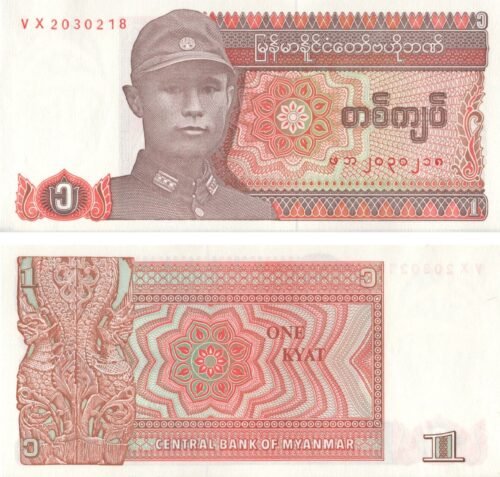
Myanmar 1 Kyat 1990, P-67, UNC
0,99 € -
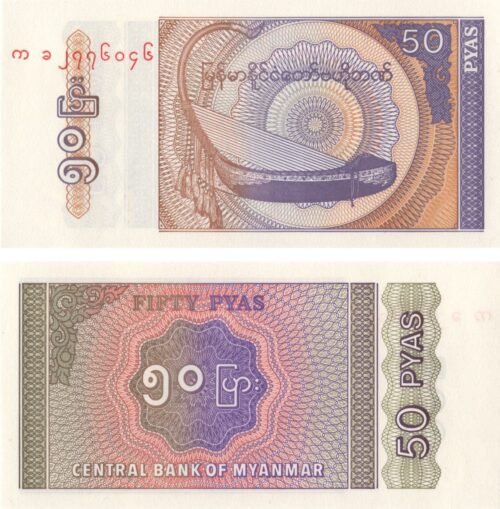
Myanmar 50 Pyas 1994, P-68, UNC
1,49 € -
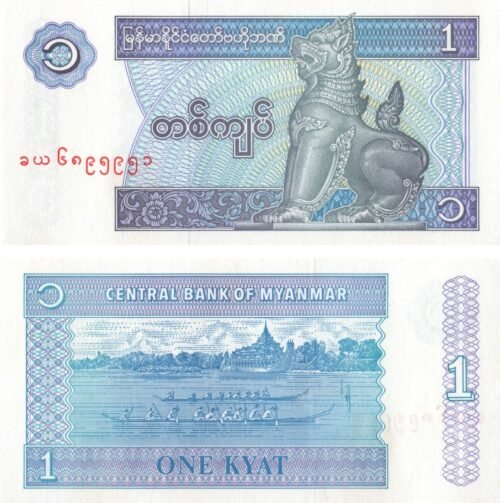
Myanmar 1 Kyat 1996, P-69(2), UNC
0,99 € -
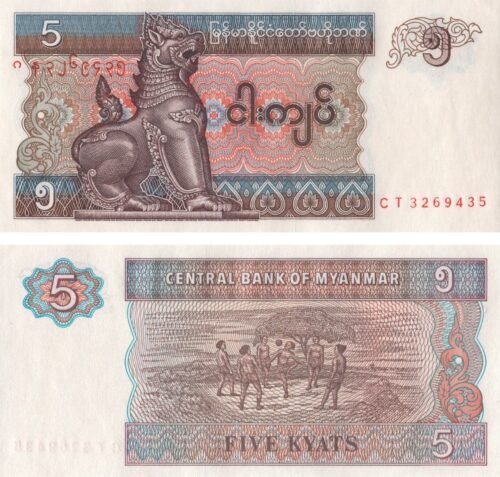
Myanmar 5 Kyats 1995, P-70b, UNC
0,99 € -
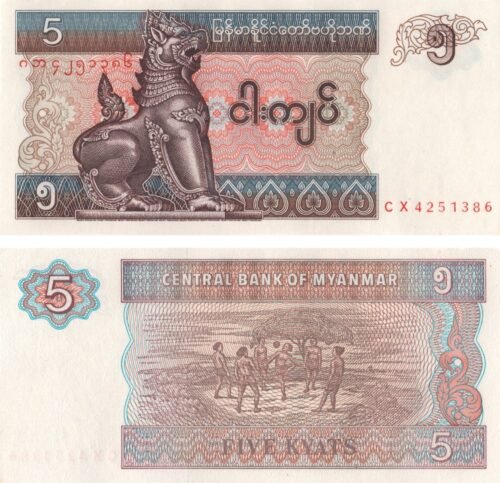
Myanmar 5 Kyats 1995, P-70br, UNC
0,99 € -
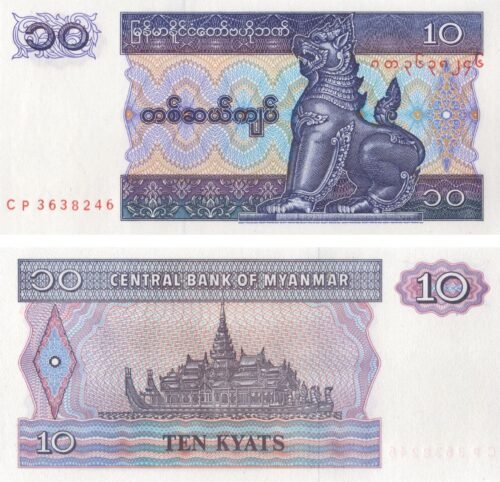
Myanmar 10 Kyats 1995, P-71b, UNC
0,99 € -
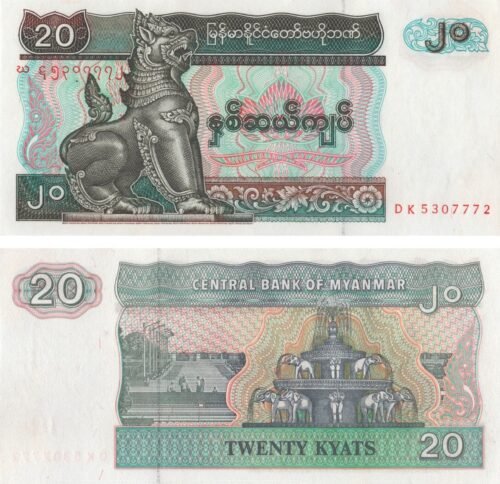
Myanmar 20 Kyats 1994, P-72, UNC
0,99 € -
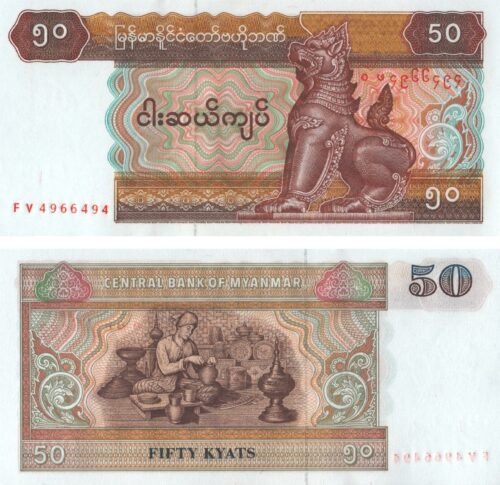
Myanmar 50 Kyats 1997, P-73b(1), UNC
0,99 € -
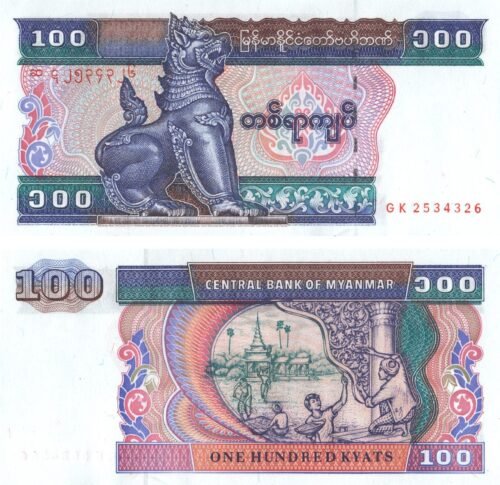
Myanmar 100 Kyats 1996, P-74b, UNC
0,99 € -
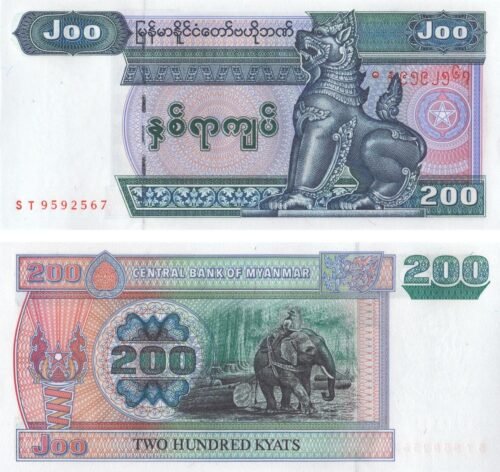
Myanmar 200 Kyats 2004, P-78, UNC
1,49 € -
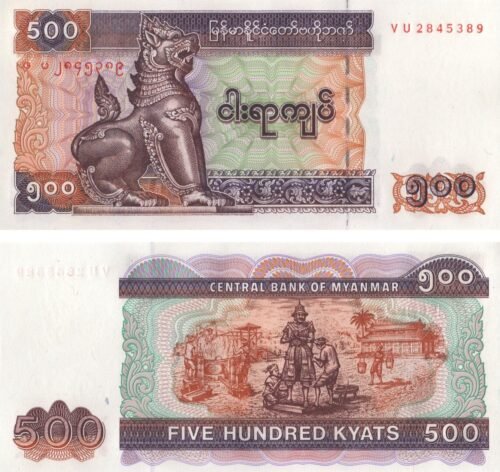
Myanmar 500 Kyats 2004, P-79, UNC
2,49 € -

Myanmar 500 Kyats 2020, P-85, UNC
2,49 € -

Myanmar 1000 Kyats 2020, P-86, UNC
2,99 €