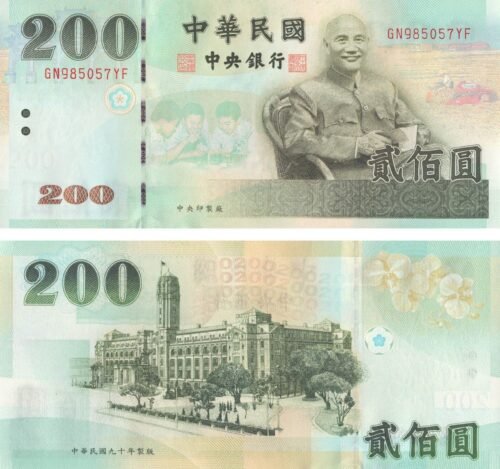
New Taiwan Dollar
The New Taiwan dollar is a post-hyperinflation reset currency, defined by its 1949 stabilisation and the precision printing standards of Taiwan’s Central Bank Printing Plant.
Quick Facts
The Story of the New Taiwan Dollar
The New Taiwan dollar (TWD) was introduced in 1949 to end extreme hyperinflation, replacing the Old Taiwan Dollar at a rate of 40,000 to 1. Initially issued by the Bank of Taiwan and later consolidated under the Central Bank of the Republic of China (Taiwan), it became the monetary foundation of one of Asia’s most disciplined economic transformations. Over decades, the currency evolved alongside Taiwan’s shift from agrarian recovery to a high-technology export economy, maintaining structural stability and consistent design philosophy.
Design & Symbolism
Banknotes of the TWD series are produced domestically by the Central Bank Printing Plant (CBPP), giving Taiwan full control over substrate quality and print execution. The notes are widely recognised for their dense cotton paper and distinctive tactile “snap,” reflecting high-pressure intaglio and tightly calibrated production tolerances. The modern series adopts a civic and educational narrative, most notably the 1,000 dollar note depicting schoolchildren and a globe, widely regarded as one of the most recognisable education-themed banknotes globally. Security architecture includes wide windowed security threads, optically variable devices (OVD), precise micro-lettering and multi-tonal wildlife watermarks, all integrated with clean, highly controlled linework.
For collectors
For collectors, the New Taiwan dollar represents a field of "Technical Consistency." UNC specimens are valued for their exceptional crispness, strong structural integrity and the clarity of their security features. Particular attention is given to the 2,000 dollar denomination, a low-circulation note that is less frequently encountered in everyday use, making high-grade examples a focused target within modern sets. Early transition issues from the late 1990s and early 2000s also attract interest as the foundation of Taiwan’s current design system. In advanced collections, Taiwanese notes are appreciated for their uniform quality, precision execution and the absence of production irregularities.
The New Taiwan dollar remains the official currency of Taiwan, circulating as a stable unit within a globally integrated, technology-driven economy.