
Papua New Guinean Kina
Born from shell and ceremony, the Papua New Guinean kina carries a rare continuity where ancestral wealth was transformed into modern currency.
Quick Facts
Country: Papua New Guinea
Code: PGK
Symbol: K
System: Decimal (1 Kina = 100 Toea)
Status: In circulation
Issuer: Bank of Papua New Guinea
The Story of the Papua New Guinean Kina
The kina takes its name from the traditional pearl shell, once used as a primary form of wealth in ceremonial exchange across the highlands. Unlike many currencies that sever ties with pre-monetary systems, Papua New Guinea preserved this origin visually: the kina shell appears prominently on multiple denominations, not as ornament, but as the conceptual core of value itself.
Design & Symbolism
This makes the kina one of the few currencies in the world that directly bridges physical commodity money and modern banknote systems—translating tribal wealth into national identity without losing its symbolic depth.
The visual language of the kina is built around cultural authority rather than political portraiture. At the centre stands the national crest: the Bird of Paradise resting upon a Kundu drum and ceremonial spear. This emblem appears across denominations, reinforcing continuity between statehood and indigenous tradition. On notes such as the 20 kina, the Raggiana Bird of Paradise is rendered with extraordinary precision, each feather articulated with fine detail that reflects both artistic and technical mastery.
Architectural symbolism is equally significant. The Parliament House in Port Moresby—designed in the form of a Haus Tambaran (spirit house)—anchors the compositions, representing a rare fusion of modern governance and ancestral law. This is not merely a building, but a statement: that national identity is constructed upon cultural continuity rather than imposed structure.
Technologically, Papua New Guinea holds a pioneering role in polymer currency. As early as 1991, it issued a commemorative 2 kina note, placing the country among the first adopters of polymer substrates worldwide. Later series expanded this approach, integrating transparent windows, vivid inks and durable materials suited to tropical conditions, while maintaining the dense symbolic layering of traditional design.
Color plays a defining role—intense reds, greens and oceanic blues reflecting both biodiversity and ceremonial aesthetics. Patterns derived from bilum weaving and carved ornament create compositions that feel tactile and rhythmic, rather than purely decorative.
Commemorative issues further deepen the collecting field. The 40th anniversary series introduces special identifiers that distinguish it from standard circulation notes, creating clear segmentation for collectors seeking completeness and rarity within modern issues.
For collectors
From a collector’s perspective, the Papua New Guinean Kina is not simply a currency—it is an anthropological document rendered in polymer. It offers a rare combination of early polymer innovation, living cultural symbolism and a complete absence of conventional political imagery, making it one of the most intellectually and visually distinctive banknote systems in circulation.
The Papua New Guinean kina remains an enduring expression of value, shaped by both tradition and modern polymer technology.
Explore the Papua New Guinean Kina Banknotes Collection
-

Papua New Guinea 2 Kina 1989, P-5c, UNC
2,99 € -
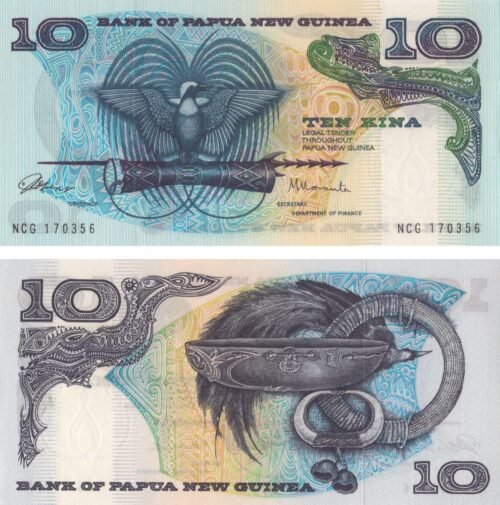
Papua New Guinea 10 Kina 1980, P-7, UNC
5,99 € -

Papua New Guinea 2 Kina 1997, P-16b, UNC
4,99 € -
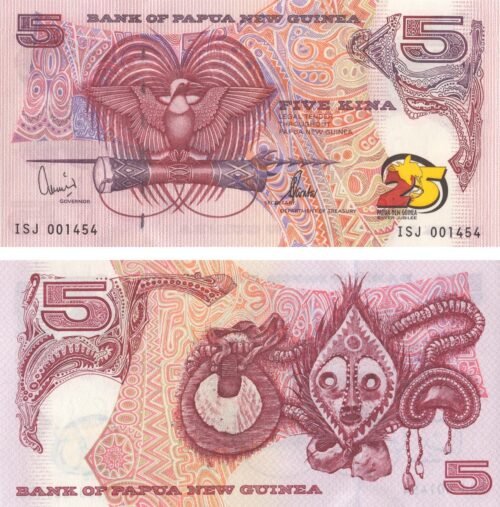
Papua New Guinea 5 Kina 2000, P-22, UNC
19,99 € -
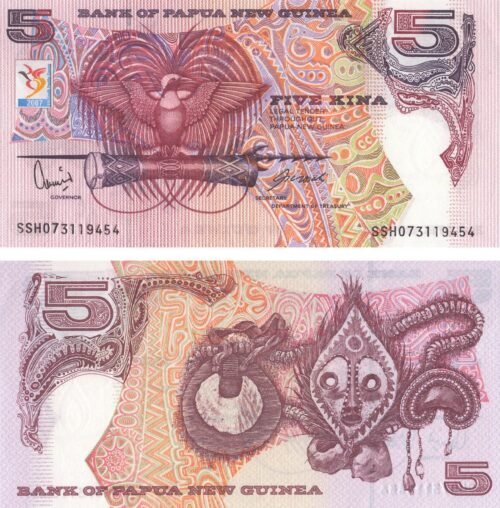
Papua New Guinea 5 Kina 2007, P-34, UNC
9,99 € -
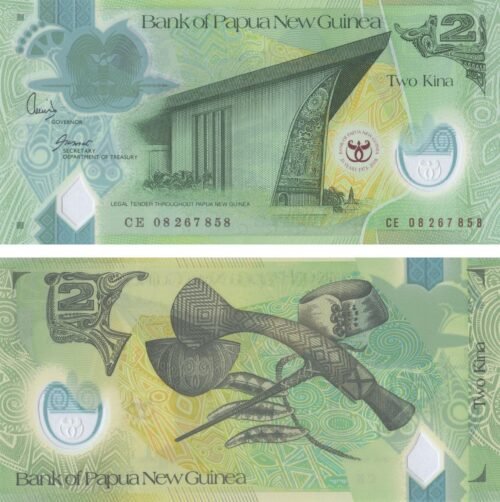
Papua New Guinea 2 Kina 2008, P-35, UNC
3,99 € -

Papua New Guinea 20 Kina 2008, P-36, UNC
3,99 € -

Papua New Guinea 100 Kina 2008, P-37, UNC
7,99 € -

Papua New Guinea 5 Kina 2010, P-39, UNC
9,99 € -
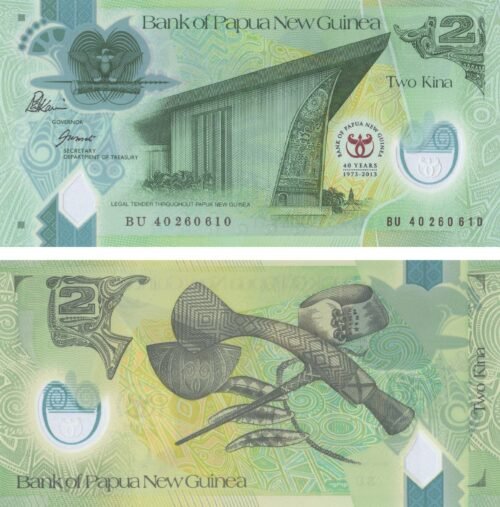
Papua New Guinea 2 Kina 2013, P-45, UNC
3,49 € -

Papua New Guinea 2 Kina 2023, P-50, UNC
2,49 € -

Papua New Guinea 5 Kina 2024, P-51, UNC
3,99 € -
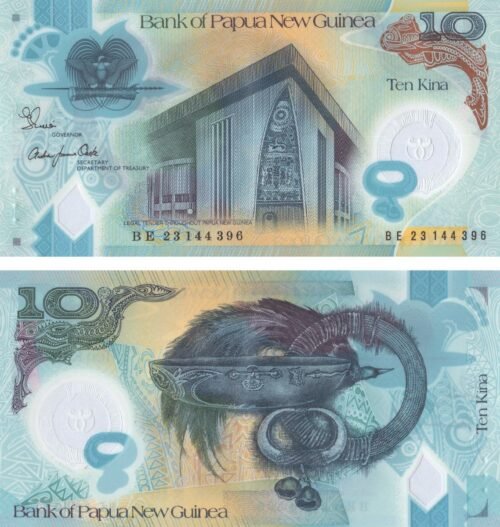
Papua New Guinea 10 Kina 2023, P-52, UNC
6,99 € -
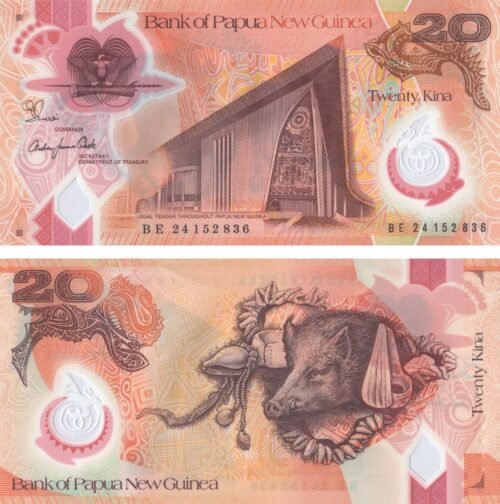
Papua New Guinea 20 Kina 2024, P-53, UNC
12,99 €