Republika Srpska Dinar
The Republika Srpska dinar was a wartime currency issued from Banja Luka during the Bosnian War, first introduced in 1992 and redenominated by one million to one on 1 October 1993 as hyperinflation accelerated.
Quick Facts
Country: Bosnia and Herzegovina
System: No subdivision issued
Status: Withdrawn
Issuers: National Bank of the Serbian Republic of Bosnia and Herzegovina, National Bank of Republika Srpska
The Story of the Republika Srpska Dinar
The Republika Srpska dinar was introduced in July 1992 for areas under Serbian control during the Bosnian War. The Banknote Book records the first dinar as replacing the 1990 Yugoslav convertible dinar at a rate of one Republika Srpska dinar to ten Yugoslav dinars, placing it at par with the contemporary Yugoslav dinar. No subdivision was issued.
The first banknote family was issued from Banja Luka by the National Bank of the Serbian Republic of Bosnia and Herzegovina. Denominations rose from 10 dinara into the millions as inflation accelerated. In 1993 the issuing legend changed to the National Bank of Republika Srpska, while the established arms-and-vase design continued through values as high as 10 billion dinara.
On 1 October 1993 the original dinar was replaced by a second Republika Srpska dinar at one new dinar to 1,000,000 old dinars. The redesigned family began at 5,000 dinara and centred on writer Petar Kočić. Inflation again drove values upward; the 10- and 50-billion-dinara notes in this family are catalogued as unissued.
The Dayton Peace Agreement ended the Bosnian War in 1995. In 1998 the convertible mark became the common currency of Bosnia and Herzegovina, replacing the Bosnia and Herzegovina dinar, Croatian kuna and Republika Srpska dinar in the country’s monetary system.
Design & Symbolism
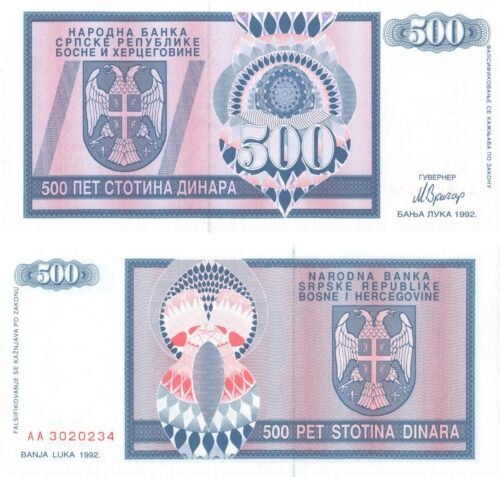
The 1992–1993 notes use a highly consistent heraldic layout. Cyrillic script appears on the front and Latin script on the back, following regulations cited by The Banknote Book. The Serbian coat of arms, large denomination numerals and a stylised vase dominate the design, with the governor’s signature on the front and the red serial number on the back.
The notes are closely related in colour and layout to contemporary Serbian Krajina issues. The issuing legend, governor signature and place of issue therefore matter visually: Republika Srpska notes identify Banja Luka, while the corresponding Serbian Krajina notes were issued from Knin.
The later 1993 arms issues retained the same basic composition after the issuing authority changed, but introduced a Greek-key watermark. The October 1993 redenomination then brought a portrait-led family with Petar Kočić on the front and the Serbian coat of arms on the back.
Security details also separate the phases. Earlier notes use solid security threads and several portrait watermarks, while the later arms and Petar Kočić issues use the Greek-key watermark. The documented series were printed by the Institute for Manufacturing Banknotes.
For collectors
For collectors, the Republika Srpska dinar should be separated into two monetary phases: the original 1992–1993 dinar and the second dinar introduced on 1 October 1993 at 1,000,000 old dinars to one new dinar. The change of issuing authority is another important catalogue boundary.
Early notes can be confused with Serbian Krajina issues because the designs are closely related. Check the issuing legend, Banja Luka place name, signature, prefix and script orientation rather than relying on colour alone. Replacement prefixes, specimens and remainders create further variety-level distinctions.
Overprints and late high denominations require particular care. The Banknote Book treats the horizontal MILIONA / DINARA overprints associated with P149–P151 as unofficial, while the 10- and 50-billion Petar Kočić notes are recorded as unissued.
The currency should also remain separate from both the Yugoslav dinar and the Bosnia and Herzegovina dinar. Its two Banja Luka issuers and the 1993 million-to-one redenomination define a coherent wartime monetary sequence visible directly in the banknotes.
Introduced in July 1992 at 1 Republika Srpska dinar = 10 Yugoslav dinars; redenominated on 1 October 1993 at 1 new dinar = 1,000,000 old dinars.