
Tajikistan Ruble
The Tajikistan ruble is an emergency post-Soviet currency, defined by civil war conditions, Goznak production and a brief, inflation-driven 1995–2000 lifecycle.
Quick Facts
Country: Tajikistan
Code: TJR
Symbol: руб.
System: Decimal (1 Ruble = 100 Kopeks)
Status: Withdrawn
Issuer: National Bank of Tajikistan
The Story of the Tajikistan Ruble
The Tajikistan ruble (TJR) was introduced in 1995 as a rapid monetary replacement following the collapse of the Soviet ruble zone and the outbreak of civil war. With minimal institutional capacity and urgent need for cash circulation, the currency was produced with direct reliance on Russian infrastructure, reflecting both political dependency and logistical necessity. Hyperinflation quickly eroded its value, forcing continuous issuance of higher denominations and exposing the fragility of the system. By 2000, the ruble was replaced by the somoni at a rate of 1,000 to 1, closing one of the shortest and most volatile currency chapters in post-Soviet Central Asia.
Design & Symbolism
Banknotes of the TJR series were printed by Russia’s Goznak and closely follow late-Soviet design templates, creating an immediately recognisable visual continuity with 1990s Russian rubles. Lower denominations feature the newly established state symbols, including the Tajik flag and the Supreme Assembly building, marking the first visual assertion of independence. Higher denominations (1,000–10,000 rubles) introduce the portrait of Ismoil Somoni, linking the emerging republic to its historical roots. Security features remain basic—standard watermarks, simple threads and conventional intaglio—reflecting the urgency of production rather than long-term durability.
For collectors
For collectors, the Tajikistan ruble is a classic "Emergency Issue" and "Short-Lived Series." UNC specimens are difficult to obtain due to extreme circulation pressure and widespread use during a period of economic collapse. Particular attention is given to the 10,000 ruble note, issued shortly before the 2000 reform and representing the peak of inflation-driven denomination expansion. The presence of counterfeits and unofficial-quality notes in circulation further elevates the importance of verified, original Goznak-printed examples. High-grade survivors are valued as direct physical records of a monetary system operating under crisis conditions.
The Tajikistan ruble was demonetized in 2000 and replaced by the Tajikistani somoni at a fixed rate of 1,000 rubles to 1 somoni.
Explore the Tajikistan Ruble Banknotes Collection
-

Tajikistan 1 Rouble 1994, P-1, UNC
0,99 € -

Tajikistan 5 Roubles 1994, P-2, UNC
0,99 € -

Tajikistan 10 Roubles 1994, P-3, UNC
0,99 € -

Tajikistan 20 Roubles 1994, P-4, UNC
0,99 € -
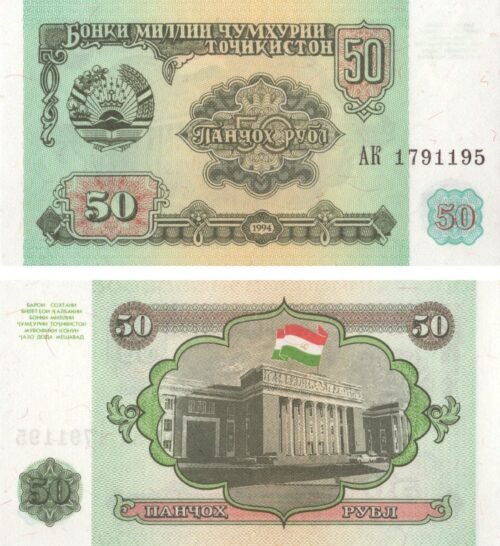
Tajikistan 50 Roubles 1994, P-5, UNC
0,99 € -

Tajikistan 100 Roubles 1994, P-6, UNC
0,99 € -
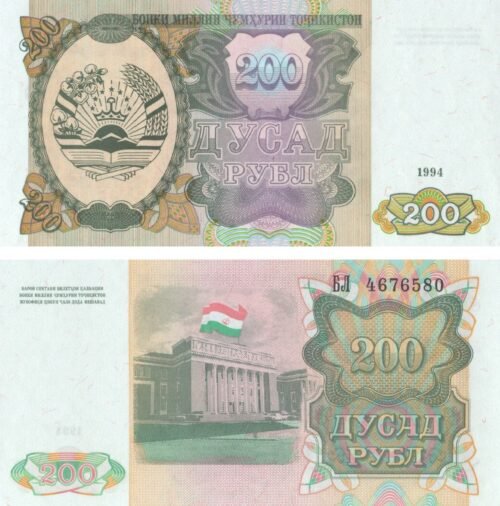
Tajikistan 200 Roubles 1994, P-7, UNC
1,49 € -
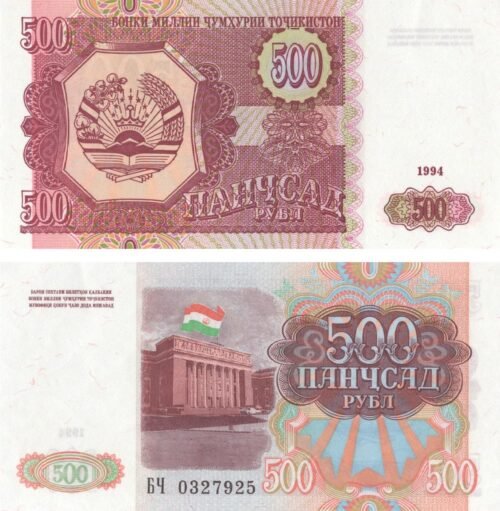
Tajikistan 500 Roubles 1994, P-8, UNC
2,99 € -
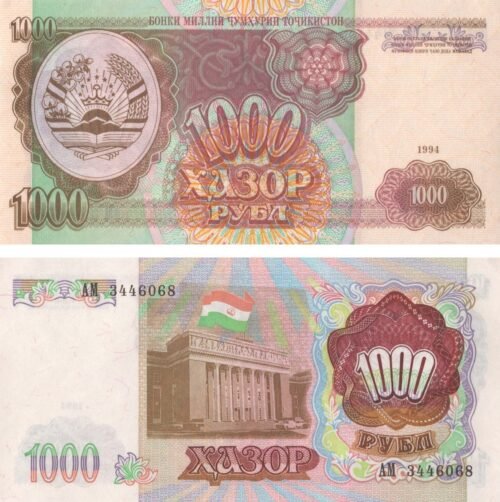
Tajikistan 1000 Roubles 1994, P-9, UNC
3,99 €