
Thailand Baht
The Thai baht is defined by royal continuity and technical precision, culminating in the transition from the long-standing Rama IX series to the modern Rama X polymer era.
Quick Facts
Country: Thailand
Code: THB
Symbol: ฿
System: Decimal (1 Baht = 100 Satang)
Status: In circulation
Issuer: Bank of Thailand
The Story of the Thailand Baht
The Thai baht (THB) represents one of Southeast Asia’s most stable and institutionally controlled currencies, closely linked to the Chakri dynasty and the Bank of Thailand. Its modern identity is shaped by the extended reign of King Bhumibol Adulyadej (Rama IX), whose portrait appeared consistently across multiple series, creating one of the most recognisable long-term portrait frameworks in modern banknotes. The transition beginning in 2018 to King Maha Vajiralongkorn (Rama X) marked a structural shift, introducing updated portraiture, revised layouts and expanded use of polymer substrates for lower denominations.
Design & Symbolism
Thai banknotes are produced by the Note Printing Works (NPW) in Bangkok and are recognised for their controlled engraving quality and precise print registration. Royal portraits are executed in refined intaglio, where the ink forms a smooth but clearly defined relief under the fingertips. Reverse compositions present structured historical narratives featuring past monarchs, temple architecture and ceremonial scenes. Modern issues incorporate advanced security elements, including optically variable devices (OVD), wide windowed security threads and multi-tone watermarks. Polymer denominations introduce transparent windows with embedded features, combining traditional Thai ornamentation with contemporary security engineering.
For collectors
For collectors, the Thai baht offers a structured and continuous royal series where transitions define collecting strategy. The late Rama IX issues form a closed historical group, while the Rama X series establishes a new phase with updated materials and security design. Polymer denominations introduce an additional collecting dimension, with their distinct surface, transparency elements and long-term durability. UNC examples are valued for precise registration, intact surface quality and the clarity of both intaglio detail and optical features.
The Thai baht remains the official currency of Thailand, operating within a decimal system and supporting a stable regional economy.
Explore the Thailand Baht Banknotes Collection
-

Thailand 10 Baht 1980, P-87(6), UNC
2,99 € -

Thailand 20 Baht 1981, P-88(17), UNC
3,99 € -
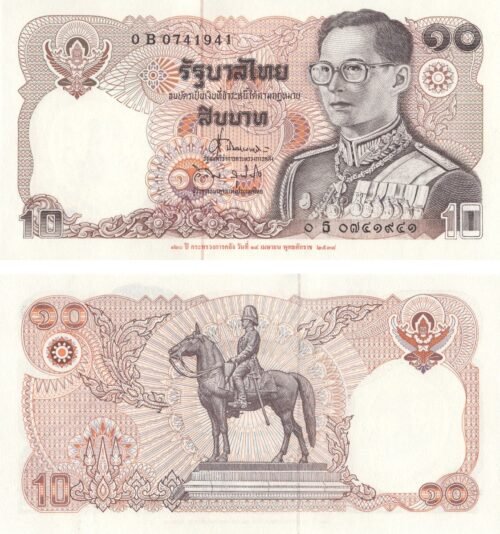
Thailand 10 Baht 1995, P-98, UNC
2,99 € -

Thailand 20 Baht 2003, P-109(9), UNC
2,99 € -

Thailand 20 Baht 2016, P-118(3), UNC
2,49 € -
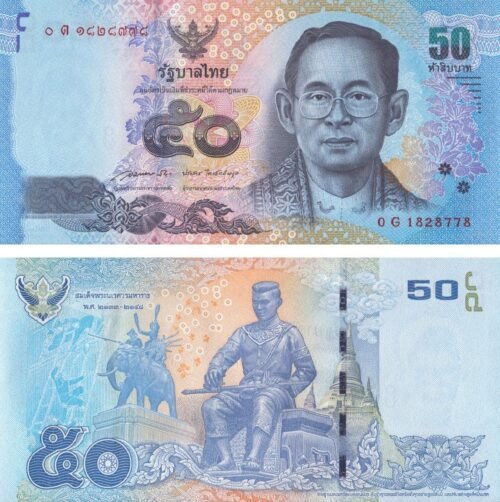
Thailand 50 Baht 2015, P-119(3), UNC
3,99 € -

Thailand 20 Baht 2018, P-135a, UNC
2,99 € -

Thailand 50 Baht 2018, P-136a, UNC
3,99 € -
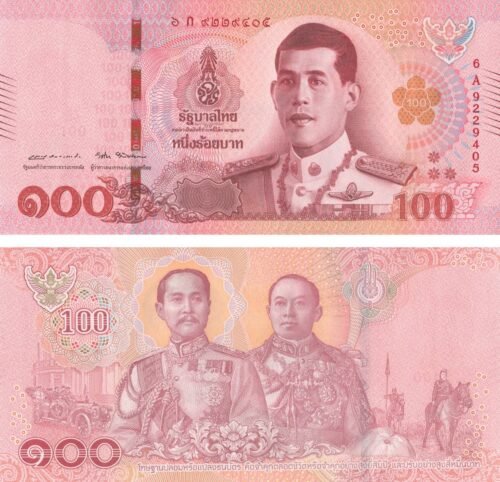
Thailand 100 Baht 2018, P-137a, UNC
7,99 € -

Thailand 20 Baht 2022, P-145(1-1), UNC
2,49 € -
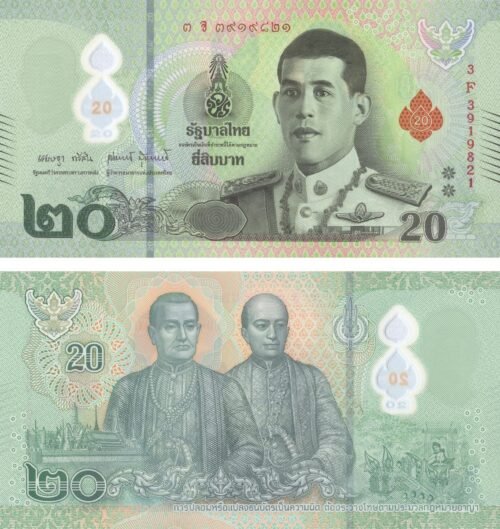
Thailand 20 Baht 2024, P-145(3), UNC
2,49 € -

Thailand 50 Baht 2025, P-146, UNC
3,99 € -

Thailand 100 Baht 2025, P-147(1), UNC
6,99 €