
West African CFA Franc
The West African CFA franc (XOF) is the common currency of eight West African states, issued within a single BCEAO monetary system and distinguished on individual banknotes by member-state identification letters.
Quick Facts
Country: West African States
Code: XOF
Symbol: CFA
System: Decimal (1 CFA Franc = 100 Centimes)
Status: In circulation
The Story of the West African CFA Franc
The West African CFA franc is shared by Benin, Burkina Faso, Côte d’Ivoire, Guinea-Bissau, Mali, Niger, Senegal and Togo. It is issued by the Central Bank of West African States, or BCEAO, whose banknotes and coins have legal-tender status throughout the West African Monetary Union.
The CFA franc was introduced on 26 December 1945. After independence, its West African branch developed into the franc de la Communauté Financière Africaine, administered through BCEAO and the regional monetary union established by treaty in 1962. Guinea-Bissau joined the union in 1997, replacing the Guinea-Bissau peso with the West African CFA franc.
The currency has been linked to the euro since 1 January 1999 at a fixed rate of 655.957 CFA francs to one euro. Although the currency is used across eight countries, it remains one monetary unit with one regional issuing institution. Member-state attribution is recorded through confirmed identification letters and the corresponding Country pages, not through separate national CFA currencies.
Design & Symbolism
BCEAO banknotes follow a shared design programme across the monetary union. A defining visual element is the stylised sawfish, the official emblem of BCEAO and a symbol associated with fertility and prosperity in African tradition.
The modern banknote family presents communication, transport, agriculture, fisheries, wildlife and regional economic life. Its designs express cooperation and development across West Africa rather than the identity of only one member state.
Member-state allocation is identified by letters appearing on the banknotes: A for Côte d’Ivoire, B for Benin, C for Burkina Faso, D for Mali, H for Niger, K for Senegal, S for Guinea-Bissau and T for Togo. Their placement and presentation may vary between series. The letters identify allocation within the shared system; they are not separate currencies, separate issuing authorities or authentication features.
For collectors
The West African CFA franc can be collected at several levels. A type collection may contain one example of every denomination or design family, while a specialist collection may follow the complete range of member-state identification letters.
Dates, signatures, security changes, catalogue varieties and commemorative issues provide further distinctions. Banknotes sharing the same design and denomination may therefore remain separate collectible varieties when their dates, signatures, issue details or country letters differ.
Country attribution should be based on a visible identification letter or reliable catalogue evidence. The country where a banknote was purchased or circulated is not sufficient evidence because BCEAO banknotes bearing any of the recognised letters are valid throughout the monetary union.
The West African CFA franc circulates across eight member states and remains fixed at 655.957 CFA francs to one euro.
Explore the West African CFA Franc Banknotes Collection
-

Ivory Coast 1000 Francs 2021, P-115A, UNC
6,99 € -

Ivory Coast 2000 Francs 2019, P-116A, UNC
11,99 € -

Ivory Coast 2000 Francs 2026, P-116A, UNC
11,99 € -

Ivory Coast 500 Francs 2021, P-119A, UNC
4,99 € -

Ivory Coast 500 Francs 2026, P-119A, UNC
3,99 € -
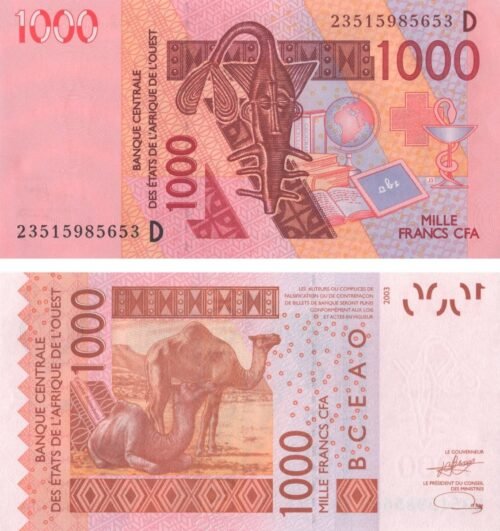
Mali 1000 Francs 2023, P-415D, UNC
5,99 € -

Mali 500 Francs 2023, P-419D, UNC
3,99 € -

Senegal 500 Francs 2022, P-719K, UNC
4,99 € -

Togo 1000 Francs 2019, P-815T, UNC
5,99 € -

Togo 1000 Francs 2023, P-815T, UNC
5,99 € -

Togo 1000 Francs 2025, P-815T, UNC
4,99 € -

Togo 2000 Francs 2024, P-816T, UNC
9,99 € -

Togo 500 Francs 2021, P-819T, UNC
3,99 € -

Togo 500 Francs 2025, P-819T, UNC
3,99 € -

Guinea-Bissau 500 Francs 2018, P-919S, UNC
4,99 € -

Guinea-Bissau 500 Francs 2025, P-919S, UNC
4,99 €